

Professional feedback doesn’t have to start with a long-term mentor. The right format depends on whether you want a listener’s reaction to the song or focused guidance on the mix.
It makes sense to seek honest guidance without spending blindly. Praise alone may feel good briefly, but actionable notes can show you what’s working and what to revisit. This guide explains what useful professional feedback looks like, how to ask focused questions, and how to treat criticism as information about your music rather than a verdict on you.
Then, we’ll explore four ways to get an outside perspective, from structured reviews to targeted mixing input, and how to prepare a track so feedback leads to clear next steps. Whether you’re refining a rough demo or polishing a release, the goal is feedback you can use, not noise to collect.
Key Takeaways
- Define what you want to learn before sharing a track, whether that’s how the song connects with listeners or how a specific element of the mix is working.
- Ask for observations tied to a moment or craft choice, so you can turn broad reactions into practical next steps.
- Separate comments about the work from judgments about you, then keep track of which revisions make the song stronger.
- Choose a feedback format that fits your goal, from a structured review to a focused conversation with a mixing engineer.
1. Characteristics of useful industry feedback
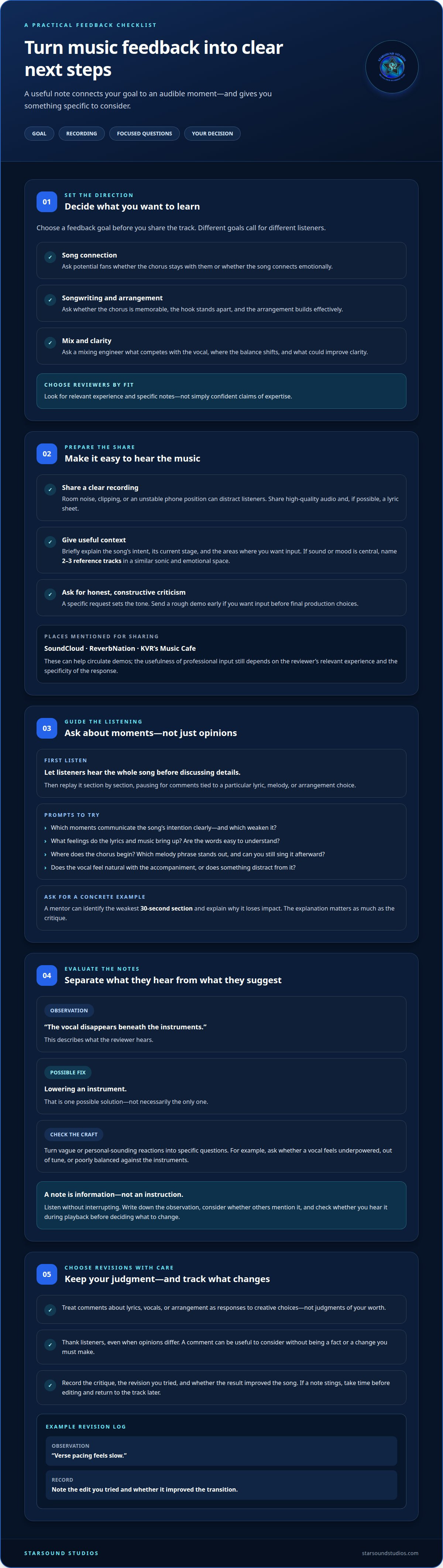
Useful feedback connects a clear goal to an audible example. Before sharing a demo, decide whether you want reactions to its emotional impact, songwriting, commercial appeal, or mix. Each goal calls for a different kind of listener. Potential fans can tell you whether a chorus stays with them, while a mixing engineer can identify masking or balance problems. Judge a reviewer’s credibility by the relevance of their work and the specificity of their notes, not simply by confident claims of expertise.
For example, a mix note might explain how low-end energy in the 200-400 Hz range masks a vocal. A songwriting note could identify a hook-to-verse transition at 1:03 that feels flat because the hook melody doesn’t stand apart. Ken Lewis says useful feedback should name both strengths and areas to improve. That balance helps you preserve what gives the song character while choosing what to revise.
SoundCloud and ReverbNation can host tracks for sharing, while KVR’s Music Cafe is a forum where musicians can post audio links. These platforms help circulate demos, but useful professional input depends on the reviewer’s relevant experience and the specificity of their response.
Ask reviewers which moments communicate your intention clearly and which weaken the song. For mixing feedback, ask what competes with the vocal, where the balance shifts, and what might improve clarity. For songwriting, ask whether the chorus is memorable and whether the arrangement builds effectively. Focused questions make it easier to connect each comment to a decision.
Share reference songs when sound or mood is central to your goal. Naming 2-3 tracks in a similar sonic and emotional space gives a reviewer context for your direction. Send a rough demo early if you want input before committing to final production choices. The most useful response points to a specific moment, explains its effect, and offers a practical direction without replacing your artistic judgment.
2. Recording and receiving feedback constructively
Before sharing a performance, make a clear recording with a quality recording tool. Room noise, clipping, or an unstable phone position can distract listeners from the song. For a demo, share high-quality audio and, if possible, a lyric sheet. Tell listeners you want honest, constructive criticism rather than praise alone. A specific request sets a useful tone.
Give listeners space to hear the whole song before discussing details. Then replay it section by section, pausing for comments. This helps people connect reactions to a particular lyric, melody, or arrangement choice instead of relying on general impressions. Ask a mentor to identify the weakest 30-second section and explain why it loses impact. The explanation matters as much as the critique.
Prompts can help listeners describe what they hear, even without technical vocabulary. Ask what feelings the lyrics and music bring up, whether the words are easy to understand, and where they hear the chorus begin. For a vocal, ask whether the singing feels natural with the accompaniment or whether something distracts from the performance. For a melody, ask which phrase stands out and whether they can still sing it afterward.
Listen without interrupting, and write down the specific observation before deciding what to change. A comment such as “the chorus arrives without enough lift” gives you something to explore, not an instruction you must follow. Thank each listener, even when opinions differ. Keep a record of feedback, revisions, and results to see which changes serve the song and which don’t.
If you need a clearer capture of your performance before sharing it, consider professional recording at Starsound Studios.
3. Separating criticism of music from criticism of the person
A comment about a lyric, vocal, or arrangement describes a creative choice, not your worth. If a listener says the second verse slows the song, treat that as a response to the pacing. It doesn’t erase the work you put into writing or recording. Separating your music from your identity makes it easier to assess feedback without accepting every opinion as fact.
Turn personal-sounding reactions into questions about craft. “Your voice is weak” is vague; ask whether the delivery feels underpowered, out of tune, or poorly balanced against the instruments. “I don’t like this chorus” may point to a melody, lyric, or transition that isn’t connecting. Specific observations give you something to examine while preserving your artistic direction.
For a professional critique, share a high-quality recording and, if possible, a lyric sheet. Add a short note about the song’s intent, its current stage, and the areas where you want input. For example, explain that you’re testing whether the chorus feels emotionally earned, rather than asking whether the reviewer likes you or your overall talent. Clear context keeps the focus on the music.
After receiving notes, separate observations from suggested fixes. A reviewer might say the vocal disappears beneath the instruments. That’s an observation. Lowering an instrument is one possible solution, but not necessarily the only one. Consider whether other listeners mention the same issue and whether you hear it during playback. Then choose revisions that serve the song’s intention.
Keep a simple record of the critique and your response. For example, note “verse pacing feels slow,” then record the edit you tried and whether it improved the transition. This turns a difficult reaction into a practical experiment. If a comment stings, take time before editing. Returning to the track later can help you distinguish a useful craft note from a difference in taste.
4. Typical cost of professional music feedback
Professional feedback costs vary by format and depth. These formats serve different needs: one provides a review, while the other focuses on a live discussion with an engineer.
Peer critiques and online communities can offer reactions without a formal paid session. Their value depends on the experience and attention of the people responding. Professional feedback is more focused on the reviewer’s expertise and your chosen questions. Independent musicians can find producers or engineers through music communities, industry relationships, and credits on work they respect. Look for relevant experience, not just confident claims.
To reach a mentor, A&R representative, or music school, make a concise request with a clear purpose. Share a finished demo or work in progress, explain what kind of response would help, and briefly introduce your project. A mentor may offer ongoing guidance, an A&R representative may respond from an industry perspective, and a music school may provide learning or critique opportunities.
Protect unreleased music by sharing it only with the intended listeners, and use a pseudonym if public identification makes you uneasy. Keep your request focused and share only the material the reviewer needs. For local input, look for music organizations and studios hosting artist-feedback events. Attend regularly and build relationships through thoughtful participation.
Choose the format that matches your goal: a structured review for focused notes, or an engineer consultation for detailed mixing discussion. If the next step is production work rather than critique, explore professional audio support for your track.
Starsound Studios
Starsound Studios helps artists carry useful feedback into the next stage of making a track. When critique points to a mix that needs more clarity, Stereo Mixing or Remote Mixing can help shape its balance. If the song is ready for final polish, Mastering or Remote Mastering supports that finishing stage. Recording is another option when you need to capture a performance as the project develops, while Dolby Atmos Mixing (9.1.4) offers an immersive format for suitable work.
Bring the notes that matter most, such as a vocal that feels buried or an arrangement that needs more impact. Clear feedback gives the production process stronger creative direction while keeping your artistic intention at the center. To discuss how Starsound Studios’ recording, mixing, or mastering services can support your next step, get in touch with the studio.
Turn your next note into a creative decision
Feedback is most valuable when it helps you choose what to do next, not when it pulls your music toward someone else’s vision. As you consider how to get professional feedback on my music, keep your artistic intention in view: choose notes that clarify it, and let the rest inform rather than define your direction.
When feedback points toward a more polished sound, Starsound Studios offers Stereo Mixing, Mastering, and Dolby Atmos Mixing (9.1.4). These services can support different stages of shaping a track, from refining its stereo mix to preparing a final master or creating an immersive mix. The right next move depends on what your music needs and the experience you want listeners to have.
Keep creating with curiosity. If you’re ready to discuss the next step for your track, contact Starsound Studios.
Frequently Asked Questions
How do I get honest feedback on my music without paying thousands for a mentor?
Start with targeted, one-off feedback rather than committing to ongoing mentorship. Ask trusted musicians to exchange critiques, or submit one track for a structured review. Set a clear limit on what you want reviewed, such as vocal balance or the chorus’s impact. That keeps the request focused and helps you decide whether deeper guidance would be useful.
What are the best ways to get professional feedback on my music?
Match the feedback method to the decision you’re facing. A producer can help assess arrangement and overall direction, while a mixing engineer can focus on sonic balance. For commercial appeal, include reactions from listeners outside your usual creative circle. If you’re in Cleveland, local music communities can also create opportunities to hear varied perspectives and build useful creative relationships.
How much do professional music feedback services cost?
These prices reflect different formats, so consider whether you need written notes on a track or focused discussion with an engineer. Before choosing, define the decision you want help with and select the format that addresses it.
How do I evaluate whether music feedback is credible and useful?
Look for feedback grounded in relevant work and specific listening observations. A useful reviewer can point to a moment, describe its effect, and explain the craft choice involved. For example, “the second verse loses momentum” gives you more to assess than “the song needs work.” Compare comments with your artistic goals, then test suggestions against the track rather than accepting them automatically.


