

A polished mix can’t make an underwritten song compelling. To decide whether your song is good enough to release, look beyond how familiar it feels after countless listens: does it connect with listeners, hold its own beside music you admire, and sound clear across different playback systems? Production can sharpen a strong idea, but it can’t replace one.
It’s natural to hear every rough edge in a track you’ve been shaping for a while. The useful question is whether those flaws distract from the song itself, or whether its core idea, performance, and structure already work.
In this guide, you’ll learn how to gather honest listener feedback, compare your track with relevant releases, check its sound, and identify which weaknesses production can address. These practical ways to assess your song can help you choose your next step based on the music, not just your nerves.
Key Takeaways
- Ask listeners who understand your style for specific, honest feedback, then look for recurring responses rather than reacting to every opinion.
- Compare your track with music in a similar lane to spot differences in energy and production without losing sight of your own artistic identity.
- Listen for clear vocals, balanced frequencies, and distracting recording flaws across different playback systems.
- Separate songwriting issues from mix or recording issues: production can refine a compelling song, but it can't supply a missing hook, structure, or emotional core.
1. Getting useful feedback from online communities and listeners
Start with listeners who enjoy music similar to yours, not only friends who want to encourage you. Share a solid version, then ask what they remember after one listen. A specific response, such as “the chorus stayed with me,” tells you more than a general “I like it.” Ask what felt unclear, too, and notice whether different listeners point to the same moment.
Try the musical-heroes test: imagine sending the track to your top five musical heroes. Would you feel comfortable with them hearing this version? The exercise isn’t about matching their sound. It helps reveal whether you stand behind the songwriting, performance, and recording, or hope polish will cover a weakness.
Online communities can offer perspective beyond your immediate circle. Share a complete, representative version and give listeners context about the genre and intended mood. Ask focused questions, such as whether the vocal is easy to follow or the chorus arrives at the right moment. Avoid asking whether the song is simply “good.” That invites vague praise or criticism without a useful next step.
Turn responses into constructive feedback by separating personal taste from repeated observations. If one listener dislikes the tempo, that may be a matter of preference; if several lose interest before the chorus, examine the arrangement. Ask what they would change and why. Then decide which comments support your artistic direction instead of trying to satisfy every opinion.
AI-powered A&R feedback can provide another perspective, but treat its output as prompts for reflection, not a release verdict. Ask it to assess a specific element, such as lyrical clarity or whether the hook is memorable, and compare its response with human listeners’ comments. Before deciding, consider whether at least two people outside your family respond positively, with the structure, vocal, and mix ready. Let recurring evidence guide the choice.
2. Using peer-level comparisons and audio analysis
Choose reference tracks that share your genre, arrangement, and intended listening context. Compare your finished song at similar playback loudness, then note differences in vocal presence, groove, and energy. A Drake record may offer inspiration, but a track by an artist at a similar stage can provide a more useful production comparison. The goal is a clear reference point, not imitation.
Listen to the lyrics as well as the mix. Follow each line without reading along, and notice whether the vocal communicates the story or gets buried under guitars and synths. Then use technical audio analysis to investigate what you hear. If the kick loses definition, check whether low-end energy from 20 to 100 Hz is masking it. Measurements can direct attention, but listening tells you whether the issue matters musically.
Compare overall loudness with care. Around -14 LUFS is a commonly suggested integrated-loudness target for platforms such as Spotify, but the appropriate level can vary by genre. Treat it as a reference, not a pass-or-fail threshold. A louder master isn't automatically more exciting; compare at matched loudness to judge tone, dynamics, and impact more fairly.
Independent listener panels and structured review services are options artists may encounter when seeking reactions to unreleased music. Use this feedback as one input alongside direct listening and peer comparisons, rather than treating a platform response as the ultimate release verdict. Before acting on a comment, ask what it points to: a hard-to-understand lyric, a chorus that lacks lift, or simply personal taste. That distinction keeps revisions focused.
Make a short comparison note for each listen: one strength, one audible difference, and one change worth testing. If you want to build confidence interpreting meters and mix decisions, audio engineering classes at Starsound Studios can help develop those critical listening skills. The finished track should still serve your song's identity, not a measurement or reference track.
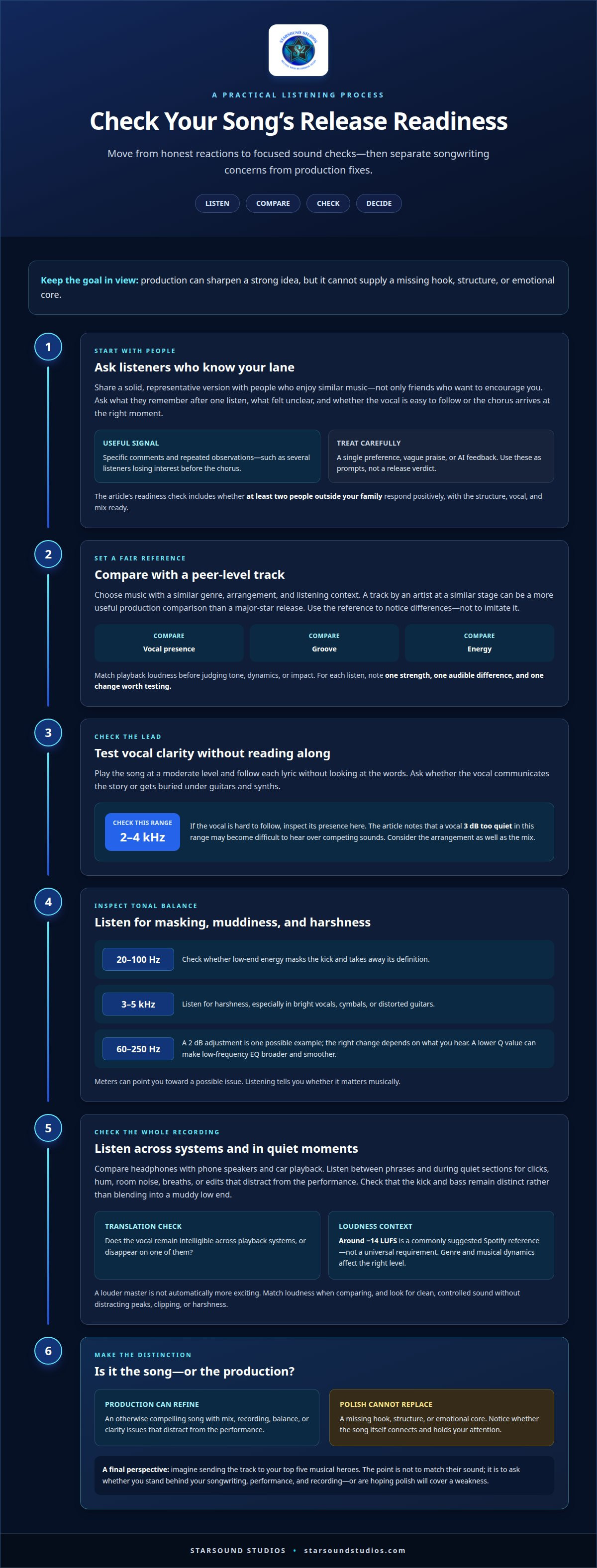
3. Checking vocal clarity, frequency balance, and recording cleanliness
Before release, aim for clean, distortion-free audio and a balanced mix that translates across playback systems. Around -14 LUFS is a useful Spotify reference, not a universal loudness requirement; genre and musical dynamics affect the right mastering level.
A professionally mixed and mastered song feels clear, cohesive, and controlled. The vocal, instruments, and low end each have space, while the dynamics retain energy without distracting peaks, clipping, or harshness. The master should enhance the performance, not flatten its character.
You may ask yourself, “is my song good enough to release?” Start with the lead vocal. Play the record at a moderate level and follow the lyrics without reading them. If guitars or synths mask important words, inspect the vocal’s presence around 2-4 kHz. A vocal that is 3 dB too quiet in that range may become difficult to hear over competing sounds. Adjust the arrangement or mix with the song’s emotional focus in mind.
Next, listen for frequency balance and fatigue. The 3-5 kHz range can reveal harshness, especially in bright vocals, cymbals, or distorted guitars. Check whether the kick and bass remain distinct rather than blending into a single, muddy low end. A 2 dB adjustment in the 60-250 Hz range is one possible example, but the right change depends on what you hear. A lower Q value can make equalization in lower frequencies broader and smoother.
If “is my song good enough to release?” still feels unresolved, check that the recording is clean. Listen between phrases and during quiet sections for clicks, hum, room noise, breaths, or edits that distract from the performance. Compare headphones with phone speakers and car playback; a vocal that disappears on one system may need a balance adjustment. Address audible distractions, then listen again at a comfortable level. A song that stays intelligible, balanced, and emotionally present has a sound that supports its performance.
4. Why production cannot fix a weak song
A producer can shape tone, dynamics, and arrangement, but those choices can’t create a compelling idea from nothing. If the chorus repeats without adding meaning, another layer of synths may make it louder, not more memorable. Start by asking whether the writing gives listeners a reason to stay.
Test the song before adding production: play a stripped-back vocal and instrument version. If the melody, lyrics, and structure still communicate the feeling, production can strengthen that foundation. If the central hook feels unclear, revise the writing first. A strong mix reveals the song’s identity; it shouldn’t hide a missing one.
Choose a single when one track best introduces your sound or stands on its own. An EP or album makes more sense when several finished songs form a connected experience, such as a shared story or musical palette. Let the material and release plan guide the format, rather than using extra tracks to compensate for an unfinished lead song.
For a US release, protect your work by keeping dated lyric drafts, session files, and written agreements with co-writers and performers. These records help clarify who contributed what and which permissions you have. For questions about copyright registration or a rights dispute, consult a qualified US intellectual-property attorney; don’t assume a distributor handles those steps for you.
Independent releases also put practical decisions in your hands. Confirm that samples and guest performances are cleared, contributor credits and metadata are accurate, and the final master matches your intended release. Plan how listeners will discover the track, too. A polished file can still go out with incorrect credits or no clear path to an audience.
Use this order: strengthen the writing, settle the arrangement, then refine the production. If the song’s core holds attention in a simple performance, technical work can help it reach listeners with clarity and impact.
Starsound Studios
Starsound Studios can help when your song’s core feels ready, but its recording or mix still needs a professional finish. Stereo mixing and mastering refine balance, clarity, and translation across playback systems, while recording supports artists developing a stronger performance or capture. For a spatial presentation, the studio also offers Dolby Atmos Mixing (9.1.4).
Bring a clear sense of what’s working and what still feels unresolved. That gives the production process a focused starting point, whether you need a polished stereo mix, mastering, or support shaping the recording. Production can strengthen the presentation while keeping the song’s identity at the center.
If you’re ready to discuss the next step for your track, contact Starsound Studios.
Give your next version a clear direction
A release doesn’t need to represent every possibility your song could become. It needs to capture the version you believe in and can stand behind. If you’re still asking whether your song is good enough to release, focus on the decision in front of you: does the track express your intent, and will further production meaningfully serve it?
Starsound Studios offers Stereo Mixing, Mastering, and Dolby Atmos Mixing (9.1.4) to help bring a release into focus. The right next step depends on what your song needs, from a refined stereo presentation to an immersive mix. Keep your artistic direction at the center of that conversation.
Contact Starsound Studios to discuss your track and move toward a release that feels true to your vision. Your next confident step starts with the music you believe in.
Frequently Asked Questions
Is your music really good enough?
It can be, even if it won’t appeal to every listener. A useful test is whether the track delivers the feeling and identity you intended, not whether everyone likes it. Write down the song’s purpose in one sentence, such as “a restless breakup song that turns defiant.” If the performance and arrangement support that intention, personal taste alone doesn’t determine readiness.
The Actual Test: Is There a Song There?
There’s a song there when its central idea gives the listener a reason to follow it from beginning to end. Check whether the verses develop the thought, the chorus adds a memorable point of focus, and the ending feels intentional. For example, a repeated chorus can work if each verse changes how its message lands. If sections feel interchangeable, revisit the writing before adding production.
How can I tell if my song is ready to release?
Set the track aside overnight, then listen the next morning without opening the project file. Note any issue that still matters, and avoid changing details simply because they’re available to adjust. Give the finished version a week without major changes before making the final call. If you can stand behind the song after that pause, you have a more considered basis for release.
How do I get honest feedback on an unreleased song?
Share a private demo with listeners who understand the style, and ask each person for one specific observation. For example, ask where the song’s emotional turning point occurs, rather than whether they like it. Don’t explain what you hope they’ll hear before they listen; that can shape their response. Compare their independent comments afterward, focusing on useful observations rather than personal taste.
How can I test audience interest in a song before releasing it?
Use a brief preview where your intended listeners already follow your music, then pay attention to meaningful responses. A comment identifying a lyric or asking when the full track arrives offers more insight than a passive view. You can also perform the song live and notice whether listeners stay engaged through the chorus. Treat these signals as clues, not a guarantee of future reach.


