
A Dolby Atmos mix is more than a stereo track with extra movement. A Dolby Atmos mixing studio in Cleveland should use speaker-based monitoring so the engineer can shape sound around the listener, including overhead. The room’s speaker layout matters because it lets the engineer hear how the immersive mix behaves beyond standard stereo playback.
It’s natural to wonder how this process differs from a conventional mix and what to prepare before a session. This article explains how speaker-based Atmos studios work, what mixing services can involve, and how to find music studios offering immersive audio in and around Cleveland. You’ll also learn why organized stems help an engineer translate your production into an immersive mix while preserving the character of the original.
Key Takeaways
- Understand how a 9.1.4 speaker layout places sound around and above the listener, and why the room matters when shaping an immersive mix.
- Prepare organized stems for an Atmos workflow; effects and processing should already be included in each stereo stem.
- Look beyond a studio directory listing: Dolby’s directory studios submit their own details and documentation, rather than receiving individual Dolby approval.
- Compare the studio’s monitoring setup and mixing approach with your creative goals, including whether the Atmos version preserves the stereo mix’s character.
- Explore how stereo mixing, mastering, recording, and Dolby Atmos mixing can support different stages of a music project.
Speaker-based Dolby Atmos studios
A speaker-based Dolby Atmos room lets an engineer hear sound from multiple directions, including overhead. Dolby describes speaker-based monitoring as the ultimate way to create and deliver content. This matters because the mix can be judged in the room, not only through headphones or stereo speakers. Placement, level, and movement become audible choices.
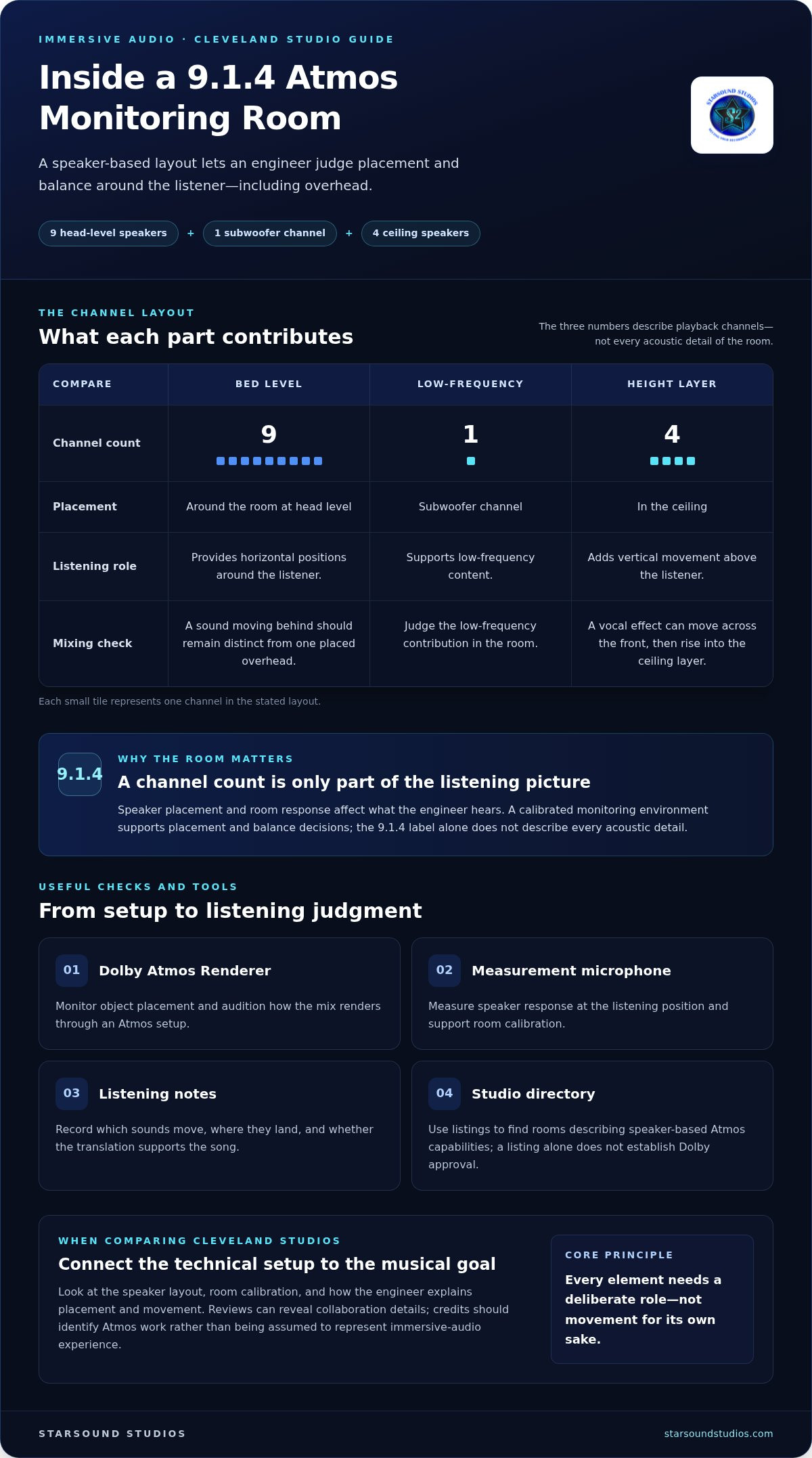
The 9.1.4 configuration describes the room’s playback layout. It uses nine speakers around the room at head level, one subwoofer channel, and four height speakers in the ceiling. The first number represents the bed-level speaker channels, the middle number represents the subwoofer channel, and the final number represents height channels. For example, a vocal effect can move across the front speakers, then rise into the ceiling layer.
Speaker placement gives the engineer a practical reference for panning and balance. A sound placed overhead should remain distinct from one moving behind the listener. The subwoofer supports low-frequency content, while nine head-level speakers provide horizontal positions. Four ceiling speakers add vertical movement. Each element needs a deliberate role, not movement for its own sake.
Useful tools serve different checks:
- Dolby Atmos Renderer: useful for monitoring object placement and auditioning how a mix renders through an Atmos setup.
- Measurement microphone: useful for measuring speaker response at the listening position and supporting room calibration.
- Studio directory: useful for finding rooms that describe speaker-based Atmos capabilities; a listing alone doesn't establish Dolby approval.
- Listening notes: useful for recording which sounds move, where they land, and whether the translation supports the song.
Room design also shapes what engineers hear. Haverstick Designs developed the mixing room discussed in this article, illustrating how acoustic design and speaker layout work together. A room’s response affects tonal judgment, so engineers rely on a calibrated monitoring environment when making placement and balance decisions. The 9.1.4 label describes channels, but it doesn't describe every acoustic detail of the room.
Reviews and client credits can help artists assess a Cleveland studio’s communication and project experience. Read reviews for specific details about collaboration, and look for credits that identify Atmos work rather than assuming every mixing credit reflects immersive-audio experience.
When comparing a Dolby Atmos mixing studio in Cleveland, focus on the speaker layout, room calibration, and how the engineer explains placement and movement. These details connect the technical system to the listening experience. A purpose-built speaker room gives creators a dedicated space to shape dimension, clarity, and musical intent.
Dolby Atmos mixing services
An Atmos mixing service reshapes a production for immersive playback. The engineer places and balances elements in a three-dimensional sound field while protecting the song’s identity. For example, backing vocals might widen around the listener while the lead remains focused. The goal is purposeful perspective, not motion on every track.
A typical workflow starts with a creative brief and organized session materials. The brief can identify the emotional focus, a preferred stereo reference, and sounds that should move. The engineer then builds the spatial mix, reviews balance and placement, and prepares the agreed deliverables. Clear feedback helps ensure each revision addresses a specific musical choice.
Quality control means listening for balance, distracting movement, and whether the Atmos version retains the stereo mix’s character. Delivery requirements vary by destination, so files are prepared to meet the relevant platform specifications. A final review should also catch export errors and confirm the supplied files open and play correctly.
- Digital audio workstation: organizes the session and supports editing, balance, and stem playback.
- Dolby Atmos Renderer: helps audition spatial placement and review the rendered mix.
- Session notes: keep artistic priorities and revision requests clear across the project.
- File playback software: provides a practical check that exported deliverables open and play.
For this workflow, prepare organized stems rather than raw multitrack tracks. Each stereo stem should include its intended effects and processing. For example, print a vocal delay into the vocal stem if it is part of the approved production. Use clear stem names and consistent start points, and include a stereo reference for musical context.
Cleveland studio services may include immersive mixing, stereo mixing, and remote mixing. For contact details, use the studio’s official contact page or business listing. When reviewing service information, distinguish Atmos mixing from stereo-only work, since the deliverables and monitoring approach differ.
Turnaround depends on stem organization, arrangement complexity, requested revisions, and approval pace. A concise brief and complete exports help the engineer begin without avoidable file preparation. Revision timing also depends on how quickly notes arrive and whether they describe clear, specific changes.
Before a session, make a simple delivery checklist: stems, stereo reference, creative notes, and destination format. This gives the engineer a clean starting point and keeps attention on the mix. For remote work, organized file delivery and focused feedback can make collaboration more efficient without changing the creative direction.
Finding Dolby Atmos music studios
Start with a search focused on Cleveland and nearby Ohio communities. Use terms for music mixing, immersive audio, and Dolby Atmos together. Then compare each studio’s stated workflow, room capabilities, and relevant credits. A general recording listing may describe tracking or stereo mixing without offering immersive music mixing, so look for a clear description of the Atmos service.
Dolby’s studio directory can help locate facilities that report Dolby Atmos capabilities. Dolby does not certify or approve individual Dolby Atmos music studios listed there. Studios in the directory submit their details and documentation indicating they meet Dolby’s recommendations and guidelines. Treat an entry as a useful lead, not as Dolby’s endorsement of a specific studio.
- Dolby studio directory: useful for discovering studios that submit information about their Atmos facilities and capabilities.
- Search maps: useful for comparing Cleveland-area locations, travel routes, and public business details.
- Studio portfolio: useful for finding named credits and examples connected to immersive music work.
- Review platforms: useful for spotting specific comments about communication, revisions, and project collaboration.
Next, assess evidence of the work itself. A stereo mixing credit shows experience with a different format than an Atmos credit. Look for project descriptions that identify the engineer’s role and mix format. If a sample is available, listen for purposeful placement, stable lead vocals, and an arrangement that still feels coherent. These listening criteria reveal more than a broad claim of “immersive sound.”
Reviews and credits answer different questions. Reviews can describe an artist’s experience with communication or revisions; credits can connect an engineer to specific releases. Read both as context, rather than treating either as proof of technical quality. A detailed review about feedback on a mix tells you more than a generic rating.
For Cleveland studios, compare practical details that affect your project. Note whether the studio offers in-room sessions or remote collaboration, what audio materials its workflow accepts, and which deliverables it prepares. The stated process should align with your production stage. Finished stereo stems, for example, call for a different handoff than an unfinished multitrack session.
Keep a short comparison sheet with the studio name, Atmos experience, relevant credits, workflow notes, and travel considerations. This helps separate local convenience from format-specific experience. Before choosing, match the room and engineer’s approach to the sound you want, such as subtle spatial depth or clearly moving effects. The right fit makes those artistic priorities part of the technical plan.
When comparing profiles, treat time in the field as background rather than a substitute for evidence of Atmos work. Lashon Evans' profile says he has been learning to mix music for about 13 years, while Ben Wilkins' profile says he has been recording and producing music for over 20 years. Those descriptions indicate different kinds of experience, so check each against relevant credits, stated role, and the format of the work.
Ask for examples that match your project stage, and confirm the expected handoff before booking.
Immersive audio
Immersive audio gives a mix space beyond the left-to-right stereo image. Engineers can position sounds around the listener and use height for added dimension. Artistic choices matter most: a passing effect might travel overhead while a lead vocal stays anchored. A strong Atmos mix preserves the song’s original character rather than adding movement everywhere.
A room’s monitoring system helps translate those choices into sound. One Cleveland setup uses nine Focal Alpha 80 speakers and a Neumann subwoofer for immersive mixing. Dolby measured Starsound Studios’ room, which the studio says meets Dolby’s EQ curve. Together, these details describe a specific playback environment, not a guarantee that every production will suit the same spatial approach.
Preparation shapes the workflow. Starsound Studios requires recordings as stems because raw tracks won’t work in its Atmos mixing process. Effects and processing must already be included in each stereo stem. For example, if a vocal delay is essential to the production, it belongs in the vocal stem. Clear stem names and a stereo reference also help preserve intent as elements are repositioned.
Useful tools support distinct listening and delivery tasks:
- Dolby Atmos Renderer: helps audition spatial placement and review how a mix is rendered.
- Digital audio workstation: organizes stems and supports balance, editing, and automation.
- Focal Alpha 80 monitors: provide the room’s main speaker playback for evaluating placement and tonal balance.
- Neumann subwoofer: supports low-frequency monitoring in the immersive setup.
- Stereo reference mix: helps compare the Atmos version’s character with the original presentation.
Review each transition with a musical purpose. A percussion accent moving behind the listener can create depth; moving every drum hit may distract from the groove. Compare vocal focus, bass weight, and effect placement against the stereo reference. Then listen through the full song, because a moment that sounds striking alone may interrupt the arrangement in context.
Before delivery, review the complete mix for balance, unintended movement, and consistency between sections. A chorus might open spatially while the verse remains intimate, but both should feel like the same song. A Dolby-certified room, calibrated monitoring, organized stems, and an intentional stereo comparison give the engineer useful references for these decisions. The result should expand perspective while keeping the artist’s identity in focus.
Starsound Studios uses a Neumann subwoofer for immersive audio mixing. Treat low-frequency playback as one part of the monitoring picture, not as a cue to make bass effects more prominent. The aim is to judge whether the low end remains coherent as sounds are placed around the listener and whether the mix stays connected to its stereo reference.
As you make revisions, return to the same musical passages and compare them with the stereo presentation. Keep movement purposeful, and avoid letting spatial detail pull attention away from the lead or groove. The subwoofer supports low-frequency monitoring, while the artistic decision remains whether each placement serves the song. Recheck the full arrangement after changes so the immersive perspective supports the music and preserves its original character.
Dolby Atmos mixing studios in Cleveland Ohio
For Cleveland artists, the right studio depends on the project and workflow. Ohio’s first and only Dolby-certified Atmos mixing studio is in North Royalton, near Cleveland. Its room uses a 9.1.4 configuration. That gives local artists a speaker-based option without traveling beyond the region.
Location is only one part of the decision. A nearby studio can suit artists who want to attend a session and hear revisions in the room. Remote mixing can work for artists sending organized files from elsewhere. Consider your preferred feedback process, the materials you have ready, and whether in-person listening matters to your creative decisions.
Use a consistent search process to compare options around Cleveland. Search Maps for studio locations and travel routes, then review each studio’s own service descriptions. Dolby’s studio directory can help identify facilities that submit details about their Atmos capabilities. Dolby does not certify or approve each studio listed there; listed studios submit documentation indicating they meet Dolby’s recommendations and guidelines.
- Maps: useful for comparing North Royalton with your starting point and estimating the practical travel route.
- Dolby studio directory: useful for finding facilities that report Atmos capabilities and submit supporting documentation.
- Studio portfolio: useful for reviewing project credits and identifying immersive-music experience.
- Audio file checklist: useful for organizing stems, a stereo reference, and notes before mixing begins.
Then compare the technical and creative fit. A 9.1.4 setup identifies the playback layout, but your decision should also account for how the engineer approaches the song. For example, an artist seeking subtle room around vocals may have different goals from someone planning pronounced overhead effects. A clear brief helps connect those priorities to the mix.
Studio credits and reviews can add useful context. Look for credits that specifically identify Atmos work, rather than assuming a general mixing credit covers immersive formats. Reviews can describe communication and revision experiences, while a portfolio gives you examples of the engineer’s work. Together, they help you understand both the craft and collaboration style.
Before choosing, write down your location, session preference, project stage, and desired sound. That short comparison makes the next step clearer. If you’re ready to discuss how your music could translate into an immersive mix, explore your project options.
Starsound Studios: Stereo Mixing
Starsound Studios can help shape your project through Stereo Mixing when you want a focused, polished two-channel release. If your artistic direction calls for spatial depth, Dolby Atmos Mixing (9.1.4) offers an immersive alternative. Mastering can support the final stage, while Recording serves projects still taking shape in the studio.
Choose the format that fits your material and intended listening experience. A stereo mix centers balance, clarity, and impact across left and right channels; an Atmos mix creates space for placement around and above the listener. For a project moving between formats, discuss how its creative identity can carry through each version.
To explore the right fit for your music, contact Starsound Studios or visit starsoundstudios.com.
Give your next mix a new perspective
Your next release can begin with a simple creative decision: what should listeners notice, and how should the sound make them feel? Let that intention guide the format, mix priorities, and details you share with your engineer. A focused brief gives the session a clear artistic center, whether you’re preparing a stereo release or exploring what a Dolby Atmos mixing studio in Cleveland can bring to your music.
Starsound Studios offers Stereo Mixing, Mastering, and Dolby Atmos Mixing (9.1.4). Each serves a different point in shaping and finishing a release, with your artistic direction at the heart of the work. Share where your project stands and what you want the finished music to communicate.
Contact Starsound Studios to start a conversation about your project. Bring your ideas, references, and creative priorities. The next step is turning them into a listening experience that feels distinctly yours.
Frequently Asked Questions
What equipment and room specifications should I expect from a Cleveland Dolby Atmos music studio?
Expect a multichannel speaker system, subwoofer, and an acoustically prepared room. Starsound Studios’ 9.1.4 setup uses nine Focal Alpha 80 speakers and a Neumann subwoofer. Dolby measured the room, which the studio says meets Dolby’s EQ curve. The studio is the first and only Dolby-certified Atmos mixing studio in Ohio. These specifications give engineers a defined monitoring environment for assessing spatial placement and tonal balance.


