

The closest studio isn’t automatically the right fit for your record. Finding a mixing engineer Cuyahoga County artists can trust takes more than looking at a profile or listening to a few samples. You also need to understand how the engineer will approach your sound and collaborate with you.
A strong mix brings clarity and balance without sanding away the character that makes your music yours. The right choice depends on your project’s needs, the engineer’s approach, and how you prefer to work, not just location.
This guide will help you assess fit, prepare your tracks and references, and choose between local studio work and remote mixing. Starsound Studios in North Royalton serves artists in the greater Cleveland area with recording, mixing, and mastering, and also accepts tracks for remote mixing and mastering. You’ll learn what to communicate before mixing begins and when Dolby Atmos might suit a project. It’s an additional option, not a requirement for every stereo release. A thoughtful choice can support both the technical polish and the spirit of your music.
Key Takeaways
- Choose a mixing engineer Cuyahoga County artists can work with by prioritizing creative and workflow fit, not location alone.
- A clear project brief and well-chosen references help communicate the sound and character you want to preserve.
- Compare local studio access with remote file submission to decide which workflow best supports your collaboration needs.
- Prepare for mixing by defining your goals, organizing your tracks, and identifying the musical details that matter most.
- Starsound Studios is based in North Royalton, Cleveland, Ohio, and is the first and only Dolby-certified Atmos mixing studio in Ohio.
Finding a Mixing Engineer in Cuyahoga County: Start With Your Project
Choosing an engineer means trusting someone with more than a set of audio files. You’re sharing the sound, emotion, and intent behind your project, then collaborating to bring those elements into focus. If you’re searching for a mixing engineer Cuyahoga County artists can work with, begin by identifying what your music needs. Don’t choose on proximity or a polished profile alone.
This guide is for artists looking for mixing services, not people seeking an audio-engineering job or a provider for live sound reinforcement. Mixing recorded music shapes the balance and presentation of existing tracks. It differs from recording, which captures performances, and mastering, which prepares a finished mix for release. A brief overview of audio mixing can clarify the engineer’s role, but your project’s goals are the most useful place to start.
Use this checklist to compare fit. You don’t need technical language for every answer. Clear descriptions of what you hear and want are valuable.
- Project goals: Identify what the mix should bring forward, such as vocal presence, rhythmic impact, or a sense of space.
- Communication: Look for a process that welcomes your direction and gives you a clear way to share feedback.
- Sample relevance: Listen for qualities that matter to your project, including balance, detail, and the feel of the performance.
- Workflow: Decide whether you want to collaborate in person or send tracks for remote mixing.
- Access: Weigh travel and studio visits against the convenience of working remotely from your location.
What should a Cuyahoga County artist look for in a mixing engineer?
Start with the project’s format and intended listening experience. A vocal-led track may call for different priorities than a layered arrangement or a full release. Relevant audio examples can help you judge an engineer’s work, but also consider whether the process makes room for your creative direction. A strong fit listens to what you want the music to feel like, not just what might need technical adjustment.
How does North Royalton fit a Cleveland-area studio search?
Starsound Studios is a professional recording facility in North Royalton, Cleveland, Ohio. Its convenient highway access can make local studio visits practical for Cleveland-area artists who value working together in person. If you’re comparing facilities for recording as well as mixing, the Cleveland recording studios guide offers a related perspective. Location affects access, but the right workflow should still serve the music.
What a Professional Mixing Workflow Should Bring to Your Music
A mix takes recorded parts and shapes how they work together. The goal isn’t to make every element louder or brighter. It’s to establish balance and clarity in a way that supports the artist’s intent. A useful definition: Professional mixing balances and shapes recorded elements around the artist’s goals. That takes technical judgment, attentive listening, and collaboration. Berklee’s overview of a professional mixing engineer also describes the role’s combination of creative decisions and audio expertise.
The artist brings the vision. The engineer brings perspective and tools to help realize it. Early communication gives both sides a shared reference point, while organized tracks and a considered listening context make the handoff more productive. If a vocal should feel intimate and forward, say so. If the bass and kick need to feel distinct, name that priority instead of making a vague request for more impact.
How should an artist communicate the sound they want?
Choose reference tracks that demonstrate specific qualities, then explain what to listen for: the vocal’s placement, the relationship between instruments, the overall energy, or the sense of space. References communicate direction, not a request to reproduce another artist’s recording. They help translate an impression into useful mixing priorities while leaving room for your own arrangement, performance, and identity to lead.
A short brief can cover the project’s intended feel, essential elements, and any parts you want to preserve as they are. Keep feedback concrete and focused. “Let the lead vocal stay clear over the guitars” gives the engineer a workable priority. “Make it sound better” doesn’t explain what better means to you.
What does studio equipment contribute to a mixing environment?
Equipment supports careful decisions, but it doesn’t replace a clear artistic brief. Starsound Studios’ mixing environment includes high-definition converters, clean pre-amps, high-end speakers, and analog EQ and compressor on every channel. The studio’s acoustically treated room supports listening, and it also has an acoustically treated vocal booth. These features provide a practical setting for hearing and shaping recorded material.
Before sending tracks or beginning a studio session, give the engineer context and organize the material so the parts are easy to identify. Use clear track names, note any intentional relationships between parts, and share references alongside your priorities. You don’t need to dictate every processing choice. A useful handoff gives the engineer enough information to make informed decisions and gives you a clear way to respond to the developing mix.
If you’re looking for a mixing engineer Cuyahoga County artists can collaborate with, consider how Starsound’s mixing approach and studio environment can support the direction you’ve described.
Local Studio or Remote Mixing: Compare the Workflow for Your Project
Choosing a local or remote workflow is less about which one is “better” and more about how you want to collaborate. A nearby studio makes in-person access practical. Remote mixing can suit artists who have organized tracks ready to send and don’t need to travel. Starsound Studios works with local artists from North Royalton and accepts remote mixing projects. Use the comparison below to see which setup fits your project and preferences.
| Consideration | Local studio workflow | Remote mixing workflow |
|---|---|---|
| Studio access | Visit the North Royalton facility, with convenient highway access for local artists. | Send tracks to the studio without traveling for the mixing process. |
| Project handoff | Discuss the project and its priorities in the context of a studio visit. | Provide organized tracks, project context, and reference tracks with your submission. |
| Collaboration needs | May suit artists who value local access and face-to-face interaction. | May suit artists comfortable sharing direction and feedback remotely. |
| Project circumstances | Consider this if being near the studio is useful to your workflow. | Consider this if travel isn’t practical or an in-person visit isn’t necessary. |
When can working with a local mixing engineer help?
A nearby studio can simplify access for artists who prefer a local facility and want to discuss their project in person. Starsound’s North Royalton location serves Cleveland-area artists, and convenient highway access is a practical consideration when planning a visit. Proximity is only one part of fit, though. Let your goals, the engineer’s approach, and the way you want to collaborate guide the decision.
How does remote mixing work with a Cuyahoga County studio?
Starsound Studios accepts tracks remotely for mixing, so you can work with a Cuyahoga County studio without making a visit. Send clearly named tracks, a concise project description, and references that illustrate the qualities you’re aiming for. This gives the engineer useful context and keeps the work focused on your intended sound.
Remote work can suit you if you’re outside the immediate area, travel is inconvenient, or you prefer to hand off files and collaborate from your own space. A local workflow may feel more comfortable if being near the facility matters to you. Neither choice guarantees a better creative fit. The key is having a communication approach that lets you express priorities and respond to the mix.
For a broader look at how mixing and mastering fit into release preparation, Starsound’s professional mixing and mastering services guide provides additional context. As you compare workflows, choose the one that makes it easiest to share your artistic direction and stay involved in the decisions that matter to your music.
Prepare Your Tracks and Brief Before Mixing Begins
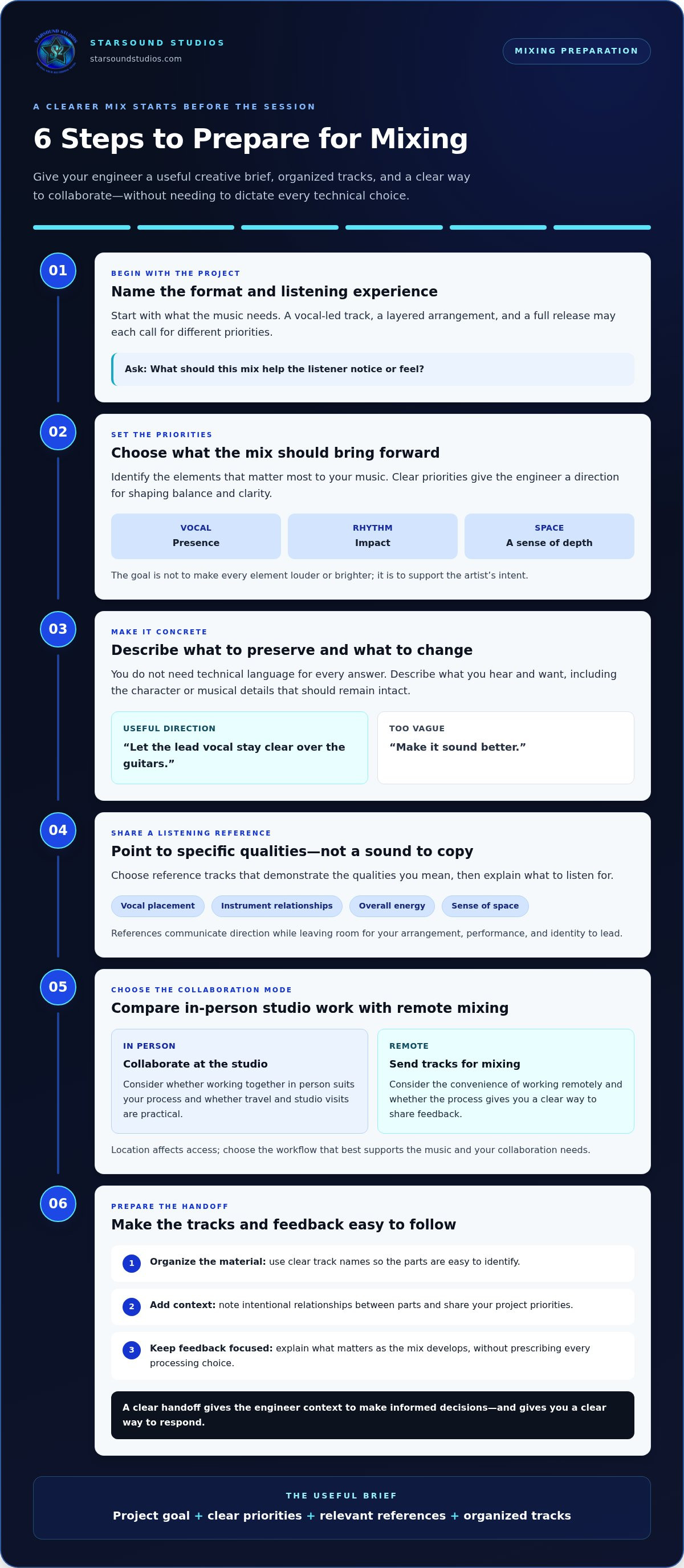
A thoughtful handoff gives the engineer a clearer path into your music. Before sending files or beginning a session, write a brief that explains what the song should feel like, which details matter most, and what needs to remain untouched. You don’t need specialized terminology. A few precise notes can protect the character of the performance and help the mix move in the right direction.
Use this sequence to prepare:
- Define the goal. Describe the intended mood and listening experience. Is the track meant to feel close and intimate, spacious, energetic, or restrained?
- Organize the tracks. Use clear names that identify each part, such as lead vocal, harmony, bass, or percussion. Keep the handoff coherent, and follow the project’s stated file and delivery instructions rather than assuming a particular format.
- Prepare references. Choose tracks that communicate your direction, and note what you want the engineer to hear in each one.
- Communicate priorities. Identify essential elements, intentional effects, and any creative preferences or technical concerns you want addressed.
What should you include in a mixing brief?
Describe the song’s intended feel, your key priorities, and the elements you consider essential. References are encouraged, but explain why each one matters. Perhaps you like the vocal’s presence, the space around the drums, or the overall energy. Treat references as a way to describe qualities, not as a request to copy another artist’s recording. Keep notes focused so the engineer can distinguish creative choices from technical issues.
For genre-specific EQ, Starsound Studios uses iZotope’s Tonal Balance Control. Sharing references alongside your description gives the engineer context for understanding the sound you’re aiming for, while leaving room for the mix to serve your song’s identity.
How can organized tracks make remote handoff clearer?
Clear track names reduce guesswork, especially when an engineer is working from files rather than sitting beside you. Group or label parts to reflect the arrangement, and include a concise note about anything the names alone can’t explain. For example, mention that a vocal effect is intentional or that two parts are designed to work together. Don’t assume technical delivery requirements. Follow the instructions provided for your project.
These habits can also make remote work easier to follow. Artists preparing a handoff can use this track preparation checklist for professional mixing as a companion to their own brief. A little organization helps the engineer focus on listening and shaping the music, not decoding the session.
If you’re ready to put these preparation steps into practice, explore mixing with Starsound Studios and bring your project’s direction into the conversation.
Work With Starsound Studios, a Cuyahoga County Mixing Engineer
Starsound Studios is a professional recording facility in North Royalton, Cleveland, Ohio, serving artists who want a thoughtful, technically grounded approach to their music. The team includes a ProTools-certified engineer with decades of studio experience. Whether you’re developing a stereo mix or preparing tracks to send remotely, the focus is on understanding your creative direction and treating the music with care.
Stereo mixing is a core part of the studio’s work. Local artists can access the North Royalton facility, while remote mixing lets artists send tracks without traveling. That flexibility matters when choosing a mixing engineer Cuyahoga County musicians can work with. The right process should fit the project and the artist, not force every song into the same workflow.
For artists interested in immersive audio, Starsound Studios is the first and only Dolby-certified Atmos mixing studio in Ohio, with a 9.1.4 system. Dolby Atmos is an additional creative option, not a requirement for a stereo project. Your intended release and the listening experience you want to create can help shape which format makes sense.
What distinguishes Starsound Studios for local artists?
Artist-focused care starts with listening to the project’s goals and keeping the artist’s intent at the center of the process. Starsound’s listed credentials include an Emmy Award win and a Better Business Rating. Its mixing environment includes high-definition converters, clean pre-amps, analog EQ and compressor on every channel, high-end speakers, and an acoustically treated room and vocal booth. These features complement the engineer’s experience.
References are encouraged, and for genre-specific EQ, the studio uses iZotope’s Tonal Balance Control. Explaining what you want a reference to communicate helps connect technical decisions to your direction, whether your priority is vocal presence, instrument balance, or the overall energy of the mix. The goal is to support the song’s character, not overwrite it.
How can artists begin a Starsound mixing project?
For studio work, use the website’s Book Now option to book studio time. For remote mixing, send your tracks to the studio. A clear project brief and references can set the creative context for either workflow. Consider what you want listeners to notice, which elements are essential, and whether local studio access or remote file submission best suits the project.
Your next step is simple: explore mixing services and book with Starsound Studios. Bring your tracks, references, and ideas. The collaboration begins with the sound you want to create.
Give Your Next Mix a Clear Creative Direction
You don’t need to have every technical decision figured out before mixing begins. Start by identifying what you want the listener to feel, which parts of the song matter most, and what workflow will help you stay connected to those priorities. That clarity gives a mixing engineer Cuyahoga County artists choose a meaningful starting point while leaving room for skilled creative judgment.
Bring your rough mix, a few references, and honest notes about what feels right or unfinished. Your brief can evolve as the mix takes shape. The strongest collaboration keeps your artistic identity in focus while making space for fresh perspective and careful refinement.
Ready to take the next step with your music? Explore mixing services and book with Starsound Studios. Start with the sound you’re imagining, and let the project grow from there.
Frequently Asked Questions
How do I find a mixing engineer in Cuyahoga County?
Look for a mixing engineer Cuyahoga County artists can collaborate with whose work and process suit your project. Compare audio examples for qualities relevant to your arrangement, such as vocal placement or how a dense instrumental stays clear. Listen at a comfortable volume and consider whether the sample’s balance and energy align with your goals. Then choose a local or remote workflow that fits how you want to take part.
Can I work with a Cuyahoga County mixing engineer remotely?
Yes. Starsound Studios accepts tracks remotely for mixing, so you can work with a Cleveland-area studio without visiting in person. Remote work can be useful if you’re outside the area or prefer to prepare your project at home. Include context with your tracks, such as the intended mood and important production details, so the engineer understands what you want the mix to preserve.
What should I send a mixing engineer before work begins?
Prepare the recorded tracks, a concise project brief, and reference tracks that demonstrate qualities you like. Use clear track names and note which elements should stay prominent or which effects are intentional. For example, identify a vocal effect as part of the song’s sound rather than an error to remove. Follow the studio’s project-specific instructions for file formats and handoff details.
How do I know whether a mixing engineer is right for my song?
Judge the fit by more than genre labels or a polished sample. Consider whether the engineer’s examples demonstrate qualities your song needs and whether you can comfortably explain your creative priorities. Try describing one detail you want preserved, such as a raw vocal texture. The engineer’s approach should keep that artistic intention in view while addressing your mix goals.
Does Starsound Studios offer stereo mixing in Cleveland, Ohio?
Yes. Starsound Studios offers stereo mixing from its professional recording facility in North Royalton, Cleveland, Ohio. Stereo mixing suits projects intended for conventional two-channel playback. Artists can work with the studio locally or send tracks remotely. Share your project’s intended listening experience and creative priorities to guide the mixing process toward the sound you want listeners to hear.
Is Starsound Studios the only Dolby-certified Atmos mixing studio in Ohio?
Yes. Starsound Studios is the first and only Dolby-certified Atmos mixing studio in Ohio, with a 9.1.4 system for immersive audio mixing. Dolby Atmos is an additional format to consider when it supports your artistic vision. It isn’t required for a stereo release. Think about how you want the music to surround or position the listener before deciding whether an immersive mix suits the project.
Can I provide reference tracks for a mixing project?
Yes. Starsound Studios encourages reference tracks. Choose examples that communicate specific qualities, such as vocal presence, tonal balance, or overall energy, and explain what you’re responding to in each. References convey direction; they aren’t instructions to duplicate another artist’s recording. For genre-specific EQ, Starsound uses iZotope’s Tonal Balance Control, and your references add context for the sound you’re aiming to achieve.


