
What if your next step in music isn’t another networking event, but the right connection between learning, community, and production? The ohio music industry offers all three, yet its opportunities can feel scattered across schools, artist networks, events, and studios.
One artist may need industry connections, another a funding lead, and someone else a polished release. The useful next move depends on your goal. This guide brings Ohio’s music pathways into focus, from education and artist communities to industry events and professional production, so you can choose a practical next step instead of trying to pursue everything at once.
Local studio work can also connect with remote collaboration. At Starsound Studios in North Royalton, Cleveland, artists can develop recordings through mixing and mastering, including Dolby Atmos mixing in a 9.1.4 system. Starsound Studios is the first and only Dolby-certified Atmos mixing studio in Ohio. Whether you’re building skills, growing your network, or preparing music for release, start with what your project needs now.
Key Takeaways
- See the ohio music industry as a network of creative work, education, events, venues, and production, rather than a single scene or institution.
- Use the Ohio University Music Industry Summit as one possible connection point, and check the event page for current details.
- Match your next move to your goal: build skills, connect with peers, or prepare music for release through local or remote production.
- Turn a release idea into a workable roadmap by defining the goal, assessing your tracks, choosing support, preparing files, and setting milestones.
- Explore how recording, mixing, mastering, or Dolby Atmos mixing at Starsound Studios can support a release, whether you’re nearby or collaborating remotely.
What Does the Ohio Music Industry Include Beyond Recording Studios?
The ohio music industry is the connected activity that helps music get created, learned, shared, and professionally produced across the state. It includes artists building careers and music businesses, as well as the people and places that support their work: educators, conferences, venues, studios, and industry groups. These parts overlap, but they serve different purposes. A conference can help someone learn and meet peers; a studio can help an artist shape a recording for release.
That wider view matters. Looking only at studios misses the people developing skills and audiences, while treating one event as the whole industry overlooks the creative work happening between gatherings. Ohio’s musical history and range of genres provide useful context. The overview in Music of Ohio offers a starting point for exploring that cultural landscape. The working industry also depends on practical connections between creative vision, expertise, and finished audio.
Which parts of the music ecosystem support an artist?
Each participant brings a different kind of knowledge. Artists write, perform, and define a project’s sound and direction. Producers help develop arrangements and guide creative decisions, while recording and mixing engineers translate performances into a coherent recording. Educators build skills, and industry organizations can connect people with information, programs, and professional communities.
Events add another layer. A summit, panel, or workshop can offer focused learning and the chance to meet people with different experience. Those conversations may inform an artist’s next move, but attendance alone doesn’t guarantee a job, collaboration, or release. Get more from an event by bringing a clear question, listening closely, and following up thoughtfully when there’s a genuine reason to continue the conversation.
Production can be local, remote, or a blend. An artist might record with nearby engineers, then collaborate with musicians or other creative partners elsewhere. With remote mixing and mastering, tracks can be sent to an engineer without everyone working in the same room. Geography shapes how people connect, but it doesn’t determine whether they can contribute to the same project.
How do Cleveland and Athens fit into Ohio’s music landscape?
Cleveland and Athens illustrate different points in this network, not a complete map of Ohio’s music scenes. North Royalton, in the Cleveland area, is home to Starsound Studios, a professional recording facility offering recording and post-production. Its services include stereo mixing, mastering, remote mixing and mastering, and Dolby Atmos mixing in a 9.1.4 system. Starsound Studios is the first and only Dolby-certified Atmos mixing studio in Ohio.
Athens is home to Ohio University and its Music Industry Summit, an example of how education and industry programming can create a place for discussion and connection. These are distinct options within a broader ecosystem: one centered on professional audio production, the other on a university-based industry event. Your best starting point depends on the work in front of you, whether that’s building skills, meeting peers, or getting a recording ready for its next stage.
How the Ohio University Music Industry Summit Connects Artists and Industry
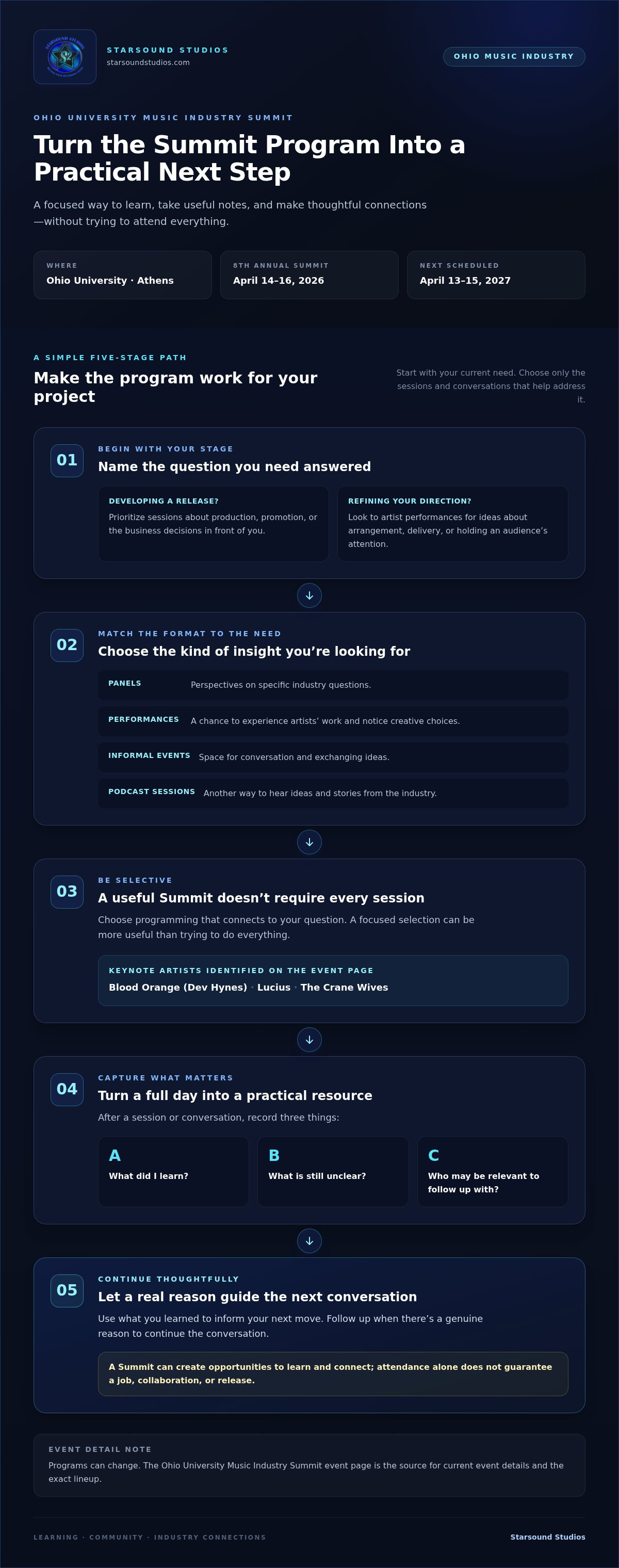
The Ohio University Music Industry Summit is one connection point within the broader ohio music industry, not a stand-in for every artist community, venue, studio, or opportunity in the state. Held in Athens on the Ohio University campus, the 8th annual Summit took place April 14 to 16, 2026. Ohio University’s event page identified Blood Orange (Dev Hynes), Lucius, and The Crane Wives among the keynote artists. The next Summit is scheduled for April 13 to 15, 2027. Programs can change, so use the Ohio University Music Industry Summit page for current event details and the exact lineup.
A summit’s value isn’t simply being in the room. It comes from choosing how to use the time. Panels can offer perspectives on specific industry questions; performances let attendees experience artists’ work; informal events create space for conversation; and podcast programming offers another way to hear ideas and stories. Each serves a different purpose. None guarantees a meeting, a job, or a collaboration, so treat the program as a chance to learn and make thoughtful connections, not a promise of a particular result.
What can artists learn from an industry summit?
Start with a question tied to your current stage. If you’re developing a release, prioritize sessions that speak to production, promotion, or the business decisions you’re facing. If you’re still refining your direction, an artist performance may offer a fresh perspective on arrangement, delivery, or how a set holds an audience’s attention. Use informal conversations to exchange ideas, and listen for approaches or experiences relevant to your work in podcast sessions.
Be selective. You don’t need to attend every session to get value from the event. A focused note about what you learned, what remains unclear, and who might be relevant to follow up with can turn a full day of programming into a practical resource.
How should you prepare for an Ohio music industry event?
A little preparation makes networking feel more natural. Keep your introduction concise and specific: what you make, what you’re working on, and what kind of conversation would help. If you bring a work sample, make it easy to access and share it only when it fits the discussion. Then give the other person room to respond. A useful exchange is a conversation, not a pitch delivered at speed.
- Set a goal: Choose one priority, such as learning about production or meeting potential collaborators.
- Prepare a question: Ask something grounded in your current project rather than making a broad request for career advice.
- Plan a follow-up: Make a brief note of the conversation and, if appropriate, send a respectful message that refers to the shared topic.
After the event, turn one useful insight into an action. That might mean developing a skill, reconnecting with someone you met, or clarifying what your next release needs. If a conversation raises a production question, explore recording and mixing support as one part of your next step.
Which Ohio Music Industry Path Fits Your Goal: Learning, Community, or Production?
The right next step depends on what’s holding your music back. You may need technical knowledge, fresh perspectives, collaborators, or a finished recording that’s ready to share. In the ohio music industry, these pathways can work together rather than compete. Choose the one that addresses your most immediate need, then build from there.
| Goal | Useful pathway | Practical first action |
|---|---|---|
| Build technical or career skills | Structured learning, such as audio engineering classes | Write down the skill or knowledge gap you want to close, then look for relevant instruction. |
| Gain perspective and meet peers | Industry events, panels, and artist communities | Choose an event based on a question you want answered or a conversation you hope to have. |
| Develop a song or release | Local recording, mixing, or mastering support | Assess what’s complete and identify the next production task. |
| Work with an engineer from elsewhere | Remote mixing or mastering | Organize your session files and clarify the sound you’re aiming for. |
Think of the table as a starting point, not a ranking. An event might help you identify a skill to develop; learning may reveal what your track needs next; and production conversations can clarify goals for future work. If funding is relevant to your plans, review current opportunities listed by the Ohio Arts Council, then assess whether their requirements match your project.
When is an event or educational opportunity the right next step?
Choose an event when you want context, conversation, or exposure to industry perspectives, rather than a technical solution for a track that’s already in progress. Choose structured learning when you’re deliberately building knowledge, such as recording techniques or engineering skills. A specific question helps you focus: “How can I prepare better session files?” is more useful than “How do I succeed in music?” For an introduction to the work and career skills involved, explore this Cleveland sound engineer career guide.
When does professional production become the priority?
Production support may be the practical move when a song’s creative direction is clear, the arrangement is ready to develop, or you’ve reached a technical decision you can’t confidently resolve alone. Recording captures a performance; mixing shapes the balance and character of the tracks; mastering prepares the completed mix for release. Identify the stage you’re at and the outcome you want before starting the conversation.
Artists near Cleveland can work locally, while remote mixing and mastering make collaboration possible beyond the area. Prepare organized files, notes about your intentions, and reference tracks that communicate the sound you’re after. If you’re weighing the final production stages, this Cleveland mixing and mastering services guide can help clarify what each stage contributes.
How to Build a Practical Ohio Music Industry Roadmap for Your Next Release
A release plan turns connections and creative ideas into a sequence of decisions. In the ohio music industry, your roadmap doesn’t need to be complicated. It should make the next action clear, show what support the project needs, and leave room to adjust as the music develops.
- Define the release goal. Decide what you’re preparing: a single, an EP, or another project. Write down what “ready” means for this release, such as a finished mix, a master, or a recording that captures a particular performance.
- Assess the music. Listen with the goal in mind. Note what’s complete, what still needs creative decisions, and any technical concerns. Separate changes you can make yourself from questions that call for an experienced collaborator.
- Select support. Match the need to the right next step. That might mean learning a production skill, reconnecting with a potential collaborator, recording locally, or arranging remote mixing or mastering. Choose support that addresses a real project need rather than adding activity for its own sake.
- Prepare files and direction. Organize the session materials, label files clearly, and write a concise description of the sound and feeling you’re aiming for. Gather reference tracks that help communicate your intent.
- Set milestones. List the decisions and tasks that remain, assign responsibility where needed, and choose review points that fit the project. Milestones create momentum without relying on an arbitrary deadline or assuming every release follows the same schedule.
How can an artist turn a networking conversation into progress?
After an event or conversation, record the useful details while they’re fresh. Ask permission before noting or sharing anything personal. Then choose one relevant follow-up, such as sending a brief message about the topic you discussed or noting a skill to develop. Keep collaborators, learning needs, and production tasks together in the release plan, so a promising conversation becomes a clear next step rather than another loose contact.
What should artists prepare before professional audio production?
Arrive with organized session files, clear references, and a short explanation of your artistic vision. References are encouraged at Starsound Studios, where iZotope’s Tonal Balance Control is used. For a deeper look at preparing for a studio session, read this professional recording studios in Cleveland guide.
For example, an artist with a finished arrangement but unfinished mixes might use an event conversation to clarify a production question, prepare files and references, then plan mixing and mastering as distinct milestones. Cleveland-area artists can work with a studio locally; remote mixing and mastering also let artists collaborate from outside the area. The roadmap keeps the creative vision in focus while making the production handoff more deliberate.
When your release needs professional audio support, explore recording, mixing, and mastering at Starsound Studios.
How Cleveland-Area Production Can Support Your Ohio Music Industry Journey
Events, education, and artist communities can help you find direction. Professional production is where that direction takes shape in the recording itself. Starsound Studios is a professional production facility in North Royalton, Cleveland, Ohio, serving Northeast Ohio and remote clients worldwide. Its work includes Audio Recording, Audio Mixing, Audio Mastering, and Dolby Atmos Immersive Audio mixing. For artists building a release, these services connect creative intent with the technical decisions that bring a track to its finished form.
Starsound Studios is the first and only Dolby-certified Atmos mixing studio in Ohio. Its Dolby Atmos mixing takes place in a 9.1.4 system, offering an immersive format alongside stereo production. This capability may suit artists whose project calls for an immersive mix rather than a stereo-only presentation.
What can artists expect from Starsound Studios’ production environment?
The studio combines a modern analog console with high-definition audio converters, clean microphone preamps, and analog equalizers and compressors on every channel. An acoustically treated room and vocal booth support recording, while high-end speakers provide a listening environment for detailed audio work. Reliable monitoring and capture help the artist and engineer make informed decisions throughout a session.
Technical resources are only part of the experience. A Pro Tools-certified engineer with decades of studio experience brings focused attention to the recording and production process, while the artist’s vision remains central. The guiding philosophy is to record correctly to mix less: thoughtful preparation and capture can give later stages a stronger foundation.
How can Northeast Ohio and remote artists work with the studio?
Local artists can book Audio Recording in Studio A at the North Royalton facility. Artists outside the Cleveland area can send tracks for Remote Mixing or Remote Mastering, making it possible to collaborate across distance without being in the same room. The right approach depends on the project: recording takes place in the studio, while mixing and mastering can move forward with prepared audio files and clear creative direction.
Before production begins, identify what stage your music is at and what you want the next stage to accomplish. For an overview of immersive production and its role in Cleveland, explore this Cleveland Dolby Atmos mixing guide. It can help you consider whether an immersive mix fits the artistic direction of your release.
Whether you’re preparing to record locally or arranging remote mixing or mastering, start with a clear conversation about your goals. Explore recording, mixing, mastering, and Dolby Atmos production at Starsound Studios as you plan your next step.
Make Your Next Music Move Count
Your next step doesn’t need to solve every challenge at once. Choose one action that moves a current project forward: strengthen a skill, reconnect with a potential collaborator, or prepare a song for professional production. Then give that action your attention. A clear focus can turn the ohio music industry from a collection of scattered opportunities into a path shaped around your creative priorities.
When your music is ready for its next stage, Starsound Studios offers a collaborative production environment grounded in technical care. Its work is backed by an Emmy Award win and a Better Business Rating, giving artists useful context as they consider who will help shape their sound.
Whether you’re preparing to record or refining a mix for release, take the next step with intention. Explore professional recording, mixing, and mastering at Starsound Studios and bring your vision into focus with a team invested in the details and the feeling of the music.
Frequently Asked Questions About the Ohio Music Industry
What is the Ohio music industry?
The ohio music industry includes the people and organizations involved in making, teaching, presenting, and supporting music across Ohio. For an independent artist, that might mean learning audio skills, finding peers through an event, building a local audience, or preparing recordings for release. These paths serve different needs. Name your current priority, then look for a relevant opportunity rather than trying to engage with every part of the industry at once.
Is the Ohio University Music Industry Summit open to artists?
Yes, artists can attend the Ohio University Music Industry Summit. At the 2026 event, students at any institution, educators, and Ohio University alumni could attend in person for free; other in-person attendees paid $75, and a virtual-only option was free. The next Summit is scheduled for April 13 to 15, 2027. Check Ohio University’s event information for updated registration details and programming before making plans.
Where is the Ohio University Music Industry Summit held?
The Summit takes place in Athens, Ohio, on the Ohio University campus. If you’re traveling, use the event’s current schedule and campus information to plan your arrival, session choices, and time for informal conversations. The location makes the Summit a university-based gathering, not a complete picture of Ohio’s music activity. Artists can use it as one point of connection while pursuing other opportunities elsewhere.
How can independent artists get involved in Ohio’s music industry?
Begin with one achievable action tied to your work: attend a relevant panel, join a local artist conversation, build a production skill, or organize a release plan. Bring a concise introduction and a specific question so conversations have a natural focus. Afterward, follow up where there’s a genuine shared topic. If you meet someone whose work relates to your project, send a brief note referencing that conversation rather than a generic pitch.
Can Ohio musicians work with a Cleveland studio remotely?
Yes. Starsound Studios works with remote clients worldwide for mixing and mastering, so artists don’t need to travel to Cleveland for those services. Organize the audio files, label tracks clearly, and write down the sound or changes you want the engineer to focus on. References can help communicate your direction. Remote work is most useful when the project materials and creative goals are easy to understand.
What does a professional music studio do for an Ohio artist?
A professional studio can help an artist capture performances and develop recordings through audio production. Depending on the project stage, that may mean recording vocals or instruments, balancing and shaping multitrack audio through mixing, or preparing a completed mix through mastering. In Cleveland, an artist might use a studio to move from a home-recorded demo toward a release-ready production. Clear goals help the engineer focus on the work that matters most to the artist.
Does Starsound Studios offer Dolby Atmos mixing in Ohio?
Yes. Starsound Studios offers Dolby Atmos mixing in a 9.1.4 system at its North Royalton, Cleveland, Ohio facility. Starsound Studios is the first and only Dolby-certified Atmos mixing studio in Ohio. An immersive mix may suit a project where spatial presentation supports the artistic direction. Artists can consider how their existing recording and arrangement might translate to this format as they plan production.


