

What if pushing your song louder could make it sound less powerful on college radio? FM stations apply their own processing, so a pre-crushed master may lose the punch and dynamics that give your track its character. Mastering for radio airplay is about preparing a balanced, technically sound recording, not chasing maximum loudness or assuming a polished master guarantees rotation.
If you’re unsure what “radio-ready” actually means, or which Cleveland station might connect with your sound, start with two things you can control: a master that preserves the music’s impact and a thoughtful pitch to programmers whose shows fit your track. Starsound Studios provides mastering and remote mastering from North Royalton, Cleveland, Ohio. The focus is technical quality control shaped around the music, not a promise of airplay.
This guide covers how to prepare your master without mistaking streaming targets for universal radio requirements, research Cleveland college stations and their programming, and assemble a clear, professionally labelled submission. You’ll also learn to check each station’s current instructions, approach DJs and music directors respectfully, and follow up with realistic expectations.
Key Takeaways
- Use mastering for radio airplay to refine clarity, balance, and musical impact, not to guarantee station acceptance.
- Check the final mix for tonal balance, transient detail, low-frequency buildup, and distortion at practical listening levels.
- Compare Cleveland and Northeast Ohio stations by their publicly described programs, playlists, and current submission policies.
- Make your pitch concise and personal, with a clear track description and a relevant connection to the station or show.
- Starsound Studios’ mastering specifications for major streaming platforms are -14 LUFS and -4 dB True Peak, not universal college-radio requirements.
What Radio Mastering Can and Cannot Do for Your Song
A radio-ready master is a finished recording that sounds clear, balanced, and technically sound across familiar listening environments. It has been checked for issues such as harshness, uneven bass, distortion, and dynamics that feel inconsistent from one section to the next. That final quality-control pass helps your music present itself with intention. It does not decide whether a station will play it.
Mastering refines the final mix rather than rebuilding it. It can shape tonal balance, manage overall dynamics, and help the track maintain a consistent listening experience. For a broader overview of the process, see What is Audio Mastering? The goal is not to erase the character of the mix, but to help its energy and detail come through as intended.
What does radio-ready mastering mean?
Translation is the test. A mix that feels full on studio monitors might sound boomy through car speakers, thin on headphones, or crowded on a small radio. Listen at practical levels on more than one system and note problems that recur. If the vocal disappears when the guitars come in, or the kick and bass blur together on a car stereo, address those details before submission.
Broadcast processing and playback equipment can also reveal problems that were less obvious in the studio. A station’s signal path may alter dynamics, while a listener’s receiver and speakers add their own color. Careful mastering can help a track arrive with balanced tonality and controlled peaks, but no single master can make every playback setup sound identical. College stations may publish different delivery instructions, so don’t assume one file type or loudness target applies everywhere.
Why mastering alone does not secure college-radio airplay
A polished master is one part of a pitch. A programmer still decides whether the song suits a show, fits the station’s current programming, and meets its submission instructions. A complete, clearly labelled submission makes the track easier to consider, but it cannot replace a genuine match between the music and the program.
A polished master can prepare your song for consideration; only the station can decide to put it on air. That distinction keeps mastering for radio airplay in its proper role: a musical and technical step that helps your work arrive in strong shape, not a shortcut to acceptance. Even a thoughtful submission may receive no reply or broadcast. That is part of working with independent programmers and varied show schedules, not proof that the song has no audience.
Focus on what you can control: deliver a finished track that represents your sound, then pitch it to stations and shows whose publicly described programming aligns with the music. Mastering supports that first impression. Selection remains the station’s call.
How to prepare a master for Cleveland college radio
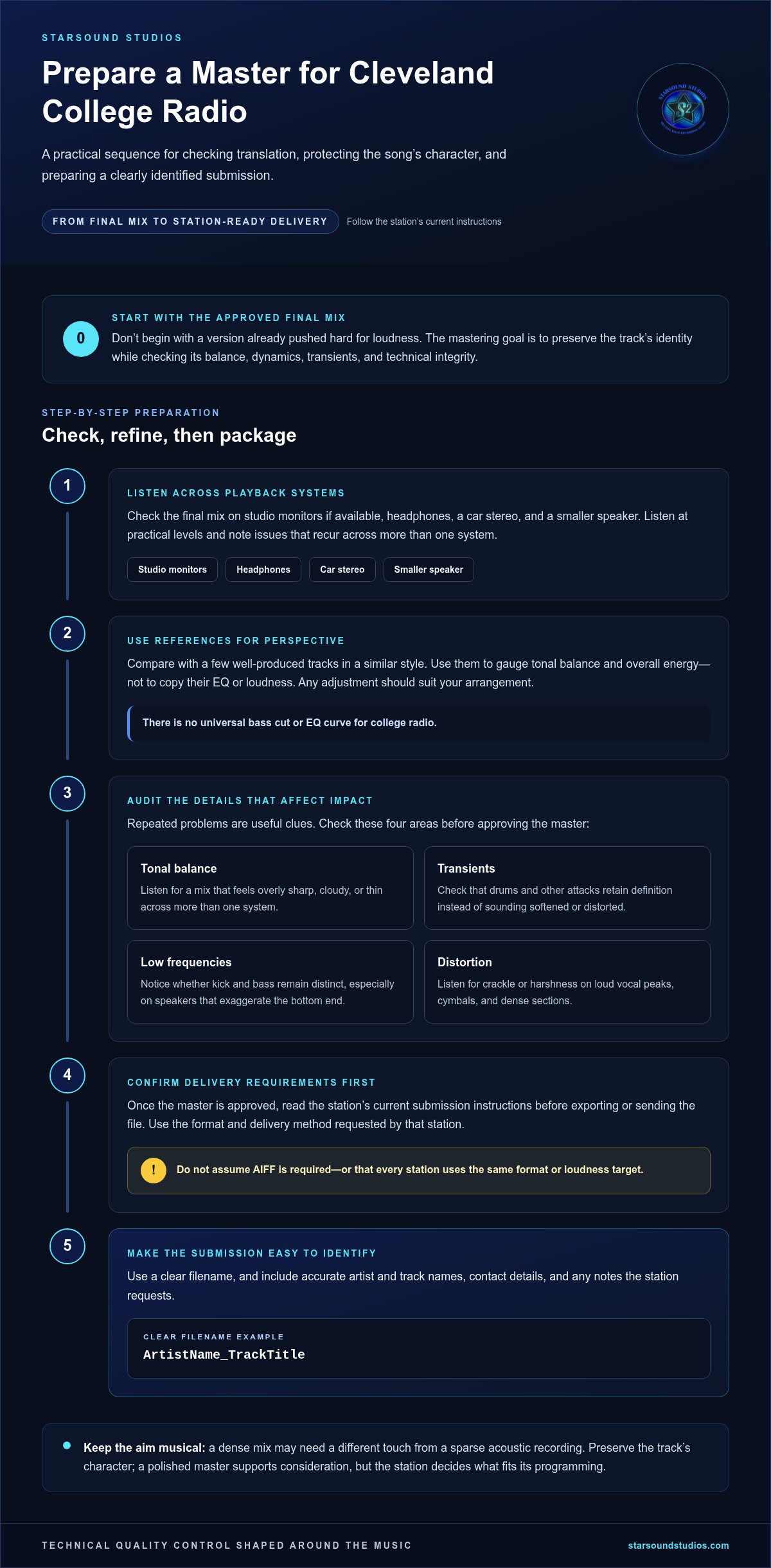
Begin with the approved final mix, not a version that has already been pushed hard to sound louder. The mastering stage should preserve the track’s identity while checking its tonal balance, dynamics, transients, and technical integrity. A dense mix may need a different touch from a sparse acoustic recording. The aim is a confident, cohesive presentation, not a one-size-fits-all radio sound.
For a deeper look at the process, explore this Cleveland audio mastering guide. The key to mastering for radio airplay is to make careful decisions in service of the song, then follow the target station’s published delivery requirements. Don’t assume every college station specifies the same format or loudness.
Check the mix translates before final mastering
Listen to the final mix on studio monitors if available, headphones, a car stereo, and a smaller speaker. Note issues that keep showing up: a vocal that gets buried, a kick that masks the bass line, or cymbals that turn harsh at moderate volume. Repeated problems are more useful clues than differences caused by any one playback system.
Compare with a few well-produced tracks in a similar style. Use them to gauge tonal balance and overall energy, not to copy their EQ or loudness. A reference can reveal that your mix feels unusually dark or bright, but the adjustment should suit your arrangement. There’s no universal bass cut or EQ curve for college radio. Mastering Techniques for Radio offers further context on EQ, compression, and leaving room for mastering.
- Tonal balance: Listen for a mix that feels overly sharp, cloudy, or thin across more than one system.
- Transients: Check that drums and other attacks retain definition instead of sounding softened or distorted.
- Low frequencies: Notice whether kick and bass remain distinct, especially on speakers that exaggerate the bottom end.
- Distortion: Listen for crackle or harshness on loud vocal peaks, cymbals, and dense sections.
Prepare the final audio file and its identifying details
Once the master is approved, read the station’s current submission instructions before exporting or sending anything. Use the requested file format and delivery method; don’t assume AIFF is required. This AIFF audio format guide can help explain the format if you encounter it in a station’s instructions.
Make the file and message easy to identify. Use a clear filename such as ArtistName_TrackTitle, and include accurate artist and track names, contact details, and any requested notes in the submission. Follow the station’s published technical guidance rather than assuming a radio loudness target. A careful final check helps prevent a strong track from being overlooked because its details are unclear. For experienced support preparing the finished sound, Starsound Studios mastering can be part of your final production process.
How to choose Cleveland college stations that fit your music
Build a shortlist by researching what stations and individual shows actually play, not by guessing from a school name or a broad format label. A targeted pitch gives a programmer context for why your song belongs in their rotation. Programming fit is more useful than sending one pitch everywhere.
Start with Cleveland-area options such as WJCU, WRUW, WCSB, and WBWC, then widen your search to Northeast Ohio if it makes sense for your release. Review official station websites, show descriptions, recent playlists, and submission information. Look for documented openings that match your track, such as a specialty program or a stated interest in local artists or new releases. Don’t infer those opportunities if the station hasn’t described them.
Match your track to a program, not just a station name
Listen to a show or scan its recent playlists before writing. Notice the sounds, styles, and kinds of releases the programmer features, then compare them with your song’s actual character. A genre label is only a starting point: production, mood, instrumentation, and format can all affect fit. Prioritize the shows whose public programming gives you a clear, honest reason to pitch.
Station | Potential fit to research | Submission route | What to verify
WJCU 88.7 FM | Triple-A show “The Heights” or a genre-specific program | “The Heights” submissions: Laurie Jenkins at [email protected]. Other genres: [email protected] | Current eligibility and delivery instructions for the relevant program
WRUW-FM 91.1 | Individual shows whose playlists align with your sound | Identify and contact a suitable programmer or DJ | The show’s current focus and preferred submission approach
WCSB 89.3 FM | Research current programs and playlists for a documented match | Check the station’s official channels | Current contact, submission route, and requirements
WBWC 88.3 FM | Its described alternative modern rock programming may suit some tracks | Check the station’s official channels | Whether a specific show fits and how it accepts music
Check each station’s submission instructions
Before pitching, confirm the current route on the station’s official website or other official channels. Note whether it wants a link, an attached file, or a message addressed to a particular music director or DJ. Record any stated file specifications and requested artist details. Requirements can change, so don’t reuse old instructions just because they worked for another release.
Keep your comparison notes simple: station, relevant show, contact or submission route, and stated requirements. If a route isn’t clear, research further rather than guessing or sending the same materials indiscriminately. This makes each pitch more specific and keeps your submission aligned with the station’s process.
How to submit your song and follow up professionally
A strong submission makes it easy for a programmer to understand who you are, hear the track, and see why you chose their station or show. Keep the process organized and personal. A repeatable workflow helps you avoid rushed messages, missing details, and generic pitches.
- Research: Choose a station or program whose current public information suggests a genuine fit. Recheck its official submission instructions before sending anything.
- Personalize: Address the appropriate music director, DJ, or program contact when one is named. Mention a specific, accurate reason the track suits that show.
- Prepare: Gather the requested audio or listening link, a brief artist introduction, track details, and accurate contact information.
- Submit: Use the station’s stated delivery route and include only the materials it asks for.
- Track: Record the station, contact, date, delivery method, and any response so future communication stays clear and courteous.
Build a complete, easy-to-review submission
Keep the note brief, but make it useful. Include your artist name, track title, a concise genre description, and a reliable way to reach you. Add one sentence explaining the connection to the station or specific program, such as a shared musical style or a genuine local tie. Don’t overstate your connection or attach extra files the station hasn’t requested.
A simple message might read: “Hello [Name], I’m [Artist] from [area]. I’m sharing ‘[Track Title],’ a [brief style] track that I thought could fit [show] because [specific reason]. Here’s the requested listening link. Thank you for your time.” Adjust it to the station’s instructions and your real story. For broader context on how production supports a finished release, see this guide to Cleveland mixing and mastering services.
Follow up without turning the pitch into pressure
Respect each station’s preferred contact method and any published guidance about responses or follow-ups. Don’t assume there’s one standard waiting period for every show. If the station gives no guidance, use your judgment, keep any later note courteous and concise, and avoid repeated messages that add no new information. A quiet inbox doesn’t necessarily tell you what the programmer thought of the song.
Keep a simple submission log with the date, route, contact, and response. That record helps you avoid duplicate pitches and makes it easier to learn which approaches are appropriate for future releases. Professional outreach is part of presenting your music with care, alongside thoughtful mastering for radio airplay. If your track is ready for a focused final polish, explore audio mastering at Starsound Studios.
How Starsound Studios approaches mastering for radio-ready music
At Starsound Studios, Audio Mastering is a focused final production stage: an opportunity to refine a finished mix while protecting the artist’s intent. It can help a track feel cohesive and technically prepared for release, but it can’t determine whether a college station selects or broadcasts the song. That choice belongs to the station and its programmers. A strong master supports your pitch; it doesn’t replace a thoughtful match or complete submission.
Mastering specifications depend on the intended use. Starsound Studios’ stated specifications for major streaming platforms are -14 LUFS and -4 dB True Peak. These are not universal college-radio requirements. The studio provides a single master meeting platform standards, rather than separate masters for each platform. For radio submissions, follow the target station’s current published audio and delivery instructions instead of assuming a streaming specification applies.
What the artist can expect from Starsound mastering
Technical tools support careful listening, not decisions made by numbers alone. Process Audio’s Meter Decibel is used for LUFS compliance, while iZotope’s Tonal Balance Control helps guide genre-specific EQ decisions. References are encouraged. A track that captures the warmth, punch, or openness you’re aiming for can help communicate your creative direction. The reference informs the conversation; the goal remains a master that serves your own song.
Starsound Studios is based in North Royalton, Cleveland, Ohio, and remote mastering is available for artists beyond the area. The studio is the first and only Dolby-certified Atmos mixing studio in Ohio. That Atmos distinction is part of the studio’s broader audio expertise, while mastering decisions for this project stay centered on your final mix and release needs.
Prepare your project for a collaborative mastering session
Bring the approved final mix and share concise notes about what matters most: perhaps the vocal should stay forward, the drums should retain their impact, or the arrangement should keep its intimate feel. Include relevant creative references and mention any sections or playback concerns you’d like considered. Clear direction gives the mastering process a strong starting point without prescribing a fixed sound before the music is heard.
If you’re still refining the mix or want more context on the process, Starsound’s Cleveland audio mastering guide offers a deeper overview. With your mix, references, and release destination in view, mastering for radio airplay becomes a purposeful quality-control step, not a formula for station acceptance.
To give your finished track focused attention, explore Starsound Studios’ mastering services.
Give your next release a confident final polish
Your next step is to bring the finished mix and your creative direction into a focused mastering process. A considered master can help your song make its strongest impression, while station research and a thoughtful pitch help you reach local programmers. Build your release with care, one decision at a time.
At Starsound Studios, your music is shaped with the attention of a ProTools-certified engineer with decades of studio experience. The studio has an Emmy Award win and a Better Business Rating, and remote mastering makes collaboration possible beyond the Cleveland area.
If your track is ready for its final production stage, explore Audio Mastering at Starsound Studios. Share your finished mix and creative direction to get started.
Frequently Asked Questions
Does mastering make a song more likely to get played on college radio?
Mastering can help your track sound balanced and prepared for playback, but it can’t control a station’s programming choices. In mastering for radio airplay, the engineer’s role is to refine the sound, not secure a slot. A programmer may also consider whether the track suits a particular show, whether your submission follows its instructions, and how it fits editorially. A polished recording supports consideration, but it can’t guarantee selection or broadcast.
Should I use the same master for streaming and college radio?
Follow the receiving station’s published delivery specifications rather than assuming a streaming master suits every broadcast workflow. Starsound Studios provides a single master meeting platform standards, with specifications of -14 LUFS and -4 dB True Peak for major streaming platforms. Those figures aren’t universal broadcast requirements. If a college station requests a particular file or technical adjustment, follow that delivery instruction and clarify its intended use before preparing the submission.
Can independent artists submit music to Cleveland college radio?
Independent artists can research Cleveland college-radio opportunities, but eligibility and preferred submission routes vary by station and program. Start with the station’s current public policies, then review its programming to find a plausible match for your sound. If submissions are welcome, send a concise, personalized pitch through the requested method. Don’t assume a station accepts unsolicited music or that a general contact address is the right route for every show.
What should I include in a college-radio song submission?
Follow the station’s instructions first, then prepare accurate artist and track details, a brief introduction, and reliable contact information. Include only the audio and supporting materials it requests. A concise note explaining why you chose that specific program gives the recipient useful context, such as a musical connection or relevant Cleveland-area tie. Check spelling, links, and filenames before sending; a clear package makes your message easier to assess.
How long should I wait before following up with a college radio station?
There’s no universal response time, so follow any guidance the station publishes. Log when and how you submitted the track, then use that record to avoid duplicate messages and respect stated timelines. If a follow-up is appropriate, keep it courteous and brief, refer to your original submission, and avoid asking for a particular outcome. Silence doesn’t necessarily indicate rejection; programmers may have different workloads and communication practices.
Do I need a different master for every Cleveland college station?
Not necessarily. Read each station’s delivery instructions before preparing files; a technical request may concern format or delivery rather than a new creative master. Don’t assume every Cleveland station needs a different version. Starsound Studios provides a single master meeting platform standards, not separate masters for each platform. If a station states a specific requirement, distinguish that practical delivery need from changing the sound of the song itself.


