

Your best booking demo may not be your most polished studio track. When you’re preparing a demo for Cleveland venues, the goal is to make your live identity clear: a booker should quickly hear what your act sounds like, what makes it distinctive, and whether it fits the room. That can feel like a balancing act, especially when you’re choosing between songs or worrying that rough audio will distract from strong material.
A focused presentation can do more than a long playlist or a crowded pitch. This guide will help you select two or three songs that reflect your set, present them clearly, and build an easy-to-review booking package with the essentials venues need. You’ll also learn how to tailor a concise message to each Cleveland venue and make sure your demo matches the live performance you’re offering. If your recordings need more clarity or character, professional recording, stereo mixing, and mastering can bring your sound forward while preserving what makes the performance yours.
Key Takeaways
- Shape your demo around the booking questions a venue needs answered, including audience fit and performance energy.
- Use a simple track-selection process to choose songs that represent your act, not just its newest release.
- Compare studio, live, and rehearsal recordings to decide which format best communicates your stage potential.
- When preparing a demo for Cleveland venues, make your pitch specific to each room and keep the listening experience simple.
- Recording, stereo mixing, and mastering can bring greater clarity and character to your music while preserving its identity.
What Cleveland Venues Need to Hear in a Music Demo
A booking demo should showcase the act, not just its production quality. A clear vocal or distinctive guitar tone can catch a listener’s attention, but a venue also needs to understand the music’s style, how the performers work together, and the energy they bring to a room. Make those elements easy to hear, while giving the booker a clear sense of the audience and event where the act could fit.
A music demo is a concise sample that represents an act’s sound and performance identity. That purpose has evolved over time, as outlined in The Wikipedia article on music demos. For a venue pitch, think beyond a collection of tracks: choose material that helps someone picture your act onstage. A full-band recording can communicate interaction and momentum; a stripped-back performance may better show songwriting, vocals, or an intimate format.
Genre is one clue, not the whole story. Audience, event format, and performance energy help complete the picture. A booker considering a support slot may want to know whether your sound complements the event. A full-set pitch should suggest that your repertoire and stage presence can sustain a longer performance. Be specific without overstating your draw or promising a fit you can’t support.
Identify the act’s strongest booking case
Start with one or two clear sentences that describe your sound, lineup, and live format. For example: “We’re a four-piece indie rock band with original songs, harmony vocals, and a high-energy full-band set.” Then choose demo material that reflects the performances you want to book, rather than a one-off studio arrangement that doesn’t represent your stage setup. If your set includes originals, covers, or both, mention that when it helps a venue understand the experience you offer.
Keep the description grounded. If a track features a guest musician or production layers that aren’t part of your live show, clarify that briefly. The aim isn’t to flatten your sound. It’s to set accurate expectations and let the act’s real strengths come through.
Match the pitch to the venue’s programming
Before preparing a demo for Cleveland venues, review each venue’s publicly described programming and submission process. A room that presents varied live music may consider a different range of acts than an event series built around a specific community or format. Compare your style and audience with what the venue actually presents, then explain the connection in a sentence that feels personal rather than mass-produced.
Be equally clear about the opportunity you’re seeking: a full set, a support slot, or another format. Don’t assume the venue’s preferred show structure, audience size, or booking requirements. For instance, Beachland Ballroom directs artists to its submission form, while Wade Oval Wednesdays requests an electronic press kit, social media handles, and music samples from applicants. These examples show why it’s useful to follow each organizer’s published instructions. Tailor the pitch to the opportunity and let the demo answer the musical question.
Choose Demo Tracks That Make the Act Easy to Understand
The right tracks give a booker a clear first impression, then enough context to understand the act’s range. Don’t default to the newest release simply because it’s current. A song that captures your live sound, strongest performance, or clearest connection to the booking opportunity may make a more convincing introduction. When preparing a demo for Cleveland venues, choose for representation and fit, not release date alone.
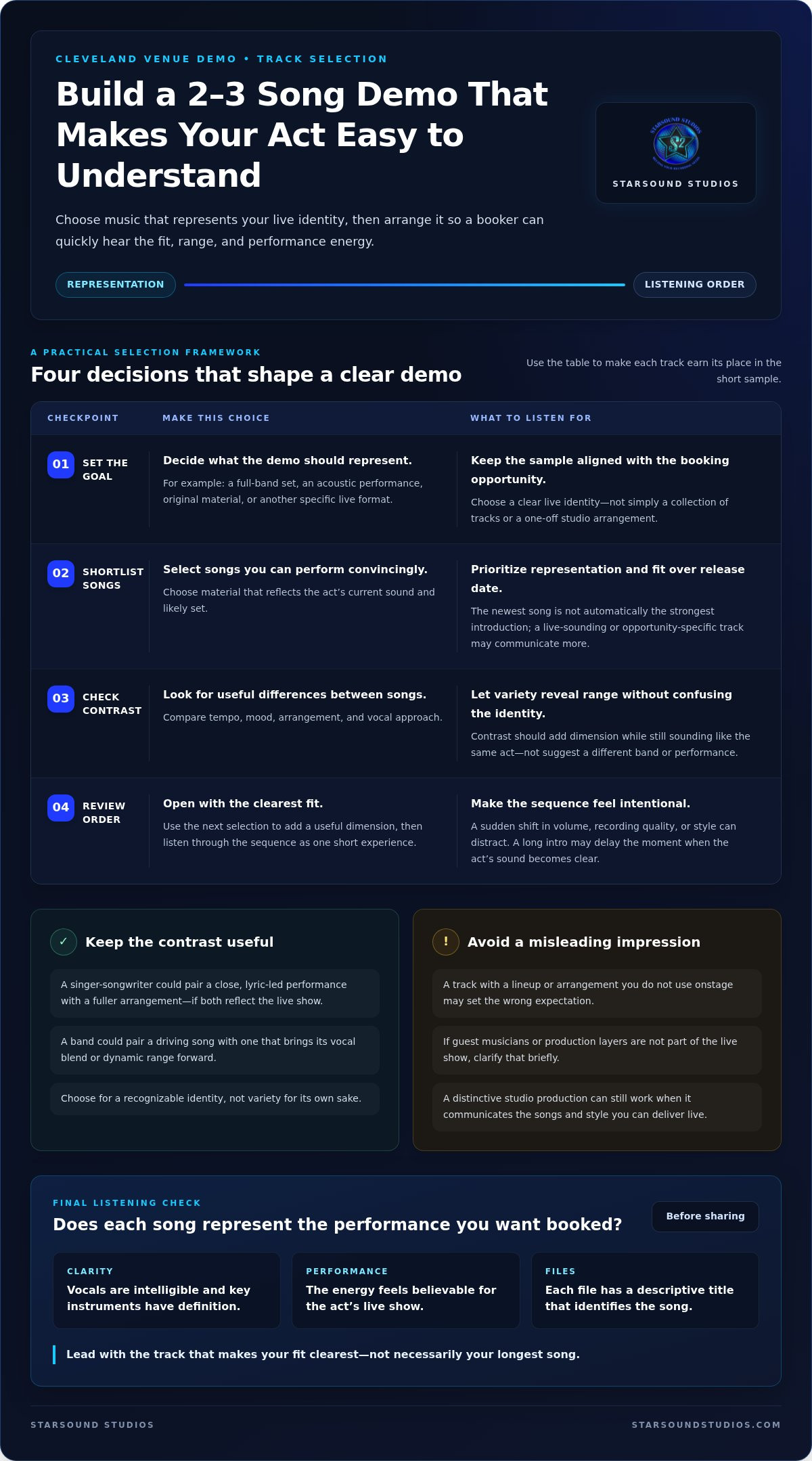
Use this sequence to make the selection deliberate:
- Define the booking goal. Decide whether the demo should show a full-band set, an acoustic performance, original material, or another specific live format.
- Shortlist representative songs. Select material you can perform convincingly and that reflects the act’s current sound and likely set.
- Check the contrast. Listen for useful differences in tempo, mood, arrangement, or vocal approach. Keep variety that adds dimension without making the act seem unfocused.
- Review the order. Start with the clearest fit, then listen through the sequence as a short, connected experience.
Select songs for identity and range
Choose tracks that reveal what makes your act recognizable. A singer-songwriter might pair a close, lyric-led performance with a fuller arrangement, if both reflect the live show. A band could use one driving song and one that brings its vocal blend or dynamic range forward. Check that vocals remain intelligible, key instruments have definition, and the performance energy feels believable. Contrast should illuminate the same musical identity, not suggest a different act.
Be honest about what the recording represents. If a track features an arrangement or lineup you don’t use onstage, it may give a booker the wrong impression. A distinctive studio production can still work if it communicates the songs and style you can deliver live.
Sequence a short listening experience
Lead with your most immediately representative selection, then use the next track to add a useful dimension. Lead with the track that makes your fit clearest, not necessarily your longest song. The purpose is quick evaluation, not a discography. An extended intro or slow build may suit the full performance, but it can delay the point when your sound becomes clear in a booking sample.
Before sharing, play the tracks in sequence and consider whether their transitions feel intentional. A sudden change in volume, recording quality, or style can distract from the music. Give each file a descriptive title that identifies the song and, when helpful, the performance format. Avoid vague labels such as “Demo Track 1.” Clear navigation lets the listener focus on the act.
If a promising song is held back by an unclear vocal, uneven balance, or a mix that doesn’t convey its dynamics, careful stereo mixing for your demo can help its character come through while keeping the performance at the center.
Compare Recording Formats for a Cleveland Venue Demo
A recording format is useful when it answers a specific booking question. Does the venue need to hear the detail of your songs, the chemistry of the band onstage, or how the act sounds in a room with minimal production? Each approach reveals something different. A polished studio track can showcase musical detail and a considered mix, but by itself it may not communicate the feel of a live set.
Use this comparison to match the recording to what you want a booker to understand:
| Format | Strengths | Trade-offs | Useful when you want to show |
|---|---|---|---|
| Studio recording | Clear vocals, defined instruments, and deliberate balance | May not capture live interaction or stage energy | Your songs, sound, and musical detail |
| Live recording | Performance energy, ensemble interaction, and a sense of the act in a room | Room sound, audience noise, or uneven levels may distract | How the group performs together |
| Rehearsal capture | A direct, practical snapshot of the current lineup and arrangements | Vocal clarity and instrument balance can vary | How the act sounds in a straightforward run-through |
There’s no universally best format, and none guarantees a booking. Choose based on the question behind the pitch. If the music’s arrangement and vocal performance are central to the act, a studio recording may communicate those details effectively. If chemistry, improvisation, or movement between band members matters, a clear live capture may offer more relevant evidence. A rehearsal recording can help when it sounds representative and lets the listener follow the song without struggling through room noise.
Studio recording: detail, balance, and musical identity
Studio recording gives you control over how the performance is captured, so vocals and instruments can come through with definition. Thoughtful mixing helps each part sit in the arrangement without turning the result into a different act. The goal is clarity with character, not polish that disguises the sound you’ll bring onstage. Artists refining a studio track for a booking demo can explore professional mixing and mastering services.
Live and rehearsal recordings: energy and context
A live capture can let a booker hear how performers interact, build dynamics, and carry a song in performance. Choose a recording where the music remains clear enough to evaluate. A rehearsal take can be a useful, less formal snapshot, especially if it reflects the lineup and arrangements you plan to present. Keep the signal intelligible and representative. Unclear vocals, clipping, and excessive room noise pull attention away from the performance.
As you’re preparing a demo for Cleveland venues, choose the recording that most honestly answers the booking question. A studio track paired with a clear live excerpt can offer complementary context, provided both represent the same act and the pitch stays focused.
Prepare the Demo Files and Pitch Before Contacting Cleveland Venues
A strong recording can lose impact if the link won’t open or the pitch makes a booker search for the essentials. Build a small, phone-friendly package that puts the music and booking context within easy reach. Before sending, work through this sequence:
- Research the venue. Review its public programming, booking page, and submission instructions. Note a genuine connection between your act and the events it presents.
- Personalize the message. Address the relevant contact when that information is published, and open with a specific detail about the venue’s programming.
- Link the demo. Use one reliable listening link with descriptive track titles. Test it while signed out or in a private browser window to catch access barriers.
- Summarize the act. Introduce the artist or band, describe the sound and live format, and state what kind of booking you’re seeking.
- Follow the venue’s process. Submit through its stated form or email channel, include requested materials, and follow any published guidance about follow-up.
Make the demo straightforward to listen to
Make every click clear. Label files with the artist and track name, rather than generic names such as “final mix” or “song two.” Before sending, check that the link plays on a phone, opens without a sign-in requirement, and leads directly to the intended music. If you’re using a playlist, put the most relevant track first and remove anything that doesn’t support the pitch.
Keep supporting material lean. A concise artist bio, relevant social profile, or one-page electronic press kit can provide useful context, but oversized attachments and a long stack of unrelated links can bury the demo. Make the music easy to reach.
Write a venue-specific booking message
Keep the first message brief, courteous, and easy to scan on a phone. A practical structure is a personalized opening, a one-sentence description of the act, a relevant live detail, the booking format you’re proposing, and the demo link. Add your name and reply contact. Close with one clear, low-pressure next step, such as inviting the booker to listen or consider the act for a suitable opening. Don’t send repeated nudges when the venue’s instructions ask you to wait or not follow up.
For example, a note might mention a publicly listed series that suits your sound, explain that you’re seeking a support slot, and point directly to a short demo. Keep the connection truthful; avoid implying a relationship with the venue or knowledge of its plans that you don’t have. For more local context on the recording process, this guide to recording studios in Cleveland explores what artists can consider as they prepare music to share.
Careful preparation makes your pitch easier to review without making it feel overproduced or impersonal. If you’d like to refine the recording itself, explore recording and mixing at Starsound Studios as part of preparing a demo for Cleveland venues.
Refine Your Cleveland Venue Demo with Starsound Studios
A demo doesn’t need elaborate production for its own sake. It needs to communicate your music clearly and faithfully. If the performance feels strong but the recording obscures the vocals, blurs the instruments, or loses the dynamics that make the act compelling, focused recording or post-production can help the listener hear what you intend. The right support depends on what’s already working and what’s getting in the way.
Choose the support that fits the demo’s current stage
Recording can help when you need a stronger capture of a representative performance, whether you’re building a new demo or recording material that reflects your current live sound. A thoughtful recording process gives the music room to come through without requiring you to imitate a different artist or reshape your identity.
Stereo mixing shapes the recorded tracks into a cohesive listening experience. It can bring a buried vocal forward, help instruments occupy their own space, and balance the energy between sections. The intent isn’t to make every act sound the same. It’s to support the character already present in the performance.
Mastering is a final stage for a completed mix. It can refine the overall presentation so the finished track feels considered and ready to share. It can’t replace a suitable performance or a mix that communicates the music, and no production step can promise a venue booking. The aim is a demo that represents your sound with clarity.
As you’re preparing a demo for Cleveland venues, start by identifying the issue you want to solve. If the source recording doesn’t capture the performance convincingly, consider recording. If the parts are present but don’t sit together, mixing may be the better focus. If the mix is complete and needs final polish, mastering may suit the project’s stage.
Take the next step with an artist-centered studio
Starsound Studios is a professional recording and post-production facility in North Royalton, serving Greater Cleveland and remote clients. Recording, stereo mixing, and mastering can work together as parts of a focused project, with the artist’s goals and musical identity at the center. Artists who aren’t recording at the facility can also work remotely through mixing and mastering.
Starsound is Ohio’s first and only Dolby-certified Atmos mixing studio, with 9.1.4 immersive mixing capability. That’s a specialized studio credential; for a venue demo, the essential question remains whether the version you share makes your act easy to understand.
You’ve done the key work: clarifying the booking goal, selecting representative tracks, choosing a format, and preparing a concise pitch. If a recording or mix could communicate your music more clearly, explore Starsound Studios’ recording and audio services and consider what kind of support would best serve your demo.
Give Your Next Booking Pitch a Clear Starting Point
Your demo doesn’t have to represent every direction your music might take. It needs to help the right listener understand what you bring to a particular show. Treat each pitch as a focused introduction, then update your materials as your live act evolves. That way, preparing a demo for Cleveland venues becomes part of building a thoughtful connection between your music and the opportunities you pursue.
If a recording is keeping your performance from coming through as clearly as it could, thoughtful production can help you shape a stronger presentation while keeping your artistic identity at the center. Explore recording, mixing, and mastering at Starsound Studios to find the right support for your next demo.
Make the music unmistakably yours. Then send it forward with confidence.
Frequently Asked Questions
How many songs should I include in a demo for a Cleveland venue?
There’s no fixed number; choose enough material to make your booking case clear without turning the pitch into a catalogue. For artists preparing a demo for Cleveland venues, the submission form may set a track limit or request a particular sample format, so read it before assembling your links. If no limit is given, make each song earn its place by adding useful information about your act, rather than including tracks simply because they’re available.
Should my venue demo be a live recording or a studio recording?
Either can work, depending on what you want the listener to assess. If your studio version has layers or arrangements that aren’t part of the live lineup, pair it with a live excerpt or briefly explain the difference. If the live capture has distracting crowd noise, a studio track may make the songs easier to hear. Label the recording context clearly so the booker knows what they’re listening to.
Do I need a complete album before pitching Cleveland venues?
No, you can pitch with a small group of finished, representative tracks without having an album ready. A venue is assessing the act and the proposed performance, not whether you’ve completed a full release campaign. For example, if you have a few released songs and more originals in your set, say so accurately. Distinguish finished recordings from works in progress, and don’t present unfinished material as a final track.
Can I send an unreleased song as part of my demo?
Yes, if the song represents your act and you’re comfortable sharing it with the booking contact. Use a private listening link with access settings that let the recipient play it, and identify it as unreleased in the track title or pitch. Before sending, test the link from a browser where you aren’t signed in. Choose a finished version that lets the listener focus on the performance, not unresolved recording issues.
Should I include an electronic press kit with my venue demo?
Include an EPK if the venue requests one or if it adds relevant context to your pitch. A concise bio, accurate lineup information, selected performance details, contact information, and a few useful press photos can help a booker understand the act. Keep the music prominent, and make sure the EPK is easy to view on a phone. If the venue asks for separate materials, follow its preferred format.
How should I follow up after sending a demo to a Cleveland venue?
Follow the venue’s published follow-up instructions, including any request not to send another message. If no guidance is provided, one brief, courteous follow-up after a reasonable interval is enough. Refer to your original submission, restate your act’s name and booking request, and include the demo link again if that makes it easier to find. Avoid repeated messages; a lack of response doesn’t necessarily indicate the venue has reviewed or rejected the pitch.


