
A stack of business cards won’t build a music career in Cleveland. Meaningful connections grow when musicians show up consistently, share what they’re working on, and make room for collaboration. That’s the heart of networking for musicians in Cleveland, even if walking into a room of strangers can feel awkward or overly transactional.
The good news: you don’t need a perfect pitch or a packed contact list. You need to know where local musicians and industry professionals gather, how to start a natural conversation, and what to do after you’ve met someone. Small, genuine exchanges can lead to creative partnerships that develop over time.
This guide will help you find Cleveland’s music communities and discovery channels, from open mics and independent venues to arts organizations and industry meetups. You’ll also get practical ways to introduce yourself, follow up without making it feel like a sales pitch, and keep a promising connection alive. The goal isn’t to collect contacts in one night. It’s to build relationships that support your music and give your next creative project room to grow.
Key Takeaways
- Approach networking for musicians in Cleveland as reciprocal relationship-building, not a search for quick contacts.
- Explore peer communities, professional organizations, events, and creative spaces to find connections that fit your goals.
- Use discovery platforms to find opportunities, then verify event dates and organizer details before making plans.
- Prepare a brief introduction about your current musical interests and a specific question to make conversations easier to start.
- Build familiarity over time by returning to relevant communities, sharing progress, and offering support to fellow musicians.
Why networking for musicians in Cleveland starts with genuine creative connections
Finding the right collaborator can feel more difficult than writing a song. The challenge isn’t simply meeting people; it’s finding musicians and industry professionals whose interests, working styles, and creative direction connect with yours. That’s why networking for musicians in Cleveland works best as a practice of building trust, not a race to collect names.
A useful connection can begin with a conversation about a local show, a production technique, or an unfinished idea. It doesn’t need to lead to a booking, a session, or a business opportunity that same day. Listen as much as you share, and let the exchange develop at a natural pace. A thoughtful conversation leaves room for both people’s goals.
Cleveland’s arts communities offer more than places to be seen. They can help musicians learn from one another, discover collaborators across genres, and become familiar faces within the city’s creative life. The region’s musical identity has deep roots; the history of Cleveland's punk music scene, for example, shows how artists, bands, and venues can shape a community together. Online discussions can provide an entry point, while in-person gatherings give people a chance to continue those conversations and build rapport.
What does networking mean for a musician?
Musician networking is the ongoing, mutual exchange of ideas, skills, and creative opportunities among people who help make, present, and support music. That circle may include artists, producers, recording engineers, venue teams, and music organizations. The focus is shared interest and mutual support: learning how someone works, offering a useful perspective, or finding common ground in a project. A professional relationship may grow from that connection, but it doesn’t need to begin with a pitch.
Think of the difference this way: collecting a contact is an outcome; building a relationship is a process. Rather than leading with a request, ask about the other person’s work, share what you’re exploring, and look for a sincere point of connection. If there’s a good fit, a next conversation can emerge without forcing it.
Set a useful goal before reaching out
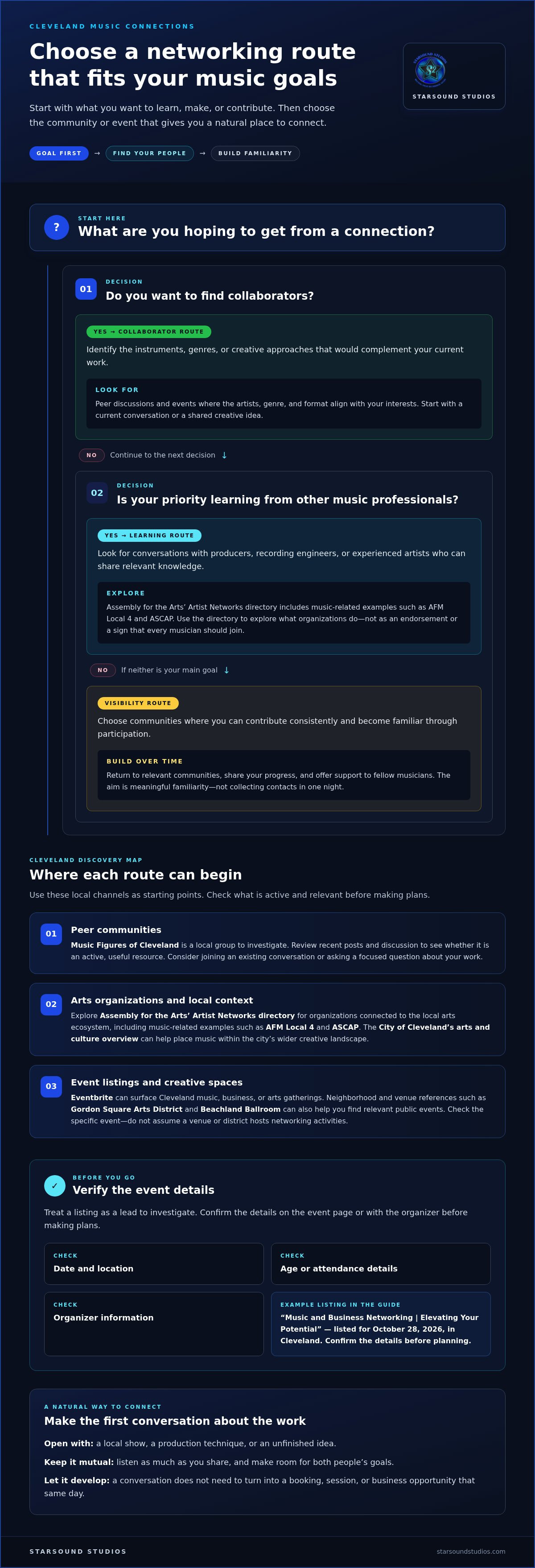
Before choosing a group, event, or organization, decide what you hope to learn or find. A clear goal makes the local music landscape feel more manageable and helps you choose where to spend your attention. Be specific about the people you’d like to meet and the kind of work you want to make together.
- To find collaborators: Identify the instruments, genres, or creative approaches that would complement your current work.
- To learn: Look for conversations with producers, engineers, or experienced artists who can share relevant knowledge.
- To build visibility: Seek communities where you can contribute consistently and become familiar through your participation.
One focused intention is enough. You’re not trying to meet everyone; you’re making it easier to recognize the conversations that could lead somewhere meaningful.
Where Cleveland musicians can find local communities, events, and contacts
There’s no single doorway into Cleveland’s music community. Start with the kind of connection you’re seeking, then explore peer groups, professional organizations, event listings, and creative spaces. Each offers a different way to encounter people: online groups can surface shared interests, while shows and arts events create opportunities to talk face to face.
Explore Cleveland music groups and artist networks
Search for local peer communities such as the Music Figures of Cleveland group, but look at recent posts and discussion before relying on it as an active resource. A group’s name alone won’t tell you whether its members are sharing useful conversations now. Introduce yourself by responding to a current discussion or asking a focused question related to your work.
Assembly for the Arts’ Artist Networks directory can help you discover organizations connected to the local arts ecosystem. It includes music-related examples such as AFM Local 4 and ASCAP. Treat the directory as a starting point for exploring what each organization does, not as an endorsement or a signal that every musician should join. The City of Cleveland’s official arts and culture overview can also help you place music within the city’s wider creative landscape.
Find events and creative spaces that fit your goals
Eventbrite is useful for discovering Cleveland gatherings. Try searches and filters for music, business, or arts events, then verify the date, location, age or attendance details, and organizer information on the event page or with the organizer before you make plans. For example, the Music and Business Networking | Elevating Your Potential event is listed for October 28, 2026, in Cleveland. An event listing is a lead to investigate, not a substitute for confirming the details.
Neighborhood showcases and established music spaces can offer natural settings to meet artists, audiences, and people involved in the scene. Gordon Square Arts District and Beachland Ballroom are locally surfaced cultural references; don’t assume every venue or district hosts networking activities. Instead, look at the specific performance or public event, and consider whether its artists, genre, and format align with your interests. Familiarity with Cleveland’s broader arts institutions can also help you recognize how music fits into the city’s cultural fabric.
Professional creative environments matter, too. A recording studio isn’t automatically a networking event, but sessions and project work can bring artists and audio professionals together around a shared result. Explore this Cleveland recording studios guide to understand the role of a studio in developing music. When a new collaboration is ready to move from an idea to a finished recording, recording and mixing at Starsound Studios can be one possible next step. Starsound Studios is in North Royalton, Cleveland, Ohio. Choose discovery channels with intention, and networking for musicians in Cleveland becomes easier to shape around real creative opportunities.
Choose the right Cleveland networking route for your music goals
Different channels serve different purposes. A peer group may help you find artists with overlapping interests, while an organization may offer professional resources or a more structured community. An event gives you a set time and place to meet people; a creative space brings people together around the work itself. None guarantees a booking, collaborator, or career result. The best first step is the one you can approach with a clear purpose and realistic commitment.
Match the channel to the connection you want
Start with the kind of interaction that suits your goal. Online groups can make it easier to follow local conversations and learn who’s working in a genre or scene. Events support face-to-face introductions and a broader sense of local activity. Organizations may be useful for professional resources, community, or advocacy. For a directory-based starting point, Assembly for the Arts lists Cleveland music organizations and resources.
| Channel | Best suited to | Interaction and time | Possible next step |
|---|---|---|---|
| Online groups | Informal discussion and finding peers with shared interests | Conversation online; participation can be occasional or ongoing | Join a relevant discussion or connect around a shared musical interest |
| Events | Meeting people in person and learning about the local scene | A scheduled gathering; time depends on the event format | Introduce yourself to someone whose work or goals interest you |
| Organizations | Exploring structured communities, professional resources, or advocacy | Engagement varies by organization and its activities | Review its purpose and decide whether it fits your current needs |
| Creative spaces | Connecting through shared project work and music-making | Usually linked to a specific project or session | Discuss a practical next step for developing the work together |
Assess whether a networking opportunity is worth your time
Before committing, look beyond a listing’s title. Check its intended audience, format, organizer, and current details. Consider whether the people involved, musical focus, and working stage relate to what you’re seeking. A broad arts gathering may suit someone exploring the scene; a focused professional organization may be more relevant to a musician looking for industry resources. In networking for musicians in Cleveland, fit matters more than volume.
Choose an opportunity that fits your goal, offers a format you’re comfortable with, and leaves a natural way to follow up. That simple test helps you avoid signing up for everything. Pick one accessible option, participate with attention, and notice whether it gives you a useful conversation or a clearer sense of your next move.
If a connection grows into a recording project, a professional studio can become one practical part of that process. Starsound Studios in North Royalton, Cleveland, works with local and remote artists on recording, mixing, and mastering. Explore recording and mixing at Starsound Studios as a potential next step when your collaboration is ready to develop its sound.
How to prepare, start conversations, and follow up with Cleveland musicians
A good conversation doesn’t require a polished pitch. It takes a little preparation, genuine curiosity, and a thoughtful next step. This repeatable process can help make networking for musicians in Cleveland feel more natural, whether you meet someone at a local gathering or connect online.
Prepare a natural introduction and conversation opener
Before reaching out, shape a brief introduction around three things: your role, what you’re working on, and one musical interest. For example: “I’m a vocalist working on indie soul tracks, and I’m looking to learn more about live arrangements.” Keep it conversational. You’re giving the other person an easy opening, not delivering a full biography.
Then ask a question that invites more than a yes-or-no answer. You might ask what local projects they’re enjoying, which influences are shaping their current work, or how they usually collaborate with other artists. Listen closely to the response and follow its thread. Don’t turn the first exchange into an immediate pitch for a booking, a session, or a favor.
Use this simple sequence to guide your next interaction:
- Before: Review the event or group, choose one goal, and prepare a short introduction and a question.
- During: Start with a shared context, ask about the other person’s work, and listen for an interest you genuinely have in common.
- After: If the conversation feels welcome, follow up with a brief, personal message that refers to something you discussed.
Follow up without making the connection feel transactional
A concise follow-up keeps the conversation alive without creating pressure. Mention where you met, recall a specific detail, and offer a natural next step only if it fits. For instance: “It was great talking with you at the showcase. I liked hearing about your project’s layered vocal approach. Here’s the track I mentioned, in case you’re curious.” Share a link, demo, or resource because it relates to the conversation, not simply to promote yourself.
Keep a private note of the person’s name, their musical interests, and anything you agreed to do. That small habit helps you follow through accurately and remember context later. If they don’t respond, give them space; a follow-up is an invitation, not an obligation.
In-person events aren’t the only way to begin. If you can’t attend, make a considered online introduction through a relevant music group or professional profile. Refer to a specific post or project, say why it caught your attention, and ask one focused question. Avoid sending the same generic message to several people. A specific, respectful note gives the recipient something real to respond to.
If a promising connection develops into a recording project, a collaborative studio environment can help bring the work into focus. Explore recording and mixing at Starsound Studios as a next step for developing your music with professional audio support.
Turn Cleveland music connections into lasting creative relationships
A promising introduction is a beginning, not a finished relationship. Familiarity grows through small, genuine interactions over time: showing up again, remembering what someone is working on, and offering support without keeping score. There’s no need to join every group or attend every event. Choose a few communities that fit your music and make participation sustainable.
Build a sustainable networking rhythm
Set a simple cadence you can maintain, such as checking a relevant online community once a week and attending a suitable gathering when your schedule allows. Consistency matters more than intensity. Share a useful resource, respond thoughtfully to a peer’s update, or congratulate someone on a release or performance. These gestures help turn a username or brief introduction into a familiar creative presence.
- Share progress on a project, even when it’s a small milestone or a question you’re working through.
- Attend a community or gathering again when its people and focus feel relevant to your goals.
- Offer practical help, such as feedback you’re qualified to give or an introduction that makes sense for both people.
- Follow through on what you say you’ll do, and make room for others to respond in their own time.
Repeated interaction can make future conversations about collaboration feel more natural. You may learn how someone approaches songwriting, production, performance, or project planning before deciding whether your working styles align. That familiarity can open the door to exploring an idea together, but it doesn’t guarantee a partnership, booking, or career outcome. Let the creative fit develop at its own pace.
Bring a promising musical project into a professional studio
When a song or collaboration is ready for focused development, studio work can give the project a dedicated environment and experienced technical support. Starsound Studios in North Royalton, Cleveland, offers recording, stereo mixing, mastering, and audio engineering classes. It is the first and only Dolby-certified Atmos mixing studio in Ohio. For more context on audio work and professional paths, explore this Cleveland sound engineer and career guide.
For musicians practicing networking for musicians in Cleveland, the lasting value is the creative community built through steady, reciprocal participation. Keep sharing, learning, and making room for collaboration. If you’re ready to develop a project with professional recording or audio support, explore Starsound Studios.
Let your next creative idea take shape
The most valuable next step may be giving a promising idea room to grow. A conversation with a new collaborator can become a writing session, a shared demo, or a fresh direction for a track. Let the work guide what comes next, and keep making space for the people and perspectives that bring out its strongest qualities.
When you’re ready to move a project into a professional recording environment, Starsound Studios in North Royalton, Cleveland, Ohio, brings an artist-centered approach to recording, mixing, and mastering. The studio is the first and only Dolby-certified Atmos mixing studio in Ohio and has an Emmy Award win.
Networking for musicians in Cleveland is less about forcing an outcome than staying open to what a genuine creative connection might make possible. Take one idea, one conversation, or one unfinished track and give it a next step. Explore Starsound Studios when you’re ready to develop your project with professional audio support.
Frequently Asked Questions
How can musicians in Cleveland find networking events?
Use event listings such as Eventbrite, local arts directories, and Cleveland music community groups to discover possible gatherings. Before making plans, check the current date, organizer, intended audience, and format on the event’s own page or through its organizer. Listings can change, and an event that suits a producer may not fit a songwriter seeking peer feedback. Judge each option against your current musical goals.
Where can Cleveland musicians meet collaborators outside formal networking events?
Local artist communities, collaborative projects, showcases, and music-related spaces can create room for easy conversation without a formal networking agenda. Gordon Square Arts District and Beachland Ballroom are locally surfaced cultural examples, not guaranteed networking events. Check current programming before visiting, then let the setting guide your approach: ask an artist about a performance or a project you genuinely enjoyed, rather than opening with a request to work together.
Is joining a musicians’ organization useful for an independent artist?
It can be useful if an organization’s focus matches your needs and the level of participation you want. Assembly for the Arts’ directory offers a way to explore options, including listings for AFM Local 4 and ASCAP. Before deciding, review each organization’s current purpose, membership details, and relevance to your work as an independent artist. Joining may provide a community or resource, but it doesn’t guarantee work or career growth.
Can online networking lead to in-person music collaborations in Cleveland?
Yes. An online group or direct message can help Cleveland musicians discover common interests before deciding whether to meet. Start with a specific shared point, such as a genre, instrument, or production approach, and exchange relevant work only when it adds context. If both people are comfortable, suggest a clear next step, such as discussing a song idea in person. Treat online contact as an introduction, not a promise of collaboration.
What should I say when introducing myself to another musician?
Keep it simple: name your musical role, mention what you’re working on, then ask an open question that fits the setting. For example, “I play keys and I’m developing a set of instrumental tracks. What kind of projects are you enjoying lately?” The other person has an easy way to respond. Listen to their answer, adapt your follow-up, and resist turning the introduction into a sales pitch.
How soon should I follow up after meeting a musician?
Follow up while the conversation is still easy to recall, but there’s no universal deadline. A short note can mention where you met and bring up a detail you both discussed, such as a local artist or recording approach. If you suggest another conversation, keep the invitation easy to accept or decline. If they don’t reply, leave the door open without sending repeated messages or treating silence as a commitment.
What information should I include in a follow-up message to a potential collaborator?
Make the message brief and specific: remind them where you met, refer to one part of your conversation, and include a relevant link or idea only if it helps. If you’re proposing a collaboration, state a manageable next step, such as exchanging a rough demo or talking through an arrangement. Leave room for them to say no or respond later. Skip large attachments and multiple unsolicited pitches; one clear note is enough.


