

The loudest track in the playlist isn't necessarily the one with the highest peak; it's the one that commands the most physical space through psychoacoustic depth. You've spent weeks perfecting your mix, yet it still sounds thin on a smartphone or loses its life the moment you try to match commercial volume levels. This frustration is common, especially as the industry shifts toward immersive formats. Mastering for Dolby Atmos requires a different mindset than traditional stereo, shifting the focus from sheer pressure to an expansive, three dimensional energy that translates across every listening environment. In 2026, achieving professional loudness is no longer about winning a war, but about mastering the science of perception.
It's exhausting to watch your transients disappear as you chase a competitive edge, and we understand that delicate balance between technical precision and artistic soul. You deserve a master that feels powerful and expensive without sacrificing the punch that makes your listeners move. This guide will teach you how to navigate 2026 LUFS standards, from the -14 LUFS stereo sweet spot to the -18 LUFS immersive requirements. We'll demystify True Peak ceilings and explain why hitting these targets is essential for modern streaming. By the end, you'll know exactly how to achieve that elusive clarity and when to bring your vision to a professional sanctuary like Starsound Studios to ensure your sound truly resonates.
Key Takeaways
- Understand the shift from the "loudness wars" to 2026 normalization standards, ensuring your tracks hit the -14 LUFS target for stereo streaming without losing their emotional punch.
- Discover how mastering for Dolby Atmos requires a specialized -18 LUFS approach to create an expansive, three-dimensional sonic experience that translates across all immersive platforms.
- Learn the critical difference between Integrated and Short-term LUFS to maintain consistent energy throughout your track while protecting your transients from aggressive limiting.
- Master the art of mix preparation by managing low-end energy and headroom, providing the foundation needed for a high-impact, professional master.
- Explore how leveraging a 9.1.4 immersive suite can inform better stereo decisions, giving your music the competitive edge it needs in today's market.
Beyond the Knob: Why Volume Mastering Defines Professional Sound
Volume isn't just a number on a meter. It's the visceral sensation of air moving in a room, the way a kick drum hits your chest, and the clarity that allows a vocal to sit right in front of your face. For years, the industry was locked in The Loudness War, a technical arms race where dynamic range was sacrificed for sheer signal voltage. In 2026, the landscape has shifted. We've moved into the era of loudness normalization, where streaming platforms automatically level the playing field. Professional mastering is no longer about being the loudest; it's about being the most impactful within the established standards.
A master that translates perfectly across different systems requires a sophisticated understanding of psychoacoustics. Whether your fans are listening on high-end monitors in Cleveland or earbuds in North Royalton, the track needs to retain its emotional energy. This is especially true when mastering for Dolby Atmos, where the goal is to use three dimensional space to create a sense of power that traditional stereo limiting simply can't match. When you move beyond the volume knob, you start focusing on the texture, density, and movement of the sound.
The Difference Between Gain and Loudness
Gain is an input parameter. It's the raw signal strength you feed into a processor. Loudness, however, is the perceived intensity of that sound over time. If you simply turn up the gain on a track, you quickly run out of digital headroom, leading to harsh clipping and flat, lifeless transients. A professional mastering engineer doesn't just "turn it up." They use precise tools to increase the average energy of the track while protecting the peaks. This process creates a master that feels loud and expensive without triggering the distortion that ruins a listener's experience.
Why Home Masters Often Sound Small
The most common reason a home master sounds "small" compared to a commercial release is a lack of low-end control. Sub-frequencies carry immense energy; if they aren't managed, they trigger limiters too early, squashing the rest of the mix. At Starsound Studios, we use professional monitoring in a meticulously treated space to reveal these hidden bottlenecks. Steve The Mix identifies the frequency imbalances that eat up your headroom. By cleaning up the mud and controlling wild transients, we pave the way for a master that sounds massive. Mastering for Dolby Atmos further enhances this by distributing energy across a 9.1.4 array, ensuring every element has the room it needs to breathe and roar.
The Science of Loudness: Understanding LUFS and Peak Levels in 2026
Loudness isn't a guessing game anymore. In 2026, LUFS (Loudness Units relative to Full Scale) has solidified as the definitive way we measure audio intensity. Unlike traditional peak meters that only show the highest electrical signal, LUFS mimics how the human ear actually hears. This shift allows for a more musical approach to volume. When we talk about mastering for Dolby Atmos, these numbers become even more critical because the technical delivery requirements are much stricter than stereo. Whether we are working in our North Royalton suite or collaborating with artists online, these metrics guide every decision.
How to Read a Loudness Meter
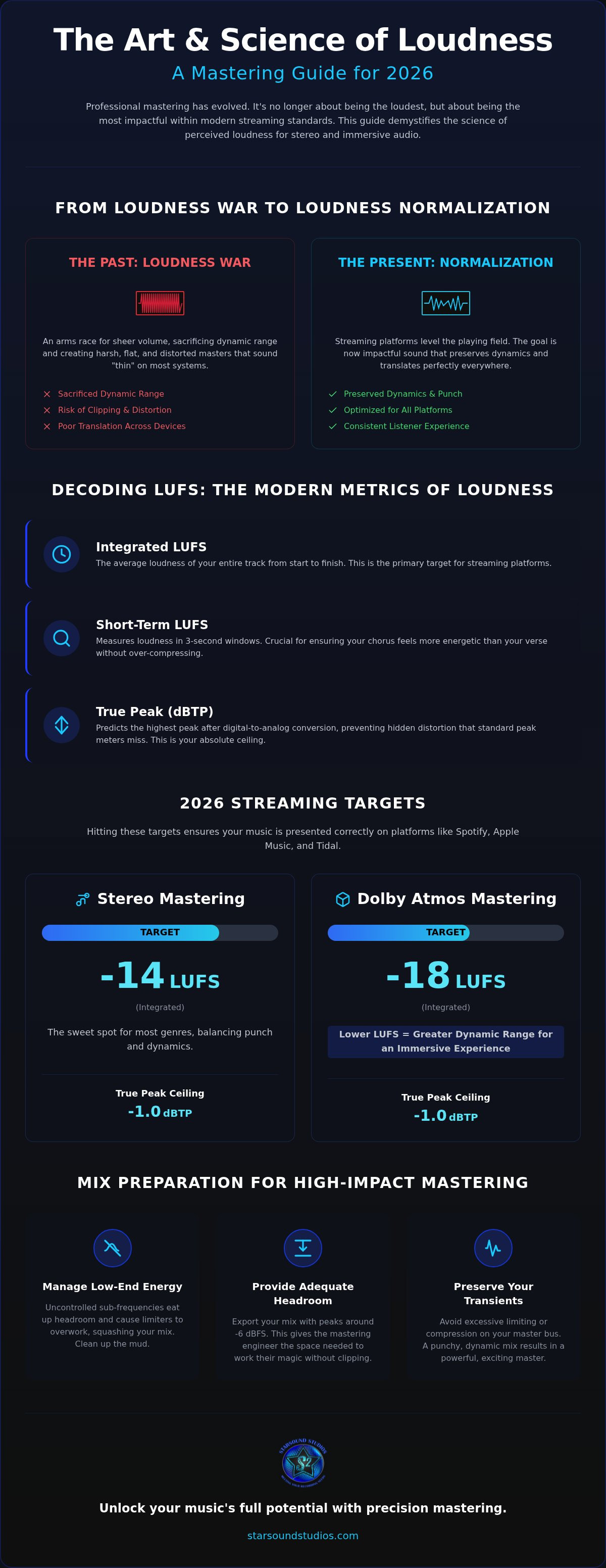
LUFS is the measurement of human perceived loudness over time. To get a professional result, you need to look at three specific metrics. Integrated LUFS gives you the average loudness of the entire track. Short-term LUFS measures three second windows, which is vital for ensuring your chorus has enough "jump" compared to the verses. Finally, the Loudness Range (LRA) tells you how much dynamic contrast exists. While -14 LUFS is the common target for stereo streaming in 2026, it's a guideline. Some genres thrive at -12, while others need the breath of -16.
Peak vs. True Peak: The Hidden Distortion
Your digital meter might show you're safe at -0.1 dB, but it's likely lying. Standard peak meters only measure the samples themselves. When that digital signal is converted back to analog or compressed into an Ogg Vorbis or AAC file for streaming, the "inter-sample" peaks can fly well above zero. This creates a gritty, digital distortion that tires the listener's ears. True Peak (dBTP) meters calculate these hidden peaks to prevent this. For 2026 distribution, a ceiling of -1.0 dBTP is the industry standard to ensure your music stays clean after encoding.
This level of precision is exactly why understanding the technical nuances of Mixing for Dolby Atmos is essential before the mastering stage. If you're unsure if your True Peaks are under control, our remote mastering team can provide a technical audit to ensure your tracks are streaming-ready. Dynamic Range (DR) scores also play a massive role in perceived power. A track with a higher DR score often feels "louder" and more exciting because the transients are intact. Mastering for Dolby Atmos encourages this dynamic preservation, as the -18 LUFS target for immersive audio allows for incredible detail and punch that traditional "hot" masters often destroy.
Streaming Standards in 2026: Navigating Spotify, Apple, and Beyond
Loudness normalization has fundamentally changed the creative game. It's no longer a race to 0 dBFS. In 2026, streaming platforms act as the ultimate gatekeepers, ensuring listeners don't have to reach for their volume knob between tracks. If your master is too loud, the algorithm simply turns it down. If it's too quiet, the platform might turn it up, potentially introducing unwanted limiting artifacts. Understanding these digital targets is the only way to ensure your artistic vision remains intact from our North Royalton studio to the listener's earbuds.
The trap many creators fall into is chasing a specific number without considering the genre or the format. While hitting a target is important, the density and saturation of the track determine its perceived power. A track can hit -14 LUFS and still sound "wimpy" if the transients are too wild or the frequency balance is skewed. Conversely, a track with too much limiting will sound flat and exhausted once the platform levels it. Finding the balance between technical compliance and emotional impact is the hallmark of a professional master.
Platform-Specific Loudness Targets
As of September 2026, the digital landscape follows a clear set of regulations. Spotify, Tidal, Amazon Music, and YouTube Music all target an integrated loudness of -14 LUFS. Apple Music remains the outlier with its Sound Check feature targeting -16 LUFS. However, mastering for Dolby Atmos requires a much more conservative and strict approach. The industry standard for immersive distribution is -18 LUFS. This lower target isn't a limitation; it's an invitation for incredible dynamic range. While broadcast media often requires specific gated measurements, these streaming numbers are your primary North Star for commercial releases.
The Penalty of Over-Compression
Many artists still believe that pushing a master to -6 or -7 LUFS will make it stand out in a playlist. In the current era, this actually has the opposite effect. When a platform turns that track down by 7 or 8 dB to hit the -14 LUFS target, it loses its competitive edge. The result is a song that sounds small and squashed compared to a track mastered at -11 LUFS with preserved transients. You lose the "air" around the vocals and the "snap" of the snare. At Starsound Studios, we guide Cleveland artists to find the sweet spot for their specific sound.
- EDM and Hip-Hop: Often benefit from a denser master (-10 to -12 LUFS) to maintain energy in clubs.
- Folk and Jazz: Thrive with more breath (-15 to -16 LUFS), allowing natural timbres to shine.
- Immersive Audio: Mastering for Dolby Atmos at the required -18 LUFS ensures your spatial mix has the headroom to feel truly massive.
Steve The Mix works to ensure that your track doesn't just meet a technical requirement but dominates the speakers with clarity and purpose. Whether you're aiming for a heavy-hitting club track or a delicate acoustic performance, we calibrate your sound for the 2026 streaming environment with absolute precision.
Preparing Your Mix for High-Impact Mastering
Mastering isn't a rescue mission. It's the final elevation of a creative vision. A common mistake is believing a mastering engineer can "fix" a cluttered mix by simply adding volume. In reality, pushing a congested mix into a limiter only magnifies its flaws. To achieve that polished, commercial impact, your mix must be balanced and dynamic before it leaves your workstation. This preparation is even more critical when mastering for Dolby Atmos, as the immersive field exposes every frequency overlap with surgical clarity.
Clearing the Mud: Low-End Management
Low frequencies are the primary consumers of digital headroom. If your sub-bass is uncontrolled, it will trigger the mastering limiter long before the rest of your mix reaches a competitive level. High-passing non-bass instruments is a simple but transformative step. By removing the low-end rumble from vocals, guitars, and hi-hats, you reclaim space for the elements that actually need it. 1dB of unnecessary low-end can rob 3dB of perceived high-end volume. Additionally, ensure your kick and bass are phase-aligned and utilize subtle sidechaining to prevent them from fighting for the same frequency pocket. This foundation allows for a master that feels massive and stable.
Headroom and Delivery Specs
Technical precision in your export is non-negotiable. We ask artists to provide files with at least -6dB of peak headroom. This gap allows Steve The Mix to apply the necessary analog and digital processing without hitting a digital ceiling. It's also vital to remove any limiters or heavy clippers from your master fader before bouncing. If you've already "baked in" the compression, there's very little room for us to optimize the track's energy. Think of the mix as the raw material; we need the flexibility to shape it into a finished diamond.
When exporting, stick to high-resolution formats. We recommend providing an audio format aiff or WAV file at the project's native sample rate and 24-bit depth. Avoid lossy formats like MP3 at all costs during this stage. Whether you are using our full mixing and mastering services or sending a finished mix from your home setup in Cleveland, these specs ensure we have the highest quality data to work with. Ready to hear your music's full potential? Reach out to Starsound Studios today for professional mastering that brings your creative vision to life.
Precision Volume Mastering in Cleveland: The Starsound Advantage
Starsound Studios stands as a beacon for artists who refuse to settle for generic sound. Located in North Royalton, we provide a sophisticated environment where technical details are handled with absolute precision, allowing you to focus entirely on your creative vision. Steve The Mix leads our facility with a philosophy centered on collaborative mentorship. He doesn't just apply a standard limiter chain; he listens to the intention behind your work. This high-attention approach ensures that every project leaving our Cleveland facility possesses a world-class polish that stands up to any major label release.
We utilize a hybrid workflow that captures the rich, harmonic warmth of high-end analog hardware while maintaining the microscopic precision of modern digital tools. This balance is crucial for hitting the competitive targets of 2026 without sacrificing the soul of the music. Whether you're working on a gritty underground hip-hop track or a polished pop anthem, our process is designed to highlight the unique identity of your sound. We don't just aim for volume; we aim for impact.
Mastering for Dolby Atmos and Immersive Audio
Our facility is the first and only Dolby Atmos studio Cleveland creators can access for true 9.1.4 monitoring. This certified environment is a game changer for critical volume decisions. When mastering for Dolby Atmos, we use the expansive soundstage to inform even our stereo mastering choices. By understanding how a track translates in a three dimensional space, we can better manage frequency density in a stereo mix. This results in a master that sounds huge in a car, retains its punch on club systems, and offers incredible detail on headphones. Mastering for Dolby Atmos at the required -18 LUFS standard ensures your music has the headroom to feel truly immersive and powerful.
Collaborative Mentorship: Your Sound, Our Science
We believe that every artist deserves more than a one-size-fits-all AI mastering algorithm. Those sterile tools can't understand the spirit of a song or the specific energy of a vocal performance. At Starsound Studios, we provide personalized feedback on your mix before the mastering process begins. If we notice a frequency bottleneck or a phase issue that might rob your track of its power, we'll let you know. This collaborative process ensures the best possible final result. Whether you're a local artist in Cleveland or utilizing our remote mastering services from across the globe, you receive the same elite level of care. Ready to elevate your sound? Start by Booking your session at Starsound Studios and experience the difference that professional, human-led mastering makes for your career.
Claim Your Space in the 2026 Sonic Landscape
Professional volume in 2026 is no longer about winning a loudness war; it's about mastering the art of impact and clarity. You've learned how managing low-end energy and protecting True Peak ceilings can transform a small mix into a massive, commercial master. Whether you're targeting the -14 LUFS stereo standard or diving into the expansive world of mastering for Dolby Atmos, technical precision is the bridge between your vision and the listener's emotion. Your music deserves to be heard with the same intensity and depth you felt when creating it.
At Starsound Studios, we combine the warmth of elite analog hardware with the surgical accuracy of digital processing. As Ohio's only Dolby-certified 9.1.4 Atmos facility, we offer a specialized sanctuary where Steve The Mix brings over a decade of expertise to every session. We don't just process audio; we mentor artists to ensure their work translates perfectly from North Royalton to the global stage. Ready to give your music the professional volume it deserves? Book Starsound Studios today. We're excited to help you realize the full potential of your sound and push your creative boundaries further than ever before.
Frequently Asked Questions
What is the best LUFS level for mastering in 2026?
The ideal LUFS level in 2026 depends entirely on your distribution format and genre. For standard stereo streaming on platforms like Spotify or Tidal, targeting -14 LUFS integrated is the baseline guideline. However, mastering for Dolby Atmos requires a stricter target of -18 LUFS to meet industry delivery specifications. At Starsound Studios in North Royalton, we help Cleveland artists balance these technical requirements to ensure their music sounds competitive regardless of the playback system.
Will Spotify turn my song down if it is too loud?
Yes, Spotify uses loudness normalization to ensure a consistent listening experience across its entire library. If your master is significantly louder than -14 LUFS, the platform's algorithm will automatically turn the volume down. This can often make a heavily limited track sound small or dull compared to more dynamic songs. It's better to preserve your transients during the mastering stage so your track retains its punch even after the platform adjusts the gain.
What is the difference between peak volume and perceived loudness?
Peak volume measures the absolute highest electrical signal level in your audio file, while perceived loudness (LUFS) measures how the human ear actually hears the intensity. You can have a track with very high peaks that still sounds quiet if the average energy is low. Professional mastering focuses on increasing the average density of the sound without hitting the digital ceiling. This creates a master that feels powerful and expensive rather than just technically loud.
Can I master my own music for volume at home?
You can attempt to master your music at home, but the primary bottleneck is usually your monitoring environment. Without a professionally treated room and high-end monitors, it's difficult to hear the low-end mud or phase issues that rob your track of volume. Our 9.1.4 suite in Cleveland provides the surgical accuracy needed for critical decisions. Many artists find that our remote mastering services offer a superior result by providing a second set of expert ears.
Why does my song sound quiet on Apple Music but loud on YouTube?
This discrepancy occurs because Apple Music and YouTube use different loudness normalization targets. Apple Music’s Sound Check typically aims for -16 LUFS, which is quieter than YouTube’s -14 LUFS target. If your song was mastered very hot, it might suffer more gain reduction on Apple Music, making it feel less impactful. Mastering for Dolby Atmos helps mitigate these issues because the -18 LUFS standard is more consistent across platforms that support immersive audio.
Does volume mastering affect the quality of my audio?
Volume mastering definitely affects audio quality if you push the signal too far into a limiter or clipper. While increasing loudness can add excitement and glue, over-compression destroys the transients that give your music its life and rhythm. The goal of a professional engineer like Steve The Mix is to find the sweet spot where the track feels commercially competitive while maintaining the sonic integrity and emotional breath of the original performance.
What is True Peak and why should I care about it?
True Peak refers to the actual peak level of an analog signal after it's converted from digital samples. Standard meters often miss inter-sample peaks that can cause distortion during streaming playback. In 2026, targeting a True Peak of -1.0 dBTP is essential for clean distribution. This safety margin ensures that when your file is compressed into Ogg Vorbis or AAC formats, the audio doesn't clip and introduce grittiness to your listener's experience.
How much headroom should I leave for a mastering engineer?
You should aim to provide your mastering engineer with at least -6 dB of peak headroom. This space is vital because it gives us the room to apply analog EQ and compression without hitting the digital ceiling. When you send files to our North Royalton facility, ensure you've removed any limiters from your master fader. This allows us to use our hybrid workflow to build volume properly, resulting in a much more polished and professional final product.


