
A Dolby Atmos "mix" done entirely on headphones isn't a Dolby Atmos mix. It's a simulation, and the difference shows up the moment a listener presses play on Apple Music or Tidal through a proper speaker array. This is the quiet truth that separates genuinely transformative online dolby atmos mixing services from the growing wave of bedroom engineers offering immersive audio in name only.
You already sense something is off. You've heard the format's potential on other artists' releases, that sensation of sound existing in three-dimensional space rather than sitting flat between two ears, and you want that for your music. The hesitation is legitimate: how do you know whether a remote engineer is working in a certified room or just running a plugin and calling it spatial audio?
This guide cuts through that confusion. You'll learn exactly what a professional Atmos workflow requires, how to prepare your stems for a true 9.1.4 mix, and what a certified ADM master file actually means for your streaming delivery. By the end, you'll know precisely what to look for, what to ask, and how to get a world-class immersive mix without stepping foot in a studio.
Key Takeaways
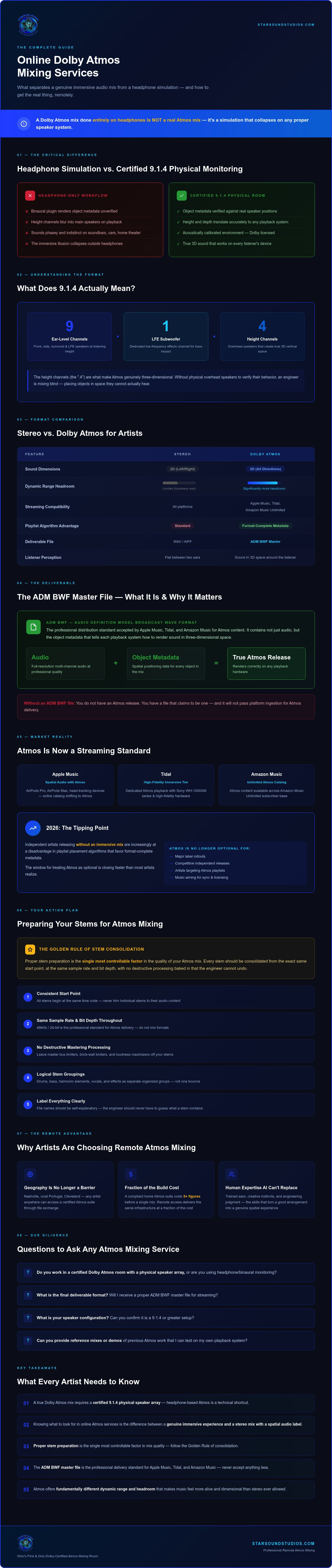
- A true Dolby Atmos mix requires a certified 9.1.4 physical speaker array — headphone-based "Atmos" workflows are a technical shortcut that compromises the final result on real speaker systems.
- Knowing what to look for in online dolby atmos mixing services is the difference between a genuine immersive audio experience and a stereo mix dressed up with a spatial audio label.
- Proper stem preparation is the single most controllable factor in the quality of your Atmos mix — and there is a specific "Golden Rule" of consolidation that every artist should follow before submitting files.
- The ADM master file is the professional delivery standard for streaming platforms like Apple Music and Tidal, and understanding what it is ensures you never accept a substandard deliverable.
- Atmos isn't just a format upgrade — it offers fundamentally different dynamic range and headroom characteristics that can make your music feel more alive and dimensional than stereo ever allowed.
What are Online Dolby Atmos Mixing Services?
At their core, online dolby atmos mixing services are professional immersive audio post-production workflows delivered entirely through remote file exchange. You upload your stems, a certified engineer works inside a purpose-built immersive monitoring environment, and you receive a finished ADM master file ready for streaming distribution. No travel. No studio booking fees. No geographic compromise on quality.
What makes this distinct from standard remote mixing is the technical infrastructure required on the engineer's end. Object-based 3D audio isn't a plugin setting or a headphone simulation. It demands a physical speaker array, Dolby certification, and an acoustic environment calibrated to exacting standards. The "online" part describes the client workflow. The mixing itself happens in a real room.
The Evolution of Immersive Audio
Immersive audio has traveled a long road from cinema surround sound to the earbuds in your pocket. What was once a theatrical experience reserved for blockbuster releases is now a consumer expectation. Apple Music introduced Spatial Audio with Dolby Atmos support across its catalog, and Tidal followed with its own high-fidelity immersive tier. Amazon Music Unlimited carries Atmos content as well. Together, these platforms have quietly shifted listener expectations, particularly among subscribers using AirPods Pro, Sony WH-1000XM series headphones, the Bose QuietComfort Ultra South Africa from SoundXcel, and other devices with head-tracking capability. The format that once required a dedicated home theater now renders dynamically on hardware most listeners already own.
Why 2026 Is the Tipping Point
The streaming landscape has reached a critical mass. Atmos-formatted releases are no longer a novelty reserved for major label rollouts. Independent artists releasing without an immersive mix are increasingly at a disadvantage in playlist placement algorithms that favor format-complete metadata. The window for treating Atmos as optional is closing faster than most artists realize.
Why Artists Are Choosing Remote Mixing
Geography used to determine access. If you weren't near a major market, a world-class immersive suite simply wasn't available to you. Remote workflows have dismantled that barrier entirely. A producer in Nashville, a singer-songwriter in rural Portugal, or a hip-hop artist in Cleveland can all access the same certified 9.1.4 monitoring environment through a well-structured file exchange process.
The financial case is equally compelling. Building a compliant home Atmos suite, calibrated speakers, acoustic treatment, and Dolby licensing, runs well into five figures before a single mix is attempted. Remote access to a facility like Starsound Studios, Ohio's first and only Dolby-certified Atmos mixing room, delivers that infrastructure at a fraction of the cost. And critically, it delivers the human expertise that no AI mixing tool currently replicates: the trained ears, the creative instincts, and the engineering judgment that transform a good arrangement into a genuinely spatial experience.
The deliverable at the end of this process is an ADM BWF file, an Audio Definition Model Broadcast Wave Format master. This is the distribution standard accepted by Apple Music, Tidal, and Amazon Music for Atmos content. It contains not just the audio but the object metadata that tells each playback system how to render sound in three-dimensional space. Without it, you don't have an Atmos release. You have a file that claims to be one.
The Advantage of Certified 9.1.4 Physical Monitoring
Here's the trap that catches artists every time. An engineer opens a binaural rendering plugin, puts on a pair of headphones, and starts placing objects in three-dimensional space. It sounds impressive through those headphones. It might even sound genuinely spatial. But the moment that mix plays back through a soundbar, a car's overhead speakers, or a proper home theater array, the illusion collapses. Object metadata that was never verified against physical speaker positions renders unpredictably. The depth evaporates. The height channels blur into the mains. What felt immersive on headphones sounds phasey and indistinct everywhere else.
This isn't a minor technical quibble. It's the central flaw in a significant portion of what currently gets labeled as Atmos content. Binaural monitoring is a useful reference tool, not a substitute for the real thing.
A 9.1.4 configuration changes everything about how an engineer makes decisions. The numbers describe a physical reality: nine channels at ear level, one dedicated low-frequency element, and four overhead speakers positioned above the listening position. Sound objects exist in actual space. A mix decision about a vocal floating above the listener isn't a guess or a simulation; it's a verifiable physical placement that the engineer can hear, adjust, and confirm against a calibrated acoustic environment. That precision is what makes the difference between an immersive mix that translates and one that doesn't.
Translation: Will It Sound Good Everywhere?
Dolby certification isn't a marketing badge. It means the room has been measured, tuned, and verified to render Atmos content within Dolby's exacting tolerances. Every speaker position, every reflection point, every frequency response curve has been assessed. When a mix sounds right in a certified room, it's because the monitoring environment accurately represents how the format will behave on consumer playback systems, from a Samsung soundbar to AirPods Pro with head-tracking to a full Atmos home theater. That's the translation guarantee that headphone-only workflows simply cannot provide. Phasey, undefined stereo images in amateur immersive mixes almost always trace back to unverified object placement. In a calibrated 9.1.4 room, those problems surface immediately and get fixed before the master leaves the building.
Starsound's Immersive Suite in Cleveland
Starsound Studios holds a distinction that matters: it's Ohio's first and only Dolby-certified Atmos mixing facility. The 9.1.4 suite isn't an approximation or a work-in-progress setup. It's a purpose-built immersive environment where high-end analog sensibilities meet the precision demands of object-based audio. Steve "The Mix" brings decades of engineering authority to every session, and his remote workflow is built around genuine collaboration, detailed revision cycles, and a creative investment in your project that goes well beyond file delivery.
For artists researching online dolby atmos mixing services, the physical infrastructure behind the engineer is the question that separates world-class results from well-intentioned shortcuts. Explore what a certified immersive session with Starsound looks like before you commit your stems to any workflow.
Stereo vs. Dolby Atmos: A Comparison for Artists
Stereo is a wall. Two speakers, a phantom center, and a left-to-right image that listeners have accepted as the default for decades. Atmos is a sphere. Sound exists above, behind, beside, and below the listener simultaneously, rendered dynamically based on the playback device in the room. That isn't a metaphor. It's a structural difference in how audio occupies space, and it changes everything about how a listener relates to your music.
Stereo compresses your arrangement into a flat plane. Every element, kick drum, reverb tail, atmospheric pad, competes for position along that same horizontal axis. Atmos dissolves that constraint entirely. Height channels open up real estate that stereo simply doesn't have. The practical result is more musical breathing room: elements that would otherwise clash in a dense stereo mix can coexist cleanly when they occupy genuinely different spatial positions. Your low end hits harder because it isn't fighting your midrange for the same two-dimensional space. Your vocals feel more present because they're not buried in a wall of competing information.
The listener experience shifts fundamentally as well. Stereo is largely passive. Atmos is active. When sound moves through a three-dimensional field, the brain engages differently, tracking spatial cues, following movement, orienting itself within the sonic environment. That neurological engagement translates directly into longer listening sessions and stronger emotional connection to the material. Listeners don't just hear the song; they inhabit it.
Technical Breakdown: Beds and Objects
Every Atmos mix is built on two structural elements. Beds are the foundational audio layer, a fixed surround format that carries ambient elements, reverbs, and the broad sonic landscape of the mix. Think of them as the room the music lives in. Objects are individual audio elements with their own spatial metadata, up to 128 tracks capable of independent movement through three-dimensional space. A lead vocal can sit precisely above and in front of the listener. A synth sweep can arc from the rear left overhead to the front right floor channel. The metadata embedded in the ADM master file tells each playback system, whether it's a soundbar, a home theater array, or AirPods Pro, exactly how to render those positions in the listener's specific environment. The mix adapts to the room rather than forcing the room to adapt to the mix.
The ROI of Atmos for Independent Artists
Editorial teams at Apple Music and Tidal actively curate Spatial Audio playlists, and Atmos-formatted tracks carry format-complete metadata that algorithmic systems recognize. Releasing without an immersive mix means competing for the same playlist real estate with fewer qualifying signals. Beyond discovery, the immersive storytelling that a genuine Atmos mix enables keeps listeners engaged through full plays rather than skips, which feeds streaming algorithms that reward retention. The Spatial Audio badge on your Apple Music profile isn't cosmetic. It signals professional-grade production to listeners who've already decided that format quality matters to them.
For independent artists evaluating online dolby atmos mixing services, the ROI calculation is straightforward: one properly executed Atmos master, built in a certified 9.1.4 environment, future-proofs your catalog for every immersive playback technology that follows. The format isn't going backward. The artists who commit now build the catalog depth that compounds in value as consumer hardware continues to catch up.
Preparing Your Tracks for Online Atmos Mixing
The quality of your Atmos mix is decided long before the engineer loads your first file. What you send determines what's possible. A certified 9.1.4 room and decades of engineering expertise can only work with what they're given, and the gap between a transformative immersive mix and a frustrating revision cycle almost always traces back to stem preparation. Get this right, and the creative work can begin immediately. Get it wrong, and you're paying for problem-solving instead of artistry.
Start by locking your stereo mix vision. Before a single stem gets exported, you need clarity on what the song is doing emotionally and spatially. Which elements carry the listener? Where does the energy live? What's the centerpiece? Atmos doesn't reinvent your arrangement; it expands it. An engineer working in three-dimensional space needs to understand your two-dimensional intent first. A reference mix, even a rough one, is non-negotiable. It communicates what your ears decided before the spatial work begins.
Then comes the Golden Rule of Atmos stem preparation: one stem, one purpose. Never consolidate elements that need independent spatial treatment into a single file. A lead vocal and a backing vocal bounced together can't be separated in three-dimensional space. A kick drum buried inside a full drum bus can't be placed independently in the low-frequency field. Each element that deserves its own position in the immersive field needs its own stem. That's the structural decision that unlocks everything the format can actually do.
Stem Preparation Checklist
Precision here prevents costly back-and-forth. Export stems according to these standards before submitting to any professional online dolby atmos mixing services:
- Sample rate: 48kHz is the Atmos standard. Not 44.1kHz. Convert before you export, not after.
- Bit depth: 24-bit minimum. 32-bit float if your DAW supports it cleanly.
- Dry vs. wet stems: Send both. Dry stems give the engineer full control over spatial reverb and effects processing. Wet stems communicate your creative intent. When in doubt, include a clearly labeled version of each.
- Time alignment: Every stem starts at bar one, beat one, regardless of when the element enters the song. No exceptions. Misaligned stems create sync errors that waste session time.
- Grouping and labeling: Organize files into clearly named folders: Vocals (Lead, Harmony, Ad-libs), Percussion (Kick, Snare, Hi-Hat, Overhead, Room), Synths and Keys, Bass, Guitars, FX and Atmospheres. Ambiguity in labeling costs everyone time.
- Headroom: Stems should peak no higher than -6dBFS. Give the engineer dynamic range to work with.
The Remote Feedback Loop
Working with online dolby atmos mixing services remotely doesn't mean losing creative control. It means learning a new communication vocabulary. When you receive a binaural render for review, listen on the best headphones available to you, ideally with spatial audio enabled on your device. Note your feedback in spatial terms: "the synth pad feels like it's in front of me but I want it behind me," or "the vocal reverb tail should float higher." That kind of directional language translates directly into object metadata adjustments. Vague feedback like "make it bigger" doesn't.
The revision cycle is where the collaboration deepens. A good engineer welcomes specific spatial direction because it produces a better result faster. Once the mix reflects your vision, you'll receive the final ADM BWF master file, the deliverable that carries your music's full three-dimensional metadata to every streaming platform that supports it.
Ready to submit your stems to a room that can actually do them justice? Start your remote Atmos session with Starsound Studios and bring your immersive vision into a certified 9.1.4 environment.
Book Your Certified Atmos Mix with Starsound Studios
Everything covered in this guide points toward a single practical conclusion: the engineer and the room behind them are the deciding factors in whether your Atmos release lands or falls flat. Starsound Studios exists at that intersection of certified infrastructure and genuine creative investment. Ohio's first and only Dolby-certified Atmos facility isn't a credential on a website. It's the physical reality that makes the difference audible.
Steve "The Mix" brings decades of engineering authority to every remote project, but what separates the Starsound experience from a transactional file exchange is the collaborative mentor approach. Your stems don't disappear into a black box and come back with a master attached. The process is a conversation. Your creative intent shapes every spatial decision, and the revision cycle is built around getting your vision right, not just getting the session done. You're not a client handing off a deliverable. You're a collaborator working with someone equally invested in the result.
Pricing is transparent and flat-rate across Atmos mixing and mastering services. No surprise fees for additional revisions. No ambiguity about what you're receiving. You'll know exactly what the engagement covers before a single stem gets uploaded, which means your energy stays on the creative work rather than the contract.
From Cleveland to the World
Geography is irrelevant to the quality of what Starsound delivers. Local Ohio talent and international artists receive the same precision, the same certified monitoring environment, and the same exacting standards on every project. The remote workflow is purpose-built for global collaboration, and the peace of mind that comes with a Dolby-certified facility travels with every ADM master file that leaves the building. When your release carries the Spatial Audio badge on Apple Music or Tidal, it's backed by infrastructure that actually earned it. This is your invitation to join the growing roster of Atmos-ready artists whose catalogs are built for every immersive playback technology that follows.
Ready to Hear the Difference?
The gap between knowing what professional online dolby atmos mixing services require and actually experiencing them closes with one conversation. Reach out to Starsound for a quote on your upcoming project, explore the portfolio of immersive and stereo productions that define the studio's range, and hear what a certified 9.1.4 environment does to music you thought you already knew. Your stems deserve a room that can honor them. Elevate your sound with Starsound Studios' Atmos services and find out what your music sounds like when it finally has room to breathe.
Your Music Deserves More Than Two Dimensions
The format has matured. The infrastructure exists. The only remaining variable is whether your catalog gets built for the world listeners are already living in, or the one they've moved on from.
This guide covered the essentials: why physical 9.1.4 monitoring is non-negotiable, how proper stem preparation shapes every spatial decision downstream, and what separates a genuine ADM master from a labeled imitation. Those aren't abstract principles. They're the practical difference between online dolby atmos mixing services that deliver and ones that disappoint.
Starsound Studios brings all three pillars together in one place: Ohio's only Dolby-certified facility, a remote workflow built for global artists, and Steve "The Mix" guiding every session with decades of engineering authority and genuine creative investment in your project.
Your stems are ready. The room is certified. The only thing left is the work itself. Transform your music with Ohio's only certified Dolby Atmos studio and hear what your sound was always capable of becoming.
Frequently Asked Questions About Online Dolby Atmos Mixing Services
How Much Do Online Dolby Atmos Mixing Services Cost in 2026?
Pricing varies considerably depending on the engineer's credentials, the monitoring environment behind them, and the complexity of your project. A bedroom engineer running binaural plugins will charge far less than a certified facility operating a genuine 9.1.4 suite, and that price gap reflects a real difference in what you're receiving. Starsound Studios offers flat-rate, transparent pricing across its Atmos mixing and mastering services, so contact them directly for a project-specific quote rather than budgeting against industry averages that don't account for certification level.
What's worth factoring into any cost comparison is the total value equation. A mix built in a certified room produces an ADM master that translates accurately across every playback system. A cheaper mix that renders poorly on real speaker arrays isn't a savings; it's a cost you'll pay again when you need it redone.
Do I Need to Re-Record My Song to Have It Mixed in Dolby Atmos?
No re-recording is required. Atmos mixing works from the stems you already have, the same exported audio files you'd send to any mixing engineer. The immersive work happens in the mix stage, not the recording stage. What matters is that your stems are separated logically, one element per stem for anything that deserves its own spatial position, and exported at 48kHz, 24-bit minimum. Your existing recordings are the raw material; the certified 9.1.4 environment is what transforms them into three-dimensional space.
Can I Release a Dolby Atmos Mix on Spotify?
As of 2026, Spotify does not support Dolby Atmos playback. The primary streaming destinations for Atmos content are Apple Music, Tidal, and Amazon Music Unlimited, each of which accepts ADM BWF master files for immersive audio delivery. That said, a properly executed Atmos mix also produces a stereo downmix that distributes to every platform, including Spotify. You don't choose between formats; you get both from a single professional session.
What Is the Difference Between an ADM File and a Standard WAV File?
A standard WAV file carries audio data only. An ADM BWF (Audio Definition Model Broadcast Wave Format) file carries audio plus the spatial metadata that tells each playback system how to render sound objects in three-dimensional space. Without that metadata, a streaming platform has no way to position elements above, behind, or beside the listener. It's the difference between a file that claims to be Atmos and one that actually delivers the format's full spatial capability to every compatible device.
How Do I Listen to My Atmos Mix If I Don't Have a 9.1.4 Speaker Setup?
During the revision process, professional online dolby atmos mixing services will provide binaural renders, stereo headphone files that simulate the spatial field. These are useful reference tools for evaluating object placement and overall balance. Listen on the best headphones you have, ideally with spatial audio enabled on your device if it supports it. Give feedback in directional terms: height, depth, front-to-back position. Once the final ADM master is delivered, the mix will render dynamically on whatever playback hardware your listeners use, from AirPods Pro to a full home theater array.
Is Dolby Atmos Mixing Better Than Traditional Stereo Mastering?
They serve different purposes rather than competing directly. Stereo mastering optimizes a two-dimensional mix for loudness, tonal balance, and playback consistency across consumer systems. Atmos mixing expands the entire spatial field, giving elements room to exist independently in three-dimensional space rather than competing along a flat horizontal plane. The practical result is more headroom, cleaner low end, and a listening experience that engages the brain differently. For catalog releases and format-complete streaming delivery in 2026, Atmos is increasingly the professional standard, not a premium upgrade.
What Stems Do I Need to Provide for a Professional Atmos Mix?
Every element that deserves its own spatial position needs its own stem file. At minimum, separate your lead vocals, backing vocals, and ad-libs; split your drum kit into individual components (kick, snare, hi-hats, overheads, room); and isolate your bass, melodic instruments, synths, and atmospheric effects. Send both dry and wet versions where possible: dry for maximum engineering control, wet to communicate your creative intent. Every stem should start at bar one, beat one, peak no higher than -6dBFS, and export at 48kHz, 24-bit minimum.
How Long Does the Remote Atmos Mixing Process Typically Take?
Turnaround depends on project complexity, stem organization, and the revision cycle. A well-prepared stem session with clear reference materials and organized, labeled files moves significantly faster than one that requires the engineer to troubleshoot alignment issues or interpret ambiguous groupings. The collaborative approach at Starsound Studios is built around detailed revision cycles rather than rushed delivery, so the timeline reflects the depth of the creative conversation. Reach out directly with your project details to get a realistic timeline before you commit your files.


