
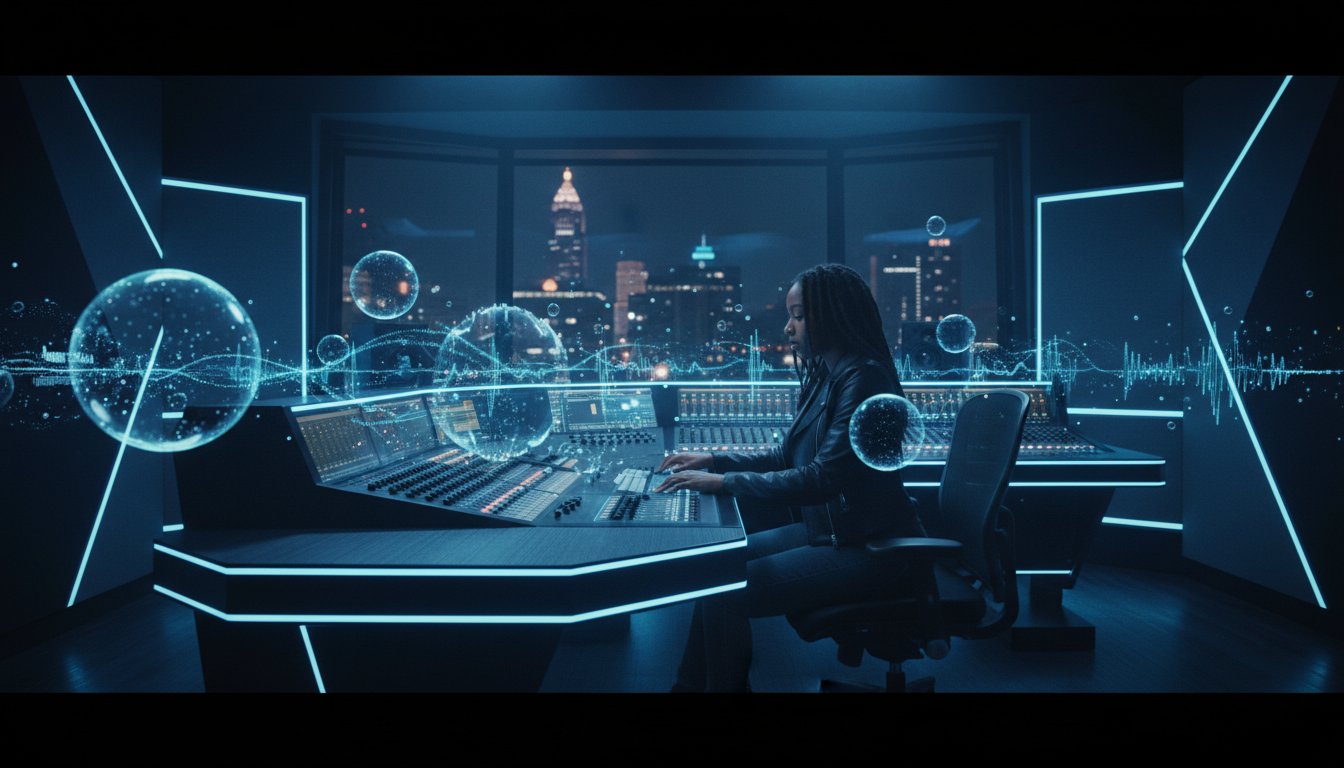
What if the stereo field you've spent years mastering is suddenly the smallest room in the house? The future of music production immersive audio has arrived, and in 2026, it's transforming from a luxury add-on into the essential framework for every serious release. You've probably felt the tension of this shift. It's that nagging concern that your hard-earned catalog might soon sound dated, or perhaps you're simply overwhelmed by the technical leap from traditional channels to 3D objects.
We believe this evolution is the most exciting frontier for creators since the birth of multi-track recording. It's a journey from the flat screen of stereo to a living, breathing sonic environment where every instrument has its own coordinate in space. Discover how immersive audio is moving beyond a trend to become the foundational architecture of modern music production and how to adapt your creative process. We'll demystify the object-based landscape, show you how to prepare sessions for professional Atmos mixing, and chart a reliable course toward world-class distribution that honors your unique artistic vision.
Key Takeaways
- Break through the stereo ceiling by adopting an object-based workflow that treats sound as a three-dimensional ecosystem rather than a fixed pair of channels.
- Understand how the future of music production immersive audio utilizes 9.1.4 configurations to translate complex spatial arrangements into seamless binaural experiences.
- Learn why Spatial Audio has become the default standard for major platforms in 2026 and how this shift influences editorial placement on Apple Music and Tidal.
- Discover the strategic necessity of remastering back-catalogs in Atmos to ensure your creative legacy remains relevant to the next generation of listeners.
- Explore the creative potential of "spheres of sound," allowing you to position your audience directly inside the music for a more profound emotional connection.
Beyond the Stereo Ceiling: Why Immersive Audio is Dominating 2026
The stereo field has reached its physical capacity. For decades, engineers have fought to cram more energy, more layers, and more "vibe" into just two channels. This is the Stereo Ceiling. It's the point where adding more detail only leads to congestion and masking effects. By 2026, the future of music production immersive audio has shattered that ceiling. We've moved beyond a flat wall of sound into a 360-degree ecosystem where every instrument occupies its own coordinate in space.
Spatial Audio is now the default standard across major streaming platforms. This isn't a niche luxury for audiophiles with high-end home theaters. Thanks to sophisticated binaural rendering, listeners experience this depth on standard headphones. Whether they're using AirPods Pro or Beats Fit Pro, your fans are hearing a three-dimensional world. They've moved from looking at a painting to walking through a sonic gallery. This accessibility is why the industry has shifted so rapidly. Artists are no longer restricted by the phantom center; they're sculpting atmospheres.
The Death of the Loudness War
For years, the industry was trapped in a race for volume. If a track wasn't loud, it wasn't competitive. Immersive audio changes the game by prioritizing dynamic range over sheer peak levels. When you have an entire hemisphere to work with, instruments don't have to fight for the same narrow stereo real estate. There is room to breathe. This creates a more sophisticated, polished listener experience. You can finally let the transients pop and the sub-frequencies bloom without sacrificing clarity. The result is music that feels alive rather than crushed.
Object-Based vs. Channel-Based Audio
Traditional audio is channel-based, meaning sound is hard-coded to specific speakers like "Left" or "Right." Modern immersive formats utilize Dolby Atmos technology to treat sounds as "Audio Objects." Each object carries independent metadata. This data tells the playback system exactly where that sound should live in a 3D space. Because it's object-based, your mix adapts to any speaker configuration. It sounds intentional on a 2.0 headphone setup and truly transformative on a professional 9.1.4 rig. It's the ultimate technical freedom for the modern creator, ensuring the future of music production immersive audio remains accessible to everyone.
Objects, Not Channels: The Technical Architecture of Modern Sound
The transition from channel-based to object-based audio is the most significant technical pivot in the future of music production immersive audio. Traditional mixing is static. You pan a sound to a speaker, and it stays there. In the Atmos ecosystem, we work with a hierarchy of "Beds" and "Objects." Beds provide the traditional 7.1.2 foundation for your core elements, while Objects are independent sound sources. These objects carry specific metadata, effectively a set of coordinates that tell the playback system exactly where to place that sound in a 3D hemisphere.
This architectural shift also redefines the future of mastering. It's no longer just about final EQ and compression on a stereo file. It's about ensuring those objects translate across every conceivable listening environment. By 2026, real-time rendering technology has reached a level of precision where the Dolby Atmos Renderer can calculate these positions with zero latency. This allows engineers to hear exactly how an object moves through the height channels in real time, providing a level of control that was previously impossible.
The 9.1.4 Monitoring Standard
The 9.1.4 configuration is the professional gold standard for a reason. The "9" represents the ear-level speakers, the "1" is the LFE (subwoofer), and the "4" identifies the height channels. Those overhead speakers are the secret sauce. They provide the verticality that makes a mix feel truly "above" the listener. Achieving this level of immersion requires a perfectly calibrated room. At Starsound Studios, we secured the first Dolby Certification in Ohio to guarantee that every mix translates with absolute precision from our studio to your fans' headphones.
Binaural Rendering: Atmos for the Masses
Most listeners experience immersive audio through standard headphones via binaural rendering. This uses a Head-Related Transfer Function (HRTF) to trick the brain into perceiving distance and height. It's a massive leap over the "Auto-Spatial" processing found on some devices, which simply applies a generic reverb to stereo tracks. A dedicated Atmos mix is intentional. It places the listener inside the performance. If you want to experience the 9.1.4 difference for yourself, our Dolby Atmos mixing services provide the technical bridge between your artistic vision and the listener's ears.
The Creative Renaissance: How Immersive Audio Changes Production
The future of music production immersive audio isn't defined by speakers. It's defined by the artist's imagination. For decades, we've lived behind a "wall of sound." It was a flat, two-dimensional plane where every element fought for dominance. Now, we build "spheres of sound." The listener is no longer an observer sitting in front of a stage. They're standing in the center of the band. This shift creates a profound emotional connection that stereo, for all its legacy, simply cannot match. It's an invitation to intimacy.
Think about those delicate "ghost" arrangements. The subtle synth pad, the whispered vocal layer, or the textured room noise that gives a track its soul. In a stereo mix, these elements often get swallowed by the "big" instruments. In a 3D space, you can tuck these textures into the upper corners of the room or place them behind the listener's head. They become felt rather than just heard. This adds a layer of psychological depth that keeps the audience engaged, revealing new details with every listen. You're not just making a song; you're building a world.
Stereo Mixing vs. Immersive Mixing
- Dynamic Movement: Stereo panning is a static line between two points. Immersive mixing allows for fluid, automated movement through a 360-degree field, adding a sense of life to the arrangement.
- Spatial Separation: Frequency masking is the traditional enemy of clarity. By moving a guitar up and a vocal forward, you eliminate the need for aggressive EQ carving. Each sound has its own home.
- Object Dynamics: Stereo relies heavily on master bus compression to "glue" a mix together. In Atmos, individual objects retain their own dynamic integrity. The result is a more open, breathable, and punchy master.
New Compositional Strategies
This renaissance forces us to rethink the writing process itself. We're now composing for the Z-axis. Using height to signify tension or release adds a new emotional tool to your kit. Imagine a choir that physically rises above the listener during a crescendo. It's visceral. It's transformative. This is why we encourage artists to visit our recording facility with a spatial mindset from day one. When you track with the end environment in mind, the studio becomes an artistic sanctuary rather than just a workplace. Your vision isn't just captured. It's expanded. This holistic approach ensures your unique identity remains the priority throughout the entire future of music production immersive audio journey.

Future-Proofing Your Catalog: A Strategic Guide for Artists
Your music is your legacy. In 2026, major labels aren't just looking forward; they're looking back. They're currently remastering massive portions of their back-catalogs in Atmos to ensure their greatest hits remain relevant in a spatial-first world. The future of music production immersive audio rewards those who adapt early. Beyond the artistic thrill, there's a clear return on investment. Apple Music and Tidal prioritize immersive content in their editorial playlists. By providing an Atmos version, you're essentially securing a front-row seat in the streaming marketplace where high-fidelity listeners reside.
Preparing your catalog for this shift doesn't mean starting from scratch. It starts with your stems. When we re-imagine a stereo session for 3D space, we look for the core elements that define the track's identity. The goal isn't to change the song. It's to expand its reach. We maintain the "soul" of your original mix while giving it the room it deserves to breathe. This process requires a delicate touch. You want the listener to recognize the song they love while feeling it in a way they never thought possible.
Pre-Production for Immersive Sessions
Successful spatial transitions begin with meticulous organization. You'll want to group your tracks by frequency and importance. Vocals, drums, and bass usually form the "bed," while melodic flourishes and atmospheric textures are treated as objects. Clean, "dry" recordings are actually better for spatial processing. They allow us to place the instrument in a virtual room without fighting the baked-in reverb of the original stereo file. Think of your mix engineer as a collaborative mentor. We help you navigate these choices, ensuring the technical details are handled with absolute precision while you focus on the creative vision.
Distribution and ADM BWF Files
The final deliverable for an immersive project is an ADM (Audio Definition Model) BWF file. This isn't just a standard audio file. It's a sophisticated container for your audio and its associated spatial metadata. Most major distributors, including DistroKid and TuneCore, now have dedicated pipelines to handle these files correctly. It's also vital to verify the binaural fold-down. We ensure that when a listener switches back to stereo, the energy and balance remain consistent. If you're ready to revitalize your existing work, our Remote Mastering and Atmos mixing services can bring your legacy into the 3D era with world-class results.
Experience the 9.1.4 Difference: Cleveland’s Premier Dolby Atmos Studio
Theory meets reality in North Royalton. While the future of music production immersive audio is often discussed in abstract terms, we've built a physical sanctuary where it actually happens. Starsound Studios is the intersection of high-end science and creative spirit in Ohio. Being the first Dolby Certified facility in the state isn't just a badge of honor. It's your guarantee of technical precision. In a world of uncalibrated home-studio Atmos setups, certification ensures that your artistic vision translates perfectly across every streaming platform and consumer device. Your music deserves more than "close enough." It deserves the absolute clarity of a room designed from the ground up for 3D sound.
Navigating this new frontier requires a guide who understands where we've been. Steve "The Mix" is a seasoned expert who bridges the gap between stereo tradition and the immersive future. He doesn't just push buttons. He acts as a collaborative mentor, ensuring the soul of your record remains intact while expanding it into a new dimension. It's a high-attention experience where your unique identity is the priority. We invite you to step out of the cramped, sterile "record room" and into a world-class 9.1.4 sanctuary where your music can finally breathe.
The Starsound Immersive Suite
Our North Royalton facility is a dedicated creative space designed for breakthroughs. The Immersive Suite features state-of-the-art acoustic treatment and a monitoring system calibrated to the highest industry standards. It's a high-energy environment. We've replaced clinical vibes with an atmosphere that inspires innovation. If you aren't local to Ohio, our Remote Mixing and Remote Mastering services bring this elite level of expertise to your project anywhere in the world. We handle the technical heavy lifting, providing you with a world-class result that honors your vision.
Start Your Immersive Journey
The transition to 3D sound is the most exciting shift in music history. We offer specialized "Stereo to Atmos" consultations to help you navigate this evolution. We'll analyze your stems, discuss your sonic goals, and map out a path to professional distribution. For those who want to master the technology themselves, our Audio Engineering Classes provide hands-on experience with the object-based workflows that are redefining the industry. Don't let your catalog become a relic of the past. Book your immersive session at Starsound Studios today.
Step Into the 3D Soundscape
The transition from static stereo to dynamic, object-based environments is more than a technical upgrade. It's a fundamental reimagining of the artist-fan connection. By embracing 9.1.4 monitoring and the precision of the Atmos Renderer, you're ensuring your music remains relevant in a marketplace that now demands spatial depth. The future of music production immersive audio belongs to those who refuse to be confined by two channels. This isn't just about sound. It's about presence.
At Starsound Studios, we've built a world-class sanctuary to facilitate this transition. As Ohio's first and only Dolby-certified Atmos studio, we provide a 9.1.4 high-fidelity environment where your vision is translated with absolute precision. Lead engineer Steve 'The Mix' brings over 10 years of expertise to every session, acting as a collaborative mentor for your creative journey. Elevate your sound with Cleveland's only Dolby-certified 9.1.4 immersive mix. Your work deserves to be heard in its fullest, most vibrant form. Let's build your sonic legacy together.
Frequently Asked Questions
What is the difference between 5.1 surround sound and Dolby Atmos?
Traditional 5.1 surround sound is channel-based, meaning audio is hard-coded to five speakers and a subwoofer. Dolby Atmos is object-based, allowing sound to move freely in a 3D hemisphere. This technology adds height channels to the mix, creating a sense of verticality that 5.1 simply cannot reproduce. It's the difference between being surrounded by a circle of sound and being inside a living sphere of audio.
Do listeners need special speakers to hear immersive audio?
Listeners don't need a multi-speaker setup to enjoy these experiences. While 9.1.4 speaker systems offer the ultimate fidelity, most fans listen through standard headphones using binaural rendering. This technology uses complex algorithms to mimic how our ears perceive sound in 3D space. As long as a fan has compatible headphones and a streaming service that supports Spatial Audio, they'll hear the immersive depth you've created.
Why is Apple Music pushing Spatial Audio so hard in 2026?
Apple Music prioritizes Spatial Audio because it represents the future of music production immersive audio and provides a premium experience that keeps users on their platform. Tracks mixed in Atmos receive better placement on editorial playlists and are featured more prominently in the interface. For Apple, it's about hardware and software synergy; for the artist, it's a powerful way to increase visibility and engagement with a high-fidelity audience.
Can I mix Dolby Atmos in my home studio?
You can technically start an Atmos mix at home using the Dolby Atmos Renderer software, which costs $299 as of May 2026. However, achieving professional translation is difficult without a calibrated 7.1.4 or 9.1.4 speaker environment. Headphones-only mixing often lacks the spatial accuracy required for major label distribution. Most independent creators find that starting the creative process at home and finishing in a certified facility ensures the best results.
How much does it cost to get a song mixed in Dolby Atmos?
The cost of an Atmos mix depends on the complexity of your arrangement and the number of stems provided. Because this process involves managing up to 128 simultaneous objects and ensuring binaural compatibility, it requires more time and specialized equipment than a standard stereo mix. Professional facilities usually provide custom quotes based on the specific needs of your project and the current state of your session files.
What are ADM files and why are they required for distribution?
ADM (Audio Definition Model) BWF files are the industry-standard deliverables for immersive projects. Unlike a stereo WAV file, an ADM file contains the actual audio tracks along with the spatial metadata that tells a playback system where to place each sound object. Streaming platforms like Tidal and Amazon Music require this format to ensure your mix renders correctly across different speaker and headphone configurations.
Is immersive audio only for certain genres like Electronic or Orchestral?
Immersive audio enhances every genre, from gritty Hip-Hop to intimate Folk. While Electronic music often uses aggressive movement, Rock and Jazz benefit from the increased "air" and separation between instruments. It allows a listener to feel like they're standing in the middle of a live performance. Every genre gains a new level of emotional impact when the "wall of sound" becomes a three-dimensional environment.
How do I prepare my Pro Tools session for a professional Atmos mix?
Start by consolidating your tracks into clean, dry stems. It's vital to remove heavy master bus compression or limiting that might "bake in" a flat dynamic range. Organize your session by category, such as Drums, Percussion, Bass, and Vocals, and ensure all tracks are clearly labeled. Providing dry versions of your tracks allows the Atmos engineer to place your instruments in a virtual 3D space with maximum clarity and precision.


