

What if the difference between a forgotten demo and a chart-topping hit isn't the price of your microphone, but the strategy behind your bank account? It's a painful reality that many creators face. You pour your soul into a project only to realize the funds ran dry before the mixing stage even began. Mastering how to budget for music production is the single most important skill you can develop outside of your songwriting. It transforms your creative process from a stressful gamble into a precise, intentional journey toward sonic excellence.
You're right to feel that the financial side of art is daunting. The confusion between hourly studio rates and flat-rate post-production can stall even the most inspired sessions. This guide provides a strategic framework to allocate your resources across recording, mixing, and mastering. We'll explore where to invest for the highest ROI, from the immersive depth of Dolby Atmos to the long-term value of engineering classes. Prepare to navigate the 2026 industry landscape with the confidence of a seasoned professional, ensuring every dollar spent serves the spirit and energy of your unique sound.
Key Takeaways
- Adopt a strategic 50/25/25 framework to ensure your project has the financial oxygen needed for a professional finish.
- Understand how to budget for music production by navigating the shift from hourly tracking fees to the predictable stability of flat-rate mixing.
- Optimize your ROI by utilizing a hybrid approach, reserving high-end studio environments for critical tracking while maintaining home-studio efficiency.
- Slash production costs through professional preparation, using rehearsal and file organization to maximize every minute of engineering time.
- Secure your place on modern playlists by integrating Dolby Atmos into your financial plan, meeting the immersive standards of 2026.
The Foundations of a Music Production Budget
A budget isn't a cage; it's a blueprint for your sonic identity. Many artists view financial planning as the antithesis of creativity, but the opposite is true. Knowing exactly where your capital is flowing allows you to make bold, fearless decisions in the studio. When you understand how to budget for music production, you stop worrying about the clock and start focusing on the performance. Precision in planning leads to passion in execution.
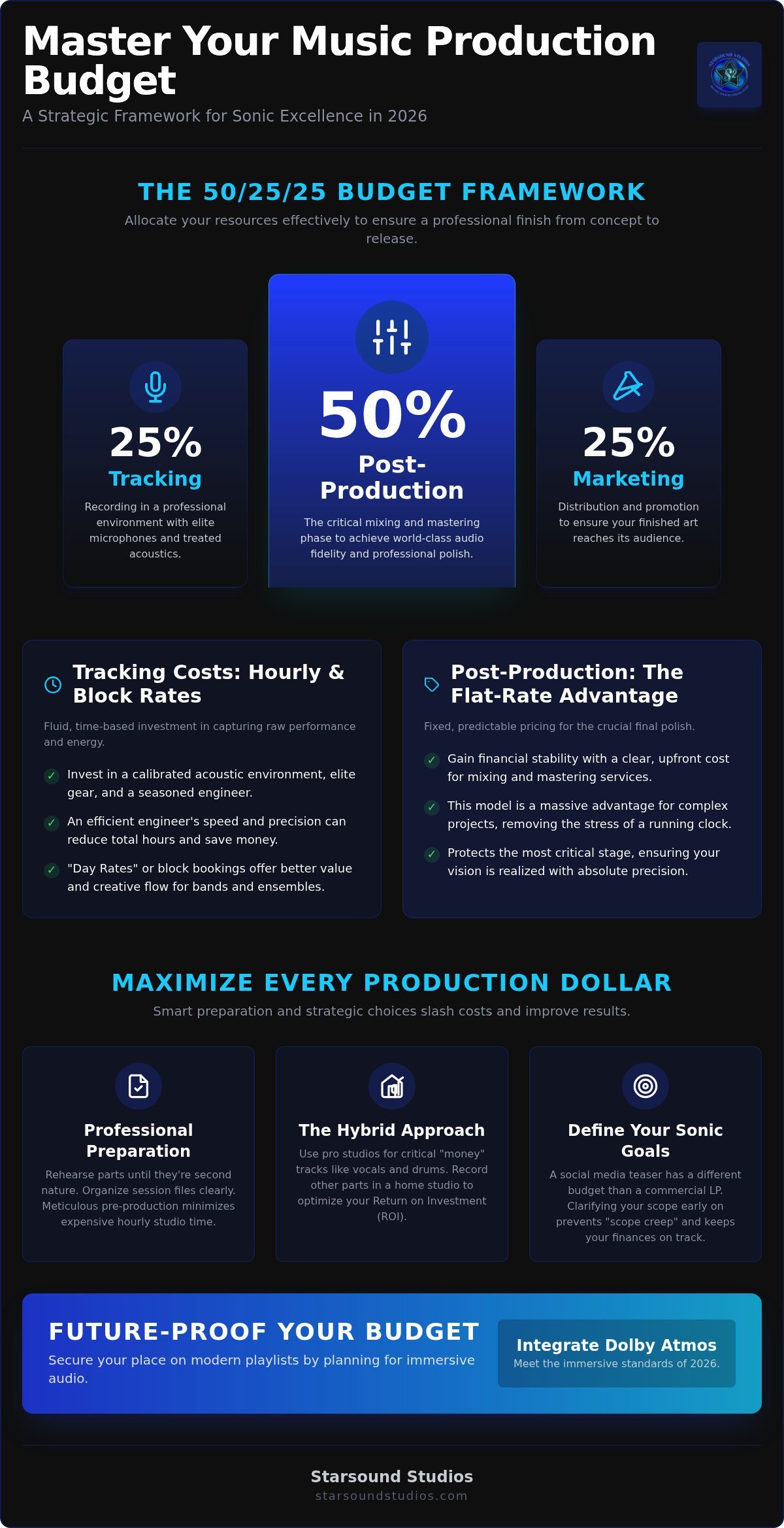
A powerful framework for the modern independent artist is the 50/25/25 rule. This strategy ensures your project has the financial oxygen needed to survive the entire journey from concept to release. It breaks down your spending into three critical buckets:
- 50% Post-Production: This covers mixing and mastering services to ensure world-class audio fidelity.
- 25% Tracking: Recording in a professional environment with elite microphones and treated acoustics.
- 25% Marketing: Distribution and promotion to ensure your art actually reaches ears.
While it might seem counterintuitive to spend half your money after the microphones are turned off, this ensures your record has the professional polish required to compete on global streaming platforms. Without this final polish, even the most expensive recording remains unfinished.
Defining Your Sonic Goals
Your financial roadmap depends entirely on your destination. A social media teaser requires a different level of investment than a commercial LP. Identifying your "must-haves" early prevents scope creep. For instance, an indie rock project might prioritize a world-class drum room, while a hip-hop artist might shift those funds into high-end vocal chain processing. Understanding the role of a record producer can help you decide if you need a creative partner to oversee these technical choices or if you're ready to manage the session yourself. Clarifying your scope early keeps your vision sharp and your bank account intact.
Allocating Funds Across the Timeline
Efficiency starts before you even step into the facility. Pre-production is the phase where you spend time to save money. Rehearsing your parts until they're second nature minimizes expensive hourly tracking fees. When you finally enter the tracking phase, your budget should focus on the environment and the tools that capture the "money" tracks, like lead vocals and acoustic instruments. Post-production remains the non-negotiable core. This is where the science of audio fidelity meets the art of creation. Knowing how to budget for music production means protecting the final stage, ensuring your vision isn't just recorded, but realized with absolute precision.
Breaking Down the Costs: Tracking vs. Post-Production
Understanding the mechanics of studio billing is the next step in learning how to budget for music production. You are essentially managing two different financial models: the fluid, hourly nature of tracking and the fixed, predictable structure of post-production. Mastering this distinction allows you to capture raw energy without the fear of a mounting bill. It turns a potential source of stress into a structured path toward a professional release.
Studio Time: Hourly vs. Block Rates
Hourly recording fees are about more than just a room. You are investing in a calibrated acoustic environment, a curated selection of elite microphones, and the ears of a seasoned engineer. While a home setup might seem cheaper, a professional engineer works with a speed and precision that often reduces the total hours required. When you are budgeting time and money for a whole production, remember that efficiency in the booth is your greatest cost-saving tool.
For bands or live ensembles, "Day Rates" or block bookings provide a sanctuary of focus. These blocks allow for a holistic creative flow that hourly sessions can sometimes disrupt. If you are tracking in recording studios, look for these opportunities to settle into the space and let the performance breathe. It is often more cost-effective to book a ten-hour block than to chase the same results across three separate three-hour sessions.
Mixing and Mastering: The Flat-Rate Advantage
Mixing and mastering represent the shift to flat-rate stability. This model is a massive advantage for complex projects because it removes the pressure of the ticking clock during the most critical creative phase. You should expect a per-track fee for stereo mixing that includes the final polish and essential technical balance. Professional mastering then ensures your track meets the strict LUFS and tonal standards of 2026 streaming platforms. Always factor in the need for alternative mixes, such as instrumentals for licensing or radio edits for broadcast. These are vital assets that should be accounted for in your initial financial plan.
Balancing local tracking with remote post-production is a modern way to optimize your spend. You get the visceral experience of a physical studio for your vocals, followed by the precision of digital delivery for the final mix. If you're ready to hear your tracks through a world-class signal chain, exploring our remote mixing services can bring that pro-studio sheen to your project regardless of your location.
The Hybrid Budget: Home Recording vs. Pro Studios
Choosing between a bedroom setup and a world-class facility isn't a binary choice anymore. It's a strategic partnership. The most successful independent artists in 2026 use a hybrid model to maximize their sonic impact. However, many fall into the 'Bedroom Demo' trap. They spend thousands on mid-tier gear but record in untreated rooms plagued by standing waves and flutter echo. This creates phase issues and frequency masking that require a professional mixer to spend hours "fixing" rather than "enhancing." When you're learning how to budget for music production, you must account for these hidden costs of home recording. Poor acoustics at home often lead to higher invoices in the mixing stage.
A smarter play is to use your home environment for the "free" elements of the process. Writing, arrangement, and MIDI programming don't require a high-end room. You can refine your vision on your own schedule. But for the "money" tracks, the lead vocals, the acoustic piano, or the driving snare, you need the specialized environment of a pro studio. Utilizing the expertise of a professional sound engineer ensures these core elements are captured with absolute precision from the start. This prevents the "high-cost fix" scenario and keeps your budget focused on growth rather than repair.
When to Save: The Home Studio Essentials
Focus your home budget on a reliable audio interface and a versatile condenser microphone. Ensure your DAW is set up for high-fidelity exports, specifically maintaining audio format aiff standards for lossless compatibility with professional facilities. Use this space for the heavy lifting of the creative process. Rough vocal ideas and complex arrangements can be polished here without the pressure of the clock. This is how to budget for music production effectively; use the home studio to prepare, so the pro studio can perform.
When to Spend: The Pro Studio Advantage
The primary reason to invest in a professional facility is critical listening. Your bedroom speakers are lying to you. Untreated rooms create "dead spots" and bass buildup that hide the true character of your sound. A dedicated studio offers a calibrated environment where every frequency is revealed. Beyond the room, you gain access to legendary signal chains. Neve preamps, SSL consoles, and elite microphones add a harmonic richness impossible to replicate with plugins alone. There's also the psychological boost. Stepping into a dedicated creative sanctuary signals to your brain that it's time for high-level output. That shift in energy often results in the best performance of your career.
Strategic Planning: Maximizing Every Production Dollar
Efficiency isn't just about speed; it's about preparation. Many artists overlook the logistical side of how to budget for music production, assuming that creativity thrives in chaos. In reality, chaos is expensive. Every minute an engineer spends searching for a lost file or waiting for a musician to learn a bridge is a minute you're paying for. Strategic planning protects your capital by ensuring the studio clock only runs during moments of high-value output. It transforms the studio from a place of expensive experimentation into a high-performance environment where your vision is realized with absolute precision.
Rehearsal is your most effective cost-saving tool. If you can't play the song perfectly ten times in a row at home, you aren't ready to track it. Hiring professional session musicians might seem like a luxury, but their ability to nail a take in fifteen minutes often costs less than spending four hours struggling to do it yourself. Learning how to budget for music production also involves accounting for the "hidden" expenses that often go ignored. Hard drives for backups, annual distribution fees, and plugin subscriptions are recurring costs that can quietly drain your funds if they aren't part of your master plan.
Pre-Production: The Budget Saver
Finalizing your tempos and arrangements before the session begins is mandatory. Use your home setup to create scratch tracks that serve as a guide for the professional recording. This allows the engineer to focus on capturing the perfect tone rather than helping you decide which chord works best in the chorus. Pre-production is the phase where artistic decisions are separated from technical costs.
Smart Gear Investments
Gear Acquisition Syndrome (GAS) is a budget killer. The market is flooded with "magic" plugins and hardware that promise instant results, but these rarely provide the same ROI as a great performance. Instead of buying a boutique preamp for one session, consider renting it or booking time in a facility that already owns one. Prioritize your instruments and your performance over software that might be obsolete in two years.
The best long-term investment you can make is in your own skill set. Taking audio engineering classes allows you to handle more of the technical load yourself, reducing your reliance on outside help for future projects. If you're ready to master the technical details of your craft, our classes provide the grounded assurance you need to reach your highest potential.
Future-Proofing Your Budget: Dolby Atmos and Immersive Audio
The sonic landscape has shifted. In 2026, immersive audio is no longer an experimental niche; it is the benchmark for major streaming platforms. When you are determining how to budget for music production, ignoring Dolby Atmos is a significant risk to your project's longevity. It is the difference between a track that sounds current and one that feels like a relic of the past. By planning for an immersive delivery from the start, you avoid the redundant costs of retrofitting your stereo stems later. This "Atmos-First" strategy streamlines the workflow, ensuring your capital is used to build a multi-dimensional experience rather than just a flat stereo file.
Starsound Studios was built to bridge the gap between independent ambition and world-class technical standards. We make immersive mixing accessible by providing a clear, strategic path for artists to transition from traditional tracking to spatial realization. This isn't just about adding more speakers. It is about creating a dedicated creative sanctuary where your unique identity is the priority. Our facility is designed to handle the technical heavy lifting, allowing you to focus on the spirit and energy of your creation.
Is Atmos Worth the Investment?
The ROI on immersive audio is tangible and immediate. Platforms like Apple Music and Tidal give significant editorial preference to Atmos-compatible tracks, often placing them in higher-visibility playlists that stereo tracks cannot access. This editorial boost is a powerful marketing asset. It justifies the higher per-song investment compared to traditional stereo mastering. Beyond the immediate launch, Atmos ensures your work remains relevant as consumer hardware continues to evolve toward spatial playback. Budgeting for this now prevents your music from sounding "dated" by 2027.
Working with a Certified Atmos Engineer
Accuracy is everything in the immersive space. You simply cannot "budget" for Atmos by relying on headphone virtualization or uncalibrated home setups. True spatial translation requires a dedicated 9.1.4 environment where sound objects move with absolute precision. As a Dolby Atmos studio Cleveland creators can trust, Starsound Studios provides the only certified 9.1.4 facility in Ohio. This local expertise gives you access to global-standard results without the logistical hurdles of coastal facilities. Understanding how to budget for music production in this new era means treating immersive audio as a core component. It ensures your technical details are handled with absolute precision while your art reaches its highest potential.
Transform Your Vision Into a Sonic Reality
Mastering the financial architecture of your project is just as vital as the melodies you write. By prioritizing high-impact post-production and embracing the immersive potential of Dolby Atmos, you ensure your art isn't just heard, but experienced. We've explored how a strategic hybrid model and rigorous pre-production protect your capital from the common pitfalls of the "bedroom demo" trap. Understanding how to budget for music production is the key to moving from a rough draft to a world-class release.
At Starsound Studios, we combine over a decade of professional engineering experience with a passion for creative excellence. Whether you're tracking locally or utilizing our remote mixing services for artists worldwide, your sound is in expert hands. As home to Ohio's only Dolby-certified 9.1.4 mixing suite, we provide the technical precision required for the standards of 2026. Ready to invest in your sound? Book a session at Starsound Studios in Cleveland today. Your highest potential is within reach, and we're here to help you capture it.
Frequently Asked Questions
How much should a professional single cost to produce in 2026?
The total investment for a professional single depends on your genre and production complexity. A commercial release requires balancing studio tracking time with high-end post-production. While home recording can reduce some initial costs, you must allocate funds for professional mixing and mastering to ensure the track meets modern streaming standards. Most successful independent artists in Cleveland prioritize their spending on the "money" tracks and final polish to maximize their impact.
Is it better to pay an engineer hourly or a flat fee per song?
The best approach is a hybrid model that uses hourly rates for tracking and flat fees for post-production. Hourly billing is standard for recording sessions in our North Royalton facility, as it covers the room, elite microphones, and the engineer's real-time expertise. For mixing and mastering, flat rates provide predictable costs. This strategy is a vital part of how to budget for music production because it removes the pressure of the clock during the final creative stages.
Can I save money by mixing my own music at home?
While mixing at home avoids immediate fees, it often leads to higher costs later. Most home environments lack the precise acoustic treatment and calibrated monitoring found in professional Cleveland studios. This can result in frequency masking and phase issues that are difficult to fix. Investing in professional stereo mixing ensures your project has the clarity and competitive energy required to stand out on global playlists without needing expensive technical repairs.
What are the most common hidden costs in music production?
Artists frequently overlook the logistical and recurring expenses that can drain a budget. Common hidden costs include:
- High-capacity hard drives for session backups.
- Annual distribution fees for platforms like DistroKid or TuneCore.
- Ongoing software and plugin subscriptions.
- Marketing and promotional capital for the release phase.
Is Dolby Atmos mixing significantly more expensive than stereo?
Immersive mixing requires a higher investment because it utilizes a specialized 9.1.4 environment and advanced engineering techniques. However, it offers a significant ROI through editorial playlist advantages on platforms like Apple Music. By adopting an "Atmos-First" strategy, you can often save money by planning for immersive delivery from the start. As Ohio's only Dolby-certified Atmos studio, we provide the precision needed to make this investment future-proof your music.
Should I budget for mastering separately from mixing?
Yes, you should treat mixing and mastering as two distinct financial line items. Mixing focuses on the balance and relationship between individual instruments, while mastering provides the final tonal correction and loudness optimization. Budgeting for these stages separately ensures that each process receives the dedicated attention it requires. This distinction is a fundamental step when learning how to budget for music production for a high-level commercial release.
How much time should I spend in a professional studio vs. at home?
You should spend the majority of your time at home on pre-production, writing, and rehearsal. Use your home setup to finalize arrangements and record scratch tracks. This preparation ensures that the time you spend in our Cleveland studio is focused entirely on high-value tasks. Capturing lead vocals through world-class signal chains and elite microphones provides a level of audio fidelity that home environments simply cannot replicate.
What is the best way to track my production expenses?
The most effective method is maintaining a detailed spreadsheet that categorizes every dollar by production phase. Break your expenses into tracking, post-production, and marketing buckets to follow the 50/25/25 rule. Include everything from session musician fees to software updates. This level of visibility keeps your project financially sustainable and allows you to make informed decisions about where to invest for the highest sonic return on your investment.


