
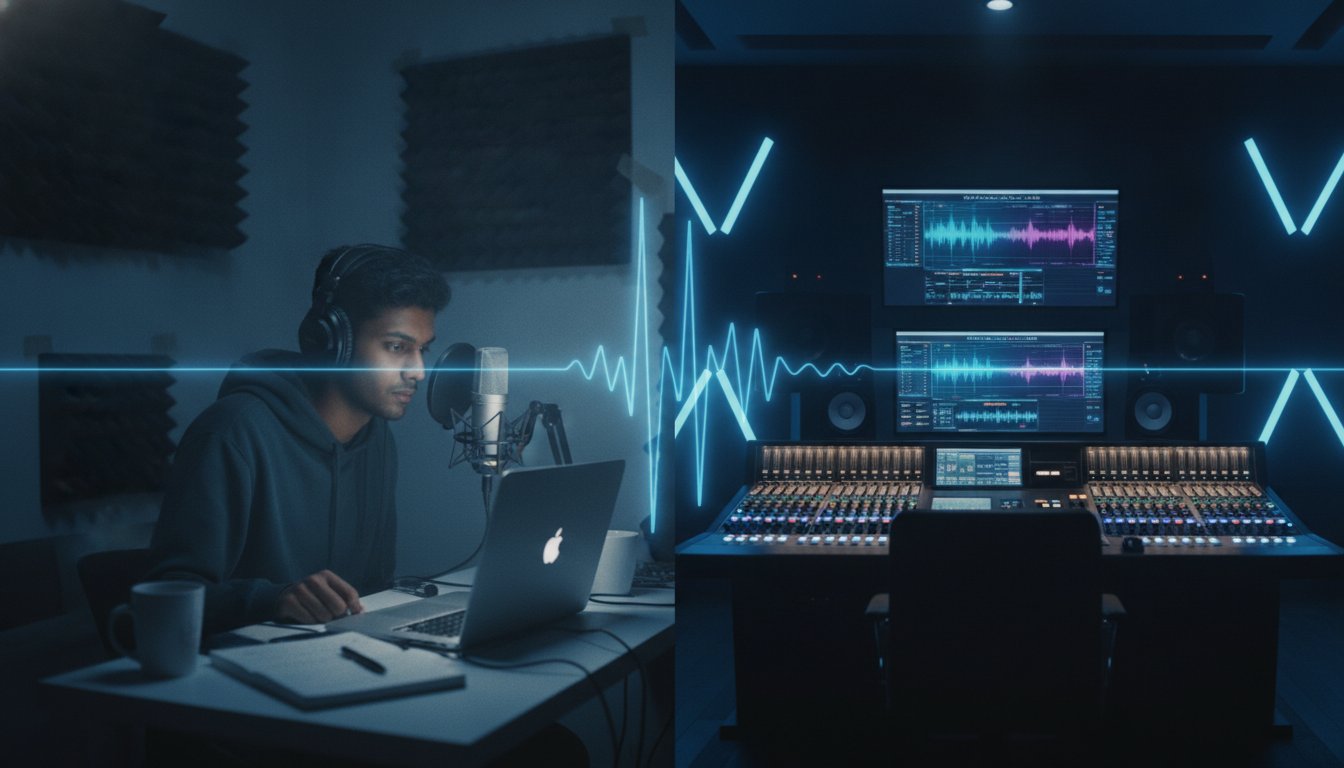
What if the high-end gear in your home studio isn't the bottleneck, but the air inside the room itself? In a landscape where over 150,000 new tracks are uploaded to streaming services every day, the margin for sonic error has vanished. You’ve likely felt the frustration of a vocal take that sounds muddy or a snare that carries the boxy resonance of an untreated spare bedroom. Even when you master how to prepare tracks for mixing, a DIY environment often introduces technical hurdles that no amount of digital processing can fully erase.
It's exhausting to battle your acoustics when you should be focused on the raw energy of your performance. We believe your music deserves a sonic identity that feels both sophisticated and deeply human. This article explores the critical differences between home setups and professional facilities so you can choose the right environment for your next project. We will look at the value of professional signal flow, the mainstream adoption of immersive audio, and how expert ears can transform a creative spark into a world-class master.
Key Takeaways
- Understand why even the best home recordings can fall into the "demo trap" and how professional signal flow bridges the gap to a commercial sound.
- Master the essential technical checklist for session organization, including exactly how to prepare tracks for mixing to ensure a seamless handoff to your engineer.
- Explore the expanding world of Dolby Atmos 9.1.4 and why immersive audio is becoming a non-negotiable standard for artists in 2026.
- Learn how to leverage a hybrid production model that combines the comfort of your home environment with the high-end precision of a professional tracking room.
- Discover how expert mentorship and high-fidelity equipment can elevate your creative vision from a simple recording to a polished, radio-ready masterwork.
DIY Recording vs Professional Recording: The Modern Artist’s Dilemma
The digital revolution of the early 2020s fundamentally changed the music industry. High-end DAWs like Pro Tools and Logic Pro became standard household tools, empowering a generation to create without gatekeepers. It’s an era of unprecedented freedom. However, this democratization created a unique challenge for the serious artist. While you can sketch an entire album in your bedroom, the leap from a creative demo to a commercial masterwork often requires more than just a laptop and a decent microphone.
The Rise of the Bedroom Producer
Home recording is the perfect playground for songwriting and initial experimentation. It allows for limitless retakes without the pressure of a ticking clock. But there is a point of diminishing returns. You can buy the most expensive interface on the market, yet if your room lacks acoustic treatment, your recordings will always carry a boxy or thin quality. Learning how to prepare tracks for mixing starts with recognizing the limitations of your environment before you hit record. Professional audio mixing can only do so much to fix a track recorded in a space with poor physics.
When 'Good Enough' Isn't Enough
In 2026, listener expectations are higher than ever, especially with the surge in spatial audio. A track that sounds fine on headphones often falls apart on a club system or in a Dolby Atmos environment. Radio-ready in 2026 means a production possesses the dynamic range, frequency balance, and immersive depth to compete with major label releases on global streaming platforms. Many artists fall into the "demo trap," where they spend months perfecting a home recording only to realize it doesn't translate to professional speakers. This usually stems from a few critical issues:
- Excessive room resonance from a lack of acoustic treatment.
- Inconsistent vocal levels due to poor microphone technique or budget preamps.
- High noise floors from computer fans, air conditioners, or household appliances.
At Starsound Studios, we believe technology should be an invisible bridge, not a barrier. Our sanctuary in North Royalton is designed to handle the technical precision so you can focus on the soul of the performance. We often guide artists on how to prepare tracks for mixing before they even step foot in the studio, ensuring every file is clean and ready for our 9.1.4 Atmos suite. Recording in a dedicated space changes your energy. You aren't just making a song; you are crafting a legacy. When you step away from the technical hurdles of a home setup, your artistic potential finally has the room to breathe.
The Technical Checklist: How to Prepare Tracks for a Professional Mix
Precision is the hallmark of a masterwork. When you transition from a home demo to a professional mix, the state of your files dictates the speed and quality of the final output. Meticulous preparation ensures that your engineer spends their time on creative balance rather than technical troubleshooting. Learning how to prepare tracks for mixing isn't just about housekeeping; it's about clearing the path for sonic breakthroughs. It's the difference between a session that feels like a struggle and one that flows with effortless energy.
Start by stripping away the clutter. Every unused take or accidental mic bump left in a silent passage is a distraction. Silence dead air in vocal tracks and ensure every clip has a proper fade-in and fade-out to eliminate digital pops. These micro-noises might be inaudible on laptop speakers, but they become glaringly obvious once they hit a professional signal chain. Clean files lead to a clean mix.
Naming and Folder Organization
An organized session is a fast session. Use a standardized numbering system like 01_Kick_In, 02_Kick_Out, and 03_Snare_Top. This ensures your tracks appear in a logical, rhythmic order in any DAW, from Pro Tools to Logic Pro. Group similar instruments into clearly labeled folders to maintain a bird's-eye view of the project. Always include a MIDI tempo map and your latest rough mix. This rough mix acts as a north star, showing the engineer the emotional intent and the creative spirit you've lived with during the songwriting process.
Consolidation and Exporting
Alignment issues are the enemy of groove. Every track must be consolidated into a single, continuous WAV file starting at Bar 1, Beat 1. This "zero point" ensures that even if your engineer uses a different system, everything stays perfectly in sync. Export at 24-bit or 32-bit float to preserve maximum headroom and audio fidelity. This high-resolution approach ensures our 9.1.4 Atmos suite has the cleanest possible data to manipulate. Check for crossfades and clicks one last time before you commit to the final bounce. If you're unsure about your current session's health, our stereo mixing experts can provide a pre-mix consultation to ensure your files are optimized for greatness.
Knowing what to keep is an art. If an effect is essential to the sound design, like a specific modulated delay or a distorted synth filter, print it to the track. However, bypass corrective EQ, compression, or "room simulators" used to mask poor home acoustics. You want the high-end hardware and expert ears to handle the heavy lifting. By mastering how to prepare tracks for mixing, you provide a blank canvas where your music can finally reach its highest potential.
The Immersive Gap: Preparing Stems for Dolby Atmos 9.1.4
The sonic horizon is shifting. For decades, we lived in a two-dimensional world defined by the left and right speakers. In 2026, that boundary has dissolved. Dolby Atmos Music has redefined the listener experience, placing the audience inside the song rather than in front of it. While the DIY revolution made recording accessible, the move toward immersive audio has created a new technical divide. Achieving a true 9.1.4 configuration, which involves nine surround speakers, a subwoofer, and four overhead channels, is a feat of engineering that remains out of reach for almost every home setup.
This isn't just about gear. It's about the physics of the room. A professional 9.1.4 suite requires precise calibration and acoustic treatment that a bedroom simply cannot accommodate. As Apple Music and Amazon Music continue to prioritize spatial audio, the demand for immersive masters has skyrocketed. If you want your music to stand out on major streaming playlists, you need to understand how to prepare tracks for mixing specifically for this object-based environment. At Starsound Studios, we operate Ohio’s only Dolby-certified Atmos mixing facility, providing the specialized environment needed to translate your vision into three dimensions.
Stereo vs. 9.1.4 Immersive Audio
Atmos is the new vinyl for the digital age. It offers a level of clarity and separation that stereo cannot replicate. In a traditional mix, instruments compete for space in a narrow field. In an immersive 9.1.4 mix, we can place a synth pad behind the listener while the lead vocal floats directly in front of them, creating a visceral, emotional connection. Beyond the art, there is a strong business case. Streaming algorithms in 2026 heavily favor Atmos-enabled tracks, often resulting in significantly better playlist placement and longer listener retention.
Preparing Stems for Immersive Mixing
Success in the Atmos world begins with high-quality source material. Recording in a professional tracking room makes the conversion to immersive audio much smoother because the signal flow is cleaner from the start. When you are learning how to prepare tracks for mixing for Atmos, the most important rule is to provide dry stems. We need the raw essence of the performance without baked-in reverbs or delays; these spatial effects are better handled within the Atmos renderer to ensure they move correctly through the 9.1.4 field. Starsound’s Atmos certification serves as a seal of approval, validating that your project meets the rigorous technical standards required by major labels and global distributors.

The Hybrid Production Model: Bridging the Gap Between Home and Studio
Professional production in 2026 isn't a binary choice between a bedroom and a high-end facility. It's a strategic partnership. The hybrid model allows you to maximize your budget while pushing your creative boundaries. You use the quiet solitude of home for experimentation and the precision of a professional sanctuary for the heavy lifting. This approach respects both your artistic process and the technical requirements of a radio-ready master.
The journey begins with pre-production. Demoing at home lets you flesh out the arrangement without the pressure of a ticking clock. This is the stage where you learn how to prepare tracks for mixing by identifying which elements are foundational and which are merely clutter. Once your vision is clear, you book professional tracking for the "soul" elements. Lead vocals and live drums need the air of a treated room and the warmth of a professional signal chain to truly resonate with an audience. Finally, you can leverage remote mixing and mastering to give your project that world-class polish. If you want to refine your DIY skills, our audio engineering classes at Starsound provide the mentorship needed to ensure your home takes meet professional standards.
What to Record at Home
Home is for the digital and the direct. Synthesizers, DI guitars, and MIDI programming thrive in a home environment because they don't rely on room acoustics. It's the perfect space for experimental layering. You can spend hours tweaking a synth patch or stacking vocal harmonies where time pressure might otherwise hinder your flow. The key is maintaining discipline. By understanding how to prepare tracks for mixing during this phase, you ensure that your experimental layers are clean, consolidated, and ready for our engineers to transform into a cohesive sonic landscape.
What to Record in the Studio
The studio is for the elements that need to breathe. Lead vocals are the heartbeat of your track. They require the pristine signal path and the expert ears of a seasoned engineer to capture every nuance of your performance. Live drums and acoustic instruments also belong in a dedicated tracking room. You want to capture the natural resonance and physical energy of the space, something a bedroom simply cannot replicate. This foundation is what allows for final mixing and mastering that translates uniformly across every playback system, from high-end audiophile setups to smartphone speakers. Recording the core of your track in a professional environment ensures that your music doesn't just sound good; it sounds undeniable.
Starsound Studios: Your Creative Sanctuary in Cleveland
A professional studio should be more than a collection of expensive hardware. It's a dedicated space where your artistic vision is protected and polished. At Starsound Studios, we've built a sanctuary in North Royalton that balances high-end technical precision with a welcoming, creative energy. We understand that stepping into a studio can feel daunting. That's why our environment is designed to feel like a collaborative home for your music, ensuring that every session is productive and inspiring.
From our meticulously tuned tracking room to the cutting-edge 9.1.4 immersive audio suite, every corner of Starsound is designed to inspire. We don't just provide a service; we invest in the holistic process of your work. Whether you are tracking lead vocals through our premium signal chain or exploring the three-dimensional depth of a Dolby Atmos mix, you are in the hands of experts who care about the final result as much as you do. Our facility serves as a bridge between the raw energy of your performance and the polished standards of global streaming platforms.
Expertise You Can Trust
Led by Steve 'The Mix' since 2014, Starsound has established a legacy of excellence that resonates across Ohio and beyond. Artists from across the Cleveland area choose our North Royalton location because they seek more than a corporate, sterile environment. They want a mentor. Our reputation is built on reliability and a deep understanding of audio fidelity. From local bands to international clients utilizing our remote mixing and mastering services, the feedback is consistent: we bring a level of passion and precision that transforms projects.
Beyond Recording: Education and Mastery
We believe in empowering the next generation of creators. Our audio engineering classes for Pro Tools and Logic Pro are designed to bridge the gap between DIY enthusiasm and professional expertise. These programs offer hands-on training on professional consoles, giving you the technical vocabulary to communicate your vision more effectively. Our curriculum even dives deep into the technical nuances of how to prepare tracks for mixing, ensuring your home-recorded stems are ready for a world-class signal chain. By improving your recording habits at home, you maximize the impact of every hour spent in our professional tracking rooms.
Your music deserves to be heard in its best possible light. Whether you're ready to dive into an immersive 9.1.4 mix or need a remote consultation on how to prepare tracks for mixing your next EP, we are here to guide the way. The journey from a creative spark to a radio-ready master starts with a single step. Book your studio tour or session at Starsound Studios today and experience the difference that a dedicated creative sanctuary can make for your sound.
Claim Your Spot in the Modern Sonic Landscape
The path to a radio-ready sound in 2026 isn't about choosing between your home and a studio; it's about strategically combining the best of both worlds. By mastering how to prepare tracks for mixing and knowing when to leverage professional signal flow, you ensure your music stands out in an increasingly crowded digital market. You now understand how the industry shift toward immersive audio has made high-end acoustics and expert mentorship more vital than ever before.
Starsound Studios provides the ultimate destination for this transition. With over a decade of engineering expertise and a reputation as Ohio’s premier creative sanctuary for artists, we offer the technical precision to turn your vision into a masterwork. Our 9.1.4 Dolby Atmos Certified Suite is ready to bring your sound into three dimensions with absolute clarity. Elevate your sound with Cleveland’s only Dolby Atmos certified studio-Book Now.
Your music is a legacy in the making. Don't let technical hurdles or untreated rooms hold back your highest potential. We're ready to help you craft something truly undeniable.
Frequently Asked Questions
Is it worth going to a recording studio if I have a good home setup?
Yes, it's worth it for the superior acoustics and professional signal flow that a bedroom setup can't provide. While home gear has improved, the physical environment of a tuned tracking room captures a depth and clarity that's impossible in an untreated space. You'll also benefit from our expert ears and high-fidelity monitoring, ensuring your performance is captured with absolute precision the first time.
How do I prepare my home-recorded tracks for professional mastering?
Start by ensuring your mix has plenty of headroom, typically peaking around -6dB. You should bypass all limiting or heavy compression on the master bus before export. Deliver your files in a high-resolution format like 24-bit or 32-bit float WAV. Much like learning how to prepare tracks for mixing, mastering prep requires a clean, dynamic file that leaves room for the engineer to work their magic.
Can I record my vocals at home and have Starsound Studios mix them?
Absolutely. We embrace the hybrid production model where you capture your performances in your own creative sanctuary. Once you finish your takes, you can send us the consolidated stems for professional mixing. This allows you to stay in your comfort zone for the performance while leveraging our technical expertise and high-end hardware to achieve a polished, radio-ready result that competes on a global scale.
What is the benefit of a Dolby Atmos certified studio for my music?
A certified 9.1.4 suite ensures your music meets the rigorous technical standards required by major streaming platforms for spatial audio. It offers a visceral, object-based listening experience that places the audience inside the music. Beyond the creative depth, Atmos-enabled tracks often receive better placement in streaming algorithms, giving your work a significant advantage in visibility and listener engagement compared to traditional stereo.
Do I need to be a pro to take audio engineering classes at Starsound?
No, our classes are designed for creators at every stage of their journey. Whether you're just opening Pro Tools for the first time or you're an intermediate producer looking to refine your signal chain, we provide a collaborative environment for growth. We'll even teach you how to prepare tracks for mixing so your home recordings meet the standards of a professional facility from the very beginning.
What should I bring to my first professional recording session?
You should arrive with your session files consolidated as continuous WAV files on a reliable hard drive or SSD. Bring printed lyrics, a clear tempo map, and a few reference tracks that capture the sonic direction you're aiming for. Being organized allows us to dive straight into the creative process, ensuring that every minute of your session is spent capturing the best possible performance.
Does Starsound Studios offer remote mixing and mastering services?
Yes, we provide remote mixing and mastering services for artists across the globe. You don't need to be in North Royalton to benefit from our 9.1.4 Atmos suite or Steve 'The Mix's' expertise. Through secure file sharing and clear communication, we work as your collaborative partners to bring a high-end, professional polish to your project, regardless of where you recorded it.
How much does it cost to record a song in a professional studio in Cleveland?
Recording costs in Cleveland vary widely based on the studio's equipment, the engineer's experience, and the specific needs of your project. Factors like track count and the inclusion of Dolby Atmos versions will influence the final budget. You should check with individual facilities for their current rates, but remember that investing in a professional environment often saves money by avoiding the need for expensive audio cleanup later.


