
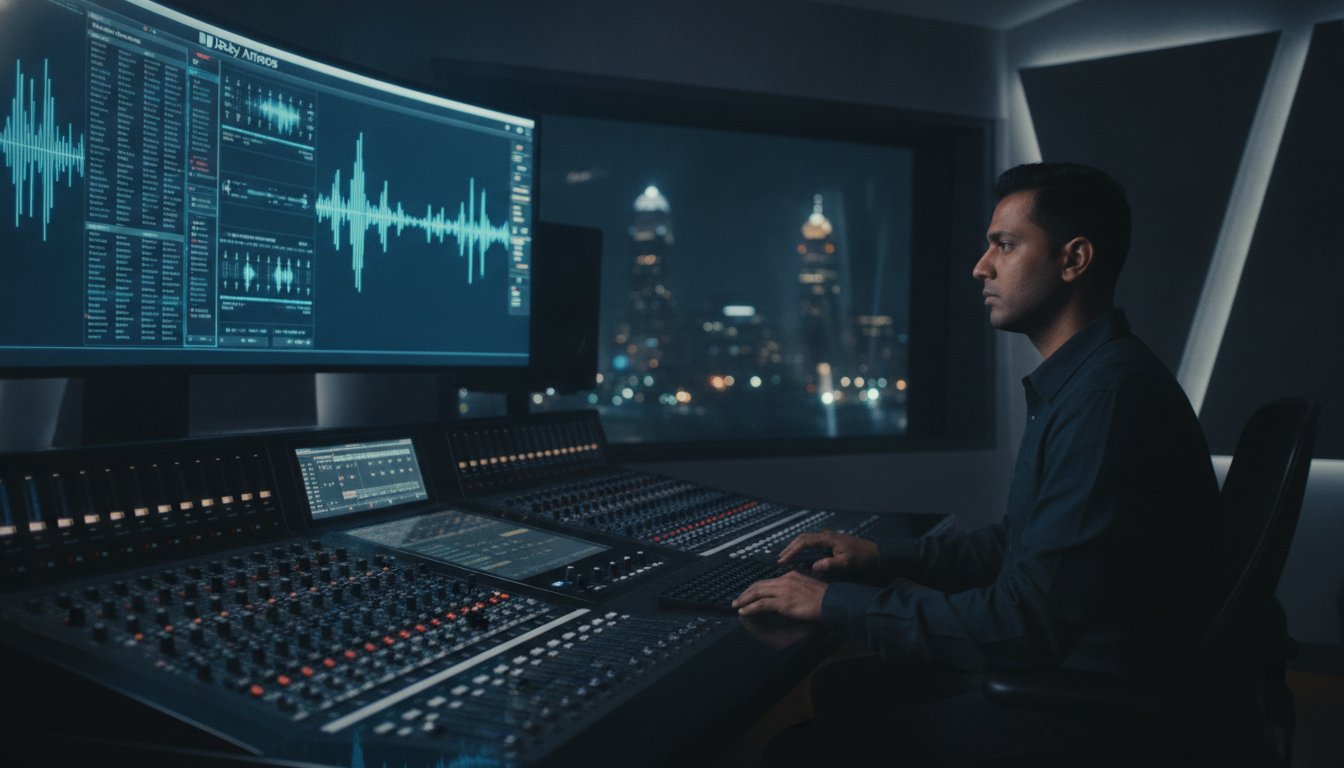
Why does your track sound like a Grammy contender in your studio monitors but completely lose its soul the moment it hits a car stereo? It's a common heartbreak for creators. You pour your spirit into a recording, yet the final result feels muddy, the vocals won't sit right, and the emotional impact you felt in the room just doesn't translate to the listener. You deserve more than a rough demo. One of the primary benefits of hiring a mixing engineer is the bridge they build between your raw creative energy and the polished, world-class sound that modern listeners demand.
We believe your work belongs in a creative sanctuary where technical precision meets artistic fire. In this article, you will discover how a professional engineer transforms your tracks into commercial-ready masterpieces while future-proofing your sound for the immersive world of Dolby Atmos. We will explore the high-fidelity edge of professional signal flow, the objective perspective of a seasoned mentor, and the essential steps to ensure your music commands attention on every streaming platform in 2026. From achieving radio-ready clarity to mastering the latest v5.4.1 Atmos workflows, it is time to give your music the professional finish it deserves.
Key Takeaways
- Understand how a mixing engineer acts as a sonic architect, balancing frequency and emotion to turn a technical recording into an evocative creative masterpiece.
- Learn why professional translation is the secret to ensuring your music sounds consistent and powerful across all listening environments, from high-end club systems to standard earbuds.
- Discover the essential benefits of hiring a mixing engineer to gain an objective perspective, helping you move past "demoitis" and hear your music with fresh, expert ears.
- Explore how Dolby Atmos 9.1.4 immersive mixing future-proofs your catalog for major streaming platforms and provides a distinct competitive advantage in the 2026 market.
- See how partnering with a collaborative mentor at a premier facility like Starsound Studios combines elite signal flow with a sanctuary-like environment for your creative vision.
What Does a Mixing Engineer Actually Do for Your Music?
Think of your raw recording as a blueprint. The tracking phase provides the foundation and the materials, but the mixing engineer is the architect of sound who balances frequency, space, and emotion to build the final structure. They don't just "fix" things; they elevate them. A mixing engineer acts as a technical translator of artistic intent, ensuring the raw energy of a performance survives the journey to a digital file. This transition from tracking to mixing is the most critical pivot point in your production. It's where a collection of isolated performances becomes a cohesive, living song.
One of the greatest benefits of hiring a mixing engineer is moving beyond simple volume adjustments into a realm of additive creativity. While a producer focuses on the arrangement, the engineer focuses on how those elements interact. Audio mixing (recorded music) involves a deep understanding of psychoacoustics and signal flow. It is about making choices that guide the listener's ear, highlighting the hook at exactly the right moment and ensuring the rhythm section feels like a physical force. They handle the technical heavy lifting so your artistic vision can shine without compromise.
The Balance of Frequency and Dynamics
Every instrument needs its own territory. Without a professional touch, frequencies often overlap, creating a "muddy" sound that fatigues the listener. Engineers use subtractive EQ to carve out space, removing unnecessary clutter to let the essential character of each sound breathe. They control the energy of the track through professional-grade compression, ensuring that a whisper is as audible as a scream without losing the life of the performance. This precision ensures your lead vocal doesn't just sit on top of the music; it commands the center of the arrangement with absolute clarity.
Creating a Three-Dimensional Soundstage
A great mix has width, depth, and height. By utilizing strategic panning and time-based effects like reverb and delay, an engineer creates a three-dimensional soundstage that pulls the listener in. There is a massive difference between a "flat" DIY mix and an immersive experience that feels like a physical environment. When considering the benefits of hiring a mixing engineer, the impact on listener engagement cannot be overstated. A professional mix uses stereo imaging to create a sense of scale, making your music feel expensive and expansive. This level of detail is what separates a bedroom demo from a track that feels at home on a major streaming editorial playlist.
The Technical Benefits: Translation, Fidelity, and Power
The bedroom is a liar. Without professional acoustic treatment, your listening environment is filled with standing waves, bass buildup, and frequency cancellations that hide the truth of your audio. One of the primary benefits of hiring a mixing engineer is gaining access to a surgically accurate space where every sonic decision is based on reality rather than guesswork. At Starsound Studios, our North Royalton facility serves as a technical sanctuary, providing the acoustic certainty required to hear the fine details of your signal flow. When you can trust what you hear, you can make bold, effective choices that translate to the real world.
Technical proficiency is the backbone of a successful release. In their overview of What Does a Mixing Engineer Do?, Berklee College of Music emphasizes that an engineer's role is to ensure a recording meets professional standards for clarity and impact. This isn't just about making things loud. It's about managing headroom and preparing your tracks so the mastering stage can achieve maximum punch without distortion. A professional mix provides the foundation for a world-class master, ensuring your music holds its own against major label releases on any 2026 streaming playlist.
The 'Car Test' Killer: Consistent Translation
We've all been there. The mix sounds massive in your headphones but thin and brittle in the car. This happens because home setups lack the monitoring accuracy to identify phase issues and low-end masking. Our calibrated 9.1.4 immersive system at Starsound Studios allows us to pinpoint these problems before they reach your listeners. Translation is ultimately about trust. When your fans hit play on AirPods, a smart speaker, or a club system, the emotional core of your song should remain identical. Professional monitoring removes the "hope" from the process and replaces it with guaranteed consistency.
High-End Gear vs. Plugin Emulations
Software has come a long way, but there is still an undeniable "air" and harmonic texture found only in real analog hardware. Elite signal flow makes a difference. High-end preamps, outboard compressors, and premium converters add a lifelike weight to digital audio that code cannot fully replicate. A seasoned pro uses these tools with speed and intention, carving out a professional sheen that feels expensive and polished. If you are looking to elevate your sound beyond the limitations of standard plugins, our stereo mixing services provide the high-fidelity edge your music needs.
Reliability is the final piece of the technical puzzle. A professional engineer understands the nuances of digital gain staging and sample rates, protecting your audio from the subtle degradation that occurs during export and upload. They act as a final gatekeeper of quality. By the time your tracks leave the studio, they aren't just mixed; they're optimized for the complex algorithms of modern streaming platforms, ensuring your artistic vision is delivered with absolute fidelity.
The Objective Ear: Why You Shouldn't Mix Your Own Songs
You have lived with your song since it was a mere hum in your voice memos. By the time you reach the mixing stage, you have likely heard every track hundreds of times. This deep familiarity is a double-edged sword. While it represents your passion, it also creates a psychological blind spot that makes true objectivity impossible. One of the most overlooked benefits of hiring a mixing engineer is the psychological reset they provide. An engineer doesn't just listen to your music; they hear it for the first time, every time, with the disciplined focus of a professional who isn't attached to the struggle of the recording process.
This fresh perspective is the only known cure for "Demoitis." This condition occurs when an artist becomes so accustomed to the flaws of a rough mix that those imbalances start to feel like "the sound" of the song. You might find yourself defending a muddy low-end or an buried vocal simply because that is how you have heard it for months. A professional engineer breaks this cycle. They act as a collaborative mentor, identifying which elements are essential and which are merely cluttering the narrative. While you are stuck in the stereo demo, a seasoned pro is already thinking about Future-Proofing Your Sound with Dolby Atmos to ensure your work meets the high-fidelity standards of 2026.
Identifying Blind Spots in the Arrangement
Frequency masking is often invisible to the person who recorded the tracks. You might be "deaf" to the way the keyboard's low-mids are swallowing the clarity of the snare drum. An engineer spots these conflicts instantly. They make the hard decisions about which instruments lead and which must support the arrangement. This outside perspective turns a crowded demo into a great record by ensuring every element has a dedicated purpose and a clear space to exist. It is the difference between a wall of noise and a masterpiece of clarity.
Emotional Pacing and Impact
Mixing is the final stage of storytelling. A professional uses automation to create energy shifts that keep a listener engaged from the first second to the final fade. They highlight the "hook" with surgical precision, using movement and depth to trigger emotional responses. There is also a massive psychological benefit to the "hand-off." Letting go of the technical burden allows you to return to your true role: the artist. When you trust a partner like Steve "The Mix" to handle the signal flow, you gain the confidence to focus on your next creation while knowing your current project is in expert hands. This collaborative synergy is one of the primary benefits of hiring a mixing engineer that DIY tools simply cannot replicate.

Future-Proofing Your Sound with Dolby Atmos Immersive Audio
Stereo has been the industry standard for over fifty years, but the horizon has shifted. In 2026, Dolby Atmos is no longer a luxury reserved for cinematic blockbusters; it is the new baseline for major label quality. This object-based format allows sounds to exist as individual entities within a 360-degree sphere. Instead of being restricted to a flat left-right plane, your music can move above, behind, and around the listener. One of the most significant benefits of hiring a mixing engineer is the ability to translate your artistic vision into this immersive world with technical precision.
Major streaming platforms like Apple Music and Amazon are actively prioritizing Atmos content in their algorithms and editorial playlists. This isn't just about a "new sound." It's about a competitive advantage. When a listener encounters a spatial audio track, the increased depth and clarity create an immediate emotional connection that standard stereo cannot match. To capitalize on this, you need a partner who understands the intricate metadata and fold-down requirements of immersive delivery. Starsound Studios offers Ohio’s premier destination for this production, featuring the state's first Dolby-certified 9.1.4 immersive audio suite led by Steve "The Mix."
The Shift from Stereo to Spatial Audio
Atmos provides a level of clarity that stereo simply cannot achieve because it physically separates instruments in a three-dimensional space. Imagine a dense arrangement where the backing vocals, percussion, and synths no longer fight for the same speaker real estate. The "wow" factor is undeniable. It gives your fans a premium experience they can't get from a standard MP3. However, achieving this requires a certified facility and specialized expertise. You can't "fake" a 9.1.4 mix on headphones; you need a calibrated environment to ensure the objects move exactly where they should.
Long-Term ROI of Professional Mixing
Investing in an immersive mix is an investment in the longevity of your catalog. As consumer hardware continues to evolve toward spatial playback, your music will be ready for the devices of tomorrow. Beyond the tech, there is a clear visibility benefit. Editorial playlists frequently favor spatial audio, giving independent artists a better chance to stand out in a crowded market. Atmos is not a passing trend, but the new global standard for high-resolution audio. If you are ready to elevate your release, explore our Dolby Atmos Mixing (9.1.4) services and secure your place in the future of sound.
Starsound Studios: Professional Mixing in Cleveland and Beyond
At the center of Starsound Studios is Steve "The Mix." He is more than a technician; he is a collaborative mentor who treats your artistic vision with the same reverence you do. Our North Royalton facility is designed as a creative sanctuary, a high-end space where the science of audio fidelity meets the spirit of creation. One of the primary benefits of hiring a mixing engineer at Starsound is the assurance that your project is in passionate, expert hands. We believe every track has a unique identity. Our job is to find the sonic signature that makes your work stand out in a crowded 2026 marketplace. Precision matters. Atmosphere counts.
Getting started is a straightforward, artist-centric process. To ensure a world-class result, we recommend preparing your stems by removing any non-essential processing and ensuring all tracks are clearly labeled. This preparation allows us to focus immediately on the creative signal flow and the emotional pacing of your song. When you hand off your project to a professional, you gain the freedom to return to your craft as a creator. You focus on the next song while we handle the technical heavy lifting. This synergy is one of the most practical benefits of hiring a mixing engineer to finalize your release.
Cleveland’s Only Dolby-Certified Atmos Studio
Ohio's music scene deserves world-class standards. Starsound Studios is proud to be the first Dolby-certified Atmos studio in the state, offering a 9.1.4 immersive audio suite that rivals the best facilities in Nashville or LA. Local artists no longer need to look toward the coasts to find elite post-production. Our North Royalton location provides a focused environment free from the sterile, corporate feel of many urban studios. We are committed to building the Ohio music community by providing professional-grade output that competes on a global level. Your music stays local, but your sound goes worldwide.
Seamless Remote Collaboration
Distance should never be a barrier to high-fidelity sound. Our remote mixing services bring the "Starsound Standard" to artists across the globe through a streamlined digital workflow. We have optimized our process for uploading tracks and receiving revisions, ensuring clear communication and a collaborative feel regardless of your time zone. Every project receives the same high-attention experience and access to our elite outboard gear. We are invested in your success. Elevate your sound with a professional mix at Starsound Studios and let us help you reach your highest creative potential.
Command the Future of Your Sound
Your music is more than just a digital file; it's your creative legacy. We've explored how the technical translation and objective perspective provided by a professional can turn a raw recording into a commercial masterpiece. From ensuring your tracks punch through on every playback system to future-proofing your catalog for the immersive world of spatial audio, the benefits of hiring a mixing engineer are clear. It's about moving beyond the limitations of the bedroom studio and embracing the high-fidelity edge of a world-class facility.
At Starsound Studios, we provide the ultimate creative sanctuary. As Ohio's first Dolby-certified Atmos studio, our 9.1.4 immersive audio suite is designed to push your art into new dimensions. Led by Steve "The Mix," our collaborative approach ensures that your unique identity remains the priority throughout the entire production. Don't let your vision get lost in a muddy mix or a flat stereo field. Ready to hear your music's full potential? Book a session at Starsound Studios today. Your highest potential is within reach, and we're here to help you capture it with absolute precision.
Frequently Asked Questions
How much does it cost to hire a mixing engineer in 2026?
Professional mixing rates in 2026 typically range from $200 to $2,000 per song depending on the engineer's experience and track complexity. Mid-tier professional engineers, who are the standard for serious independent artists, generally charge between $300 and $700 per track. High-end, major-label-tier engineers can charge $2,000 or more, while entry-level services often fall in the $100 to $250 range.
What is the difference between mixing and mastering?
Mixing is the process of balancing individual tracks like vocals, drums, and guitars to create a cohesive stereo or immersive file. Mastering is the final step that polishes that stereo mix for distribution, ensuring consistent volume and tonal balance across an entire release. One of the benefits of hiring a mixing engineer is that they provide a balanced foundation, making the mastering stage more effective.
Can a mixing engineer fix bad vocal recordings?
Engineers can use manual pitch correction and timing tools to significantly improve a vocal performance. While technical cleanup can save a track, it cannot fully replace the energy of a well-recorded source. High-fidelity results are always best achieved when the original recording is captured with professional-grade preamps and proper acoustic treatment.
How long does it take to mix a single song professionally?
A professional mix typically takes between four and eight hours of dedicated work to complete. This timeframe varies based on the track count and the complexity of the arrangement. A song with 80 tracks requires significantly more time for frequency carving and automation than a simple acoustic recording with 10 tracks.
What files do I need to send to a mixing engineer?
You should provide consolidated, dry WAV or AIFF stems that all start at the same timecode. Ensure your tracks are clearly labeled and exported at their native sample rate and bit depth. It is also standard practice to include a rough mix so the engineer understands your artistic intent and the emotional pacing of the project.
Is it worth hiring a mixing engineer for a home recording?
Hiring a pro for home recordings is often the most effective way to hide the technical limitations of a bedroom setup. A seasoned engineer can mitigate room resonances and noise issues that DIY plugins often struggle to handle. This expertise ensures your home-recorded spirit is delivered with a polished, commercial-ready sheen.
Why is Dolby Atmos mixing more expensive than stereo mixing?
Dolby Atmos requires specialized object-based panning and a certified 9.1.4 monitoring environment to ensure accuracy. The technical process involves more complex metadata management and the use of the latest software like the Dolby Atmos Renderer v5.4.1. Because it involves mixing for a 360-degree sound field rather than just two speakers, the time and equipment requirements are higher.
How many revisions are typically included in a mixing service?
Most professional mixing engineers include two to three rounds of revisions in their standard per-track rate. This allows the artist to provide feedback on the balance and energy of the mix to ensure the final result matches their vision. Clarifying the number of included revisions before work begins is a standard part of a reliable, artist-centric workflow.


