
A Dolby Atmos mix should open up a song without pulling it away from what makes it yours. If you’re searching for a Dolby Atmos mixing studio Cleveland artists can work with, look beyond the number of speakers. You need a properly configured listening environment and an engineer who keeps your creative intent at the center.
Starsound Studios, in North Royalton, is Ohio’s first and only Dolby-certified Atmos mixing studio. Its 9.1.4 environment serves Greater Cleveland artists, and remote mixing is available to clients beyond Northeast Ohio. A studio’s room setup, workflow, and collaborative approach all matter when you’re choosing where to take your music.
This guide explains what to look for in an immersive mixing setup, how an Atmos mix takes shape, and what to prepare when delivering your multitrack session. You’ll also find practical ways to share your creative priorities so the finished mix feels expansive while staying true to the song and your release plans.
Key Takeaways
- Learn how immersive placement differs from stereo mixing, and how spatial choices can serve the song without losing its identity.
- Understand what the numbers in a 9.1.4 monitoring layout describe and why the listening environment matters to mix decisions.
- When comparing a Dolby Atmos mixing studio Cleveland artists can work with, consider the room configuration, engineer communication, and workflow alongside certification.
- Prepare a smoother handoff by organizing your multitrack files and sharing a stereo reference, track notes, and creative priorities.
- See how Starsound Studios in North Royalton supports local and remote collaboration on Dolby Atmos mixes.
Choosing a Dolby Atmos Mixing Studio Near Cleveland: What the Service Includes
Dolby Atmos mixing changes how listeners experience a song. Rather than placing every sound only across a left-to-right stereo image, an engineer can position elements within a three-dimensional sound field. That creates more spatial possibilities than stereo and a different approach from surround formats built around fixed speaker channels. The goal isn’t movement for its own sake. It’s to open up the recording while keeping the song’s emotion, balance, and identity intact.
For a foundational overview of the technology, explore Dolby Atmos. For a music-focused explanation of the format and mixing process, read the Dolby Atmos mixing guide.
What makes Dolby Atmos mixing different from stereo?
Stereo mixing shapes a two-channel image, using level, panning, and other mix decisions to create width and depth between the left and right speakers. Atmos adds the possibility of placing sounds around and above the listener. For example, an engineer might keep the lead vocal anchored in front while giving backing vocals or ambient textures more space. That’s one possible approach, not a preset formula. Each placement should support the artist’s vision and the song’s character.
Where is the Cleveland-area Dolby Atmos studio?
Starsound Studios is in North Royalton, Ohio, and serves artists across Greater Cleveland. Local musicians can collaborate with the studio in person, while artists outside Northeast Ohio can work remotely without traveling. In either case, the creative direction starts with the music and the artist’s priorities.
Choosing a Dolby Atmos mixing studio Cleveland artists can work with means considering both the technical setting and the collaborative approach. The format creates new ways to shape space, but the artist remains the guide. Clear priorities, a strong stereo reference, and focused conversations help keep the immersive mix connected to the original musical intent.
How a 9.1.4 Dolby Atmos Mixing Room Supports the Mix
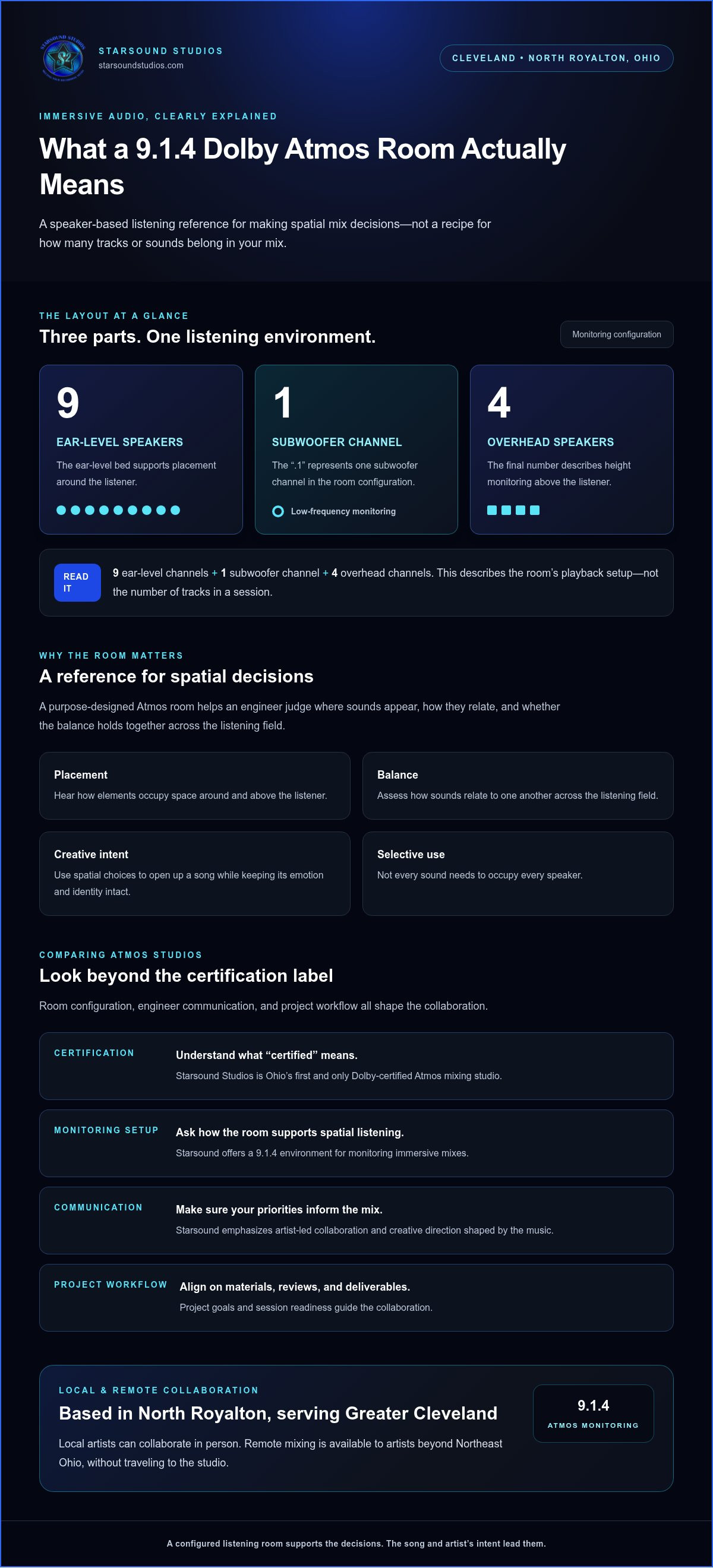
A spatial mix depends on more than creative choices in a digital audio workstation. The engineer also needs a reliable listening environment to judge where sounds appear, how they relate to one another, and whether the balance holds together across the room. A purpose-designed Atmos room provides a speaker-based reference for those decisions, helping turn artistic intent into a mix that feels intentional rather than merely spread out.
What does 9.1.4 mean in an Atmos studio?
A 9.1.4 layout describes nine ear-level speaker channels, one subwoofer channel, and four overhead speaker channels. It doesn’t guarantee a particular mix quality. The nine speakers form the ear-level bed, while the four overhead speakers provide height monitoring. This describes the room’s playback configuration, not the number of tracks in your session. A production can use spatial elements selectively; not every sound needs to occupy every speaker.
Starsound Studios offers Dolby Atmos mixing in a 9.1.4 environment. Monitoring through a layout built for immersive audio lets the engineer make placement and balance decisions while hearing how sounds interact across the listening field. Dolby’s explanation of how Dolby Atmos works offers more detail on the format’s object-based approach and rendering process.
Why ask whether a studio is Dolby-certified?
Certification language needs context. Dolby-certified Atmos mixing is part of Starsound Studios’ service, and the studio is Ohio’s first and only Dolby-certified Atmos mixing studio. When comparing facilities, consider what the room can do in practice as well as the certification label: the monitoring configuration, the engineer’s experience, how you’ll communicate creative priorities, and how you’ll review the mix. Technical readiness matters, and so does feeling heard.
For Cleveland artists, a Dolby Atmos mixing studio Cleveland search should lead to a room and an engineer suited to the work, not just a label. Starsound Studios is in North Royalton and serves Greater Cleveland. Explore Starsound Studios for Dolby Atmos mixing grounded in your project’s creative goals.
How to Compare Dolby Atmos Mixing Studios in Cleveland
A studio that works in surround audio isn’t automatically equipped or experienced for Dolby Atmos music mixing. The format has its own monitoring and production considerations, so compare more than a service description. Look at the listening environment, the engineer’s role, and how your creative direction will shape the work. For broader local-studio context, see the Cleveland recording studio guide.
| What to compare | What it tells you | Starsound context |
|---|---|---|
| Certification claims | Understand what “certified” means, and consider whether the studio’s setup supports Atmos monitoring rather than surround capability alone. | Starsound is Ohio’s first and only Dolby-certified Atmos mixing studio and offers mixing in a 9.1.4 environment. |
| Monitoring configuration | Consider how the room supports spatial listening decisions, including height and ear-level placement. | The 9.1.4 layout is designed for monitoring immersive mixes. |
| Engineer communication | Know who will shape the mix and how your references, notes, and artistic priorities will inform decisions. | Starsound emphasizes artist-led collaboration. |
| Project workflow | Align on session materials, review opportunities, and deliverables before mixing begins. | Project goals and session readiness guide the collaboration. |
Which questions should artists ask before choosing a studio?
Use an initial project conversation to establish the essentials: What monitoring configuration will be used? Who will engineer the mix? How can you review it and share notes? Which session materials should you provide, and what deliverables are included in the agreed scope? Clear answers help prevent technical assumptions from distracting from the music once mixing is underway.
Technical fit is only half the decision. A good process leaves room to explain what should remain fixed, what could benefit from added space, and how you’ll evaluate revisions. Berklee’s overview of immersive audio mixing techniques can help artists understand the creative choices involved.
How do you decide whether Atmos suits your release?
Start with purpose. Consider whether the arrangement offers meaningful spatial possibilities, such as distinct backing vocals, layered textures, or environmental elements that could benefit from placement. Then weigh that creative case against your release plan and how your intended audience may listen. An Atmos mix doesn’t guarantee platform placement, audience reach, or commercial performance. It’s a format choice, and the best reason to make it is that it serves the music.
When comparing a Dolby Atmos mixing studio Cleveland artists can work with, prioritize a capable monitoring environment and a workflow that gives your artistic intent a clear place from the first conversation through review.
Preparing Your Music for Dolby Atmos Mixing in Cleveland
A well-organized handoff gives the engineer more room to focus on the music. Before sending files to a Dolby Atmos mixing studio Cleveland artists can work with, align on the project scope, technical requirements, review process, and intended release. File formats and delivery preferences can vary, so follow the studio’s instructions instead of relying on a supposed universal standard.
What should you send a Dolby Atmos mixing engineer?
Start with a clear project brief, then prepare the session materials requested for the agreed workflow. That may mean organized multitracks or a session package. Include a stereo reference mix so the engineer can hear the existing balance and the overall character you want to preserve.
- Confirm the scope: Agree on which song or songs are included, the creative goals, and the expected deliverables.
- Organize the files: Use clear track names and a consistent folder structure. Follow the studio’s preferred file formats, naming conventions, and delivery requirements.
- Share useful references: Include the stereo mix and concise notes about key elements, such as a vocal that should stay prominent or a texture you’d like explored spatially.
- Check the handoff: Before sending, make sure the package follows the studio’s instructions and includes the agreed materials.
Keep notes specific and easy to scan. “Keep the lead vocal intimate in the second verse” gives clearer direction than “make it bigger.” If effects or processing define the sound of your stereo reference, discuss how they should be represented in the session materials.
How can you give useful mix feedback?
Useful feedback points to a moment, sound, or feeling. Note the section of the song, identify the element, and describe what you’re hearing or hoping to hear. For example: “At the final chorus, the backing vocals could feel more open, but the lead should remain the focus.” Separate essential changes from optional ideas so the core of the song stays clear while creative experiments have room to be considered.
Before mixing begins, agree on how you’ll review the work, share notes, and communicate during the process. Consolidated feedback helps the engineer respond to the full picture instead of piecemeal comments. For a broader session-handoff reference, see the professional mixing preparation checklist.
Ready to shape your project handoff and creative priorities? Discuss your Dolby Atmos mix with Starsound Studios.
Book a Dolby Atmos Mix with Starsound Studios in North Royalton
For artists looking for a Dolby Atmos mixing studio Cleveland musicians can reach locally, Starsound Studios is based in North Royalton and serves Greater Cleveland. The studio offers Dolby Atmos mixing in a 9.1.4 environment, with remote collaboration for artists outside Northeast Ohio. Starsound is Ohio’s first and only Dolby-certified Atmos mixing studio. The room, engineer, and collaborative process all contribute to a project’s fit.
What to discuss in your first studio conversation
Bring a clear picture of the release and the music. You don’t need every technical detail settled before starting the conversation; a snapshot of the project helps establish useful next steps.
- Release goal: Share where the track is in its release plan and why you’re considering an Atmos mix.
- Session status: Explain whether the recording and stereo mix are complete, and what session materials you have ready.
- Creative direction: Describe what should stay true to the existing mix and where you’re open to exploring spatial possibilities.
- Project details: Discuss file requirements, review workflow, service scope, and deliverables.
These details create a shared starting point. Artists in Greater Cleveland can work with Starsound in person, while remote collaboration gives artists beyond the area another way to work together. The conversation can focus on the sound and the practical path from session files to an immersive mix.
Start your Cleveland-area Atmos mixing project
Starsound’s work is built around technical precision and artist-led collaboration. Your references and priorities help frame the mix, while the studio’s 9.1.4 environment supports spatial decisions. If you’re also considering a stereo version or final mastering, Starsound offers stereo mixing and mastering as related services alongside Dolby Atmos mixing.
Start with the song, the vision behind it, and where you are in the process. Talk with Starsound Studios about your Dolby Atmos mix.
Bring Your Music Into the Mix
The right immersive mix starts with a room equipped for spatial monitoring, an organized session handoff, and an engineer who treats your creative priorities as the guide. A 9.1.4 environment supports detailed placement decisions, while clear references and focused feedback help keep the mix connected to your song’s identity and release plans.
Starsound Studios is in North Royalton and serves Greater Cleveland artists, with remote mixing available beyond the area. As Ohio’s first and only Dolby-certified Atmos mixing studio, Starsound combines an immersive monitoring environment with artist-led collaboration. Your references and priorities help shape the mix around the music.
Ready to explore what immersive mixing could bring to your track? Talk with Starsound Studios about your Dolby Atmos mix. Start with your vision and your music. The next creative dimension can grow from there.
Frequently Asked Questions
What is Dolby Atmos mixing for music?
Dolby Atmos mixing creates an immersive version of a song by placing sounds within a three-dimensional audio field, rather than limiting placement to the left and right channels of stereo. An engineer can shape the sense of space around elements such as vocals, instruments, and ambience while keeping the arrangement’s character intact. The aim isn’t to make every sound move, but to use spatial placement where it supports the music and the artist’s intent.
Is Dolby Atmos mixing different from surround sound mixing?
Yes. Traditional surround mixing is commonly organized around a fixed set of speaker channels, while Dolby Atmos can use audio objects that a renderer positions for compatible playback systems. This allows sound to be placed around and above the listener, rather than only across a horizontal speaker layout. The formats are related, but a studio with surround capability isn’t necessarily set up for Dolby Atmos music production or monitoring.
Do I need a Dolby-certified studio for an Atmos mix?
Look for an engineer and monitoring environment prepared for Atmos, and consider the certification alongside the practical setup. Starsound Studios is Ohio’s first and only Dolby-certified Atmos mixing studio, with a 9.1.4 environment. The room configuration, the engineer’s experience, and the way the studio collaborates with you all matter to the finished mix.
Can I work with a Cleveland Dolby Atmos mixing studio remotely?
Yes. A Cleveland-area Atmos project can be handled remotely when the artist and studio agree on the session handoff, communication, and review process. Starsound Studios works with remote clients, so artists outside Northeast Ohio can collaborate without traveling to North Royalton. Share the project scope, your stereo reference, creative priorities, and current session status, then follow the studio’s directions for preparing and delivering files.
What should I send a Dolby Atmos mixing engineer?
Prepare the multitracks or session package requested for the project, along with a stereo reference mix and concise notes about the sound you want to preserve or explore. Organized track names and files make the session easier to understand. Include details about essential elements, such as a lead vocal that should remain prominent. File formats and delivery requirements can vary, so follow the engineer’s project-specific instructions rather than assuming one standard.
How do I know if my song is suitable for Dolby Atmos?
A song may suit Atmos if its arrangement offers meaningful opportunities to shape space, such as layered vocals, distinct instrumental parts, or atmospheric textures. Complexity isn’t required, and a mix doesn’t need constant movement. Consider whether an immersive version supports the song’s emotional intent and fits your release plans. Discuss what should remain anchored, where you’re open to experimentation, and how you expect listeners to experience the music.
Where is Starsound Studios located near Cleveland?
Starsound Studios is located in North Royalton, Ohio, and serves artists across Greater Cleveland. The studio offers Dolby Atmos mixing in a 9.1.4 environment, with remote collaboration for clients beyond Northeast Ohio. Local artists can work with the studio in person, while remote artists can coordinate around their session materials and creative goals. The studio also offers stereo mixing and mastering as related services.


