

What if the only thing standing between your current demo and a global streaming hit isn't a better plugin, but the very walls surrounding you? You have likely spent late nights tweaking every frequency, yet that nagging feeling remains when you hit play on a different system. The low-end that felt powerful in your headphones suddenly sounds muddy in the car, and those intimate vocals now feel thin or boxy. It's frustrating to feel like your creative vision is being muffled by technical limitations you can't quite pin down.
We understand that every artist reaches a crossroads where they must weigh the convenience of a home studio vs professional studio. You deserve a result that translates perfectly across every platform, from smartphone speakers to high-end club systems. This article explores the critical differences in acoustic fidelity, the power of an objective engineering partner, and the technical edge of immersive audio. Discover how to transition from a DIY workspace to a dedicated creative sanctuary where your music finally achieves its full potential.
Key Takeaways
- Identify the invisible acoustic barriers like room modes that prevent your home recordings from sounding consistent across different playback systems.
- Navigate the technical gap between a home studio vs professional studio by exploring how premium signal chains and high-end converters define industry-standard fidelity.
- Unlock the power of an objective second ear to handle complex technical troubleshooting so you can focus entirely on your artistic performance.
- Explore why immersive audio formats like Dolby Atmos 9.1.4 are becoming essential for modern releases and why they require a certified environment for true precision.
- Learn how to implement a hybrid workflow that uses your personal space for inspiration while utilizing a professional sanctuary for final mixing and mastering.
The Landscape of Modern Music Production: Home Studio vs. Professional Studio
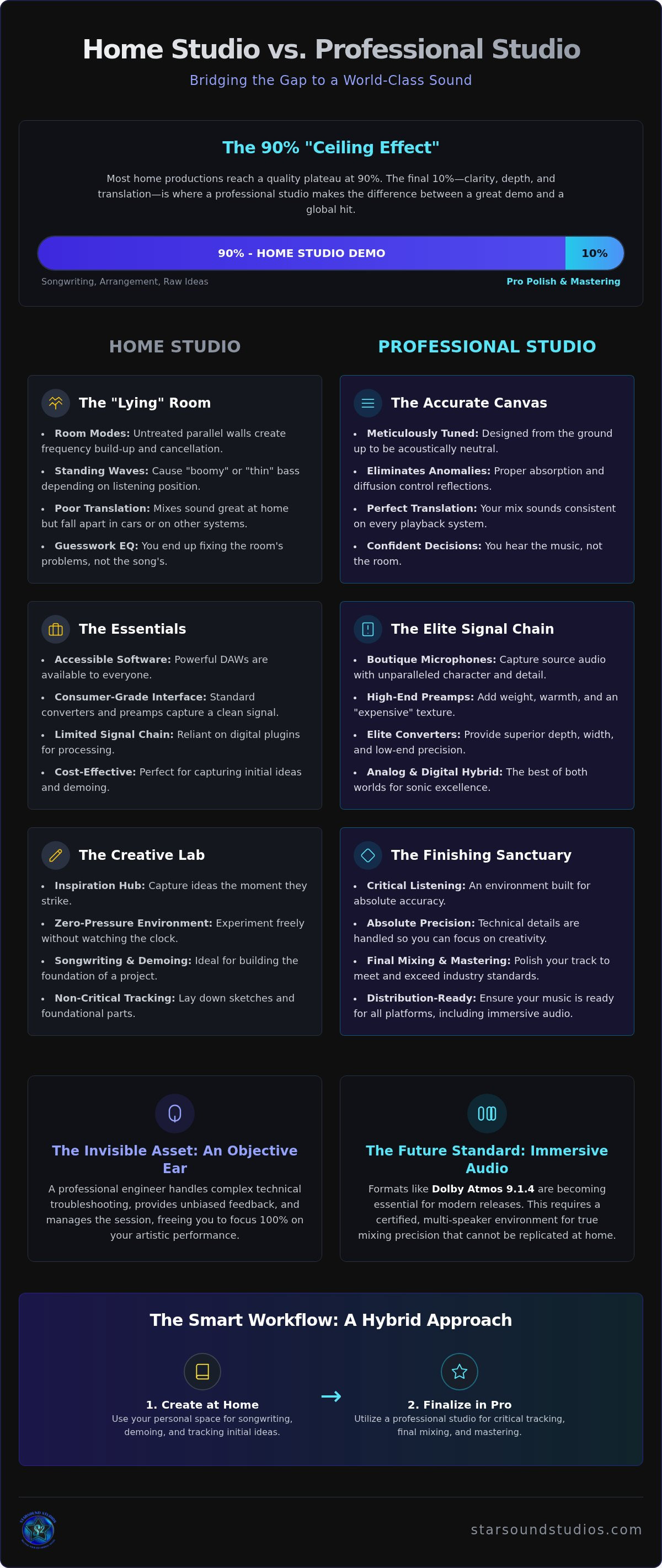
The barrier to entry has vanished. Today, a bedroom producer can access the same software used by world-class engineers. This rise of the "record room" has fundamentally changed how we create. It allows for endless experimentation without a ticking clock. However, as we move through 2026, the debate of home studio vs professional studio isn't about accessibility. It's about the "ceiling effect."
Most home-produced tracks hit a quality plateau at about 90%. That final 10% is where the magic happens. It's the difference between a great demo and a song that commands attention on a global streaming level. Modern listeners expect a level of depth, width, and low-end precision that a spare bedroom simply cannot provide. Professional standards now require more than just a laptop and an interface. They demand a space where the science of the medium meets the art of creation.
The gear is accessible. The knowledge is everywhere. Yet, the gap remains. This gap isn't just about the price of a microphone. It's about the intentionality of the environment. A professional studio is designed from the ground up to be a neutral canvas. Home rooms are often fighting against their own architecture. This creates a deceptive listening experience that leads to "lying" mixes. Weighing the benefits of a home studio vs professional studio requires looking at the final destination of your music.
The Purpose of the Home Setup
Your home setup is your laboratory. It's where you're free to fail, rewrite, and explore without financial pressure. It's the perfect tool for capturing that raw, late-night inspiration that defines your sound. Use this space for songwriting, demoing, and tracking non-critical elements. The comfort of a zero-pressure environment is unbeatable for initial experimentation. It's where the soul of the project is often born. It's a cost-effective way to track ideas before committing to a high-end recording session.
The Purpose of the Professional Facility
A professional facility is a dedicated creative sanctuary. It's built for critical listening and absolute accuracy. When you step into a pro environment, you're accessing a signal chain that plugins cannot replicate. High-end preamps, boutique microphones, and elite converters add a palpable weight and "expensive" texture to your audio. Beyond the gear, it's about meeting 2026 distribution standards. With the industry moving toward immersive formats like Dolby Atmos, the professional studio provides the specialized monitoring needed to ensure your work translates perfectly across every playback system. It's where technical details are handled with absolute precision so you can remain in your creative flow. Here, the engineering isn't a hurdle; it's a catalyst.
The Acoustic Truth: Why Your Home Record Room Might Be Lying to You
Your bedroom walls are whispering secrets, but they aren't the ones you want to hear. In the debate of home studio vs professional studio, the biggest differentiator isn't the gear; it's the air. Most residential spaces suffer from room modes and standing waves. These invisible acoustic anomalies cause certain frequencies to build up or vanish entirely based on where you stand. You might think your kick drum is thunderous, but you're actually just sitting in a bass "hot spot" created by the room's geometry. The moment you move six inches, that power disappears.
This leads to the dreaded translation problem. Every artist has experienced the frustration of a mix that sounds incredible at home but falls apart in the car. The vocals vanish. The low-end becomes a muddy mess. This happens because your home environment is lying to you; it's forcing you to make EQ decisions to "fix" the room rather than the song. To achieve a truly world-class sound, Starsound Studios utilizes a meticulously tuned environment to eliminate this guesswork. This ensures your creative vision remains intact across every speaker system, from earbuds to festival stacks.
Acoustic Treatment vs. Room Correction Software
Many creators try to bypass physics with room correction software. While these digital tools can help flatten a frequency response, they cannot fix physical nulls or long decay times. Software can't stop a sound wave from bouncing off a drywall surface and creating a smear. There is a massive difference between "deadening" a room with cheap foam and "tuning" a space with professional diffusion. High-end diffusion scatters sound energy rather than just killing it, creating a wider and more accurate soundstage that makes your stereo imaging pop with life.
Monitoring: Hearing the Full Spectrum
Accuracy requires more than just decent speakers. Most home monitors struggle to reproduce the sub-bass region with any real precision. You're effectively mixing blind in the lowest octaves. Professional monitoring chains involve elite D/A converters and calibrated speaker systems that reveal the full frequency spectrum without bias. It's about the confidence of knowing that what you hear is exactly what is there. When you stop guessing, you start making better creative decisions. If you're ready to experience this level of clarity, consider how a professional stereo mixing session can transform your perspective.
Beyond the Laptop: Equipment and Signal Flow Differences
Software has closed the gap, but the physical signal chain remains a definitive boundary in the home studio vs professional studio comparison. In a dedicated facility, the path your sound takes is curated for maximum harmonic richness. It is not just about one piece of gear. It is about the cumulative effect of fifty tracks passing through high-end circuitry. This creates a depth and "expensive" texture that digital emulations often struggle to replicate. While plugins are incredible for convenience, they lack the physical voltage that adds weight to a vocal or punch to a snare.
Headroom is the silent hero of professional production. When you mix entirely "in the box," you are limited by the math of your software. Professional facilities utilize analog summing and elite A/D converters to preserve every nuance of your performance. This hardware-centric approach provides a sense of air and space that feels three-dimensional. It transforms a flat, digital recording into a living, breathing piece of art. At Starsound Studios, we treat the signal flow as a creative instrument in its own right.
Microphones and Preamps: The Front End
The front end of your recording determines the ceiling of your mix. Budget-friendly clones of classic microphones can get you close, but they often introduce a subtle digital harshness in the high frequencies. Authentic "desert island" microphones paired with high-voltage preamps capture transients with absolute precision. This combination smooths out the source material before it even hits your hard drive. By reducing harshness at the source, you spend less time "fixing" audio and more time refining the performance. It is a more efficient, inspired way to work.
The Dolby Atmos Advantage
As we look toward the standards of 2026, stereo is no longer the only finish line. Immersive audio is becoming the mandatory standard for major platforms like Apple Music and Tidal. Achieving an accurate Dolby Atmos mix in a bedroom is nearly impossible. The technical hurdles of a 9.1.4 speaker array, which includes nine surround speakers, a subwoofer, and four overhead channels, require a certified environment. Our 9.1.4 suite offers a level of immersion that home setups simply cannot replicate. Utilizing professional Dolby Atmos mixing in Cleveland is the most effective way to future-proof your music. It ensures your project is ready for the next generation of listeners who demand a fully holographic audio experience.
The Invisible Asset: Professional Engineering and Creative Direction
You can buy the same plugins as a pro, but you can't buy their ears. In the home studio vs professional studio debate, the human element is often the most undervalued component. An objective "second ear" is your biggest secret weapon. When you're too close to a project, it's easy to lose perspective on the sonic balance. A professional engineer brings a fresh, unbiased viewpoint that identifies exactly what a track needs to compete on a global scale. They don't just turn knobs; they interpret your vision through a technical lens.
Efficiency is where the value becomes undeniable. A seasoned expert often achieves a better sound in a single hour than a DIY creator does in ten. Instead of spending your session wondering "why is this buzzing?" or fighting a technical glitch, you stay in your creative zone. At Starsound Studios, Steve "The Mix" brings over 10 years of experience to the table. He acts as a collaborative mentor, guiding you through the process to ensure your performance is captured with absolute precision. This partnership eliminates the guesswork that often stalls independent projects.
The Engineer as a Technical Gatekeeper
Technical excellence starts long before the mixing stage. A pro engineer ensures proper gain staging and phase coherence from the very first take. They utilize advanced editing and vocal alignment techniques that provide a polished, radio-ready foundation. This level of preparation is vital when moving toward professional mixing and mastering services. By handling the technical gatekeeping, the engineer allows the music to breathe without the clutter of amateur mistakes. It's about getting it right at the source rather than trying to "fix it in the mix."
The Creative Psychology of a Pro Studio
There is a powerful psychological shift that happens when you step into a dedicated creative sanctuary. The "Red Light" effect focuses your energy in a way that a bedroom setup simply cannot. You're no longer the producer, engineer, and artist all at once. Removing this hat-switching fatigue allows you to reach your highest potential as a performer. For those who want to bridge the gap, accessing hands-on audio engineering classes can help you master these concepts for your own space. Ultimately, the partnership between artist and engineer is what transforms a good song into a timeless record. Ready to elevate your next project? Explore our professional recording and mixing services today.
When to Move to a Professional Studio in Cleveland
The choice between a home studio vs professional studio often boils down to your final objective. If you're building a demo to share with bandmates, your bedroom is plenty. However, if you're aiming for a commercial release that stands tall against industry giants, you need the translation and depth only a tuned facility provides. It's an investment in your career's longevity. A world-class sounding record is your calling card to labels, playlisters, and fans. It represents your brand with the seriousness your art deserves.
Investing in professional production offers a tangible return on inspiration. When your music sounds like it belongs on the global stage, you gain the confidence to market it aggressively. You stop apologizing for the "lo-fi" quality and start celebrating the sonic impact. At Starsound Studios, we help you bridge that final gap. We transform raw creative energy into a polished, competitive product that translates across every playback system in existence.
Signs You’ve Outgrown Your Home Studio
You'll know it is time to transition when your creative vision feels muffled by your environment. Perhaps your tracks sound "small" or narrow compared to your favorite artists on Spotify. You might be struggling with persistent low-end clarity or a vocal "mud" that no amount of EQ can seem to fix. If you're ready to embrace the future of music with immersive Dolby Atmos, a home setup simply won't suffice. These are the signals that your artistic vision has expanded beyond your physical walls. It is time to step into a space that can handle your ambition.
- Your mixes consistently fail the "car test" despite hours of tweaking.
- You lack the specialized monitoring required for 9.1.4 immersive audio.
- The technical side of engineering is draining your creative stamina.
- You need an elite signal chain to capture the true character of your voice.
How to Bridge the Gap
You don't have to choose one or the other. Many modern creators adopt a hybrid workflow that maximizes both convenience and quality. Record your guitars and synthesizers at home where you're most comfortable experimenting. Then, book a dedicated vocal tracking day at our North Royalton facility to capture elite performances through a premium signal chain. For those working outside of Ohio, our remote mixing and remote mastering services provide global-tier quality without the travel. It’s the most efficient way to ensure your project receives the professional attention it deserves.
Taking the next step is about partnership. We invite you to contact Starsound Studios to discuss your project vision and how we can help you achieve industry-standard fidelity. You can even book a tour of our North Royalton sanctuary to see our Dolby-certified 9.1.4 Atmos suite in person. Your music is your identity. Don't let technical limitations define it. Reach out today to start the conversation and give your next project the world-class foundation it needs.
Elevate Your Sonic Identity for 2026
The journey from a bedroom demo to a world-class release is defined by the choices you make for your sound. Deciding between a home studio vs professional studio is about knowing when your vision requires a higher ceiling to truly breathe. By stepping into a calibrated environment with elite engineering, you eliminate the guesswork that often holds back independent projects. You gain the confidence that your music will translate perfectly across every playback system, from earbuds to the biggest festival stages.
Starsound Studios is more than just a technical facility; it's a creative sanctuary in North Royalton where Steve "The Mix" brings over a decade of award-winning expertise to every project. As Ohio’s only Dolby-certified 9.1.4 Atmos facility, we provide the immersive precision needed to future-proof your music for the next generation of listeners. Your art deserves to be heard exactly as you intended, with the depth and clarity that only a professional sanctuary can provide. Ready to elevate your sound? Book a session at Starsound Studios today and let's bring your highest creative potential to life.
Frequently Asked Questions
Is a professional studio worth the money for an independent artist?
A professional studio provides the translation and finality needed to compete on global streaming platforms. While a home studio is great for songwriting, a pro environment ensures your music sounds consistent across all playback systems. This investment shifts your project from a bedroom demo to a commercial release. It's about the ROI of a world-class sounding record that labels and playlisters take seriously.
What is the biggest difference between home and pro studio acoustics?
The primary difference is the management of low-end frequencies and room modes. Professional facilities are meticulously tuned to provide a neutral listening environment, whereas home rooms often suffer from standing waves that "lie" to your ears. When you compare a home studio vs professional studio, the pro space eliminates the guesswork. This allows for precise EQ decisions that ensure your mix translates perfectly in the car.
Can I record at home and have it mixed at a professional studio?
Absolutely, this hybrid workflow is extremely common in 2026. You can capture your initial inspiration and non-critical tracking in your personal space, then utilize remote mixing or mastering for the final polish. Starsound Studios frequently works with Cleveland artists who track at home but want our elite signal chain and 9.1.4 monitoring for the final result. It's a cost-effective way to achieve industry-standard audio fidelity.
Do I need a professional studio for Dolby Atmos music?
Yes, achieving an accurate Dolby Atmos mix requires a certified environment and a specific 9.1.4 speaker array. Most home setups lack the physical space and acoustic treatment to manage thirteen separate audio channels with precision. As Ohio’s first and only Dolby-certified Atmos mixing studio, Starsound Studios provides the technical infrastructure that is impossible to replicate in a residential bedroom. Professional certification ensures your immersive mix meets the strict requirements of Apple Music.
What should I bring to my first professional recording session?
You should arrive with your multi-track files or stems clearly labeled and organized on a reliable drive. Bring high-quality reference tracks that represent your desired sonic direction, along with printed lyrics and any specific creative notes. Preparation is the key to maintaining your creative flow. Being organized allows Steve "The Mix" to focus entirely on the art and technical precision of your performance rather than troubleshooting file compatibility.
How do I know if my home studio is "good enough" for tracking?
Your home setup is likely sufficient for tracking if you have a low noise floor and minimal room reflections. Listen for "boxiness" in your vocals or a lack of clarity in the low frequencies. If your recordings sound professional enough to be "fixed" with a high-end mix, you've reached the limit of your home studio vs professional studio utility. If the raw source material sounds thin or noisy, it's time to book a pro tracking session.
Why do my home recordings sound thin compared to professional ones?
Home recordings often sound thin because they lack the harmonic richness and headroom provided by high-voltage analog hardware. Professional signal chains add weight and "expensive" texture that digital plugins struggle to mimic. Beyond the gear, the expertise of a seasoned engineer like Steve "The Mix" ensures that your tracks are captured with proper gain staging. This professional foundation prevents the digital harshness that frequently plagues DIY recordings and results in a fuller sound.
Is it better to buy more gear or book studio time?
Booking studio time is generally a better investment if your goal is a finished, competitive product. Buying gear requires a steep learning curve and constant troubleshooting that can drain your creative energy. When you book time at our North Royalton creative sanctuary, you're not just renting equipment; you're accessing a decade of engineering expertise and a tuned environment. This approach guarantees a world-class result today rather than a slightly better demo months from now.


