

What if the secret to a competitive, radio-ready record in 2026 isn't actually turning it up? It's a frustrating reality for many creators. You spend weeks perfecting a mix, only to find it sounds thin, quiet, or strangely distorted once it hits the major services. The truth is that mastering for streaming platforms has evolved far beyond the old loudness wars. Today, it's about dynamic integrity and technical precision. We understand that your music is more than just a digital file; it's your creative identity. You want it to hit with the same impact and clarity as a major label release, whether it's playing through a smartphone or an immersive 9.1.4 suite.
We've seen the confusion surrounding LUFS targets and RMS levels, and we're here to clear the air. This guide will unlock the technical secrets to making your music sound professional, loud, and dynamic on every major platform. We'll break down the specific 2026 requirements for Spotify, Apple Music, and the essential standards for Dolby Atmos. You'll learn how to maintain headroom, avoid playback distortion, and decide when to partner with a professional engineer for that final, world-class polish. Let's transform your vision into a sonic masterpiece that commands attention.
Key Takeaways
- Stop chasing raw volume and start prioritizing dynamic range; loudness normalization has effectively leveled the playing field for every artist.
- Dial in the perfect technical balance for mastering for streaming platforms by understanding why -14 LUFS is a helpful target rather than a rigid limit.
- Discover the competitive edge of Dolby Atmos and why 2026 is the definitive year for independent creators to embrace immersive audio.
- Understand why a professional engineer's ear remains the ultimate tool for capturing a song's spirit, providing a depth that AI algorithms simply can't replicate.
- Follow our expert checklist for mix preparation to ensure your creative vision is ready for the precision of a world-class mastering facility.
Understanding Loudness Normalization in 2026
Loudness normalization is the great equalizer of the modern listening experience. Streaming services prioritize a seamless flow for the listener. They don't want fans reaching for the volume dial every time a new track begins. By implementing these automated adjustments, platforms ensure every song sits at a consistent perceived level. This shift effectively signaled the end of the Loudness War, a period where engineers felt forced to sacrifice depth and clarity just to be the loudest voice in the room. Today, the focus has returned to quality. LUFS is the standardized measurement of perceived loudness.
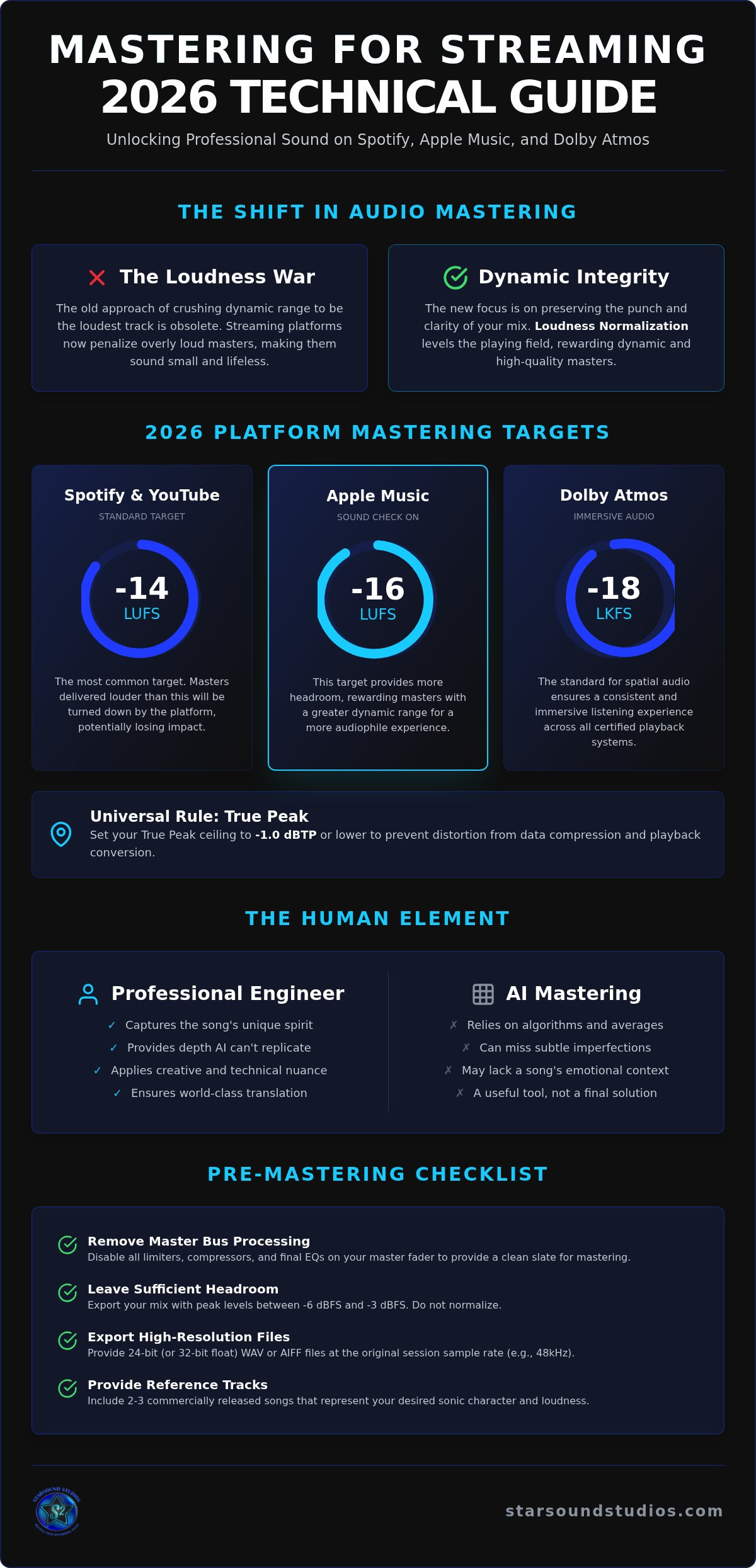
Platforms differ in their specific targets, which adds a layer of complexity to mastering for streaming platforms. Spotify and YouTube Music generally target -14 LUFS integrated. Apple Music leans toward -16 LUFS when Sound Check is enabled. Mastering your record excessively loud no longer provides a competitive advantage. Instead, it invites the platform's software to turn your track down, often resulting in a sound that feels small and congested compared to more dynamic releases. It's a technical hurdle that requires a sophisticated touch to overcome.
The Role of Playback Algorithms
Spotify provides users with three distinct volume settings: "Loud," "Normal," and "Quiet." These algorithms are the gatekeepers of your sonic impact. If you deliver a master that is "too hot," the "Loud" setting might apply its own limiting to your audio. This can introduce unwanted artifacts or squash the transients that give your music its life. A song with preserved dynamic range will often sound punchier and more vibrant than one that has been brick-walled. It's about finding the sweet spot where energy meets clarity. We prioritize that punch, ensuring your drums crack and your vocals soar regardless of the listener's app settings.
LUFS vs. RMS: Which Metric Actually Matters?
While both metrics track power, LUFS (Loudness Units Full Scale) is the modern industry standard for a reason. It uses frequency weighting to mimic the human ear's sensitivity, specifically focusing on the mid-range where we perceive the most detail. RMS (Root Mean Square) is a measure of average electrical power. It remains a valuable tool for checking consistent energy levels and ensuring your low-end isn't overwhelming the mix. To achieve a professional result, we use high-quality metering plugins to monitor two key values:
- Integrated LUFS: The average loudness of your entire track from start to finish.
- Short-Term LUFS: The loudness of 3-second windows, perfect for checking if your choruses have enough lift.
Balancing these technical requirements ensures your artistic vision remains the priority. This precision provides a polished result that translates across every device, from high-end monitors to basic earbuds. Mastering for streaming platforms in 2026 is less about the sheer volume and more about the integrity of the sound. Once your tracks are ready for the world, opting for commission free music distribution ensures that you retain the full value of your high-quality production.
Technical Specs for 2026: LUFS, True Peak, and Headroom
Achieving a professional sound requires more than just hitting a specific number on a meter. While many online tutorials suggest -14 LUFS is the magic key, experienced engineers treat it as a reference point rather than a rigid boundary. Mastering for streaming platforms in 2026 demands a deeper understanding of how these numbers translate into real-world playback. If your track is exceptionally dynamic, a lower LUFS value might actually preserve more of your artistic intent. Conversely, pushing a track too hard to hit a specific target can destroy the crest factor. This is the vital difference between your peak levels and average loudness. When the crest factor is too small, your drums lose their snap; they become buried in a wall of sound rather than cutting through the mix with authority.
Platform-Specific Loudness Standards
Apple Music utilizes its Sound Check feature to normalize tracks to -16 LUFS. This provides more room for dynamic range, making it a favorite for audiophiles. Because Apple uses the AAC codec, your master needs to be optimized for their specific ecosystem to avoid artifacts. YouTube handles audio differently; it calculates loudness based on the video's audio track and applies a "loudness penalty" if you exceed their thresholds. High-resolution services like Tidal and Amazon Music HD have even stricter requirements to ensure their premium listeners experience maximum fidelity. If you are looking for that final polish, our remote mastering services can help ensure your tracks meet these varied specs with absolute precision.
The True Peak Ceiling Explained
Digital audio isn't just about what you see on a standard peak meter. True Peak metering accounts for inter-sample peaks that occur during the conversion from digital to analog or when encoding to lossy formats like MP3. A peak at -0.1 dB might look safe in your DAW, but it can easily cause clipping and audible distortion once it's processed by a streaming server. We recommend a True Peak maximum of -1.0 dB for most releases. For high-intensity genres where the energy is relentless, dropping that ceiling to -2.0 dB is often safer. Headroom is essentially sonic insurance for your digital distribution. It protects your transients from being mangled by the aggressive compression used by streaming apps. This level of detail is just as critical as the environment used for mixing in Dolby Atmos, where technical accuracy is non-negotiable. Mastering for streaming platforms is about safeguarding the spirit of your music against the technical limitations of the digital world.
Immersive Mastering: The Dolby Atmos Advantage
The sonic landscape has shifted. By 2026, immersive audio has transitioned from a high-budget luxury to a standard expectation for independent releases. Listeners are no longer confined to a flat, two-dimensional stereo field. They want to be inside the music. Mastering for streaming platforms in this new era requires more than just a volume check; it requires a sophisticated understanding of three-dimensional space. While a traditional stereo master is a fixed two-channel file, an immersive master is delivered as an ADM BWF file. This complex container holds both "beds" for foundational sound and "objects" that can be positioned anywhere in a 360-degree environment.
This technical evolution provides a massive advantage for creators who embrace it early. It's about presence. It's about impact. When you release in Atmos, you aren't just uploading a song; you're providing an experience that translates from high-end home theaters down to a simple pair of spatial-enabled earbuds. To achieve this, you need an environment designed for precision. Translation is everything. Without a Dolby-certified room, you're essentially mixing in the dark. We've built a sanctuary where the science of sound meets the art of the mix, ensuring every object is placed with intentionality and every frequency is balanced for maximum emotional weight.
Apple Music and Spatial Audio
Apple Music has become the primary driver of this revolution. Tracks mastered in Atmos receive the coveted "Spatial Audio" badge, a visual signal to listeners that they're about to hear something premium. This isn't just marketing; Apple's editorial teams frequently prioritize Atmos-ready tracks for their most influential playlists. The technical standards here are strict. The loudness standard for immersive audio is -18 LUFS integrated. This lower target preserves incredible dynamic range, allowing for the "breath" and "life" that often gets crushed in stereo loudness wars. Don't be fooled by AI tools claiming to "upmix" your stereo files. True spatialization requires a human ear to decide where a vocal should sit or how a synth should swirl around the listener. It's a creative choice, not a mathematical one.
Starsound’s 9.1.4 Immersive Suite
As Ohio’s only Dolby-certified Atmos facility, we offer a technical edge that few can match. Our 9.1.4 suite is calibrated to the highest industry standards, providing the grounded assurance that your mix will sound perfect on every platform. Steve "The Mix" approaches every project as a collaborative mentor, focusing on how object-based audio can elevate your unique identity. We don't just process files; we sculpt soundscapes. Whether you're looking for subtle depth or a wild, immersive journey, our facility is designed to bring that vision to life. For a deeper look at how we're changing the local landscape, check out The Definitive Guide to Dolby Atmos Mixing in Cleveland. It's time to step out of the stereo box and into the future of sound.
DIY vs. Professional Mastering: The Value of the Human Ear
Mastering for streaming platforms has never been more accessible, but accessibility often comes at a hidden cost. AI-driven platforms promise a radio-ready sound with a single click. They're fast. They're convenient. However, they lack the one thing your music needs most: artistic intent. An algorithm doesn't know why you chose that specific, gritty snare tone or how the bridge should feel like an emotional release. It simply applies a mathematical average based on a generic database. This robotic approach often leads to over-limiting and a tragic loss of the very transients that make your music breathe.
A professional mastering engineer serves as the final set of objective ears. We see the project from a distance, identifying common DIY mistakes before they reach the listener. Poor stereo imaging or excessive compression can make a track feel small once the streaming codec takes over. We ensure your creative identity remains the priority, providing the grounded assurance that every technical detail is handled with absolute precision. It's about the "vibe." It's about soul. Algorithms can calculate, but they cannot feel.
The Limits of Artificial Intelligence
Automated tools frequently struggle when faced with complex arrangements or experimental genres that don't fit a standard mold. If your track blends orchestral elements with heavy synth-wave, an AI will likely get confused. This results in tonal imbalances that can sound harsh or muddy on consumer speakers. Perhaps the biggest drawback is the lack of a conversation. You can't ask an algorithm for feedback on your mix bus before the final print. A human mentor can point out frequency masking or phase issues, helping you improve as a creator. For those ready to move beyond automated presets, Professional Audio Mastering in Cleveland offers a deeper look at the human element in the signal chain.
Acoustic Accuracy and High-End Gear
Your home office might be comfortable, but it isn't a calibrated mastering environment. Professional studios are designed to be acoustically transparent. This environment reveals "hidden" problems in the low end that basic monitors or headphones simply cannot reproduce. If you can't hear the problem, you can't fix it. At Starsound Studios, we provide more than just high-end gear; we offer a collaborative sanctuary. Steve "The Mix" works alongside you to ensure your project translates perfectly across every device. It's a place where the science of the medium meets the art of creation. Ready to give your project the precision it deserves? Partner with us for professional mastering and hear the difference a trained ear makes.
Preparing Your Mix for the Starsound Mastering Suite
Your creative journey reaches its critical final stage at the hand-off. To ensure the best results when mastering for streaming platforms, your mix must be delivered with enough technical room to breathe. We view this stage as a partnership. Your role is to provide a clean, high-resolution canvas so we can apply the final polish that makes your music shine on every device. This preparation isn't just about following rules; it's about protecting the energy and spirit you've worked so hard to capture in the studio.
The most important step is removing any limiters or aggressive clippers from your master bus before you export. While these tools make your mix sound loud during the production phase, they bake in distortion and squash the transients that we need to manipulate during mastering. By delivering a dynamic file, you give us the flexibility to use our high-end analog chain and digital processors to their full potential. Follow this essential checklist for a professional delivery:
- Disable Master Bus Processing: Turn off any "loudness" plugins that aren't essential to the mix's tone.
- Check for Clipping: Ensure no individual tracks or the master fader are hitting the red.
- High-Resolution Export: Use 24-bit or 32-bit float WAV files; never deliver MP3s for mastering.
- Provide Reference Tracks: Share 2-3 songs that represent your target "vibe" to help us understand your vision.
Technical Export Requirements
Headroom is vital. We recommend aiming for -3 dB to -6 dB of peak headroom on your master output. This prevents the inter-sample peaks from causing issues before we even begin our process. Always keep your sample rate native to your project. If you recorded at 48kHz, export at 48kHz to avoid unnecessary conversion artifacts. For a deeper dive into the preceding steps that lead to a perfect file, explore The Art of Professional Stereo Mixing. This ensures your foundation is solid before the final master.
Communicating Your Vision
Technical precision is only half the battle. We need to understand the soul of your project. Are you chasing a warm, vintage saturation that feels like a classic vinyl record? Or is your vision a bright, modern, and aggressive sound that cuts through a club system? Sharing these sonic goals helps us tailor our approach to your specific identity. We often suggest a pre-mastering mix consultation to catch any potential issues early. This collaborative mentor relationship is what sets us apart from sterile, automated services. When you're ready to transform your vision into a world-class release, Book your mastering session at Starsound Studios.
Elevate Your Sound for the Future of Music
Mastering for streaming platforms in 2026 is no longer about winning a volume war; it's about winning the listener's heart through clarity and depth. By prioritizing dynamic range over raw loudness and mastering the nuances of True Peak ceilings, you ensure your creative vision translates perfectly from high-end systems to everyday earbuds. The rise of immersive audio has opened a new dimension for independent artists, making certified technical precision more valuable than ever before. Quality is the new currency.
We believe every project deserves a world-class finish that reflects the artist's unique identity. At Starsound Studios, we combine the science of a 9.1.4 immersive monitoring environment with the seasoned ear of Steve "The Mix." As Ohio’s only Dolby-certified Atmos mixing studio, we're dedicated to helping you navigate these technical standards while keeping your artistic spirit front and center. It's time to stop settling for automated presets and start investing in a sound that truly resonates with your audience.
Elevate your sound with professional mastering at Starsound Studios. Your music has reached its highest potential; now let's make sure the world hears it exactly as you intended. We're ready to bring your vision to life.
Frequently Asked Questions
What LUFS level is best for Spotify in 2026?
Spotify continues to use -14 LUFS integrated as its primary target for loudness normalization. However, mastering for streaming platforms is about more than just hitting a specific number. The best level depends on your genre and the emotional energy of the song. We focus on finding the sweet spot where your track sounds competitive without triggering the platform's limiter. This ensures your music remains punchy and clear rather than sounding squashed or distorted.
Should I master my whole album to the same loudness level?
No, you should prioritize a consistent perceived flow rather than identical meter readings. A delicate acoustic ballad shouldn't be as loud as a high-energy dance track. We focus on the relationship between songs to ensure the listener doesn't have to adjust their volume. In our Cleveland facility, we listen to the album as a holistic journey. We balance the emotional weight of each track so the transition feels natural and professional.
Will my song sound quieter if I don’t master it to -14 LUFS?
Not necessarily. If your song is mastered at -16 LUFS, Spotify will actually turn it up to meet their target, provided you have enough headroom. If you master much louder, the platform will turn it down. The key is to preserve your transients. A dynamic track at -14 LUFS often sounds louder and more vibrant than a crushed track that has been normalized down by an algorithm. Integrity is everything.
Do I need a separate master for Apple Music and Spotify?
While not strictly mandatory, it is often beneficial for high-end releases. Apple Music's Sound Check defaults to -16 LUFS, giving you more room for dynamic range than Spotify's target. Many of our clients in the Cleveland area opt for a dedicated Atmos master alongside their stereo version when mastering for streaming platforms. Tailoring your output to these specific platform standards provides a subtle but significant competitive edge in the digital market.
What is True Peak and why does it matter for streaming?
True Peak measures the absolute maximum level of your audio signal, including inter-sample peaks that occur during digital conversion. Standard meters often miss these, leading to hidden distortion. For streaming, we recommend a True Peak limit of -1.0 dB. This acts as a safety buffer. It prevents the lossy encoding processes used by major platforms from introducing audible clipping and artifacts that can degrade the professional polish of your song.
Can I master my own music using stock plugins?
You can achieve a decent result with stock plugins if you have a trained ear and a neutral listening environment. However, software cannot replace the acoustic accuracy of a calibrated room. Most home setups in North Royalton or elsewhere have frequency build-ups that mask low-end problems. Professional mastering provides an objective perspective and high-end processing that stock digital limiters cannot replicate, ensuring your work translates perfectly to every playback system.
How long does professional mastering take at Starsound Studios?
Our turnaround time varies based on the specific needs of your project and our current studio schedule. We prioritize giving every track the dedicated attention it requires for a world-class result. Steve "The Mix" works closely with you to establish a timeline that respects your release goals while ensuring the technical details are handled with absolute precision. This collaborative approach ensures your final master is never rushed and always meets our high standards.
Is Dolby Atmos mastering worth it for independent artists?
Absolutely. By 2026, immersive audio has become a massive driver for editorial placement on Apple Music and Tidal. Releasing in Atmos gives you a distinct advantage because these platforms prioritize Spatial Audio tracks in their curated playlists. As Ohio's only Dolby-certified studio, we have seen how this technology elevates independent projects. It provides a deeper, more emotional connection with your audience, making your music stand out in a crowded digital landscape.


