

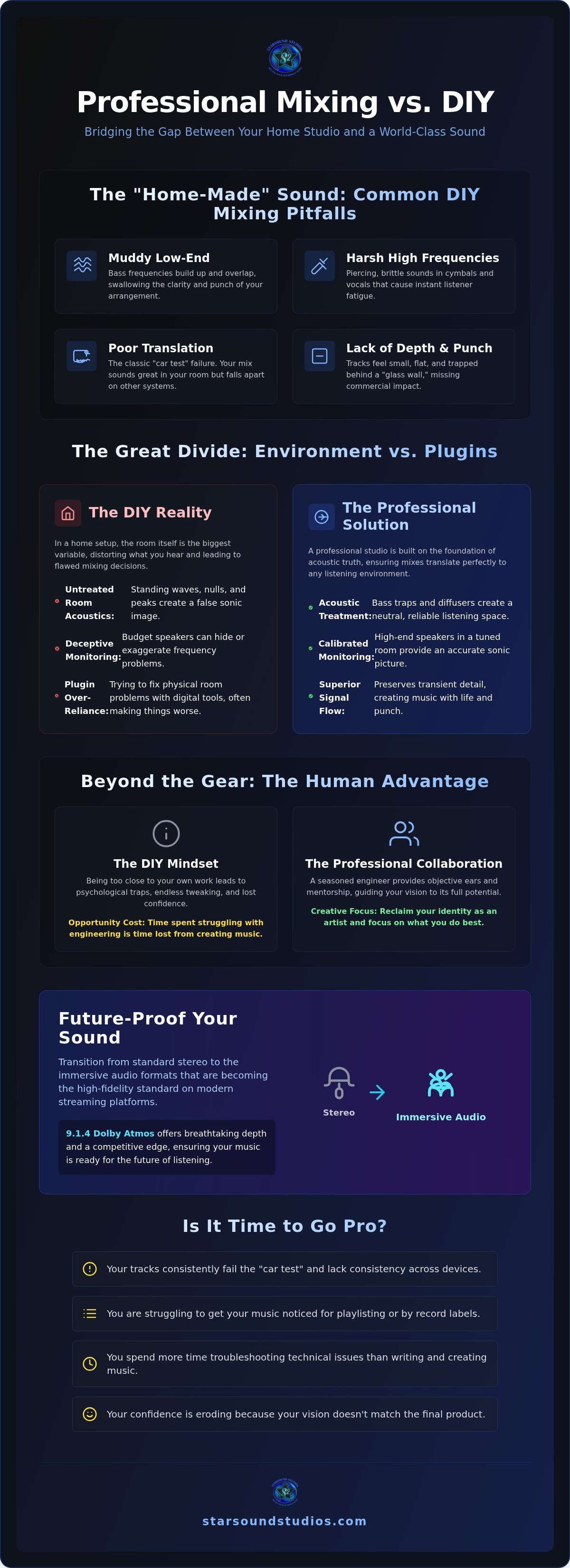
Your home studio in 2026 boasts more raw processing power than the legendary rooms of the nineties, yet your tracks still feel small, muddy, and trapped behind a glass wall. It is a common frustration. You have mastered your DAW, invested in AI-assisted plugins, and spent countless nights chasing that elusive commercial sheen. Still, the low-end wanders, the vocals will not sit, and the stereo field lacks the breathtaking depth you hear on your favorite playlists. The debate of professional mixing vs diy is not just about who has the better gear. It is about the science of the medium meeting the pure art of creation.
We understand that your music is your legacy. Your work deserves a sanctuary where technical precision meets artistic enthusiasm. This guide will help you discover the critical technical and artistic differences between home-brewed mixes and professional studio results to decide if your music is ready for the next level. We will explore how specialized monitoring, objective expertise, and immersive 9.1.4 Dolby Atmos capabilities can transform a good song into a competitive masterpiece that commands attention on every streaming platform. It is time to bridge the gap between your vision and a world-class reality.
Key Takeaways
- Learn why even the most advanced plugins cannot compensate for an untreated room and how professional acoustic translation ensures your sound remains consistent across every listening environment.
- Analyze the critical technical gaps in professional mixing vs diy to eliminate muddy low-ends and harsh frequencies that signal a home-made production.
- Gain an objective edge by collaborating with a seasoned engineer who serves as a mentor, helping you navigate the psychological traps of being too close to your own work.
- Explore the transition from stereo to immersive 9.1.4 Dolby Atmos to future-proof your tracks for the high-fidelity standards of modern streaming platforms.
- Recognize the key indicators, such as lack of playlisting or label interest, that signal it's time to move your project into a dedicated creative sanctuary.
The DIY Mixing Glass Ceiling: Why Your Tracks Sound "Home-Made"
The car test remains the ultimate heartbreak for the independent creator. You spend weeks in your home studio perfecting every snare hit, only to find that the kick drum vanishes and the vocals sound brittle once you hit the open road. This is the "translation issue," the primary hurdle in the professional mixing vs diy debate. It is not just about your talent. It is about the physical limitations of your creative space. When your room is lying to you, your mix will lie to your listeners.
The "home-made" signature is unmistakable to a seasoned ear. It manifests as a buildup of muddy low-mids that swallow the clarity of your arrangement, or harsh, piercing high frequencies that cause instant listener fatigue. These artifacts happen because home setups often lack the acoustic neutrality required for precision. Audio mixing (recorded music) requires a delicate balance of frequency, dynamics, and spatial placement. Without a calibrated environment, you are essentially painting a masterpiece in a room with flickering lights. This DIY plateau does more than just hurt your sound; it erodes your confidence as an artist, making you wonder if the song was ever good to begin with.
The Problem with "Good Enough" Monitoring
Budget studio monitors in an untreated bedroom are deceptive. They create "nulls" and "peaks" where certain frequencies disappear or explode, leading you into a psychological trap of endless plugin tweaking. You add another compressor or a new AI-powered EQ to fix a problem that only exists because of your room's standing waves. Professional mixing and mastering services in Cleveland, like those at Starsound Studios, eliminate this guesswork. By working in a world-class facility, you ensure that every decision is based on sonic truth, not acoustic fiction.
The Time-to-Quality Ratio
In 2026, the music industry moves at a relentless pace. While tools like Pro Tools 2026.4.1 have made high-end processing more accessible, the learning curve remains steep. Calculate the hours you spend wrestling with a single mix. Now, consider the opportunity cost. Every hour you spend acting as a frustrated engineer is an hour you aren't writing, performing, or building your brand. Professional results require a level of speed and precision that DIY setups struggle to match. Outsourcing allows you to reclaim your identity as an artist while ensuring your output meets the high-fidelity standards required for modern streaming playlists.
The Invisible Advantage: Acoustic Treatment vs. Plugin Power
You can buy the same virtual compressors used by Grammy-winning engineers, but you cannot buy the way their room reacts to sound. This is the silent differentiator in the professional mixing vs diy debate. While software has become incredibly sophisticated in 2026, it remains a digital approximation of physical reality. A $10,000 plugin folder cannot compensate for a $100 room where standing waves and frequency build-ups distort what you hear. Professional mixing is built on the foundation of acoustic translation, which is the ability of a mix to sound consistent and powerful whether it is played on a high-end hi-fi system, a smartphone, or a club PA.
High-end signal flow does more than just change the volume. It preserves transient detail, those initial bursts of energy in a snare hit or a vocal consonant that give music its life and punch. When you work with a professional, you are paying for an environment where you can finally combine the roles of music listener and audio engineer without the constant second-guessing caused by poor acoustics. It is about moving beyond "loudness" and into the sophisticated territory of harmonic saturation and depth.
The Science of the Mixing Environment
Standing waves and bass traps are not just industry jargon; they are the gatekeepers of your low-end. In an untreated DIY space, bass frequencies bounce off walls and cancel each other out, leading you to boost the low-end until it becomes a muddy mess in the real world. A calibrated listening environment, such as a 9.1.4 immersive suite, provides the absolute truth about your audio. This precision allows an engineer to identify and fix phase issues that are invisible in a home setup. At Starsound Studios, our 9.1.4 Atmos suite represents the pinnacle of this technical precision, offering a creative sanctuary where every frequency is accounted for.
Analog Warmth in a Digital World
There is a tangible difference between a digital emulation and high-voltage analog hardware. Professional stereo mixing often utilizes premium outboard gear that introduces pleasing non-linearities and "weight" that plugins struggle to replicate. These tools provide harmonic saturation that makes a mix feel expensive and finished. Headroom is the breathing room for your song’s dynamics. By utilizing high-end gear, we ensure your tracks have the space to move and breathe, avoiding the flat, two-dimensional sound often associated with DIY projects. If you are ready to experience this level of fidelity, exploring professional mixing services is the natural next step in your creative journey.
Objective Ears: The Psychological Benefit of an Outside Engineer
Your music is deeply personal. When you have spent months crafting every lyric and melody, you lose the ability to hear the track as a first-time listener would. This psychological attachment, often called "Demoitis," is a common trap in the professional mixing vs diy journey. You become accustomed to the technical flaws of your rough mix. You stop hearing the harshness in the vocals or the lack of clarity in the mid-range because your brain fills in the gaps. An outside engineer provides the essential gift of objectivity. They hear your music with fresh ears, identifying the subtle barriers that stand between your vision and the listener's emotional response.
A professional engineer acts as a collaborative mentor rather than a mere service provider. Their role is to refine your vision, not just adjust your levels. By bringing in a third party, you gain a partner who is just as invested in the final product as you are. This collaboration provides a massive confidence boost. Knowing your work has been vetted and polished by a professional gives you the certainty needed to release your music into a competitive market. You move from wondering if it is "good enough" to knowing it is world-class.
Steve "The Mix" and the Starsound Philosophy
At Starsound Studios, lead engineer Steve "The Mix" embodies this mentor-style approach. He centers the artist's unique identity in every session, ensuring that technical precision never overshadows the soul of the performance. The process moves beyond technical balancing into the realm of artistic glorification. It's about finding the emotional core of your song and using the science of audio to make it shine. We have built a creative sanctuary in North Royalton where your spirit meets our science, resulting in a sound that is both polished and authentically yours.
Communication and Revisions
Many artists hesitate to outsource because they fear losing control. However, a professional process is designed to enhance your control, not diminish it. You don't need to speak "engineer" to get results. You can describe your goals in terms of feeling, color, or energy. A seasoned pro translates "I want the bridge to feel like a sunset" into specific frequency and spatial adjustments. This creative synergy is why local recording studios in Cleveland Ohio remain the gold standard for serious creators. The professional revision process is structured and stress-free, moving you toward perfection through clear, intentional communication rather than the aimless plugin-tweaking of a DIY setup.
Future-Proofing Your Sound: Beyond Stereo to Immersive Audio
By August 2026, the sonic landscape has shifted fundamentally. Stereo is no longer the final frontier for artists who want to be taken seriously. Major streaming platforms like Apple Music, Tidal, and Amazon have made spatial audio the default experience for millions of listeners. This transition has changed how we perceive arrangement and emotional impact. In an immersive environment, sounds are no longer fighting for space in a narrow left-right field. They live in a 360-degree sphere that wraps around the listener, creating a visceral connection that stereo simply cannot replicate. This is where the professional mixing vs diy divide becomes an insurmountable wall.
The technical requirements for immersive audio make home-brewed results almost impossible. While you might attempt a binaural mix on headphones, you cannot accurately judge how those objects will translate to a calibrated speaker system without a dedicated room. Immersive mixing requires specialized software, complex routing, and a physical environment that has been acoustically tuned for multi-channel playback. Trying to DIY an Atmos mix is like trying to paint a mural while looking through a keyhole. You lack the perspective needed to ensure your music sounds world-class on every system.
Understanding the 9.1.4 Dolby Atmos Edge
A certified Dolby Atmos studio Cleveland provides more than just a high speaker count. It offers a precise environment where every sound is treated as an independent object in three-dimensional space. Starsound Studios features Ohio’s first Dolby-certified 9.1.4 suite, providing the ultimate edge over traditional home setups. This configuration uses nine surround speakers, one subwoofer, and four overhead speakers to create a seamless dome of sound. Atmos mixing is an object-based process, not just "more speakers." This technology gives your instruments more "real estate," allowing for a level of clarity and depth that makes even the densest arrangements feel open and breathable.
Preparing Your Music for 2026 Standards
Labels and distributors are increasingly demanding Atmos deliverables as a standard requirement for new releases. If you only provide a stereo file, you are already behind the curve. Having an immersive version of your single is a massive competitive advantage, signaling to industry gatekeepers that your work meets professional standards. It ensures that your music remains relevant as high-fidelity and spatial audio become the primary ways fans consume art. Don't let your sound be left in the past. If you're ready to elevate your project, our Dolby Atmos mixing services provide the technical precision and artistic vision to move your music into the future.
Making the Leap: When to Hire a Professional Mixer
Deciding between professional mixing vs diy often comes down to one simple question: does your sound match your ambition? If you're receiving positive feedback on your songwriting but finding radio silence from labels or playlist curators, the production is likely the barrier. Your music is your calling card. In a 2026 market saturated with content, "good enough" is a dangerous standard. When your tracks feel thin or cluttered compared to your influences, it's a clear signal that your project has outgrown the bedroom studio. It's time to invest in the clarity and impact that only a professional facility can provide.
The decision to outsource relies on the "Big Three" criteria: Budget, Timeline, and Artistic Importance. Budget isn't just a cost; it's an investment in your legacy. Timeline matters because a professional engineer works with a precision and speed born of thousands of hours of repetition. Finally, consider the artistic weight of the project. Your lead single or debut album deserves a level of technical excellence that honors the spirit of the work. By preparing your tracks meticulously, consolidating files, and labeling stems clearly, you can save time and ensure your engineer spends every minute focused on the art, not the housekeeping.
The Hybrid Approach: DIY Tracking, Pro Mixing
The modern artist doesn't have to choose between total independence and a massive studio bill. Many creators now embrace a hybrid model. You handle the tracking in your own creative sanctuary, focusing on the raw emotion and performance, and then send the stems to a professional for the final polish. This keeps your process intimate while ensuring the result is world-class. To get the most out of this approach, you must ensure your raw captures are pristine. Check out our guide on how to record your voice to ensure your vocal takes are ready for a commercial-grade mix.
Booking Your Session at Starsound
Starsound Studios is designed to be more than a service provider; we are your collaborative partner. Working with Steve "The Mix" means entering a space where your unique identity is the priority. Whether you prefer the convenience of remote mixing or the immersive energy of an in-person session in North Royalton, we provide a mentor-style experience that respects your vision. We handle the technical precision so you can stay in the creative flow. It's time to elevate your sound with professional mixing and mastering and discover the true potential of your music. Let's build your sanctuary together.
Claim Your Place in the Future of Sound
The decision regarding professional mixing vs diy is ultimately a commitment to your creative legacy. You've likely experienced the glass ceiling of home production, where untreated rooms and limited perspective stifle your song's true potential. By choosing a professional path, you gain more than just technical clarity. You secure acoustic translation that works on every system and the objective expertise needed to elevate your work from a demo to a commercial masterpiece. It's about ensuring that the emotional impact you felt during the writing process reaches the listener without compromise.
Starsound Studios provides the ultimate creative sanctuary for this transformation. As Ohio’s only Dolby-certified 9.1.4 Atmos studio, we offer the cutting-edge immersive capabilities that define the 2026 listening experience. Through the mentor-style guidance of Steve "The Mix," your project receives the dedicated attention it deserves within a sophisticated, artist-centric environment. We don't just process audio; we glorify your artistic identity using the highest standards of engineering precision. The science of the medium is here to serve your vision.
Ready to hear your music as it was meant to be? Book a session with Starsound Studios today.
Your music is ready for the world. We're ready to make sure the world hears it with the depth, width, and power you always intended.
Frequently Asked Questions
Is professional mixing worth it for a beginner?
Yes, because it provides a roadmap for your future productions. Working with an expert allows you to hear your music's true potential early in your journey. You'll learn how a polished track should sound, which helps you identify mistakes in your own recordings. It's an investment in your education as much as your art. A mentor-style engineer can highlight issues in your tracking that you might otherwise repeat for years.
Can I get a professional mix using only stock plugins at home?
While modern stock plugins are powerful, the challenge of professional mixing vs diy isn't just about software. It's about the acoustic environment and the monitoring system. Even with the best plugins, you can't fix what you can't hear. Professional studios use calibrated rooms and high-end converters to make precise decisions. Stock plugins are capable tools, but they can't compensate for the phase issues and frequency masking present in an untreated bedroom.
What is the difference between mixing and mastering?
Mixing is the process of balancing individual tracks, like vocals and drums, to create a cohesive song. Mastering is the final polish applied to the stereo file to ensure it sounds consistent across all playback systems. Think of mixing as building the car and mastering as the final wax and safety check. Both are essential steps. Mixing handles the internal balance, while mastering prepares the track for the competitive standards of streaming platforms.
How much does it cost to have a song professionally mixed in 2026?
Industry rates vary based on the engineer's experience and the complexity of your project. High-end engineers with major credits often charge significantly more than independent specialists. Factors like track count and the need for immersive formats like Dolby Atmos also influence the final investment. You should research current industry standards to find a professional whose expertise aligns with your budget and artistic goals. Every project has unique requirements that dictate the final cost.
Do I need to be in the studio for the mixing process?
You don't need to be physically present to achieve world-class results. Remote mixing has become a standard practice in 2026, allowing artists to collaborate with engineers across the globe. Digital tools make it easy to share high-fidelity files and provide detailed feedback through structured revision cycles. However, visiting a facility like Starsound Studios in North Royalton offers a unique opportunity to hear your music in a calibrated 9.1.4 immersive environment first-hand. It's an inspiring experience.
Will a professional mixer change the "vibe" of my song?
A great engineer enhances your existing vibe rather than replacing it. Their goal is to clarify your artistic intent and make your vision sound more expensive and impactful. By removing technical distractions like mud or harshness, the emotional core of your music shines brighter. Communication is key. Providing a rough mix and reference tracks ensures the engineer understands the specific energy and spirit you want to convey in the final product.
How long does it take for a professional to mix one song?
A single song typically takes between four and eight hours to mix, depending on the complexity of the arrangement. This includes the initial setup, technical cleanup, balancing, and the application of creative effects. Large sessions with hundreds of tracks or immersive Dolby Atmos requirements may take longer to perfect. Professionals work with a level of intentionality that ensures every second of your music is polished to meet modern high-fidelity standards.
What files do I need to send to a professional mixing engineer?
You should provide consolidated, dry audio stems that all start at the same time-stamp. These files should be high-quality WAV or AIFF formats, typically 24-bit or 32-bit float. Include a dry version without effects and a wet version if a specific sound is essential to your vision. Don't forget to include your rough mix and a few reference tracks. Clear labeling and organized folders help your engineer spend more time mixing and less time sorting.


