

Your master recordings are your legacy, but without the right paperwork, they are just data sitting on someone else's hard drive. It is a sobering thought for any creator who has poured their soul into a session. You want to focus on the perfect vocal take or the precision of a 9.1.4 Dolby Atmos mix, not the fine print. We know that understanding recording studio contracts feels like learning a second language while you are trying to write a hit. It is completely normal to feel a sense of dread when terms like recoupable expenses and mechanical royalties start flying across the table.
We are here to bridge the gap between your artistic vision and the legal framework that protects it. This comprehensive guide will empower you to navigate the complexities of label and studio agreements with the confidence of a seasoned pro. You will learn how to secure ownership of your masters, decipher streaming royalty splits in a market where digital revenue accounts for over 80 percent of the industry, and negotiate creative control. From technical deliverables to long-term rights, we are breaking down the essential clauses you need to know to ensure your career stays in your hands.
Key Takeaways
- Learn to distinguish between transactional studio service agreements for mixing and mastering and long-term label partnerships that involve marketing and distribution.
- Gain a professional edge by understanding recording studio contracts, specifically how recoupable expenses and advances impact your actual take-home pay.
- Identify critical red flags like broad indemnity clauses and re-recording restrictions that could limit your creative freedom years after a project is finished.
- Discover why a detailed technical rider is essential for documenting deliverables in high-end formats like Dolby Atmos 9.1.4 immersive audio.
- Master the art of negotiation to protect your intellectual property, ensuring your creative rights remain secure even during small independent sessions.
The Essential Role of Contracts in the Modern Recording Process
A Recording contract is far more than a stack of legal papers designed to protect a corporation. In 2026, it serves as a professional roadmap that defines the technical and financial boundaries of your creative project. It’s the blueprint for your sonic vision. As independent artists continue to dominate the market, the old dynamic of the record label as a gatekeeper has faded. Today, the studio has emerged as a collaborative partner. This shift means that understanding recording studio contracts is no longer just for the elite; it is a fundamental skill for every artist who steps into a tracking room.
Without a written agreement, projects often fall victim to scope creep. This happens when a simple mix session slowly expands into uncompensated production work or endless revisions that drain your budget and energy. A clear contract establishes exactly where the engineering ends and where the production begins. It ensures that everyone is moving toward the same world-class result without the friction of unstated expectations. It turns a vague "working relationship" into a precise, professional alliance.
Protecting Your Sound and Your Wallet
A solid agreement defines the specific services you are purchasing. Are you paying for hourly tracking, flat-rate stereo mixing, or remote mastering? Each of these requires different resources and engineering focus, just as specialized projects like cinematic audiobooks from NARRA require clear terms for high-end voice production. Verbal agreements almost always fail in high-pressure creative environments because memory is subjective. A contract fixes this by setting hard deadlines for final file delivery and outlining the number of allowed revisions. It protects your investment by ensuring you aren't left waiting for files when your distribution date is looming. It keeps the focus on the music, not the logistics.
Contractual Clarity in the Era of Immersive Audio
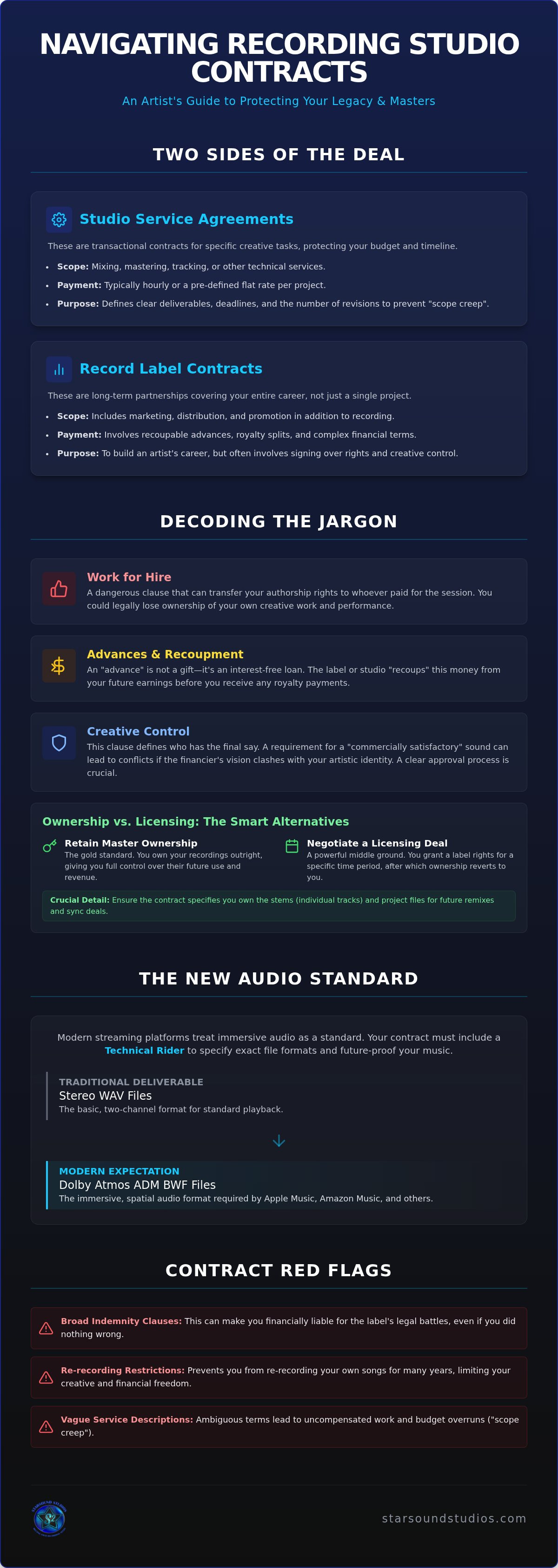
The rise of spatial audio has changed the list of required deliverables. In 2026, simply asking for a "high-res file" is not enough. You must specify whether you need standard Stereo WAVs or Dolby Atmos ADM BWF files for immersive distribution. Modern streaming platforms like Apple Music and Amazon Music now treat Atmos as a standard expectation. Your contract should include a technical rider that ensures your session is documented for these immersive formats. This level of structured planning is the key to achieving sonic excellence in 2026. By defining these technical specifications upfront, you guarantee that your work is future-proof and ready for the most advanced playback systems in the world.
Decoding the Jargon: Key Clauses Every Artist Must Understand
Peeling back the layers of industry jargon is the only way to see who truly benefits from your labor. Understanding recording studio contracts starts with the "Work for Hire" clause. This legal phrase can strip you of authorship, handing the legal rights to your performance over to whoever paid for the session. If you want to keep your legacy, you need to negotiate for ownership or a fair licensing term. Advances are loans. They feel like a windfall, but they are interest-free debts that the label or studio will recoup from your future earnings before you see a single royalty check.
Creative control is the other side of this coin. Who has the final say on the "radio-ready" sound? You want a partner who respects your vision, but many standard agreements grant the financier the power to demand "commercially satisfactory" results. This can lead to friction if your experimental edge clashes with their market expectations. A clear contract defines the approval process, ensuring the sonic identity of the project remains in your hands while meeting professional standards.
Ownership vs. Licensing
Retaining your masters is the gold standard. Licensing is a viable middle ground. By granting a label the right to use your music for a set period, you keep the long-term value of your catalog. This must include your stems. These individual track elements are vital for future remixes or lucrative sync licensing deals in film and gaming. When you invest in professional audio mastering in Cleveland, ensure your contract specifies that you own the high-resolution master and the underlying project files. This level of transparency is a core part of how we handle remote mixing and mastering projects for our global clients.
Financial Terms and Hidden Deductions
Distinguishing between a service agreement and a label deal is the first step toward professional autonomy. One is a straightforward purchase of technical skills. The other is a complex, multi-year alliance. Understanding recording studio contracts in 2026 requires you to identify which role the facility is playing in your career. When you hire a studio for mixing and mastering services, you are the project lead. You control the timeline, the creative direction, and usually the final assets. A label deal, conversely, often trades that autonomy for the massive marketing reach and distribution networks that independent artists struggle to build alone.
Cost structures also differ wildly between these two paths. Studios typically operate on hourly tracking rates or flat-rate project fees for post-production. Labels often provide an advance, but as we discussed earlier, that money is a debt to be repaid. Exclusivity is the hidden trap here. While a studio might want you back for your next album, they won't legally block you from recording elsewhere. Labels frequently include "lock-in" periods that prevent you from releasing music with anyone else for years. Always check the duration of these restrictions before signing your creative life away.
The Independent Path: Studio Service Agreements
For the modern independent creator, the studio service agreement is the most common document you will encounter. It should be precise. It must outline the scope of work, the engineer’s fee, and the specific revision policy. Don't assume that a flat rate includes infinite tweaks. Most professional rooms offer two or three rounds of revisions before additional costs kick in. You also need to verify the deliverable formats. Ensure your contract guarantees high-resolution files, such as the audio format aiff or standard WAVs, and specify the sample rate and bit depth to avoid technical headaches during distribution.
The Traditional Path: Record Label Deals
Signing to a label is a different beast entirely. In 2026, 360 deals remain the standard for new talent. This means the label takes a percentage of everything, from your t-shirt sales to your touring revenue. You must pay close attention to release commitments. If a label "shelves" your project, you could be stuck in legal limbo without the right to release your own music. Territory and duration are equally critical. Does the label own your work globally or just in specific markets? Is the term for five years or the life of the copyright? These details determine whether your partnership is a launchpad or a cage.
Red Flags and Negotiation Strategies for Artists
Signing a contract is an act of trust. That trust must be guarded by specific legal safeguards to ensure your career isn't derailed by a single bad clause. Understanding recording studio contracts requires a sharp eye for the indemnity clause. This often forces the artist to be solely responsible for any legal disputes or copyright claims. You shouldn't be the only shield. A fair agreement shares this burden, protecting you from the high costs of litigation if a third party challenges the work. It's about mutual protection in a professional partnership.
Watch out for re-recording restrictions. These clauses often prevent you from recording the same songs for a different label for several years after your contract ends. While common, they can be negotiated down to a more reasonable timeframe. You also need clear audit rights. This is your legal power to check the label's books and verify that your streaming royalties are being paid correctly. Without this, you are simply taking their word for it. Finally, a termination clause is your emergency exit. It defines exactly how you can get your rights back if the relationship sours or the label fails to meet its obligations.
Spotting Bad Deals Before You Sign
Vague "Creative Approval" language is a major red flag. If a label or studio has sole discretion over whether a project is "commercially satisfactory," they can shelf your music indefinitely. This effectively kills your momentum. Beware of "work until satisfied" clauses. These often exploit the sound engineer by demanding endless free labor, which eventually compromises the quality of your final mix. Another trap is cross-collateralization. This allows a label to use the profits from your successful second album to pay off the unrecouped debts of your first one. It keeps you in a cycle of debt that is difficult to break.
Negotiating Like a Pro
You have more leverage than you think. In 2026, a strong social media following or a history of independent sales is a powerful bargaining chip. Use this data to push for better royalty splits or more creative autonomy. Consider a "Sunset" clause for management or label commissions. This ensures that their cut of your earnings phases out over time after the contract ends. It prevents you from paying for past services forever. Always include a "Key Man" clause. If the specific engineer or A&R you signed for leaves the company, this clause gives you a legal out. It ensures you aren't stuck with a team that doesn't understand your sound. If you are ready to work with a team that values transparency as much as sonic fidelity, book your next recording session with us today.
The Starsound Standards: Professionalism Beyond the Paper
At Starsound Studios, we believe a contract is the foundation of a creative sanctuary. It is a document of mutual respect. We move beyond cold legalities to provide a framework where your vision can thrive without technical or financial ambiguity. Understanding recording studio contracts is the first step toward a world-class release. It transforms a loose collection of ideas into a legally protected asset. We approach every agreement as a collaborative mentor, ensuring you are as confident in the business details as you are in your vocal performance.
A critical component of our process is the technical rider. This is especially vital when working in our Dolby Atmos studio Cleveland. We document every deliverable, from standard stereo masters to complex 9.1.4 ADM BWF files. This level of precision guarantees that your music meets the strict requirements of modern streaming platforms. We also offer audio engineering classes to empower you. Mastering the technical and business sides of the industry ensures you never feel like a spectator in your own career.
Transparent Post-Production Workflows
Our workflows are built on absolute clarity. We establish firm milestones for every stage of the process, including tracking, mixing, and final mastering approval. This eliminates the uncertainty that often plagues creative projects. Your files are handled with technical precision. We use secure delivery protocols and maintain archival backups of your master recordings. You aren't just hiring a service; you are entering a partnership. We walk you through every technical requirement. We want you to understand the "why" behind every engineering choice we make for your sound.
Elevating Your Career in Cleveland
Ohio’s only Dolby-certified Atmos facility is more than just a room with high-end speakers. It is a place to build a professional portfolio that stands up to global standards. By combining our elite technical environment with legally secure agreements, you gain total peace of mind. You own your legacy. Your work is in both capable and passionate hands. Your next step is to finalize your project roadmap. Booking your session is the beginning of a journey that ends with a polished, world-class result that you own and control.
Secure Your Sonic Legacy
You now have the tools to protect your masters and navigate the complex financial terms of the modern industry. From mastering the technical rider to identifying predatory clauses, understanding recording studio contracts is the ultimate shield for your creative independence. It ensures that when you step into the booth, your only focus is the music. Your career is built on the decisions you make before the red light even goes on. It's about taking control of your future.
We are here to provide the technical precision of our 9.1.4 immersive audio suite alongside the professional guidance of Steve 'The Mix'. As Ohio's first Dolby-certified Atmos studio, we prioritize your creative rights as much as your sonic fidelity. Don't leave your legacy to chance. Ready to record your next hit? Book a session at Starsound Studios today! We are ready to help you reach your highest potential with a world-class release that stays firmly in your hands.
Frequently Asked Questions
What is a 'Work for Hire' clause in a recording contract?
A Work for Hire clause is a legal tool that designates the person or company paying for a session as the legal author and owner of the audio. In many standard agreements, this means you lose ownership of your masters from the moment you record them. Artists in the Cleveland scene should negotiate this carefully to ensure they retain their creative rights. It is the difference between owning your legacy and being a temporary contractor for your own music.
Do I need a lawyer to review my studio agreement?
Yes, having a specialized entertainment attorney review any major label or long-term agreement is essential for your protection. While a simple service agreement for tracking or mixing at a facility like ours is more straightforward, understanding recording studio contracts of a larger scale requires legal expertise. A lawyer ensures that boilerplate language doesn't hide predatory terms. It is a small upfront investment that prevents massive financial losses and legal headaches down the road.
What are recoupable expenses in a record deal?
Recoupable expenses are costs the label pays on your behalf that are later deducted from your share of the earnings. These often include recording fees, mixing, mastering, and marketing budgets. Essentially, these are interest-free loans that you must pay back before you see any profit. Since streaming generated 4.9 billion dollars in the first half of 2026, it is vital to know exactly which costs are being charged back to your account so your royalties aren't swallowed by debt.
Can I break a recording contract if the label doesn't release my music?
Breaking a contract because of a shelved project depends entirely on your release commitment clause. If your agreement doesn't specify a firm release date or a right to terminate if the music isn't distributed, you could be stuck in legal limbo. understanding recording studio contracts means ensuring you have a legal out if the label fails to bring your work to market. This protection keeps your creative momentum alive even if a partnership fails to deliver results.
Who owns the stems and multi-track files after a session?
Ownership of stems and multi-track files usually follows the ownership of the master recording. However, your contract should explicitly state that you receive these high-resolution assets upon final payment. For projects in our Cleveland 9.1.4 immersive suite, we ensure artists receive the specific deliverables they need for distribution. Having these files is critical for future remixes, sync licensing opportunities, and re-mastering your work for new audio formats that may emerge in the coming years. If you want to see how music is integrated into console titles, visit Ocean Media.
What is a 360-degree music deal and should I sign one?
A 360-degree deal is an agreement where a label receives a percentage of every revenue stream you generate, including touring, merchandise, and publishing. While these provide significant upfront support, they can be deeply restrictive for independent creators. You should only sign one if the label offers a level of marketing and infrastructure you couldn't possibly build yourself. Always negotiate a sunset clause to eventually phase out these commissions and regain your financial autonomy as your career grows.
How do royalty splits work for streaming on Spotify and Apple Music?
Streaming royalty splits are divided between the sound recording owner and the songwriters. In the current 2026 landscape, where streaming makes up 82 percent of total U.S. music revenue, these splits are the lifeblood of your career. Typically, the label or distributor takes a cut, the producer may receive points, and the artist receives the remainder. It is vital to define these percentages in writing before you upload your tracks to platforms like Spotify or Apple Music to avoid disputes.
What is the difference between a recording contract and a publishing deal?
A recording contract covers the specific audio recording of a song, known as the master. A publishing deal focuses on the underlying composition, which includes the lyrics and melody. These are two separate copyrights that generate different types of income. You can own your masters while someone else manages your publishing, or vice versa. Keeping these distinctions clear in your mind is essential for protecting your intellectual property and maximizing your total earnings in the modern music industry.


