

In 2026, the difference between a legendary record and a costly mistake isn't just the gear; it's the 48 hours before you step through the studio doors. You've likely felt that spike of adrenaline when the red light goes on, followed immediately by the sinking realization that your lyrics aren't quite finished or your guitar strings are dead. It's frustrating to watch your hard-earned budget vanish into hourly rates while you're still troubleshooting basic arrangements or struggling with performance anxiety. We understand that your music is your legacy. That's why mastering how to prepare for a recording session is the most critical skill an artist can develop.
This guide provides the technical and mental architecture you need to ensure your next project achieves world-class audio fidelity and emotional impact. We'll walk you through the essential steps of pre-production, from finalizing your tempo maps in Ableton Live 12 to ensuring your technical communication with the engineer is seamless. By the time we're done, you'll have a streamlined roadmap to transform your creative vision into a polished, immersive reality. Your time in our creative sanctuary should be spent capturing magic, not fixing mistakes. Let's build the foundation for your best work yet.
Key Takeaways
- Finalize your song arrangements and lock in your BPM with a click track before arrival to ensure every studio minute is spent on creative exploration rather than structural fixes.
- Master the technical essentials of how to prepare for a recording session by performing deep instrument maintenance and setting your digital files to modern 32-bit float standards.
- Transition into "Studio Mode" by rehearsing your material off-book and with headphones to bridge the gap between rehearsal space comfort and high-pressure performance.
- Curate a selection of 3 to 5 reference tracks to provide your engineer with a clear sonic blueprint, ensuring technical precision meets your unique artistic spirit.
- Learn how to leverage a professional 9.1.4 Dolby Atmos environment to elevate your project from a standard stereo mix to a world-class immersive experience.
Pre-Production: Crafting the Blueprint for Your Songs
Pre-production is where your vision gains its skeleton. It's the phase where arrangement, tempo, and key are finalized before you ever step into our North Royalton facility. When considering how to prepare for a recording session, your first priority is a rigorous arrangement audit. Trim the fat. If a bridge doesn't serve the hook, cut it. Every second of the track must engage the listener. You also need to identify the 'Hero' of the song. Is this a vocal-driven ballad where intimacy takes center stage, or a rhythm-heavy anthem where the beat is the primary focus? Knowing this allows our engineering team to prioritize the right signal paths from the very first take. Without this clarity, you risk wasting valuable hours chasing a sound that hasn't been defined. High-end production requires a clear roadmap, and that map is drawn long before the microphones are placed. This stage is about objective listening. It's about stepping away from the emotional attachment of the songwriter and looking at the track through the eyes of a producer. By the time you arrive at Starsound Studios, the song should be a lean, high-impact machine ready for capture.
Finalizing Tempo and Key
Find the 'pocket' by testing your song at +/- 3 BPM increments. A slight shift often transforms a sluggish groove into something that breathes. Pre-production is the essential bridge from a rough demo to a world-class master. Verify the key for vocal health early to prevent a strained performance. Locking in your BPM with a click track is non-negotiable for technical precision, especially when planning for immersive 9.1.4 Dolby Atmos mixing.
The Power of the Demo Track
A rough 'scratch' track helps the engineer understand the intended energy and movement. These demos identify arrangement clashes before the clock starts ticking. Share these files with your producer early to align on the sonic direction. A high-quality demo is a masterclass in how to prepare for a recording session because it exposes weaknesses while you still have time to fix them. It allows the studio to remain a dedicated creative sanctuary.
Technical Readiness: Preparing Your Gear and Digital Files
Technical precision is the bedrock of artistic freedom. If your gear fails, the creative spark dies. Part of knowing how to prepare for a recording session is adopting a "Zero Latency" mindset before you ever load the van. This means your home project is scrubbed of technical debt, plug-in heavy processing is frozen, and your physical instruments are in peak condition. You don't want to spend three hours of a premium session chasing a ground hum or fixing a rattling bridge. Precision pays dividends in fidelity, especially when your goal is a world-class result. It's about ensuring the transition from your private workspace to our high-end facility is seamless and stress-free.
The Instrument Checklist
Fresh strings are vital, but timing is everything. Change your guitar or bass strings 24 to 48 hours before your session. This window allows the metal to stretch and settle, ensuring stable intonation under the heat of studio lights without the distracting "metallic zing" of brand-new wire. Check every fret for buzzes and every knob for crackles. Microphones are unforgiving mirrors; they will catch the hardware rattle you've ignored for months in the rehearsal room. If you use active pickups or pedals, install fresh batteries regardless of their current charge. Stable power supplies and high-quality shielded cables are the silent heroes of a clean signal path. For drummers, new heads are a requirement. Tune them to the song's key to ensure the kit resonates in harmony with the music.
File Management and DAW Compatibility
Digital hygiene is just as critical as physical maintenance in a modern production environment. For 2026, the gold standard for high-end production is a sample rate of 48kHz or 96kHz with a bit depth of 32-bit float. This 32-bit float standard is particularly powerful, as it virtually eliminates digital clipping during the recording process and provides immense headroom for our engineers. Mastering how to prepare for a recording session involves aligning your digital hygiene with these professional standards. Consolidate your tracks so every file starts at Bar 1, Beat 1. This prevents alignment nightmares during import into our Pro Tools or Logic Pro systems. Use professional naming conventions; "Lead_Vocal_Verse1" is infinitely more useful than "Audio_01_Comp." If you are prepping stems for professional mixing and mastering services, ensure all non-essential time-based effects like reverb are removed. This gives the mixer the necessary space to place your sounds within the 3D field of a 9.1.4 Atmos suite. A well-organized session allows our engineers to focus on the art of the mix rather than the logistics of the file. If you're unsure about your file exports, check our technical spec requirements before your start date.
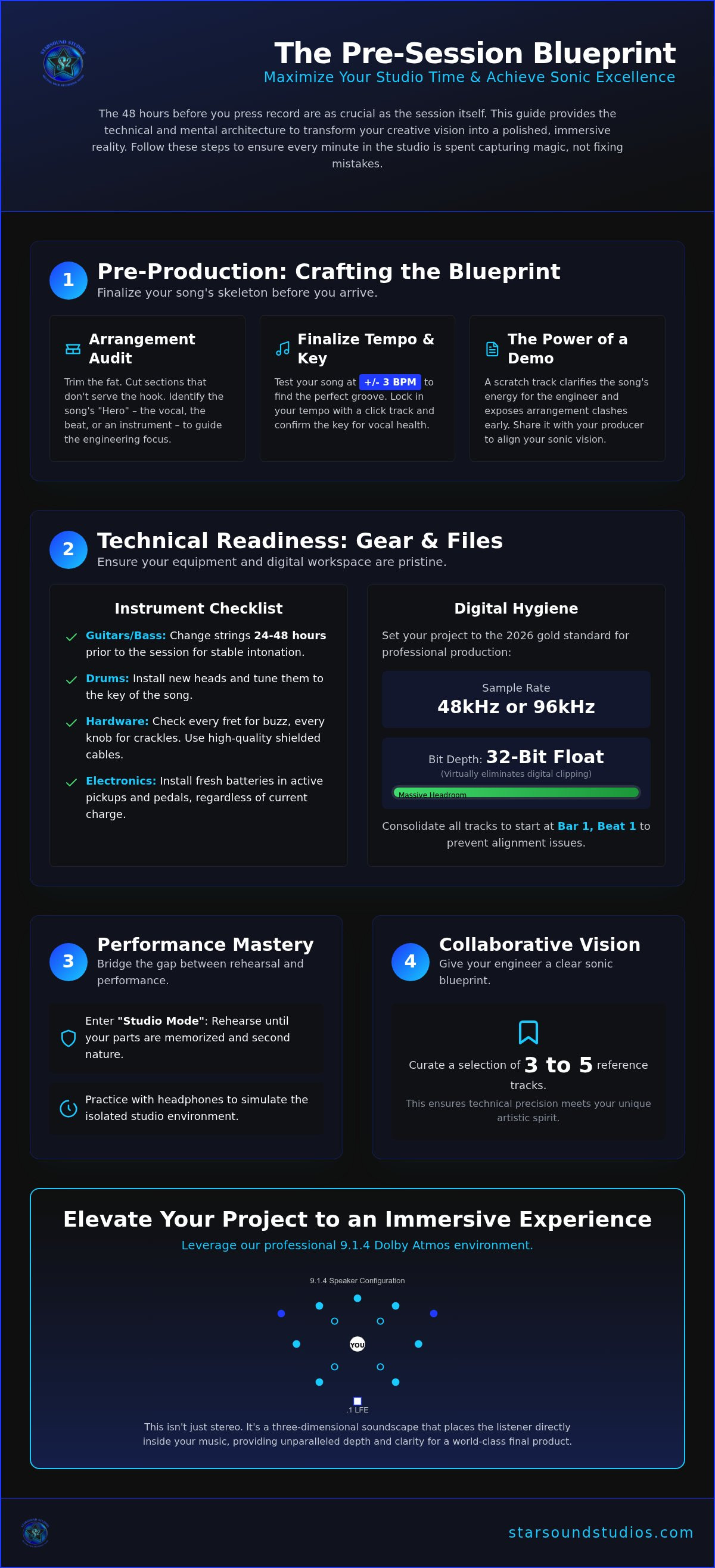
Performance Mastery: Rehearsing for Efficiency
The studio is a microscope. It magnifies every nuance, every hesitation, and every missed beat. While your home demos might sound great, true performance mastery is about consistency under pressure. A major part of learning how to prepare for a recording session involves transitioning your mindset from "playing through" to "executing." You shouldn't be reading lyrics or staring at a chord sheet when the red light is glowing. Rehearsing "off-book" is essential. It frees your brain from the logistics of the song, allowing you to focus entirely on emotional expression. When you aren't tethered to a music stand, you can actually feel the music. This is where the magic happens.
Enter "Studio Mode" during your final rehearsals. Practice with a metronome and headphones to simulate the isolated environment of a professional tracking room. Many bands struggle when they can't see each other across a stage. In the studio, you'll often be in separate booths or isolated pockets. You need to know your parts so deeply that you don't rely on visual cues from the drummer or the bassist. Vocal health is equally paramount. In the 72 hours leading up to your session, prioritize hydration and rest. Avoid vocal strain. Your voice is a delicate instrument, and a fatigued performance cannot be fixed with high-end processing. If you want to maximize your time, show up with your parts already written into your DNA.
The 10,000-Hour Rule in 10 Minutes
Isolate the difficult transitions. If a specific bridge or solo feels shaky, loop it until it becomes muscle memory. Record your own rehearsals on your phone; it's the only way to hear "the truth" of your timing and pitch. Rehearse at 10% faster and slower tempos to master control. This ensures that even if the adrenaline of the session pushes your heart rate up, your hands and voice remain steady. Precision is the result of disciplined repetition.
Vocal Preparation and Stamina
Develop a warm-up routine that matches the intensity of your genre. A metal vocalist needs a different preparation than a jazz singer. Knowing your lyrics by heart provides a massive psychological edge, reducing anxiety and allowing you to maintain "vibe" without sacrificing technical accuracy. When you're prepared, the studio becomes a sanctuary rather than a source of stress. This mental clarity is the secret to how to prepare for a recording session that yields world-class results.
The Collaborative Vision: Communication and Reference Tracks
Great records aren't just played; they're communicated. Understanding how to prepare for a recording session means learning to translate your abstract artistic feelings into a technical language your engineer can act upon. You aren't just hiring a person to push buttons. You're entering a partnership where technical precision meets your unique creative spirit. To ensure this partnership succeeds, you must arrive with a clear sonic blueprint. This starts with selecting 3 to 5 reference tracks that define the "neighborhood" your song should live in. Don't just pick songs you like. Pick songs that have the specific low-end weight, snare snap, or vocal air you desire. Telling Steve 'The Mix' that you want the sub-bass of a modern trap record but the acoustic guitar intimacy of a folk classic gives us a concrete target. It bridges the gap between your imagination and our 9.1.4 Dolby Atmos environment.
You should also distinguish between engineering and production. Engineering is the art of capturing the performance with absolute fidelity. Production is the art of shaping that performance to fit a specific vision. Knowing which role you need your engineer to play helps set realistic expectations for the day. If you want a collaborative mentor to help with arrangements, that's a different conversation than simply tracking a pre-set arrangement. Clear communication prevents frustration and ensures every minute in our North Royalton sanctuary is productive. If you're ready to start that conversation, reach out to discuss your project's sonic goals today.
Selecting Effective Reference Tracks
Your references are your "North Star" when ear fatigue sets in after hours of tracking. Always use high-quality audio format aiff or WAV files. Compressed MP3s from streaming platforms hide the very details we need to hear, such as the depth of the soundstage or the texture of the transients. By using lossless files, you provide a clear benchmark for audio fidelity. We can A/B your session against these tracks to ensure we're hitting the professional standards expected in 2026. This is a vital part of how to prepare for a recording session that competes on a global level.
Communicating with Your Engineer
The vocabulary of sound can be tricky. Instead of "make it warmer," try "can we reduce the high-end sparkle?" Instead of "make it bigger," ask for "more room ambiance or stereo width." This technical specificity helps your engineer make precise adjustments quickly. During the tracking process, provide constructive feedback in real-time. If a headphone mix isn't inspiring you, say so. Our goal is to make you feel comfortable and inspired, as your comfort directly impacts the final result. Setting these expectations early creates a streamlined, stress-free recording experience.
The Starsound Experience: Navigating Your Session in North Royalton
Stepping into Starsound Studios in North Royalton is a shift in frequency. Our facility is a creative sanctuary where the noise of the outside world fades. When you walk into our professional 9.1.4 Dolby Atmos suite, you aren't just entering a room. You're stepping into the future of recorded sound. Every acoustic panel and high-end signal path is positioned to serve your unique identity. Mastery of how to prepare for a recording session ensures that when you arrive, you can fully inhabit this space. You won't be distracted by technical hurdles. You'll be ready to capture magic. Our environment is designed to inspire, providing the perfect balance of technical authority and artistic comfort.
Immersive Intentionality
Tracking for an immersive landscape requires specific intentionality. We utilize our Dolby Atmos studio in Cleveland to expand your sonic boundaries beyond the traditional stereo field. To do this effectively, we prioritize recording clean and isolated tracks. This isolation is the secret to a successful Atmos mix. It allows us to place individual elements anywhere in the 3D environment without unwanted bleed. Microphone bleed limits movement; clean tracks enable 3D placement. Working in a world-class certified facility provides a psychological edge. You know the technical details are handled with absolute precision. This confidence inspires you to reach your highest potential.
Booking Your Professional Session
As your session concludes, the focus shifts to data integrity and the next phase of post-production. We manage your data backup with the same care we use for the recording itself. Once tracking is complete, we'll discuss the roadmap for mastering to ensure your project is ready for 2026 distribution standards. To make this hand-off seamless, prepare your Session Pack with any MIDI maps or reference notes for Steve 'The Mix.' Choosing a professional recording studio in Cleveland is an investment in your legacy. Contact us for a consultation in North Royalton. Let's realize your vision together. We are invested in your world-class result.
Ready to Capture Your Legacy?
Your creative vision deserves more than a standard recording; it deserves a world-class environment where technical precision meets artistic spirit. By mastering how to prepare for a recording session, you've already done the heavy lifting. You've audited your arrangements, stabilized your gear, and rehearsed until your performance is muscle memory. Now, it's time to let the science of the medium work for you. At Starsound Studios, we provide the ultimate creative sanctuary in North Royalton, featuring Ohio's only Dolby-certified Atmos mixing suite. With Steve 'The Mix' at the helm and our 9.1.4 immersive audio monitoring, your project will achieve a level of fidelity that stands out in the 2026 landscape.
This is where your blueprint becomes a masterpiece. Whether you're tracking isolated elements for a 3D soundstage or finalizing a high-fidelity stereo master, we're here to ensure the process is as inspiring as the result. Don't leave your sound to chance. Ready to elevate your sound? Book your session at Starsound Studios today. We're just as invested in your final product as you are. Let's create something timeless.
Frequently Asked Questions
How much time should I book for a single song recording?
You should typically book between 4 and 8 hours for a single song, depending on the complexity of your arrangement. If you've mastered how to prepare for a recording session by finalizing your lyrics and rehearsing with a metronome, you'll move much faster. This window allows for setup, sound checks, and multiple takes to capture the perfect performance. Complex full-band tracking may require the full day, while vocal-only sessions are often more efficient.
Should I bring my own instruments or use the studio’s gear?
We always recommend bringing your primary instruments because your familiarity with their feel translates to a better performance. However, our Cleveland facility is equipped with professional-grade microphones and preamps that can elevate your sound. If you bring your own guitar or bass, ensure it's been professionally set up with fresh strings 24 to 48 hours prior. You're welcome to blend your personal gear with our high-end signal paths for unique textures.
Can I record my vocals at home and bring them to Starsound for mixing?
You can certainly bring home-recorded vocals for mixing, but tracking in a professional environment offers significant advantages in audio fidelity. Our North Royalton studio provides a controlled acoustic space and elite signal chains that home setups often lack. If you choose to record at home, ensure you use a high-quality interface and avoid baked-in effects. This gives Steve 'The Mix' the cleanest possible source material for a world-class stereo or immersive result.
What is the best audio format for bringing files into the studio?
The gold standard for 2026 is 32-bit float WAV or AIFF files at a sample rate of at least 48kHz. Using these high-resolution formats preserves the dynamic range and frequency response of your performance. It's a critical step in how to prepare for a recording session that will eventually be mixed in our 9.1.4 Dolby Atmos suite. High-resolution files prevent digital artifacts and provide the necessary headroom for sophisticated post-production processing and mastering.
How many people should I bring with me to the recording session?
Limit your guests to essential creative personnel only, such as band members or a dedicated producer. While it's tempting to bring friends for support, extra people can inadvertently create distractions or noise that interferes with the creative flow. Our studio is a sanctuary for focused creation. Keeping the room small ensures that the engineer can maintain a direct line of communication with the artist, leading to a more efficient and professional recording experience.
What happens if we don't finish the song in the allotted time?
If a project isn't completed within the booked window, we can schedule additional tracking sessions to ensure the work meets our high standards. We never want to rush a performance, as the emotional impact is the most important element of the record. However, thorough pre-production is the best way to avoid this scenario. By arriving with your parts fully rehearsed, you maximize your budget and ensure the session ends with a polished, professional result.
Is there a difference in prep for a stereo mix vs. a Dolby Atmos mix?
Preparing for a Dolby Atmos mix requires a higher level of track isolation than a traditional stereo project. In an immersive 9.1.4 environment, we need clean files to move sounds precisely through the 3D space. You should avoid recording multiple instruments with the same microphone or using heavy room reverb during the tracking phase. This intentionality allows us to utilize the full depth of the Atmos field, placing your unique identity at the center of the experience.
How do I prepare my voice the morning of the session?
Start your morning with room-temperature water and a gentle vocal warm-up routine. Avoid excessive caffeine, dairy, or sugary drinks, as these can create mucus or dry out your vocal folds. It's also wise to limit talking before you arrive at the studio to preserve your stamina for the actual takes. Think of your voice as a high-performance instrument; it needs proper hydration and a gradual warm-up to reach its full potential during the session.


