

Pushing your limiter to the absolute edge won't make your track stand out; it just suffocates your art. True HD mastering isn't a black-box AI algorithm or a cheap upsampling gimmick. It's the deliberate balance of pristine dynamic headroom, surgical frequency control, and playback translation built inside a precision-calibrated listening environment.
If you've ever felt the sting of watching your mix lose its punch, clarity, and stereo width the moment it hits streaming platforms, you aren't alone. Generic automated tools promise instant polish, but they often leave your transients crushed and your high end brittle and fatiguing. You put hours of soul into crafting your sound, and you deserve better than flattened, distorted compromises.
Discover how professional HD mastering unlocks pristine dynamic range, prevents digital distortion, and translates your mixes across modern playback systems. In this guide, we'll break down the technical specifications behind genuine high-resolution audio, show you how experienced engineers protect dynamic punch at competitive levels, and explain how to export flawless mixes ready for the mastering suite.
Key Takeaways
- Discover why genuine hd mastering requires uncompressed high-resolution source material rather than algorithmic upsampling or artificial volume boosts.
- Learn how 24-bit depth and calculated headroom eliminate inter-sample clipping while preserving transient punch.
- Understand why automated online tools frequently overlook phase cancellation and low-end masking that only calibrated listening environments expose.
- Explore the exact pre-export mix protocol needed to deliver pristine, unclipped audio files ready for high-resolution processing.
- See how an impeccably balanced high-definition stereo master acts as the critical launchpad for modern spatial formats like Dolby Atmos.
Demystifying HD Mastering: What High-Resolution Post-Production Means
Slapping an elevated sample rate onto a brickwalled file doesn't make it high definition. Genuine hd mastering is an intentional acoustic optimization process designed to preserve dynamic range, protect spectral transients, and enhance harmonic depth. Exporting a compressed track into an oversized digital container won't restore lost information. True high-definition fidelity requires uncompressed, full-bandwidth source material shaped by critical listening inside a calibrated monitoring environment. It relies on nuanced human decisions rather than automated software algorithms guessing at your mix's emotional energy. Ultimately, high-definition post-production serves as your essential safeguard against downstream streaming degradation, preventing lossy codecs from turning your hard work into harsh digital artifacts.
Defining HD Audio: Beyond Standard Red Book Specifications
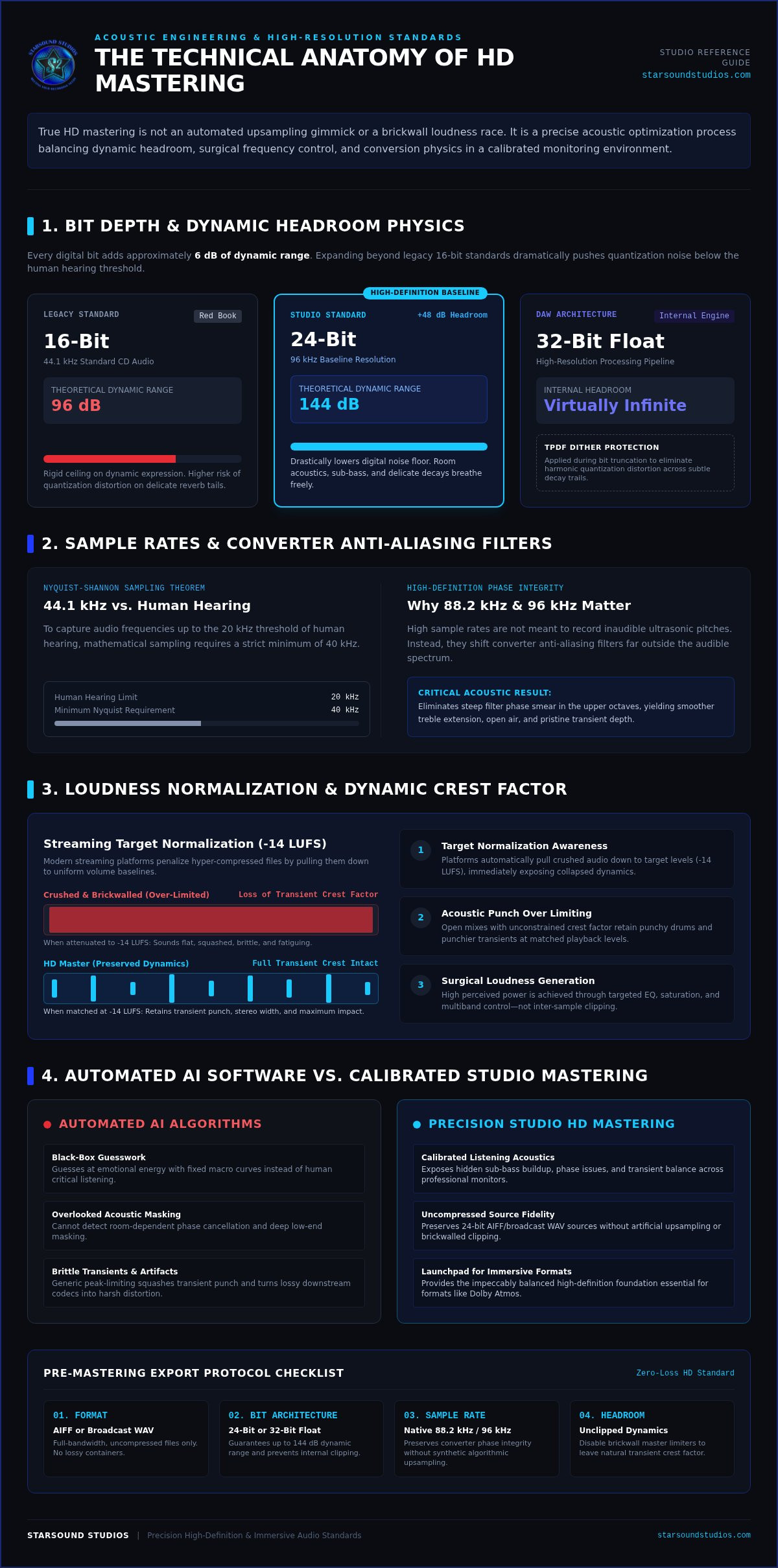
For decades, commercial audio adhered strictly to the standard Red Book specification of a 16-bit depth and 44.1 kHz sample rate. While functional, this standard places a rigid mathematical ceiling on dynamic expression, yielding a theoretical dynamic range of roughly 96 dB. Modern industry baselines for high-resolution audio require a minimum of 24-bit depth and 96 kHz sampling rates. Stepping up to 24-bit architecture expands theoretical dynamic range to 144 dB. That massive expansion drastically lowers the digital noise floor and eliminates quantization distortion, giving delicate reverbs, room acoustics, and sub-bass transients room to breathe with pristine spatial clarity.
The Loudness War Fallacy vs. Dynamic Acoustic Precision
Chasing flatlined volume on the master bus is an outdated trap. Heavy-handed peak limiting crushes natural transients, squashes the rhythm section, and causes rapid listener fatigue. Modern streaming platforms utilize loudness normalization routines that directly penalize hyper-compressed files:
- Target normalization: Services pull down crushed tracks to uniform targets like -14 LUFS, instantly exposing flat dynamics.
- Acoustic punch: Open mixes with unconstrained crest factor retain their transient impact, sounding punchier and wider at matched playback volumes.
- Perceived power: Surgical equalization, saturation, and multi-band control deliver high perceived volume without clipping distortion.
Mastering engineers use critical acoustics to build authentic punch. Through disciplined hd mastering, your mix commands competitive energy while keeping its original punch intact across every playback format.
Technical Anatomy of an HD Master: Resolution, Bit Depth, and Headroom
A flawless master isn't built on guesswork. It rests on the physics of digital signal processing. Executing true hd mastering requires managing digital conversion stages with absolute precision to protect transient punch. Handling uncompressed assets with care, such as utilizing the audio format aiff or broadcast WAV, ensures you retain pristine sonic detail before running your tracks through high-resolution processing chains.
Why 24-Bit and 32-Bit Float Outperform 16-Bit Resolution
Every bit added to digital audio delivers approximately 6 dB of dynamic range. While 16-bit audio caps out at 96 dB, 24-bit audio yields 144 dB, effectively burying quantization noise far below the human hearing threshold. Working inside modern DAWs at 32-bit floating point gives you virtually infinite internal dynamic headroom, making digital clipping inside processing chains mathematically impossible. When truncating down to 24-bit or 16-bit for distribution, applying targeted TPDF dither eliminates harmonic quantization distortion across subtle decay trails and room reverb tails.
Sample Rates Decoded: The Reality of 44.1 kHz to 96 kHz
According to the Nyquist-Shannon sampling theorem, capturing frequencies up to 20 kHz requires a minimum sample rate of 40 kHz. Higher sample rates like 88.2 kHz and 96 kHz don't exist simply to register ultrasonic content beyond human hearing. Instead, they shift converter anti-aliasing filters far outside the audible spectrum. This eliminates phase smear in upper octaves, yielding smooth treble and lifelike depth. Studying fundamental audio mastering techniques reveals that working at 24-bit/96 kHz strikes the sweet spot between acoustic fidelity and computer processing stability.
True-Peak Limiting and Intersample Peak Suppression
Standard sample-peak meters only read discrete digital points. When lossy codecs on streaming platforms reconstruct analog waveforms, consecutive high-level samples create intersample peaks that bridge beyond 0 dBFS, inducing abrasive distortion. Professional hd mastering controls this with dedicated true-peak limiting:
- Ceiling calibration: Setting limits between -1.0 dB and -2.0 dB True Peak leaves safe headroom for lossy AAC and MP3 encoding.
- Oversampling filters: Running 4x or 8x intersample detection catches hidden peaks before bouncing final assets.
If you want your music translated with complete dynamic clarity, partnering with seasoned engineers in a calibrated suite like Starsound Studios guarantees every transient translates cleanly to the streaming world.
AI Algorithms vs. Professional Engineers in High-Definition Environments
Music isn't static math. It's an emotional narrative shaped by tension and release. Automated mastering apps treat audio files like numerical puzzles, running every track through generic target curves regardless of genre or feeling. They can't detect the deliberate restraint of an acoustic breakdown, nor can they feel the explosive impact of a final chorus. While subscription algorithms promise instantaneous perfection, authentic hd mastering requires an experienced engineer evaluating the organic balance of every song. Choosing dedicated professional mastering means working with a collaborative mentor who honors your creative identity while polishing your sound to translation perfection.
Where Algorithmic Web Processors Fall Short with Complex Transients
Algorithms apply rigid formulas that choke rhythmic vitality. When a complex arrangement surges, automated limiters clamp down aggressively, flattening snare punch and pushing vocal transients into the background. Automated platforms also struggle to interpret artistic intent:
- They mistake deliberate analog warmth and intentional distortion for unwanted noise.
- They apply flat frequency profiles that rob delicate genres of their natural acoustic intimacy.
- They overlook out-of-phase stereo elements, collapsing wide synths and creating hollow, canceled mono sums.
The Decisive Advantage of Calibrated Acoustic Listening Environments
No algorithm can compensate for acoustic reality. Bedroom producers and online platforms both operate blind to room acoustic anomalies. Untreated rooms suffer from physical standing waves and severe low-frequency cancellations that hide mud below 50 Hz. In contrast, a precision-tuned mastering environment exposes every microscopic flaw across the entire audible spectrum.
Inside an acoustically calibrated space, high-end monitoring reveals whether your bassline is fighting the kick or your stereo field lacks center focus. A skilled engineer provides an essential layer of human quality control. If a mix exhibits masking or harsh sibilance, you receive actionable feedback before final output rather than an automated, clipped compromise. That human insight turns standard tracks into stunning high-definition releases through proper hd mastering execution.
Preparing Your Mix for HD Mastering: A Technical Step-by-Step Protocol
Mastering cannot rescue a damaged mix. A high-resolution chain simply magnifies whatever balance decisions exist in your stereo print, meaning preparation is everything. When you prepare your session deliberately, you give the mastering engineer clean dynamic margins to sculpt transient energy and harmonic weight. If your project suffers from deep masking or unbalanced multi-tracks that stereo processing cannot solve, exploring dedicated mixing and mastering services allows for corrective work at the individual stem level before final prints.
DAW Export Protocols: Resolution, Dither, and Native Formats
Locking in your export parameters ensures pure signal transfer from your DAW without adding unintended artifacts:
- Maintain native sample rates: Avoid applying sample rate conversion during mixdown. If you tracked at 48 kHz or 96 kHz, export at that exact frequency.
- Export unquantized bit depths: Render your files at 24-bit or 32-bit floating point. Keep master bus dither turned off at this stage, as dither should only be applied once during final delivery bit reduction.
- Choose uncompressed containers: Stick exclusively to uncompressed WAV or AIFF containers. Never bounce lossy formats like MP3 for critical post-production work.
Master Bus Discipline: Disabling Limiting While Protecting Balance
Headroom provides the canvas for analog and high-precision digital outboard chains. Strip away aggressive brickwall limiters and clippers placed solely to drive artificial loudness. If your mix falls apart when bypassing the master limiter, your group balances are masking dynamic problems. Rebalance individual channel faders until the arrangement hits between -6 dBFS and -3 dBFS peak levels on the master meter. Retain gentle mix bus compressors that provide cohesive musical glue, but ensure gain reduction rarely exceeds 1 to 2 dB.
Stereo Field Integrity and Low-Frequency Phase Coherence
Check your mix with correlation meters to ensure values hover comfortably between +0.5 and +1.0. Drops into negative territory signal out-of-phase elements that will cancel out when summed to mono. Collapse your mix to mono and listen closely: does the lead vocal stay centered, or do wide synths hollow out the midrange? Keep bass and sub-kick elements strictly centered below 100 Hz to guarantee solid energy transfer on club systems and consumer earbuds alike.
Once your audio meets these rigorous benchmarks, it is primed for professional hd mastering. Ready to hear your tracks at their absolute peak? Book your mastering session with Starsound Studios today and bring your sound to life.
Beyond Stereo: Translating HD Masters to Immersive Audio and Streaming
Modern distribution isn't a single-destination journey. Listeners consume music across a fragmented ecosystem of platforms, ranging from lossless 24-bit FLAC streams on TIDAL and Amazon Music to dynamic spatial renders on Apple Music. Navigating these requirements demands complete consistency. A pristine high-resolution stereo master serves as the definitive reference point for all downstream formats, establishing the tonal balance and dynamic weight that every transcode must mirror.
Meeting Apple Digital Masters and High-Res Lossless Standards
High-fidelity distribution relies on strict delivery protocols. The Apple Digital Masters initiative requires 24-bit high-resolution files rendered without clipping or inter-sample peak overshoots. Experienced engineers utilize real-time codec auditioning plugins to monitor precisely how algorithms compress high-frequency energy and stereo width during encoding. Because genuine hd mastering preserves essential phase relationships and headroom at native sample rates, the underlying micro-dynamics and spatial imaging survive lossy transcoding without deteriorating into brittle, fatiguing artifacts.
Bridging High-Resolution Stereo into Immersive Spatial Ecosystems
Immersive spatial playback has changed how listeners experience sound, but great spatial audio always begins with an exceptional stereo baseline. Translating stereo power into three-dimensional acoustic environments requires absolute monitoring precision:
- Acoustic parity: Calibrated 9.1.4 monitor environments inform both stereo imaging decisions and three-dimensional object positioning, preventing phase cancellation across multiple playback speakers.
- Platform discovery: Major streaming services actively favor releases that pair high-resolution stereo masters with dedicated Dolby Atmos mixes, unlocking prime placement on editorial playlists.
- Artistic continuity: Maintaining matching frequency contours between your stereo print and spatial stem arrays ensures your creative vision remains cohesive everywhere.
Achieving commercial translation across diverse formats takes more than static algorithms. It requires an intentional creative environment guided by experienced ears. Partnering with the passionate engineers at Starsound Studios connects your art with Ohio's premier Dolby-certified 9.1.4 suite and precision monitoring rooms. Through collaborative, human-driven hd mastering, your music leaves the studio with the warmth, clarity, and authority needed to captivate audiences across every system.
Bring Your High-Resolution Vision to Life
Achieving release-ready audio isn't about crushing waveforms until the life gets squeezed out. Genuine hd mastering protects your artistic vision. By prioritizing clean dynamic headroom, 24-bit resolution, and surgical true-peak control, you protect your tracks against lossy streaming degradation while ensuring impactful translation from mobile earbuds to club sound systems.
Your music deserves an intentional listening environment rather than automated presets. Based in North Royalton, Starsound Studios pairs decades of post-production leadership under Steve The Mix with pristine, precision-calibrated acoustic spaces. As Ohio's first and only Dolby-certified Atmos facility featuring a 9.1.4 monitoring suite, our studio delivers the exact critical listening environment required for both high-definition stereo masters and spatial formats.
Give your music the clarity, dynamic punch, and translation power it needs to captivate listeners worldwide. Elevate your sound with professional mastering at Starsound Studios and step into your release day with absolute confidence.
Frequently Asked Questions
Is HD mastering necessary if my listeners only use Spotify or Apple Music?
Yes, because streaming platforms convert your upload into various codecs, and high-resolution source material yields far cleaner transcode results. Apple Music natively supports lossless audio and Apple Digital Masters delivered at 24-bit resolution, while Spotify normalizes playback levels. Professional hd mastering ensures your transients survive lossy data compression intact, preventing the brittle highs and lost punch that often ruin standard uploads across consumer platforms.
What is the difference between 24-bit audio and standard 16-bit audio files?
The primary distinction lies in dynamic range and the noise floor. A 16-bit file provides 96 dB of dynamic range, whereas a 24-bit file expands that headroom to 144 dB. This massive increase reduces quantization distortion, ensuring quiet musical nuances, delicate reverb tails, and subtle room acoustics are accurately preserved without introducing low-level digital grain during conversion.
Can an automated online mastering tool deliver true high-definition audio quality?
No, automated algorithms cannot deliver true high-definition results because they process tracks against static target curves without acoustic context. They can't detect destructive low-end phase cancellations or adjust for delicate dynamic shifts between song sections. Genuine hd mastering requires the nuanced judgment of an experienced mastering engineer listening critically inside a tuned acoustic environment to make contextual decisions tailored specifically to your mix.
How much headroom should I leave on my master bus before sending tracks for mastering?
Aim for peak levels between -6 dBFS and -3 dBFS on your master output meter. Leaving this unoccupied headroom prevents converter clipping and gives the mastering engineer clean space to apply surgical equalization, analog saturation, and dynamic shaping. Avoid slamming your master fader to achieve this; instead, pull down individual track faders or group busses to preserve your internal mix balance.
What happens if I export my mix with peak limiting already applied to the master bus?
Leaving a brickwall limiter on your master bus bakes permanent dynamic compression and flattened transients directly into your audio file. Once transients are shaved off, an engineer cannot restore them. This leaves zero working headroom for analog outboard gear or precision digital tools, forcing the mastering engineer to work around audible distortion rather than enhancing your mix's natural depth and punch.
Does mastering in high resolution eliminate all digital distortion during streaming playback?
It dramatically reduces distortion, but only if true-peak intersample overs are properly suppressed. When streaming platforms transcode files into lossy AAC or Ogg Vorbis formats, digital reconstruction filters can push consecutive samples over 0 dBFS. A professional master incorporates a true-peak ceiling between -1.0 dB and -2.0 dB, ensuring the decoded audio streams cleanly without introducing abrasive digital clipping on consumer devices.
What file format is best for submitting mixes for professional audio mastering?
Always deliver uncompressed 24-bit or 32-bit float WAV or AIFF files rendered at your session's native sample rate. Avoid applying dither or sample rate conversion during export. For Cleveland-area musicians working locally or worldwide artists collaborating remotely with Starsound Studios in North Royalton, submitting clean, uncompressed files guarantees your audio enters the mastering suite with its complete acoustic fidelity preserved.


