

Did you know your music could be earning 10% more in royalties simply by existing in a new dimension? As spatial audio moves from a niche luxury to the industry standard, the choice between a stereo vs dolby atmos mix has become the most critical decision for your release. You've likely felt that pang of anxiety when listening to your tracks on Apple Music, fearing they might sound thin or lose their emotional punch compared to major label hits. It's a common hurdle for creators navigating the technical bridge between a home studio and a professional 9.1.4 immersive suite.
We understand that the shift to object-based audio can feel overwhelming, especially when you're staring down complex ADM BWF delivery requirements. This guide is here to provide the grounded assurance you need. You'll discover how Dolby Atmos mastering transforms your music from a flat stereo file into a vivid, 3D experience that translates perfectly across every headphone and soundbar. We'll explore the essential deliverables for distribution and show you how a professional touch ensures your vision meets the highest streaming standards; giving you the confidence to share your art with the world.
Key Takeaways
- Mastering is the final optimization of object-based metadata; it ensures your 3D soundscape translates perfectly from 128 channels down to binaural headphones.
- Understand the technical divergence of a stereo vs dolby atmos mix, specifically why Atmos requires a strict -18 LKFS loudness cap to maintain immersive integrity.
- Learn the essential ADM BWF delivery requirements and the calibrated workflow needed to make your music release-ready for global streaming platforms.
- Discover how Spatial Audio placement can boost your discoverability and royalty potential while future-proofing your catalog for the next decade of audio innovation.
- Explore the advantage of working with Ohio’s only Dolby-certified 9.1.4 facility to provide the professional polish that takes your project from a home-studio mix to a world-class master.
Defining Dolby Atmos Mastering: Beyond the Stereo Horizon
Mastering in the immersive era is a complete paradigm shift. It is the sophisticated final stage where object-based metadata is meticulously optimized for distribution across a global ecosystem. While stereo mastering focuses on a fixed two-channel image, Atmos mastering manages a complex web of up to 128 potential channels. It ensures your vision translates perfectly to binaural headphones and massive speaker arrays alike. This isn't just about technical compliance; it's about preserving the emotional core of your music as it moves through the Dolby Atmos technology pipeline. We analyze the spatial integrity of every element, ensuring that the listener feels the same energy whether they are in a high-end car or using standard earbuds.
The biggest shift in the stereo vs dolby atmos mix debate involves how we handle energy. In the old world, mastering was often a battle in the "loudness wars," pushing levels to the limit until the life was squeezed out of the track. In 2026, Atmos mastering is about "loudness normalization." We target a strict -18 LKFS, focusing on sonic impact and spatial clarity rather than sheer volume. This process involves a rigorous check of the ADM (Audio Definition Model) BWF file. We look for technical compliance and sonic impact. If a sound object is clipping or the metadata is corrupted, the master fails. We provide the grounded assurance that your technical details are handled with absolute precision.
The Difference Between Mixing and Mastering in 3D
Mixing is where you define the movement. It’s the creative placement of sounds within a 3D field. Mixing engineers focus on the relationship between individual stems. Mastering, however, provides the objective final check on tonal balance and spatial "clutter." We ensure the low end doesn't overwhelm the immersive field. A fresh set of ears in a calibrated 9.1.4 room is critical for Atmos success. It identifies phase issues and translation errors that smaller, uncertified environments simply cannot hear. It is the final polish that makes your work release-ready.
Object-Based Audio vs. Channel-Based Audio
Traditional audio is channel-based. It is stuck in the speakers you assigned it to during the mix. Atmos uses "objects" that allow your master to adapt dynamically to any speaker layout. Your master "unfolds" differently on a soundbar than it does on AirPods. The "Bed" (your 7.1.2 foundation) provides the solid ground, acting as the structural anchor for the song. Meanwhile, metadata dictates how objects move and scale. This flexibility is why the stereo vs dolby atmos mix comparison is so stark. One is a static picture; the other is a living, breathing environment that prioritizes the artist's original intent across every device.
Stereo vs. Atmos Mastering: A Direct Comparison
Think of stereo as a high-definition photograph. It's beautiful, detailed, and evocative, but it remains flat. Atmos is a physical space you can walk through. When comparing a stereo vs dolby atmos mix, the most immediate difference is the transition from a fixed 2-channel image to a fluid, 3D soundscape. In stereo, you're pushing sounds into a tiny window. In Atmos, that window is gone. You have an entire room to fill. This freedom requires a complete technical mindset shift. You aren't just balancing left and right; you're managing the energy of an entire environment.
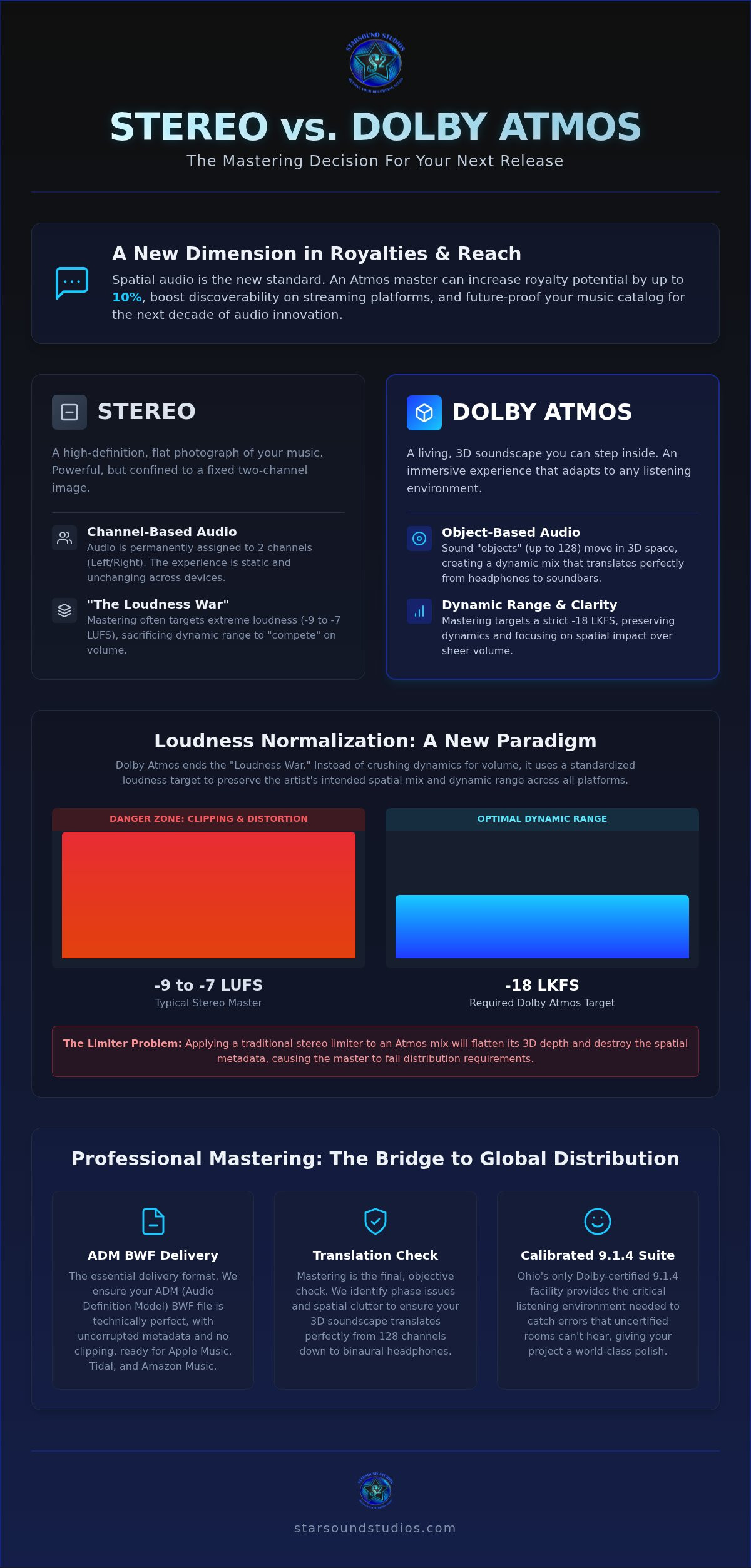
Loudness is the biggest shock for artists moving into immersive audio. Traditional stereo mastering often targets -9 to -7 LUFS to compete in a crowded market. Dolby Atmos is different. It is strictly capped at -18 LKFS. If you try to apply a traditional stereo limiter to an Atmos master, you'll encounter the "Limiter Problem." Slamming the signal destroys the metadata that defines object positioning. It flattens the 3D depth you worked so hard to create. Mastering for Atmos is about protecting the spatial integrity, not squashing the peaks. We focus on frequency management in 3D to avoid phase issues that stereo mastering tools simply cannot detect.
The Death of the Loudness War
Atmos rewards the brave. It celebrates dynamic range rather than punishing it. Streaming platforms like Apple Music and Tidal use sophisticated algorithms to handle the volume transition between stereo and Atmos tracks. You don't need to fear your track sounding "quiet" because the system balances the perceived volume for the listener. Loudness in Atmos is achieved through spatial density, not digital clipping. By placing objects strategically, we create a sense of power and visceral impact that feels massive without ever hitting a digital ceiling. If you want to ensure your dynamics are optimized, our Remote Mastering services provide that expert bridge to a professional release.
Binaural Translation: The Headphone Factor
Most of your fans aren't sitting in a 9.1.4 room. They're on the bus with AirPods. Professional mastering ensures the "binaural render" feels natural and wide rather than cramped inside the skull. We adjust distance and positioning metadata to prevent "inside the head" fatigue. This involves checking various workflows and strategies to ensure the binaural fold-down sounds as close to the speaker array as possible. We even test your master against Apple’s personalized spatial audio profiles. This guarantees a consistent, premium experience for every listener, regardless of their hardware. We prioritize your unique identity, ensuring the master translates your intent with absolute precision.
The Technical Workflow: From Renderer to Distribution
Precision is the heartbeat of professional mastering. While mixing is about the creative spark, the mastering workflow is a rigorous, four-step journey to ensure your art survives the transition from our studio to the listener’s ears. It begins with the ADM BWF file. This is the blueprint of your immersive vision. We import this into a certified Dolby Atmos Renderer, the central processing unit that translates your object metadata into actual sound. This isn't a simple "drag and drop" process. It requires a dedicated environment where the software and hardware are in perfect sync.
Environment is everything. We calibrate the monitoring suite to exact standards, typically 79dB or 85dB SPL depending on the room size. This ensures that every decision we make about tonal balance is accurate and repeatable. Next, we dive into the sonic sculpting. We fine-tune EQ and dynamics across the 7.1.2 immersive bed and individual objects. This is where the human element shines. We identify spatial clutter that software might miss. Finally, we perform an offline re-render. This creates the master deliverable that streaming services demand. The technical jump in a stereo vs dolby atmos mix becomes apparent during this re-render phase, where we aren't just bouncing audio, but baking in complex positional data for every single object.
Essential Tools: The Atmos Mastering Suite
The Dolby Atmos Renderer is the brain of the operation. It interprets metadata and tells the speakers exactly where to place each sound object. To ensure your album feels like a cohesive journey, we use the Dolby Atmos Album Assembler. This tool allows us to manage gapless playback and consistent flow between tracks, which is vital for a professional listener experience. We maintain 96kHz/24-bit fidelity throughout the entire chain. High-end DA/AD converters are non-negotiable here. They preserve the microscopic details of your recording, ensuring the "air" and "space" of your mix remain intact.
ADM BWF: The Master File Explained
Think of the ADM BWF (Audio Definition Model Broadcast Wave Format) as a high-tech container. It holds both the audio data and the metadata instructions for the renderer. This is the only format streaming services like Apple Music accept for immersive content. Because it contains up to 128 channels of information, these files are significantly larger than a standard stereo WAV. We also handle the heavy lifting of ensuring timecode and frame rate consistency. This is crucial for sync if your music is destined for video content or film. When we analyze a stereo vs dolby atmos mix, we're looking at the difference between a simple stereo file and a multi-layered data map that adapts to the listener's hardware.
Why Independent Artists Need Professional Atmos Mastering
The algorithmic landscape of 2026 has shifted. For the independent artist, the choice between a stereo vs dolby atmos mix is no longer just a creative preference; it’s a strategic necessity. Platforms like Apple Music now prioritize Spatial Audio tracks in their discovery algorithms, often granting them prime real estate in curated playlists. This increased visibility translates directly into momentum. Professional Atmos mastering serves as the ultimate archival standard. By preparing your catalog in an immersive format now, you ensure your music remains relevant and high-fidelity as hardware continues to evolve. When you weigh the long-term impact of a stereo vs dolby atmos mix, the discoverability factor alone makes the decision clear.
Professional validation also opens doors to sync licensing. Music supervisors for film and television increasingly demand Atmos deliverables to match the immersive soundtracks of modern cinema. A home-brewed file often lacks the technical rigor required for these high-stakes placements. Avoiding the "DIY" trap is essential. Attempting to master immersive audio in an untreated room leads to translation errors that can ruin your reputation with labels and distributors. We act as the bridge between your home production and professional distribution. We provide the grounded assurance that your technical details are handled with absolute precision.
Compliance and Quality Control
Labels are stricter than ever. The industry standard remains a rigorous -18 LKFS integrated loudness requirement. If your master drifts outside these bounds, it faces immediate rejection from major global platforms. We also perform deep-level checks for "illegal" object movements. These are erratic spatial transitions that cause listener disorientation and ear fatigue. Quality Control is the safety net that prevents technical glitches and phase cancellations from reaching your fans. It’s the difference between a professional product and a technical liability.
The Competitive Edge in 2026
Immersive audio is your signature. It sets your production apart in a saturated digital market where everyone is fighting for a second of attention. By utilizing height and width, you create an intimate artist-to-fan connection that stereo simply cannot replicate. It’s an evocative, sensory experience that places the listener inside your creative sanctuary. If you’re working from a distance, our Remote Mastering services ensure you get that world-class polish without leaving your own studio.
Ready to hear your music in 3D? Consult with our Dolby-certified engineers today and take the final step toward a world-class release. We are invested in your final product as much as you are.
Ohio’s Only Dolby-Certified 9.1.4 Suite: The Starsound Advantage
Physical reality matters. While many engineers attempt to replicate the immersive experience through binaural plugins or virtual studio software, these tools often fail to capture the true phase relationships and frequency response of a calibrated room. Starsound Studios stands as a beacon for creators who refuse to compromise on quality. As the first and only facility in Ohio to achieve official Dolby Atmos certification, we offer a level of precision that home setups simply cannot match. When you are navigating the choice of a stereo vs dolby atmos mix, you need the grounded assurance that your work is being evaluated in a space built specifically for this medium. It’s about more than just software; it’s about the air in the room.
Steve 'The Mix' acts as your collaborative mentor throughout this transition. He brings decades of high-end stereo expertise to the immersive field, ensuring that your artistic identity remains the priority. We don't just process files; we elevate visions. Our team provides a seamless bridge from your existing stereo stems to a world-class Atmos master. We understand that every project carries its own spirit and energy. We’re here to make sure that energy is preserved and amplified within the 3D soundscape. This is a sanctuary where the science of audio meets the heart of creation.
The Power of 9.1.4 Monitoring
The ".4" in our 9.1.4 system represents the four dedicated height channels that make the Atmos experience truly immersive. These overhead speakers are essential for accurate panning and spatial depth. Without them, you are essentially guessing where your objects sit in the vertical plane. Our suite features meticulous acoustic treatment and precise calibration. This allows us to hear exactly what the Dolby Renderer intended without the coloration of an untreated environment. If you are deciding on a stereo vs dolby atmos mix for your next release, our physical room provides a translation accuracy that virtual studio plugins simply cannot replicate. You hear the truth of your mix.
Cleveland’s Hub for Immersive Audio
We are proud to serve as Cleveland’s primary hub for world-class post-production standards. Our facility supports the local Ohio music scene while providing elite remote mastering services to artists across the globe. From our studio in North Royalton, we work with creators to ensure their masters meet the rigorous technical demands of 2026 streaming platforms. We handle the technical complexities of ADM BWF delivery and loudness compliance so you can focus on the art. Whether you are local or working with us from another continent, you receive the same high-attention experience that defines our brand.
Your music deserves the professional polish that only a certified facility can provide. Book your Atmos mastering session at Starsound Studios today and hear your creative vision fully realized in three dimensions.
Step into the Future of Sound
The transition from a stereo vs dolby atmos mix represents the most significant leap in audio production since the invention of the multi-track recorder. You've seen how professional mastering provides the essential bridge between your creative vision and global distribution standards. By securing your place in the immersive market, you aren't just following a trend; you're future-proofing your art for the next generation of listeners. From technical compliance to the visceral emotional impact of a 9.1.4 soundscape, the path to a world-class release is now clearer than ever.
At Starsound Studios, we provide the precision and passion your project deserves. As Ohio’s first and only Dolby-certified 9.1.4 facility, we combine the seasoned expertise of Steve 'The Mix' with a perfectly calibrated environment to ensure your master translates everywhere. Whether you are visiting us in Cleveland or utilizing our remote services, you're in capable hands. It’s time to move beyond the limitations of two channels and let your music breathe in three dimensions. Elevate your sound with Ohio's only Dolby-certified Atmos mastering and experience the difference that professional precision makes. Your highest potential is within reach.
Frequently Asked Questions
Does Dolby Atmos actually need mastering if the mix is good?
Yes, mastering is essential for technical compliance and ensuring the 3D soundscape translates across all devices. Even a perfect mix needs the final unfolding metadata checked in a certified room to ensure it meets the strict -18 LKFS loudness requirement. This stage acts as your safety net against technical glitches and ensures your vision remains intact on global platforms.
What is an ADM BWF file and do I need one for Spotify?
An ADM BWF (Audio Definition Model Broadcast Wave Format) is the standardized master file that contains your audio data and spatial metadata. While Apple Music and Tidal require this format for immersive releases, Spotify has historically focused on stereo. However, having this file is critical for future-proofing your catalog across the major platforms that currently dominate the spatial audio market.
Can I master Dolby Atmos music using only headphones?
You cannot master Atmos accurately using only headphones. While binaural monitoring is helpful for checking the consumer experience, you need a physical 9.1.4 or 7.1.4 speaker array to detect phase issues and spatial clutter that headphones might mask. Professional mastering ensures the stereo vs dolby atmos mix maintains its emotional impact when moving from a speaker array to a fan's earbuds.
How much does professional Dolby Atmos mastering usually cost?
The cost of professional Atmos mastering depends on the engineer's expertise and the studio's certification level. While you'll find varying rates across the industry, investing in a Dolby-certified facility ensures your music meets the high standards required by major labels and streaming services. It is about the value of precision and the grounded assurance that your master is release-ready.
Is Dolby Atmos mastering different from 'Spatial Audio' on Apple Music?
Dolby Atmos is the technical format, while Spatial Audio is Apple Music's specific brand for immersive playback. When we master your track in Atmos, we're creating the technical blueprint that Apple's Spatial Audio engine uses to deliver that 3D experience. They are two sides of the same coin; Atmos is the industry-standard source that feeds the playback ecosystem.
What should I provide to the mastering engineer for an Atmos session?
You should provide a high-resolution ADM BWF file and your final stereo master for reference. Providing the stereo version helps the engineer maintain the sonic identity and energy of your project. When analyzing a stereo vs dolby atmos mix, having both files allows us to ensure the immersive version feels like a natural, enhanced extension of your original artistic vision.
Will an Atmos master make my song sound quieter than stereo versions?
Your song won't sound quieter to the listener because streaming platforms use loudness normalization to balance levels. While the technical target is -18 LKFS, which is lower than stereo targets, the playback system automatically compensates for this difference. The result is a more dynamic, punchy sound that feels massive without the need for digital clipping or heavy limiting.
How long does the Atmos mastering process take for a single song?
The mastering process for a single song typically takes between two to four hours of dedicated studio time. This includes the technical QC check, tonal balancing in the 9.1.4 suite, and the final offline re-render to create the deliverable. It is a meticulous journey that ensures every object and bed channel is perfectly optimized for the listener's hardware.


