

A louder demo isn’t automatically more convincing. Audio mastering for booking submissions is the final polish that helps a finished mix sound balanced, controlled, and ready to represent your work. The goal isn’t to flatten its energy, but to make its details translate clearly.
You may already know that a strong track can make a lasting impression, and that its sound matters as much as the song itself. Mastering can refine tonal balance, dynamics, and playback level, but it can’t replace a solid mix or guarantee a booking.
This guide explains what mastering changes, how to prepare files for submission, and why loudness alone isn’t the goal. You’ll also learn how file formats, transfer choices, and the mastering engineer’s approach can help preserve your track’s character and keep its presentation focused.
Key Takeaways
- Preserve the mix’s dynamics and musical character rather than chasing loudness alone.
- Choose a mastering engineer whose communication and approach suit your sound and submission goals.
- Decide whether a mastered or unmastered demo best represents your track, and prepare the file accordingly.
- Understand which project details shape mastering costs, and consider audio engineering classes or mastering support for your next step.
Loudness and dynamic range
Mastering balances perceived loudness with dynamics, the contrast between quieter and louder moments. A streaming master and a booking demo can use the same mix, but their delivery needs may differ. Streaming mastering follows platform playback standards, while a booking demo should present the track clearly and consistently for evaluation.
Managing Loudness and Dynamics
Increasing loudness often reduces dynamic contrast, especially when compression or limiting controls peaks. That trade-off can make a quiet passage easier to hear, but too much processing may flatten a chorus or soften a forceful drum hit. For a booking submission, preserve the changes that make the performance feel alive.
Digital headroom matters before mastering. A 24-bit file can represent a possible dynamic range of 144 dB, while a 16-bit file can represent 96 dB. These figures describe bit depth’s theoretical range, not a target loudness for your song. A mix submitted for mastering should ideally have a maximum peak between -3 and -6 dBFS, leaving room for processing without clipping.
Using Limiting and Loudness References
A limiter controls peaks so the overall level can rise without exceeding the digital ceiling. Used heavily, it can reduce transients and make a mix feel less open. Listen for changes to snare impact, vocal detail, and the movement between verse and chorus, rather than judging the master by level alone.
Choose a reference track with a similar arrangement and energy, then compare sections at matched playback levels. This helps you assess tonal balance and perceived loudness without being misled by a louder file. Compare the reference and your mix at the same point in your audio software, and note whether compression changes the feel or clarity you want.
Adapting Masters for Streaming or Booking
Streaming masters are prepared for digital playback, while a booking demo has a different job: present the song and performance clearly to a talent buyer. There isn’t one universal loudness target for every platform or submission. Keep the demo’s vocal, groove, and arrangement easy to follow instead of forcing extra level through limiting.
For example, if a dense chorus feels smaller than the verse after limiting, ease the processing and compare again. A streaming version and a booking version may call for different delivery choices, but both should preserve the track’s identity. Use the intended destination as your reference, then judge whether dynamics and level support the listening experience.
Hiring mastering engineers
Compare engineers by listening closely to finished projects, then consider their communication and delivery process. A polished reel matters, but the right fit also understands the sound and purpose of your submission.
Choosing Mastered or Unmastered Demos
For a booking agent, a mastered demo can create a consistent, finished sound across several tracks. An unmastered demo can make sense when the mix is still changing or you want production feedback before final polish. Choose the version that represents the music accurately, rather than sending a rough bounce that distracts from the performance.
When choosing between online mastering and a local studio, use the same criteria: relevant samples, clear communication, file delivery, and revision terms. Online work suits artists who prefer sending files and giving feedback remotely. A local session may suit those who value in-person discussion. Either way, listen for how the engineer handles your genre, vocal placement, and the energy of a chorus.
Review sample projects at matched playback levels. A louder sample can seem more impressive at first, even if its balance is less suitable. Then describe your goal in practical terms, such as keeping the lead vocal forward or preserving punch in the drums. The engineer’s response can show whether they understand the direction you want.
Reviewing Turnaround and Included Services
Online mastering timelines depend on the engineer’s schedule, project scope, and revision process. Before sending files, establish the expected delivery window and how feedback affects it. The service description should clarify whether it includes a final master, a preview, revisions, or multiple formats. These details make it easier to plan around a submission deadline.
Mastering commonly addresses tonal balance, dynamics, and final playback level. Some projects may also need separate versions for different uses, so identify the destination in your brief. For example, tell the engineer whether the file is a single-track demo or part of a connected set. Clear notes focus the work without prescribing every processing move.
Online mastering can work well when file transfer and written feedback meet your needs. A studio session offers direct conversation about the sound. In either format, choose an engineer whose relevant samples and process align with your project, then agree on deliverables and timing before work begins.
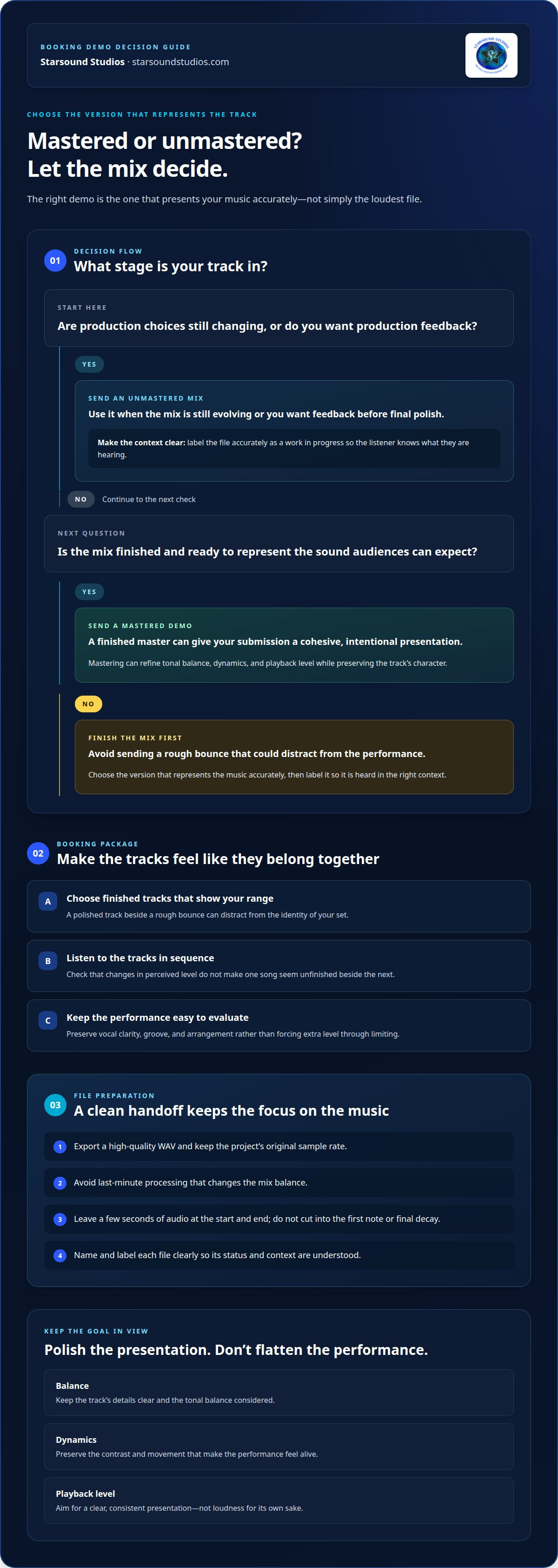
Should I submit mastered or unmastered demos to booking agents?
Send a mastered demo when the mix is finished and you want it to represent the sound audiences can expect. Audio mastering for booking submissions can give a completed mix a cohesive, intentional presentation. An unmastered mix makes sense while production choices are still changing, or when you’re sharing a work in progress for feedback. Label the file accurately so a booking agent hears it in the right context.
For a booking package, consistency matters across the tracks you include. If one song sounds polished and another is a rough bounce, the difference can distract from your set’s identity. Choose finished tracks that demonstrate your range, then listen through them in sequence. Check that shifts in perceived level don’t make one song seem unfinished beside the next.
Prepare the final mix carefully before mastering. Export a high-quality WAV, keep the project’s original sample rate, and avoid last-minute processing that changes the balance. Leave a few seconds of audio at the start and end, rather than cutting directly into the first note or off the final decay. Name each file clearly with the artist and song title, and distinguish a mastered version from a demo mix.
Before sending, play the exported file from beginning to end, not just the session inside your music software. Listen for clicks, clipped endings, missing sections, or a vocal that disappears in a dense chorus. Confirm that the upload contains the intended version and opens without requiring the recipient to search through alternate mixes. Treat audio mastering for booking submissions as a finishing choice: send a mastered file when it reflects the finished performance, and reserve a clearly identified rough mix for development feedback.
How much does professional audio mastering cost in the United States?
There isn’t one standard price for professional mastering in the United States. Costs vary with the project and are set after a quote request. Factors include track count, project complexity, revisions, and deliverables. A single finished mix and a multi-track release can require different amounts of listening and preparation.
Start by defining the work. A stereo master made from a finished mix differs from stem mastering, where separate groups of instruments are supplied. If the mix needs substantial balance changes, the project may call for mixing rather than mastering. A clear description helps establish the right scope before a quote is prepared.
- Track count: A single submission and a collection of songs involve different listening and delivery needs.
- Source files: A stereo mix and separate stems require different workflows.
- Revisions: The number and scope of included changes affect the project agreement.
- Deliverables: File formats and alternate versions can change what the engineer needs to prepare.
Compare quotes by scope, not by headline price alone. One quote may cover a stereo master and a defined revision process, while another may include additional versions or stem work. Confirm what the fee covers, which files you’ll receive, and how requested changes are handled. That makes the comparison useful without assuming similarly named services provide identical work.
Before requesting a quote, gather the final mix, identify its intended use, and describe any specific concerns, such as a vocal that feels buried. Include whether you need one track or several, and list the required deliverables. These details help the engineer estimate the work accurately. If the mix still needs substantial production changes, address those before commissioning a final master.
For booking submissions, prioritize a scope that delivers a clean, representative version of the music. A tailored quote helps you understand the work involved before committing, while keeping the focus on the sound and files your submission needs.
Starsound Studios: Audio Engineering Classes
Starsound Studios offers Audio Engineering Classes for artists who want to deepen their understanding of recording and production. If you’re still shaping a mix, Stereo Mixing can help refine its balance; for a finished mix ready for presentation, Mastering can provide final polish. Dolby Atmos Mixing (9.1.4) is another option for projects intended for immersive audio.
Choose your next step based on what your track needs now. Audio education may suit you if you want to develop your engineering skills, while mixing or mastering supports a specific project. Each path keeps the focus on presenting your music with clarity and intention.
Contact Starsound Studios to discuss the right next step for your music.
Shape the sound you want talent buyers to remember
Your submission is part of your first impression, but it should still sound like you. Let the performance lead, and make technical choices that serve the song rather than chasing a louder or more polished identity than the music calls for. With audio mastering for booking submissions, choose support that fits where your track is now.
Starsound Studios offers Stereo Mixing, Mastering, and Dolby Atmos Mixing (9.1.4). If your mix is ready for final polish, mastering can help prepare it for presentation. If the balance still needs work, stereo mixing may be the more suitable starting point. The right direction depends on the state of your project and the sound you want to share.
Bring your artistic intent into the conversation, whether you’re refining a finished track or developing its mix. Contact Starsound Studios about mastering to discuss a thoughtful next step for your music.
Frequently Asked Questions
What Is Mastering?
Mastering is the final stage of audio production, applied after mixing to prepare a track for release or sharing. It shapes the finished mix’s tonal balance, dynamics, and overall presentation. Mixing works with individual vocal and instrument tracks; mastering works with the completed stereo mix. For example, it can refine how a vocal-led song and its instrumental details come together in the finished recording.
What does audio mastering do for a music booking submission?
Mastering helps a booking submission sound cohesive and intentional, so the recording represents the music clearly. It can refine tonal balance and playback level without changing the song’s arrangement or performance. For a Cleveland-area artist sending a set of tracks, consistent presentation can make the collection feel like one considered body of work. Mastering is best viewed as a way to refine a mix, not as a substitute for the creative and technical work behind it.
Do booking agents and venues require mastered tracks?
There isn’t a universal requirement for every booking agent or venue to receive mastered tracks. A mastered track is useful when you want the recording to represent your current sound. If it’s a rough demo, label it clearly rather than presenting it as a final recording.
What audio file formats and specifications should booking submissions use?
Use the format requested by the recipient; if none is given, a high-quality WAV is a practical choice for preserving an uncompressed mix. For a mastering handoff, export at 32-bit or 32-bit floating point when possible, with 24-bit as an alternative. Keep the project’s original sample rate rather than upsampling, and leave at least 3 seconds of pre-roll and post-roll around the mix.
How loud should a mastered track be for a booking submission?
There’s no single loudness figure that suits every booking submission. Aim for a clear, balanced presentation that preserves the track’s dynamics, rather than maximizing level. Compare the master with a relevant reference at matched playback volume; otherwise, the louder version may seem better simply because it’s louder. Check that vocals and key instrumental parts remain audible on ordinary speakers and headphones.
Can over-compression or loudness normalization hurt a booking submission?
Yes, excessive compression can reduce the contrast between sections and soften transient detail, making a performance feel less open. Loudness normalization is different: playback systems may adjust a track’s level, but that adjustment alone doesn’t necessarily change its internal dynamics. Compare the processed and unprocessed versions at similar playback levels. Listen for flattened drums, strained vocals, or choruses that no longer lift.


