

Analog mastering isn’t simply digital mastering with hardware added. The benefits of an analog mastering chain come from how its equipment shapes the signal, adding harmonic saturation and helping sculpt stereo width while influencing loudness and dynamics. A typical chain may use about three compressors, each serving a different purpose in shaping dynamics.
It’s easy to associate analog processing with warmth and a wider-feeling mix, but the result depends on how the equipment interacts with the music. The right choices can add depth and character; more processing isn’t automatically better. This article explains how analog gear differs technically from digital processing, what mastering equalizers and compressors contribute, and how harmonic saturation can affect a stereo master. You’ll also learn when an analog approach may suit your sound and when precise digital processing may be a better fit. The goal is to help you choose tools that serve the mix without losing the energy and identity that made the track yours.
Key Takeaways
- Decide whether analog processing suits your track by weighing the character you want against the need for precise, transparent control.
- Understand how analog and digital processing shape a signal differently, so you can choose an approach that serves the mix.
- Learn how harmonic saturation and stereo processing can influence a master’s tone, depth, and width.
- Recognize the roles of equalizers, compressors, and other chain components to better understand the choices behind a finished master.
Is Analog Mastering Worth It?
Analog mastering is most useful when its tonal character supports the mix, not simply because the chain uses hardware. A chain with three compressors can shape loudness and dynamics across separate stages.
Analog Processing Characteristics
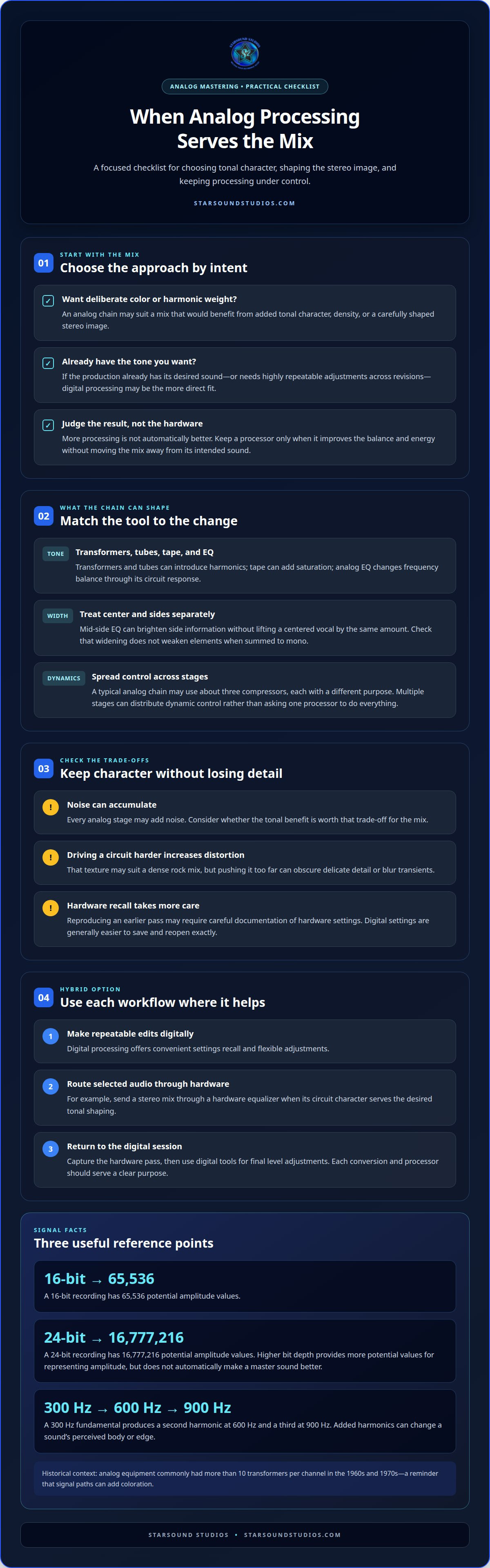
Analog processing shapes audio through physical circuits rather than software calculations. On a stereo mix, transformer or tube stages can add harmonic distortion, while equalization adjusts the balance around a chosen frequency. Potential sonic benefits include added density, tonal character, and carefully shaped width. Mid-side EQ treats center and side information separately, for example, brightening the sides without lifting a centered vocal by the same amount. A three-compressor chain can also distribute dynamic control instead of asking one processor to do everything.
Transformers, Tubes, Tape, and EQ
Transformers, tubes, tape, and analog EQ shape tone through circuits or magnetic media. Transformers and tubes can introduce harmonics; tape can add saturation, while analog EQ changes frequency balance through its circuit response. Analog equipment commonly had more than 10 transformers per channel in the 1960s and 1970s. That history illustrates how signal paths can add coloration. For a mix, the practical question is whether that color strengthens the production’s character or shifts it away from the intended sound.
Limitations and Risks
Analog processing can introduce noise and distortion, and recalling settings can take longer, so each choice has a trade-off. Every stage may add noise, while driving a circuit harder can increase distortion. That texture may suit a dense rock mix, but it can obscure delicate detail if pushed too far. To reproduce a previous pass, an engineer may need to document hardware settings carefully. For a release with several revisions, that extra precision matters; digital settings are generally easier to save and reopen exactly.
Choosing When to Use Analog
An analog chain is most beneficial when a mix needs deliberate color, harmonic weight, or a shaped stereo image. A thin-sounding drum bus, for example, may respond well to subtle saturation, while mid-side EQ can refine side brightness without changing the center in the same way. If the production already has the desired tone or needs highly repeatable adjustments across revisions, digital processing may be the more direct fit. The deciding point is whether each processor improves the balance and energy of the finished mix.
Analog mastering compared with digital mastering
Analog and digital mastering differ in how they shape and represent a signal, not in a simple quality ranking. A hybrid session can use digital processing for repeatable edits, route selected audio through analog hardware for its circuit character, then capture the result again. This lets mastering engineers choose tools according to the task.
Digital resolution depends partly on bit depth. A 16-bit recording has 65,536 potential amplitude values, while a 24-bit recording has 16,777,216. Bit depth limits a digital signal’s amplitude resolution, and it matters during digital processing. Higher bit depth therefore gives more potential values for representing amplitude, but it doesn’t automatically make a master sound better. The source, processing choices, and final balance still shape the musical result.
Analog-to-digital conversion translates a changing electrical signal into digital samples; digital-to-analog conversion turns those samples back into an electrical signal. Bit depth matters in processing, but makes little difference when the signal is simply converted from digital to analog. In a hybrid mastering path, each conversion should serve a clear purpose. For example, an engineer might send a stereo mix through a hardware equalizer for tonal shaping, then return it to a digital session for final level adjustments.
Digital plug-ins offer convenient settings recall, while analog gear can contribute the particular response of its physical circuitry. Digital emulations model aspects of hardware, but an emulation and the corresponding unit remain distinct tools, each with its own workflow. During mixing, digital processing can support precise edits; at mastering, a hardware pass may add color where desired. Neither route is automatically superior. The useful comparison is whether the processing moves the signal toward the intended sound without introducing unwanted changes.
Combining both approaches gives engineers options: analog hardware for a chosen tonal effect and digital tools for flexible adjustments. The right balance depends on the mix and the sound planned for release.
Stereo width and harmonic saturation
Analog mastering can shape dynamics, stereo image, depth, and loudness through controlled processing, but it can’t improve them automatically. Subtle saturation, for example, may make a restrained mix feel denser, while excessive processing can blur transients or narrow its impact. The result depends on how the signal responds and whether the change supports the production’s intention.
Harmonic saturation adds harmonic distortion as equipment responds to the incoming signal. A 300 Hz fundamental produces a second harmonic at 600 Hz and a third at 900 Hz. Those added frequencies can change the texture of a sound, influencing its perceived body or edge. On a bass part, a measured harmonic layer may help its character remain audible alongside kick drum energy, without simply raising its level.
Stereo width depends on the relationship between left and right channels, not just a wider control. Mid-side processing lets an engineer adjust center and side information differently. A modest change to side energy, for instance, can make guitars feel more spacious while keeping a centered vocal stable. Phase matters: if widening creates opposing channel information, elements may weaken when summed to mono. The stereo image should retain its focus across playback systems.
Depth and loudness also involve trade-offs. A compressor can control peaks and help establish a consistent level, but stronger gain reduction may reduce transient contrast. Saturation can add density, yet excess harmonic energy may crowd a frequency range or make a bright mix harsh. For a vocal-led track, preserving consonant clarity may matter more than adding thickness. A mastering engineer weighs these interactions against the intended release sound and uses only the processing that helps achieve it. Listen for changes at matched playback levels: a louder pass can seem more exciting even when its stereo balance or detail has shifted.
Typical equipment in an analog mastering chain
A mastering chain combines processors, with each stage serving a distinct tonal or dynamic purpose. A familiar signal path may begin with equalization, move through compression, and finish with limiting. Engineers choose the order and settings to suit the mix rather than inserting every available unit. A subtle EQ adjustment, for example, can shape tonal balance before compression responds to the revised signal.
Mastering equalizers provide broad tonal control, while compressor and bus-processing stages help manage dynamics. Some mastering equalizers and compressors use detented knobs, often in 0.5 dB steps, to make settings easier to recall. That precision matters when an engineer revisits a master or matches tonal decisions across tracks. Hardware remains one option; plugins can also provide flexible controls and repeatable settings within a digital session.
One named example is the Infrasonic Mastering Chain. Its equipment includes a Dangerous BAX EQ, Manley Massive Passive EQ, Maag compressors, a Rupert Neve Designs Master Buss Processor, and a treble limiter. This lineup illustrates how a chain can combine multiple equalizers with compression and limiting. Each processor has a role in the broader signal path; the equipment list alone doesn’t determine the sound. Engineers make the choices that shape the final result.
For instance, an engineer might use an EQ to balance the mix, then apply compression for controlled dynamics. A later limiter can manage peaks. Detented 0.5 dB controls support precise adjustments, while digital plugins can make settings easy to save and revise. The useful takeaway: focus on what each stage contributes, not how many units appear in a rack. A well-chosen chain serves the track’s tonal balance and dynamics. Explore ways to shape your sound with considered mastering choices.
Starsound Studios
Starsound Studios helps artists shape recordings into finished stereo releases through mixing and mastering. If you’re weighing analog coloration against digital precision, the useful next step is to discuss the sound you want and what your mix needs. A mastering conversation can focus on tonal balance, dynamics, and stereo presentation, while stereo mixing can address those qualities earlier in production. For projects intended for immersive playback, Dolby Atmos Mixing (9.1.4) is another part of the studio’s audio work. The right path depends on the material and your creative direction, not on choosing hardware for its own sake. Bring your goals for the track, whether that means preserving a clean sound or exploring more character. Contact Starsound Studios to discuss your project.
Shape the Sound of Your Next Release
The benefits of an analog mastering chain matter most when its character serves the music you want listeners to hear. Let that creative intention guide your next decision: whether the track needs a distinct sonic finish, a different stereo perspective, or simply a careful final polish. The best processing choice preserves the identity of the performance while bringing your vision into focus.
Starsound Studios supports artists across stereo mixing, mastering, and Dolby Atmos Mixing (9.1.4), with the right direction shaped by each project’s goals. Start with the sound you’re aiming for and the qualities you want to retain. From there, the next step can feel clear and collaborative, rather than driven by equipment alone.
Contact Starsound Studios about mastering and take the next step toward a release that feels true to your music.
Frequently Asked Questions
How is Analog Equipment Different Technically?
Analog equipment processes audio through electrical circuits, while digital tools calculate changes using software. The practical difference appears as signal levels and settings change: hardware behavior can reflect circuit design and operating level, while a digital processor follows its programmed model. For a mix with a sharp snare transient, engineers can compare these responses and choose the one that preserves the intended attack and tone.
What is so valuable about analog processing?
The benefits of an analog mastering chain are most relevant when its response adds character that supports the song. Gentle saturation on a drum bus, for example, may help the performance feel more cohesive without changing the arrangement. The value lies in how the result serves the music. Hardware isn’t inherently superior, and added color can distract from a sound that already feels complete.
How does analog mastering compare with in-the-box digital mastering?
The benefits of an analog mastering chain can include a distinct hardware response, while in-the-box processing keeps adjustments within the digital session. Digital tools can address a narrow task, such as reducing a harsh vocal resonance; external hardware may suit a deliberate tonal treatment elsewhere. The choice depends on which approach gives the engineer suitable control without pulling the mix away from its intended sound.
Which analog mastering equipment is commonly used, and what does each component do?
A typical chain may include an equalizer, compressor, and limiter. An equalizer adjusts tonal balance, a compressor manages dynamic movement, and a limiter controls peaks. An engineer might reduce a muddy buildup with EQ, steady a fluctuating bass line with compression, then catch occasional peaks with limiting. The sequence and amount of processing depend on the song; a device doesn’t earn a place simply by being vintage.
How does analog mastering workflow differ from digital mastering?
Analog mastering adds routing and capture decisions to the session workflow. The engineer sends audio through selected hardware, records the processed result back into the session, and compares versions at matched playback levels. Hardware settings may need careful documentation for revisions, while a digital session stores processor settings with the project. For Cleveland artists, mastering can be a focused final stage once the mix is ready for release.


