
The right Dolby Atmos mix isn’t about placing sounds overhead just because the format allows it. It’s about giving your song more space without losing what makes it yours. If you’re searching for a Dolby Atmos mixing studio Cleveland artists can work with, look beyond the promise of immersive audio: the room, engineer, and collaborative process all matter.
It’s easy for that search to get technical. What should you look for in a mixing room? What should you send, and how can you make sure the mix reflects your artistic intent? Starsound Studios in North Royalton serves the Greater Cleveland area and offers Dolby Atmos mixing in a 9.1.4 environment. When comparing studios, ask about their current certification, room configuration, and project workflow.
This guide will help you assess a Cleveland-area studio and engineer, understand how an Atmos mix takes shape, and prepare your multitrack session. You’ll also learn what to discuss about delivery and how to keep your creative vision at the center, from the first conversation through the final mix.
Key Takeaways
- Compare studios by asking about Dolby certification, monitoring setup, engineer communication, and the process from session handoff to final mix.
- Learn what a 9.1.4 speaker layout means and why a properly designed monitoring room matters when shaping spatial placement.
- Before sending your music to a Dolby Atmos mixing studio Cleveland artists can work with, confirm project requirements and organize your multitracks, stereo reference, and creative notes.
- Plan how immersive elements can expand the track while preserving its core sound and artistic intent.
- Ask Starsound Studios about its current setup, services, and options for local or remote collaboration.
Choosing a Dolby Atmos Mixing Studio Near Cleveland: What the Service Includes
Dolby Atmos mixing gives an engineer more ways to position sounds than a conventional left-right stereo mix. Instead of placing every element across two channels, the engineer can shape a three-dimensional sound field, using height and object-based placement as well as horizontal positioning. The playback system then renders the mix for the listener’s setup. For a neutral overview of the format’s development and capabilities, see Dolby Atmos technology.
Atmos differs from simply making a surround mix. It allows sounds to be treated as objects with positions in space, rather than assigning every sound to a fixed speaker channel. That flexibility can create depth and dimension, but movement for its own sake can distract from the song. The music’s character and the artist’s intent should guide the choices.
What makes Dolby Atmos mixing different from stereo?
Stereo relies on width: a guitar might sit left of center while the lead vocal stays prominent in the middle. Atmos can add a sense of height and depth. For example, an engineer might keep the vocal and rhythm section focused while placing selected backing vocals or reverberation around the listener. That’s one possible approach, not a formula. The right choices depend on the track.
A strong immersive mix doesn’t have to sound dramatically different in every moment. The goal is to use space where it supports the arrangement, mood, or storytelling while preserving the song’s essential balance. Artists exploring the format can find more detail in this Dolby Atmos mixing guide.
Where is the Cleveland-area Dolby Atmos studio?
Starsound Studios is located in North Royalton, Ohio, and serves artists across Greater Cleveland. Local musicians can discuss a project with the studio in person and explain the sound, references, and creative priorities they want the mix to honor.
Artists outside Northeast Ohio can ask about remote collaboration. Whether you’re nearby or working from elsewhere, start by describing your project and release plans. A clear conversation about your goals helps the engineer understand which sounds might benefit from immersive placement and which should stay anchored in the song’s original identity.
How a 9.1.4 Dolby Atmos Mixing Room Supports the Mix
A Dolby Atmos mix depends on more than creative choices in a digital audio workstation. The engineer also needs a monitoring environment that makes spatial decisions audible and repeatable. A 9.1.4 room provides a speaker layout for evaluating how sounds are positioned around and above the listening point, helping the engineer judge placement, level, and balance across the sound field.
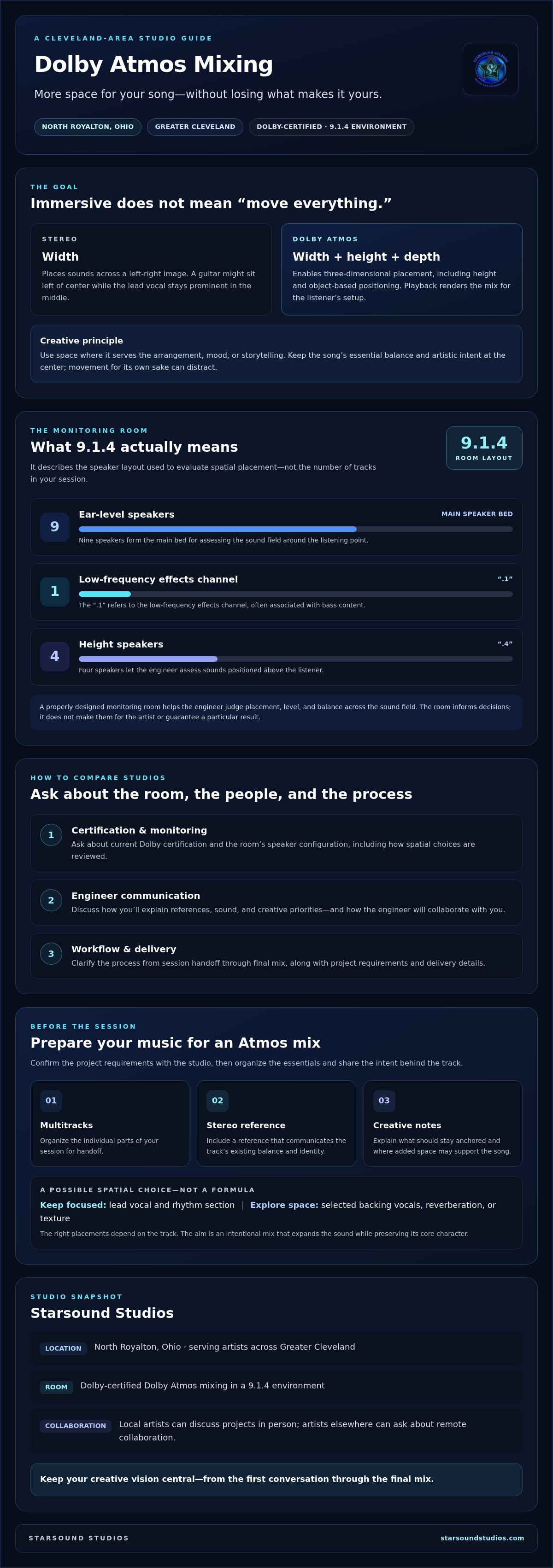
A 9.1.4 setup has nine ear-level speakers, one low-frequency effects channel, and four height speakers. It describes the monitoring layout, not the number of tracks in a session.
What does 9.1.4 mean in an Atmos studio?
The first number refers to nine speakers arranged at ear level, forming the main speaker bed. The “.1” is the low-frequency effects channel, often associated with bass content. The final number indicates four height speakers, which let the engineer assess sounds placed above the listener. Dolby’s Create Music in Dolby Atmos resources offer more context on the format’s creation process.
This layout doesn’t mean every musical element must move among every speaker. A session may contain many tracks, while the numbers describe the room’s speaker configuration. The engineer chooses how to use that space in service of the arrangement. A steady vocal, for instance, may remain grounded while a selected texture gains height. The mix should make those choices feel intentional, not like a technical demonstration.
Why does the monitoring room matter?
Listening through a multichannel system lets an engineer assess spatial relationships directly, rather than relying only on a stereo image or headphones. A purpose-designed room can help reveal whether a placement feels coherent, whether an element distracts from the lead, and how the whole mix holds together across the listening space. The room informs decisions; it doesn’t make them for the artist or guarantee a particular result.
When comparing a Dolby Atmos mixing studio Cleveland artists might consider, ask about the monitoring configuration and how the engineer reviews spatial choices with clients. Starsound Studios is Dolby-certified and offers a 9.1.4 Dolby Atmos mixing environment. Confirm the current configuration and certification directly before booking.
Certification is one part of the conversation
Certification is a useful qualification to check, but it shouldn’t replace a discussion about the engineer’s experience, communication, and project review process. Ask how you’ll share feedback and how the mix will be evaluated against your creative priorities. To learn more about Starsound Studios and prepare questions about its current Atmos service, visit the studio’s website.
How to Compare Dolby Atmos Mixing Studios in Cleveland
A studio may offer surround mixing without Dolby certification or a monitoring setup designed for Dolby Atmos. The terms aren’t interchangeable. Before choosing a Dolby Atmos mixing studio Cleveland artists can trust with their music, compare both the technical foundation and the engineer’s process. A suitable listening environment matters, as do clear communication and respect for your creative direction.
| What to compare | Questions to ask | What to listen for |
|---|---|---|
| Certification | Is the facility currently Dolby-certified for Atmos mixing? | A clear answer and a way to verify the claim. |
| Monitoring configuration | What speaker layout is used for Atmos work? | A specific explanation of the room’s monitoring setup, not just a general claim of surround capability. |
| Engineer communication | Who will mix the project, and how will we discuss creative priorities? | Curiosity about your references, arrangement, and the elements you want to preserve. |
| Project workflow | How will I review the mix, provide notes, and confirm session materials and deliverables? | A shared understanding of the process before work begins. |
Which questions should artists ask before choosing a studio?
Start with the essentials: confirm current certification and monitoring configuration, and ask who will engineer the mix. Then clarify how you’ll hear and review it, how feedback will be shared, and what session files the engineer needs. Agree on the expected deliverables before work begins. These questions turn broad promises into a practical plan and help you assess whether the studio treats collaboration as part of the work.
Technical capability matters, but so does the conversation. An engineer should be able to explain spatial decisions in plain language and make room for your perspective. If a suggested placement doesn’t feel right for the song, you should feel comfortable raising that during the review. For broader advice on evaluating recording spaces and local options, see this Cleveland recording studio guide.
How do you decide whether Atmos suits your release?
Consider what the format could contribute to the arrangement, where you expect to release the music, and how your audience may listen. A production with layered textures or distinct background elements may offer creative opportunities for spatial presentation, but Atmos isn’t automatically right for every track. Discuss the artistic purpose and release plan with the engineer. An immersive mix can support a listening experience, but it can’t guarantee platform placement, audience reach, or commercial performance.
Preparing Your Music for Dolby Atmos Mixing in Cleveland
A smooth Atmos mix begins before the engineer opens the session. Clear creative direction and well-organized files make it easier to focus on the music instead of resolving preventable handoff questions. Before sending anything to a Dolby Atmos mixing studio Cleveland artists should confirm the project scope, the studio’s technical requirements, and how review and delivery will work.
What should you send a Dolby Atmos mixing engineer?
Use this preparation sequence to get the project ready:
- Confirm the scope. Discuss which song or songs are included, your release plans, and what you expect the studio to provide. Agree on the intended deliverables before mixing begins.
- Ask for the studio’s specifications. Confirm accepted file formats, sample rate and bit depth, track naming conventions, and whether the engineer wants consolidated multitracks or a session package. Don’t assume one technical standard applies to every studio or project.
- Organize the session. Label tracks clearly, identify alternate takes or versions, and make sure the supplied files match the correct song arrangement. Follow the studio’s instructions for preparing and transferring files.
- Include a stereo reference. Share the current stereo mix so the engineer can hear the balance and overall character you’re working from. Add concise track notes that flag important parts, effects, or elements that should remain prominent.
- Describe your priorities. Explain what you hope the immersive mix will bring out and what must remain true to the original song. References can help, especially when paired with a note about what you want the engineer to notice in them.
A professional mixing preparation checklist can help you organize the handoff. For Atmos work, confirm the specific requirements directly with the studio.
How can you give useful mix feedback?
Make notes specific and easy to act on. Instead of “the chorus feels off,” identify the moment and concern: “At the second chorus, the backing vocals feel too distant. Could we compare a closer placement?” You can also describe the emotional intent, such as wanting a bridge to feel more open without pulling focus from the lead vocal.
Keep feedback consolidated, and separate essential changes from optional experiments. Before mixing starts, agree on how you’ll review the mix and share notes. That gives both artist and engineer a clear path for decisions while leaving room for creative discovery.
Once your files and priorities are ready, discuss your Atmos mixing project with Starsound Studios and confirm the session requirements before transferring your materials.
Book a Dolby Atmos Mix with Starsound Studios in North Royalton
For artists seeking a Dolby Atmos mixing studio Cleveland musicians can reach nearby, Starsound Studios is located in North Royalton, Ohio, and serves the Greater Cleveland area. The studio offers Dolby Atmos mixing in a 9.1.4 environment and is Dolby-certified for Atmos mixing. Confirm its current certification and room configuration directly before moving forward.
A first conversation is a chance to bring the artistic idea and the technical details together. Whether you’re preparing a finished multitrack session or still clarifying what the project needs, share your goals and ask how the studio can approach the mix in a way that supports the song. Remote collaboration is also available for clients beyond Northeast Ohio. Discuss the workflow and project arrangements directly with the studio.
What to discuss in your first studio conversation
Start with the release goal, the current state of your session, and why you’re interested in an Atmos mix. You might explain that you want to explore greater depth in the arrangement while keeping the lead vocal firmly at the center. Specifics like these help the engineer understand both the creative opportunity and the elements that should remain true to the song.
Then ask about current file and session requirements, how mix reviews and feedback are handled, and which deliverables are included in the agreed scope. Confirm availability and project-specific terms directly. Clear expectations at the outset help everyone focus on the music.
Start your Cleveland-area Atmos mixing project
Starsound Studios also offers stereo mixing and mastering, which may be relevant if your release plan includes formats beyond Atmos. Keep the conversation centered on the sound you want and the destinations you’re preparing for, then clarify which services fit your project. A thoughtful mix process should leave room for technical precision and your perspective as the artist.
You don’t need every technical decision settled before reaching out. Bring your questions, your current session status, and a sense of what you want listeners to feel. Talk with Starsound Studios about your Dolby Atmos mix and discuss your project goals, session readiness, and whether local or remote collaboration suits your needs.
Bring Your Atmos Vision Into Focus
The right immersive mix starts with the right fit: a room equipped to support spatial decisions, an engineer who understands your creative priorities, and a workflow that keeps your artistic intent at the center. Before committing, confirm the studio’s current certification and monitoring setup, clarify which files and deliverables the project requires, and discuss how you’ll review the mix.
Starsound Studios is located in North Royalton and serves Greater Cleveland. The studio is Dolby-certified and offers a 9.1.4 mixing environment. Confirm those details and current service availability directly. Remote mixing is also available for artists outside the area. These conversations can help you decide whether Atmos supports your release and how to prepare your session with confidence.
Ready to explore what immersive mixing could bring to your music? Talk with Starsound Studios about your Dolby Atmos mix. Start with your goals, references, and questions. The right Dolby Atmos mixing studio Cleveland artists choose should make room for both technical precision and the sound that makes the song yours.
Frequently Asked Questions
What is Dolby Atmos mixing for music?
Dolby Atmos mixing creates a three-dimensional listening experience by letting an engineer position sounds around and above the listener, rather than placing everything across a left-right stereo field. Spatial placement can bring out parts of an arrangement while keeping the song’s character intact. For example, selected backing vocals or effects might be given more space while the lead vocal remains central. The right choices depend on the music and the artist’s intent.
Is Dolby Atmos mixing different from surround sound mixing?
Yes. Traditional surround mixing generally assigns sounds to channels linked to specific speakers, while Dolby Atmos uses object-based audio, allowing sounds to be positioned in a three-dimensional space. A renderer adapts the mix for different compatible playback systems. Surround capability alone doesn’t establish that a facility is equipped or qualified for Atmos mixing, so ask about its Atmos monitoring configuration and experience with the format before choosing a studio.
Do I need a Dolby-certified studio for an Atmos mix?
Certification is a useful qualification to check, but ask what it covers and verify the studio’s current status rather than relying on a label alone. Also discuss the monitoring environment, the engineer’s experience, and how you’ll review the mix. If you’re comparing a Dolby Atmos mixing studio Cleveland artists may consider, evaluate whether its technical setup and collaborative process suit your music, not just whether it makes a certification claim.
Can I work with a Cleveland Dolby Atmos mixing studio remotely?
Remote collaboration may be possible, but confirm directly whether the studio can handle your specific Atmos project remotely and what its workflow requires. Starsound Studios offers remote mixing and serves clients beyond Northeast Ohio, though project logistics and service availability should be discussed with the studio. Ask how to prepare and transfer your session, how feedback and mix review will work, and which deliverables are included before sending files.
What should I send a Dolby Atmos mixing engineer?
Ask the engineer for the studio’s exact file and session requirements before preparing your handoff. Typically, you’ll discuss organized multitracks or a session package, a stereo reference mix, and concise notes about key musical elements and creative priorities. Confirm file formats, naming conventions, and expected deliverables rather than assuming one standard applies to every project. Clear labeling and focused notes help the engineer understand both the session and your artistic direction.
How do I know if my song is suitable for Dolby Atmos?
A song may suit Atmos if spatial presentation supports its arrangement, mood, or storytelling, but the format isn’t automatically right for every track. Consider your creative reason for making an immersive mix and where you plan to release the music. Discuss the arrangement with an engineer: layered vocals, effects, or atmospheric parts may offer possibilities, while other songs may call for a more restrained approach. The goal is musical purpose, not movement for its own sake.
Where is Starsound Studios located near Cleveland?
Starsound Studios is in North Royalton, Ohio, and serves artists across Greater Cleveland. The studio offers Dolby Atmos mixing in a 9.1.4 environment and is Dolby-certified. Confirm the current room configuration, certification status, and service availability directly before booking. Artists outside Northeast Ohio can also ask about remote mixing and how collaboration would work for their project.


