

What if the song doesn’t need another mix? If you’ve made tweak after tweak without getting closer to the sound you hear in your head, it’s reasonable to ask whether the mix is the problem. The signs you need to re-mix your song are usually repeatable: the vocal disappears on familiar systems, the low end feels muddy in different rooms, or key elements never sit together, no matter how carefully you listen.
But a frustrating playback experience doesn’t automatically mean starting over. The cause could be a mastering adjustment, a playback-system limitation, or an arrangement choice that leaves too much competing for space. Identifying the cause can save you from chasing changes that don’t address the real issue.
This checklist will help you recognize persistent mix problems, distinguish them from mastering, playback, and arrangement concerns, and choose a practical next step. You’ll learn what to listen for on familiar headphones and speakers, and when a focused revision or professional mixing support may be more useful than another round of guesswork. Keep the song’s intent as your reference point. The goal is to bring the mix closer to it with confidence.
Key Takeaways
- The signs you need to re-mix your song become clearer when you connect a specific listening symptom to a mix decision.
- Before starting over, decide whether the issue calls for changes to track balance, processing, or effects, or just a focused adjustment.
- Use a repeatable listening routine and note timestamps so recurring concerns are easy to describe and assess.
- A concise creative brief helps an engineer understand the sound and feel you want, not only what seems wrong.
- When mix issues persist, Starsound Studios offers stereo and remote mixing for artists in Greater Cleveland and worldwide.
Signs You Need to Re-Mix Your Song: What Listeners Should Notice
A mix can feel finished and still fail to serve the song. Instead of asking whether it sounds “professional” in the abstract, ask whether specific elements consistently distract from the performance or obscure the song’s intent. Audio mixing shapes how recorded parts are balanced and heard together. For a foundational overview, see Audio mixing (recorded music).
Look for problems that recur when you listen carefully on familiar headphones or speakers. One strange result on an unfamiliar device, or one person’s preference for a brighter vocal, isn’t proof that the mix needs to be redone. A persistent mix problem keeps getting in the way across familiar listening systems; a personal preference describes how someone would like the song to sound. That distinction helps separate a technical concern from a creative choice.
Does the vocal stay buried, harsh, or disconnected?
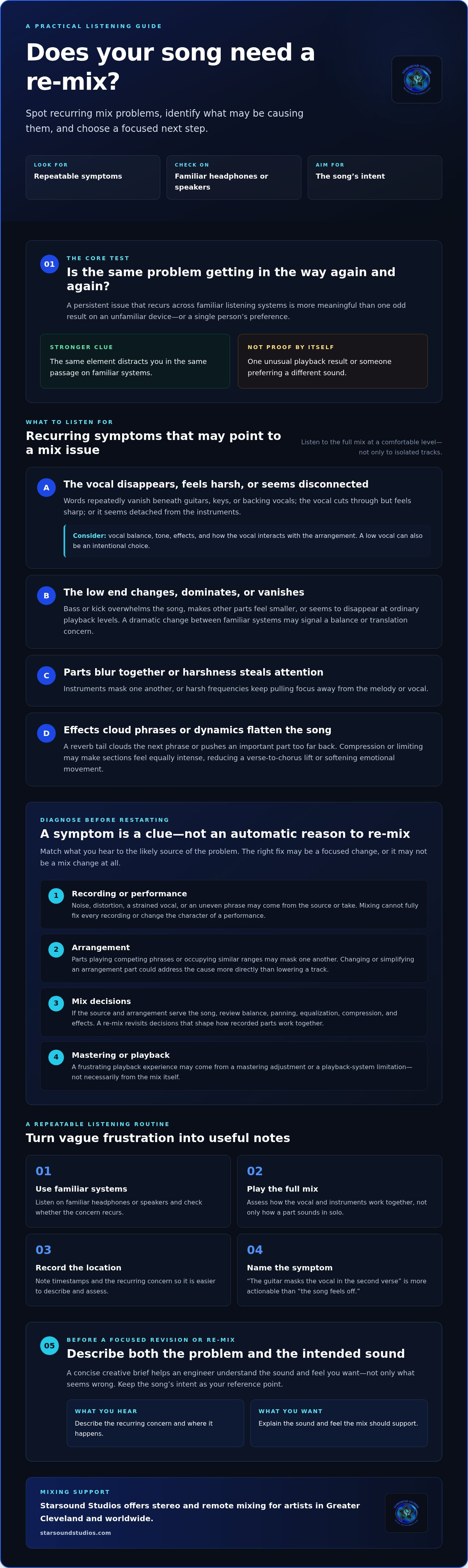
Play the full mix at a comfortable level and ask whether you can follow the lead vocal without straining. If words repeatedly disappear beneath guitars, keys, or backing vocals across familiar systems, the vocal balance or its interaction with other parts may need attention. If the vocal cuts through but feels sharp or detached, its level, tone, effects, or relationship to the arrangement may be contributing.
Check the vocal against the instruments, not in solo alone. A vocal that sounds smooth by itself can still be masked in the full arrangement. Also consider intent: a tucked-back vocal may be a deliberate performance or arrangement choice. The warning sign isn’t simply that the vocal sits low. It’s that its placement prevents the song from communicating what you want listeners to hear.
Do the low end, space, or dynamics keep distracting you?
Listen for bass or kick that dominates the song, makes other parts feel smaller, or seems to vanish at ordinary playback levels. If the low end changes dramatically from one familiar system to another, there may be a balance or translation concern. Notice masking, too: if instruments blur together or harsh frequencies repeatedly pull your attention away from the melody or vocal, the mix may need a closer look.
Reverb can create depth and atmosphere, but if its tail clouds the next phrase or pushes an important part too far back, the effect may be working against the song. Dynamics matter as well. If compression or limiting makes every section feel equally intense, the mix may flatten a verse-to-chorus lift or soften a performance’s emotional movement. Contrast should support the arrangement, not erase it.
These are meaningful signs you need to re-mix your song when they persist during attentive listening, rather than appearing once on an unfamiliar device. Note what distracts you and where it happens. The more clearly you can describe the recurring issue, the easier it is to decide whether a mix change is warranted.
Diagnose the Mix: Find the Cause Before Starting Over
A re-mix means revisiting decisions that shape how recorded parts work together: their balance, processing, panning, effects, and other mix choices. Before commissioning one, connect what you hear to a likely cause. A symptom points you toward a question, not automatically toward a full restart.
Repeated, identifiable symptoms are stronger evidence than one listening impression. If the same element causes trouble in the same passage on familiar systems, you have a useful clue. If the concern appears only once, check whether the source, arrangement, performance, or listening setup better explains it.
Is the problem in the mix, the recording, or the arrangement?
Start with the source. Mixing can shape a recording, but it can’t fully remove noise, repair every kind of distortion, or change the character of a performance. A vocal that feels strained may reflect the take itself rather than its level or EQ. A phrase that sounds uneven could call for a performance decision, not more compression.
Next, consider the arrangement. If several parts occupy similar ranges or play competing phrases at once, they may mask one another. Lowering one track might help, but simplifying or changing an arrangement part could address the cause more directly. If the source and arrangement are serving the song, inspect mix decisions such as level, panning, equalization, compression, and effects. Berklee’s guide to What is Sound Mixing? offers a useful overview of how these choices shape a mix.
Describe the issue in concrete terms: “the guitar masks the vocal in the second verse” is more actionable than “the song feels off.” It gives an engineer a place to investigate without prescribing a fix before the cause is clear.
Could mastering or playback conditions explain what you hear?
Mastering works on the completed mix. It can shape overall tonal balance, loudness, and dynamics, but it can’t independently rebalance every individual track the way a mix revision can. If one instrument consistently sits too far forward while the rest of the song feels right, the issue may need to be addressed in the mix rather than left to mastering.
Listen at a comfortable level on more than one familiar system, keeping playback settings as consistent as you can. If a problem appears only on one device, check its EQ, sound enhancement, spatial audio, or other playback settings before deciding the mix is at fault. A playback mismatch can exaggerate a concern that isn’t present elsewhere.
Once you can point to a repeatable issue and a likely stage, a professional mix review can help clarify whether a re-mix is warranted. Artists in Greater Cleveland or working remotely can explore Starsound Studios mixing services as one option.
Re-Mix, Revise, or Master: Choose the Right Fix for Your Song
Once you’ve identified what isn’t working, match the concern to the production stage that can address it. A re-mix revisits the overall interaction between tracks. A focused revision adjusts a limited number of mix decisions. Mastering works with the completed mix as a whole. Choosing the right path keeps the process anchored to the song instead of a string of guesses.
| Symptom | Likely stage | Sensible first action | When to seek review |
|---|---|---|---|
| Several elements compete, or the overall balance feels wrong | Mix | Identify which parts clash and where | The issue recurs across sections or familiar systems |
| The mix works overall, but one vocal, effect, or instrument needs attention | Focused mix revision | Describe the specific change you want to hear | Your notes aren’t producing the intended result |
| The mix balance feels right, but the finished track needs overall tonal or level refinement | Mastering | Confirm the mix is ready to be finalized | You’re unsure whether the concern belongs in the mix or master |
| A problem appears on just one device | Playback setup | Check the device’s sound settings and compare elsewhere | The concern persists on other familiar systems |
When does a song need a new mix instead of a mix tweak?
Consider a re-mix if the problem involves several tracks or changes the song’s overall balance. For example, the vocal, bass, and guitars may all compete in a way that weakens the arrangement. If the core mix is working and only a specific detail needs adjustment, a focused revision is a more direct starting point. The professional mixing and mastering services guide can help you understand what to consider when comparing professional support.
Describe the audible outcome before suggesting a technical fix. “The lead vocal loses clarity in the chorus” gives an engineer a useful creative target. “Add two decibels at a particular frequency” may lock into a solution before the cause is understood. The signs you need to re-mix your song become actionable when you connect them to recurring mix problems, rather than a single preference or playback anomaly.
When is mastering a better next step?
Mastering is the natural next step when the mix already communicates the intended balance, tone, and impact, and you’re ready to refine the finished stereo picture. It can shape the overall sound, but it can’t independently rebalance every instrument. If a vocal remains masked or one track consistently overpowers another, return to the mix rather than expecting mastering to solve a track-level issue. For a closer look at the finalization stage, see the professional audio mastering guide.
Use This Listening Checklist Before You Request a Re-Mix
A short, repeatable listening check can turn “something feels wrong” into clear, useful notes. It also helps you compare the current mix with the emotional and sonic direction you intended: intimate or expansive, raw or polished, restrained or powerful. You don’t need to diagnose every technical cause. First establish whether the concern repeats and which part of the song it affects.
How to run a useful listening check
Start with one uninterrupted playthrough at a comfortable level on a familiar system. Resist the urge to pause and adjust something mid-song. Mark the moments that pull your attention, then revisit those sections. Repeat the check on another familiar playback system, keeping its sound settings consistent.
- Listen: Play the full song without stopping.
- Log: Note the timestamp, the element that stands out, and what you hear. For example, “1:18, backing vocals mask the lead.”
- Test: Revisit the moment on another familiar system and note whether the concern persists.
- Decide: Ask whether the issue undermines the song’s intended feel or is simply a preference for a different sound.
Specific, repeatable observations are more useful than a long list of general reactions. Your notes can clarify whether the signs you need to re-mix your song point to a broader mix concern or a single adjustment.
What to prepare for a mix review
Before sharing the project for review, gather the latest approved mix, available source files, and any reference tracks that help communicate the direction you’re after. Keep feedback focused on outcomes. “I want the vocal to feel present without losing the soft mood” gives an engineer context while leaving room to find the right mix decision.
- Timestamp: Where does the concern happen?
- Audible symptom: What do you hear, and which element is involved?
- Desired change: What should the listener experience instead?
Avoid stacking new EQ, compression, or effects onto the session before the concern is understood. Extra processing can make it harder to identify what’s helping and what’s obscuring the original issue.
If your listening notes point to a persistent balance or clarity problem, explore professional stereo mixing with Starsound Studios. Artists can work with the studio in Greater Cleveland or remotely, with a clear brief to guide the conversation.
Choose Your Next Step: Re-Mix With a Clear Creative Brief
A useful diagnosis connects repeatable symptoms to the song’s intended sound and helps an engineer understand what you want listeners to experience. If the mix is close, a targeted revision may be enough. If several mix decisions keep working against the song, a fresh stereo mix could be worth considering. The signs you need to re-mix your song are a reason to investigate, not a requirement to start over.
How to brief an engineer on the problems you hear
Begin with the creative goal, then support it with concise, timestamped observations. Explain which elements should feel prominent, intimate, energetic, or restrained, and where the current mix differs from that vision. For example: “At 1:12, the chorus should open up, but the vocal and guitars feel crowded.” That communicates both the moment and the intended impact.
Share what you hear without assuming the technical solution. Instead of insisting on a specific EQ move or compressor setting, describe the outcome you’re after and invite discussion about possible approaches. The engineer can assess whether the cause lies in balance, processing, effects, or another decision while keeping your artistic intent at the center.
What to consider in a Cleveland or remote mixing partnership
Look for an engineer who understands the style, priorities, and listening experience you’re aiming for. Before work begins, ask how to deliver the files, how communication will happen, and what the revision process includes. Clear expectations help both artist and engineer focus on the music instead of sorting out avoidable workflow questions.
Starsound Studios offers stereo mixing for artists in Greater Cleveland and remote mixing for clients worldwide. The studio is in North Royalton, Ohio, while remote collaboration gives artists outside the area another way to work with the studio. Either option may be relevant if your listening notes point to persistent mix concerns. Not every song needs a re-mix; the right next step depends on the problem and the sound you want to preserve.
Bring your creative brief, questions, and the qualities that make the song yours. Talk with Starsound Studios about your mix and explore whether a new mix is the right path for your track.
Move Your Song Toward the Sound You Hear
The signs you need to re-mix your song are most useful when they point to a repeatable issue, not a single listening impression. Notice what keeps distracting you, identify whether the cause belongs to the mix, mastering, arrangement, or playback, then choose between a new mix and a focused adjustment. Clear, timestamped notes turn uncertainty into a productive conversation about the sound you want.
You don’t have to make that call alone. Stereo mixing is Starsound Studios’ primary service, with remote mixing available worldwide. Artists in Greater Cleveland can also work with the studio in North Royalton, Ohio. If persistent mix concerns are getting between your track and its intended impact, talk with Starsound Studios about your mix.
Trust the vision behind the song. With a clear diagnosis and the right next step, you can move closer to a mix that supports its character, energy, and emotional core.
Frequently Asked Questions
How do I know if my song needs to be re-mixed?
Your song may need a re-mix if the same specific problem keeps distracting you across familiar listening systems. Examples include vocals that remain hard to understand, bass that overwhelms other parts, or effects that blur important details. These signs you need to re-mix your song matter most when they interfere with your intended sound. Before deciding, check whether the cause could instead be the recording, arrangement, performance, or playback setup.
Can mastering fix a bad mix?
Mastering can refine the overall sound of a completed mix, but it can’t independently adjust every instrument or vocal. It may help with overall tonal balance, loudness, and dynamics, but a vocal masked by guitars or a bass track that overwhelms the kick may need mix changes first. If the mix already communicates the intended balance and impact, mastering is a sensible next step. If individual parts are out of balance, revisit the mix.
What are the most common signs of a poor mix?
Listen for specific distractions rather than judging the mix by a vague label. Common concerns include vocals that are difficult to follow, bass or kick that dominates or disappears, instruments masking one another, harsh sounds that draw attention, and reverb that clouds details. A mix may also feel flat if dynamics reduce the contrast between sections. One playback device or a single listener’s taste isn’t proof; look for issues that recur across familiar systems.
Is it better to re-mix a song or ask for a mix revision?
Ask for a focused revision if the mix works overall and you can identify a limited change, such as bringing one instrument forward in a specific section. Consider a re-mix if problems affect several elements or the overall balance and require revisiting multiple mix decisions. Describe what you hear and what you want listeners to experience, rather than prescribing a technical fix before the cause is understood.
How many times should I listen before deciding to re-mix?
There’s no fixed number of listens that applies to every song. Start with one uninterrupted playthrough at a comfortable level, note any distracting moments, then revisit those timestamps on another familiar system. Listen again later with fresh attention before deciding whether the concern persists. This structured approach is more useful than replaying the same passage repeatedly while making untracked changes, which can blur your sense of the song’s overall direction.
Can a professional engineer improve a mix made at home?
A professional engineer may be able to improve a home-produced mix by reassessing track balance, processing, panning, and effects. The result depends on the available source recordings and the nature of the issue. Mixing can’t fully undo every limitation in a noisy, distorted, or problematic recording. Starsound Studios provides stereo mixing in North Royalton, Ohio, serving Greater Cleveland and remote clients worldwide.
What should I send an engineer when requesting a re-mix?
Share the latest approved mix, available source files, and reference tracks if you have them. Include concise notes with timestamps, the audible issue, and the outcome you want, such as a more present vocal or a clearer transition into the chorus. Also describe the song’s style and creative direction. Before sending files, confirm the engineer’s file-delivery expectations and discuss communication and revision details so you both understand the process.


