

What if the most expensive part of your recording session isn't the studio time, but the lack of a plan? It's a common fear for every creator. You've spent weeks perfecting your lyrics and melodies, yet the question of how much does it cost to record a song still feels like a moving target. You worry about burning through your budget only to leave with a demo that sounds small or unfinished. We understand. You want your music to sound like the hits you hear on the radio, but the path from a basic demo to a professional, chart-ready production often feels hidden behind a curtain of industry jargon and inconsistent quotes.
We're here to pull back that curtain. We'll provide the grounded assurance you need to step into the booth with absolute confidence. This guide unlocks the transparency behind professional studio fees, showing you exactly how to budget for a world-class result without the financial guesswork. We'll explore the real value of high-end gear, the ROI of professional mixing and mastering, and how to prepare so you minimize billable hours. Precision meets passion. High-fidelity results. Whether you're planning a single or a full EP, you'll gain a clear framework to ensure your investment translates into a polished sound that honors your unique creative identity.
Key Takeaways
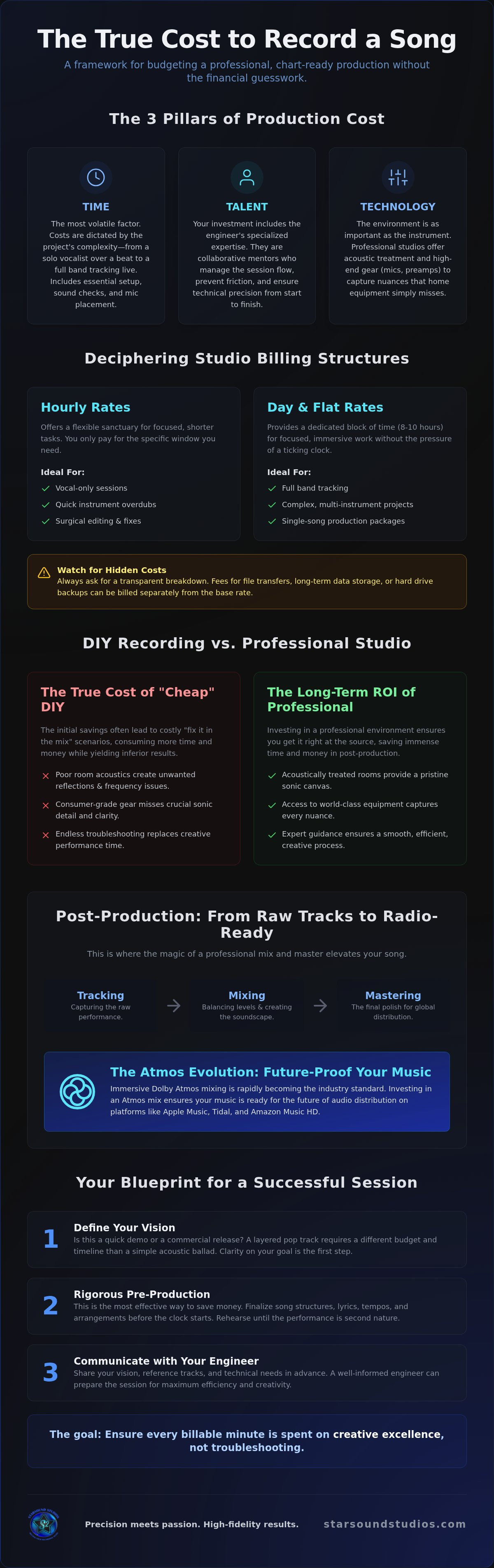
- Define the three pillars—Time, Talent, and Technology—that determine your production's financial footprint and final audio fidelity.
- Demystify how much does it cost to record a song by comparing modern hourly rates against the strategic advantage of day rates for complex projects.
- Evaluate the long-term ROI of professional post-production, including the shift toward immersive Dolby Atmos mixing as a standard for future-proof distribution.
- Identify the hidden expenses of DIY recording and why expert tracking is the most effective way to avoid costly "fix it in the mix" scenarios later.
- Implement a practical budgeting framework centered on rigorous pre-production to ensure every billable minute is spent on creative excellence rather than troubleshooting.
The Variables of Recording: What Drives the Price of a Song?
Calculating the investment for a project isn't about looking at a single price tag. It's a dynamic equation built on three pillars: Time, Talent, and Technology. While many artists ask how much does it cost to record a song looking for a flat number, the reality depends on the complexity of your vision. A three-minute pop song often demands a higher budget than a ten-minute acoustic folk ballad. The pop track might require dozens of vocal layers, intricate synth programming, and surgical editing to meet modern radio standards. A folk ballad, however, might rely on a single, evocative live performance captured in just a few takes. Precision meets passion. High-fidelity results.
A demo is a sketch; a commercial release is a finished painting. Commercial standards require a level of sonic depth and clarity that only professional environments can provide. This is where "Session Flow" becomes vital. It's the rhythmic momentum of a well-organized studio date. A smooth, professional rhythm prevents creative friction. It ensures that every minute spent in the facility translates directly into a world-class result rather than troubleshooting gear or debating arrangements.
Time: The Most Volatile Cost Factor
Tracking complexity dictates your schedule. Recording a solo vocalist over a pre-made beat is a different beast than capturing a five-piece rock band with live drums. Beyond the performance, you must account for the hidden hours. Setting up drum kits, finding the perfect mic placement, and running sound checks are essential for a professional outcome. Momentum is money. Your investment in studio time includes the engineer’s specialized expertise, not just the physical space. They are the collaborative mentors who ensure your technical details are handled with absolute precision from the first take to the final bounce.
Technology: Why Room Acoustics and Gear Matter
The history of sound recording shows that the environment is just as important as the instrument. Professional recording studio spaces offer specialized acoustic treatment that eliminates unwanted reflections and standing waves. This creates a welcoming, creative sanctuary where your sound can breathe. The science of the medium. High-end preamps, boutique microphones, and professional-grade converters capture nuances that home-grade interfaces simply miss. These technical details ensure your work has the weight, energy, and clarity needed to compete on a global stage.
Hourly vs. Flat Rates: Deciphering Studio Billing Structures
Understanding the financial architecture of your project is the first step toward creative freedom. When you ask how much does it cost to record a song, the answer usually begins with a choice between hourly precision and flat-rate security. Professional facilities in 2026 typically operate on a tiered hourly system. This reflects the caliber of the equipment and the environment's acoustic integrity. For bands or intensive tracking projects, the "Day Rate" often emerges as the superior strategy. It provides a dedicated block of time, usually eight to ten hours, allowing for a focused session flow without the pressure of the ticking clock. It's a lockout experience where your project is the only priority.
Independent artists often prefer the predictability of project-based flat fees. This model is common for single-song productions. It allows you to focus on the art while knowing the technical finish is covered. However, you must remain vigilant for hidden line items. File transfer fees, long-term data storage, and hard drive backups are often billed separately. Always ask for a transparent breakdown of what your fee covers. This ensures your budget remains as precise as your performance. Modern studios prioritize this transparency to build trust incrementally with every client.
When to Choose Hourly Tracking
Hourly billing offers a flexible sanctuary for focused tasks. It's the ideal choice for vocal-only sessions, quick instrument overdubs, or surgical editing. You only pay for the specific window you need. Efficiency is the key here. A seasoned sound engineer can significantly reduce your total spend. Their deep expertise allows them to navigate complex signal chains and DAW workflows with modern urgency. They capture the magic faster. This collaborative mentorship ensures you aren't just buying time; you're investing in a streamlined path to a world-class result.
The Security of Flat-Rate Mixing and Mastering
Post-production has largely shifted toward a per-song model to provide artists with absolute budget certainty. This structure typically includes the primary mix, a specific number of revisions, and essential deliverables like stems or instrumental passes. It removes the stress of "over-mixing" costs. You gain the grounded assurance that your track will receive the high-attention experience it deserves until it meets commercial standards. If you want to see how this high-end technical facility handles your vision, you can explore our professional recording services to start your journey. Mastering, the final non-negotiable step, also thrives under this flat-rate model, ensuring your audio fidelity is optimized for every streaming platform.
Post-Production Costs: Mixing, Mastering, and the Atmos Evolution
The sonic architecture of a hit isn't finished when the last vocal take is tracked. It's refined in the post-production suite. When artists calculate how much does it cost to record a song, they often overlook the technical depth required to compete on global playlists. Mixing is where your raw tracks become a cohesive experience. Costs here fluctuate based on complexity. A session with 120 tracks requires significantly more labor than a 20-track arrangement. Factors like surgical vocal tuning and rhythmic alignment add billable hours; however, they're the difference between a rough cut and a masterpiece. Precision in every dimension. The final polish.
Stereo Mixing vs. Dolby Atmos Immersive Mixing
Immersive audio is no longer a luxury; it's a distribution standard. While standard stereo mixing balances two channels, Dolby Atmos creates a 3D hemisphere of sound. This requires a specialized 9.1.4 monitoring environment to place over 100 audio objects in a spatial field. As the only certified dolby atmos studio cleveland, Starsound ensures your music meets the strict requirements of platforms like Apple Music and Tidal. The ROI is clear. Spatial tracks often receive preferential placement in curated playlists and can even command higher royalty tiers on select platforms. It's a future-proofing investment for your creative identity.
Mastering: The Final Insurance Policy
Think of mastering as your final insurance policy. It's the technical bridge between the studio and the listener's earbuds. Skipping this step is a gamble you shouldn't take. If your track fails streaming loudness standards, you'll face the added cost of a re-master. While automated online tools offer a quick fix, they lack the human-eared precision needed to handle complex transients and frequency balances. A professional engineer brings grounded assurance to the process. They ensure your song sounds consistent across car speakers, club systems, and high-end headphones alike. The science of the medium meets the art of creation.
The True Cost of DIY: Why "Cheap" Recording Often Fails
The temptation to track in a bedroom is real. It's accessible. It's immediate. Yet, when you analyze the total investment of your project, the question of how much does it cost to record a song takes on a new, more complex meaning. Many artists fall into the "fix it in the mix" trap. They record through budget interfaces in untreated rooms, assuming a talented mixer can polish the results later. This is a fallacy. Bad tracking leads to expensive, labor-intensive post-production. You often end up paying more for repair work than you would have for a flawless initial session. Precision at the source is the only way to achieve a world-class result.
Time is your most valuable asset. Troubleshooting driver errors or fighting with mic placement in a living room drains your creative energy. A professional facility serves as a dedicated creative sanctuary. It's a space where the science of the medium meets the art of creation. The psychological shift of stepping into a high-end environment often results in a more inspired, professional performance. Releasing a song that lacks professional sonic weight carries a heavy opportunity cost; you only get one chance to make a first impression on listeners and playlisters. A subpar demo can stall a career before it even starts.
The Hidden Bill for Poor Room Acoustics
Untreated rooms introduce "boxy" or "reverberant" artifacts into your tracks. These frequencies are often baked into the audio files. They limit your mixing options and prevent that "expensive" sound found on chart-topping hits. Professional environments utilize specialized acoustic treatment to ensure absolute precision. Home setups rarely match the fidelity of high-end preamps and professional converters. These technical tools capture the spirit and energy of a performance with a clarity that budget gear simply cannot replicate. High-fidelity results. Grounded assurance.
The Collaborative Mentor: The Value of an Engineer
An engineer is more than a button-pusher. They are your technical safety net and creative sounding board. Steve "The Mix" brings decades of expertise to every project, acting as a collaborative mentor who is just as invested in the final product as you are. They handle the technical specifications so you can focus entirely on your artistic vision. This partnership is a masterclass in itself. For those who want to dive deeper into the craft, Starsound offers audio engineering classes to bridge the gap between amateur and expert. To experience the difference a professional environment makes, book your next recording session at our premier facility and let us help you reach your highest potential.
How to Budget Your Song: A Practical 2026 Planning Guide
Success in the studio is 90% preparation and 10% performance. When you sit down to map out how much does it cost to record a song, your budget should be viewed as a strategic roadmap rather than a simple bill. A chart-ready production requires a balanced allocation of resources across four distinct phases. First, pre-production and rehearsal are your ultimate money-savers. Second, you must choose the right environment for tracking versus post-production. Third, you need to reserve a significant portion for professional mixing and mastering services to ensure your sound translates across all systems. Finally, factor in administrative costs like file delivery, licensing, and distribution fees. High-fidelity results. Precision meets passion.
- Phase 1: Pre-Production. Eliminate guesswork by finalizing arrangements and tempos before the clock starts.
- Phase 2: Tracking. Select a facility that offers the right blend of high-end gear and a welcoming, creative sanctuary.
- Phase 3: Post-Production. Invest in professional mixing and mastering to future-proof your music for immersive platforms.
- Phase 4: Finalization. Account for ISRC codes, distribution uploads, and high-resolution file storage.
Pre-Production: Cutting Costs Before You Enter the Studio
Learning the song in the studio is a budget killer. It's an expensive way to rehearse. You should arrive with muscle memory already established. The final tally of how much does it cost to record a song often drops when you invest in scratch tracks and BPM maps beforehand. This allows your engineer to set up the session with modern urgency. Consult with your collaborative mentor early. A quick pre-session chat with Steve "The Mix" can align your technical specifications with your artistic vision, ensuring no billable minute is wasted on indecision. Grounded assurance. Absolute precision.
The Cleveland Advantage: World-Class Sound in North Royalton
You don't need to pay NYC or LA premiums to achieve sonic excellence. The Midwest offers a strategic advantage for independent artists. North Royalton provides a quiet, focused atmosphere far from the distractions of a sterile corporate environment. Starsound is Ohio’s only Dolby-certified Atmos facility, offering a 9.1.4 immersive audio environment that rivals major-label studios. It's where the science of the medium meets the art of creation. Ready to turn your vision into a world-class result? Contact us today for a consultation and let's build a precise budget for your next chart-ready production.
Your Vision Deserves World-Class Precision
Your music is an extension of your identity. It's a sonic signature that deserves the highest level of technical care and artistic enthusiasm. We've explored the variables that drive production fees, from the efficiency of seasoned sound engineers to the immersive power of spatial audio. While the question of how much does it cost to record a song is essential for planning, the true focus remains on the quality of the final result. Choosing a professional environment means you aren't just paying for time; you're gaining a collaborative mentor and a high-end technical sanctuary designed to make your work shine.
As the only Dolby-certified Atmos studio in Ohio, we provide a 9.1.4 immersive audio suite that ensures your tracks are ready for the global stage. Under the expert guidance of Steve "The Mix," your project receives the absolute precision it needs to stand out on any playlist. Ready to record? Book your session at Starsound Studios today. Your highest potential is within reach, and we're here to provide the grounded assurance that every detail is handled with passion. Let's create something timeless together.
Frequently Asked Questions
Is it cheaper to record a song at home or in a studio?
Recording at home often carries a lower initial price tag, but it frequently leads to higher post-production expenses. When you track in an untreated room, you risk baking in acoustic flaws that require expensive corrective mixing. A professional studio provides a creative sanctuary with high-end converters and microphones. This ensures your source audio is pristine. You save money by avoiding the labor-intensive repair phase. It's a strategic investment in audio fidelity.
How many hours does it take to record one song professionally?
A professional recording session for a single song generally spans between four and twelve hours. This window accounts for essential setup, mic placement, and sound checking before the first take occurs. Complex arrangements with live drums or multiple vocal layers naturally require more time than a solo acoustic performance. Efficiency is the key. Arriving with a BPM map and well-rehearsed parts keeps the session flow moving and your total budget in check.
Does the cost of recording include the mixing and mastering?
Studio recording fees typically cover the room and the engineer, but they rarely include mixing or mastering. These are specialized post-production stages with their own technical requirements. When calculating how much does it cost to record a song, you should budget for these as separate line items. Mixing blends your tracks into a cohesive stereo or Atmos field. Mastering provides the final insurance policy for commercial distribution across all streaming platforms.
What is the average hourly rate for a recording studio in Cleveland?
Recording studios in the Cleveland market generally offer hourly rates between $50 and $150. This range depends on the facility's equipment tier, room size, and the engineer's level of expertise. While some budget spaces exist, premier facilities with certified monitoring environments reflect the value of their high-end technology. It's important to verify if these rates include a dedicated engineer or if that is an additional fee for your specific session.
Why is Dolby Atmos mixing more expensive than stereo mixing?
Dolby Atmos mixing involves a significantly higher level of complexity than traditional two-channel stereo. An immersive mix requires a specialized 9.1.4 monitoring environment and the placement of over 100 audio objects in a three-dimensional space. This technical depth demands more labor and specialized hardware. However, the ROI of Atmos is clear. It provides future-proof distribution and often results in preferential placement on major streaming platforms like Apple Music and Tidal.
Can I save money by bringing my own engineer to the studio?
You can sometimes save money by bringing your own engineer, but most professional studios still charge a dry hire or room fee. This covers the maintenance of high-end preamps and acoustic treatment. However, using a house engineer who knows the room's specific signal flow is often more efficient. They navigate the technical specifications faster. This allows you to focus entirely on your creative identity rather than troubleshooting a new environment's patches.
What should I bring to my first professional recording session?
Prepare for your session by bringing your lyrics, high-quality backing tracks, and a clear BPM map. If you're a musician, ensure your instruments are maintained with fresh strings or drumheads. Arriving with a scratch track demo helps the engineer understand your vision immediately. This level of preparation ensures that every billable minute is spent on capturing a world-class performance. It's the best way to honor the spirit and energy of your music.
Are there flat-rate packages for recording an entire EP or album?
Many studios offer project-based flat rates for EPs and full-length albums to provide artists with budget predictability. These packages usually bundle recording hours with mixing and mastering services. When asking how much does it cost to record a song as part of a larger project, these bundles often provide a better value than booking individual hours. Always request a detailed breakdown to see how many revisions and deliverables are included in the final fee.


