

What if you don’t need the perfect technical vocabulary to help shape a great mix? You may know exactly how you want the chorus to feel, even if you can’t name the processing that might get it there. Learning how to communicate with your audio engineer is less about speaking in jargon and more about sharing a clear creative direction. Your references, priorities, and honest reactions all help turn that vision into sound.
It’s natural to worry that feedback will come across as vague or overly critical. Specific, respectful notes give your engineer something useful to work with, and questions are part of collaboration. You don’t have to arrive with every decision made.
This guide will help you explain the feeling and details you’re aiming for, choose reference tracks, and organize the files and notes your engineer needs. You’ll also learn how to give focused feedback and build a productive working relationship, whether you’re collaborating in person or remotely. Clear communication creates more room for the music to come into focus.
Key Takeaways
- Learn how to communicate with your audio engineer by sharing the song’s purpose, intended listener, and creative priorities.
- Use reference tracks to give your engineer useful context, then explain which elements you want to capture.
- Describe a specific moment, what you hear, and how you want it to feel. No technical jargon is required.
- Gather your mix notes into one focused response and prioritize the changes that matter most.
- For remote or in-person projects, agree on how feedback will be shared and who will coordinate it.
Why clear communication with your audio engineer changes the mix
A strong mix starts with more than a set of tracks. Your engineer needs to understand the artistic intent behind them: what the song should make a listener feel, which details define its identity, and what should stay in the foreground. That context helps guide technical choices throughout audio mixing. You don’t need specialist vocabulary to provide it. Learning how to communicate with your audio engineer means describing what you hear and feel, not trying to do the engineer’s job.
Unclear requests can create mismatched expectations, even when both people are working in good faith. “Make it bigger,” for example, might mean a more powerful chorus, a wider stereo image, or a stronger vocal presence. If you and your engineer picture different outcomes, the mix can move away from your intention. A little context helps align the target before adjustments begin.
What your audio engineer needs to understand
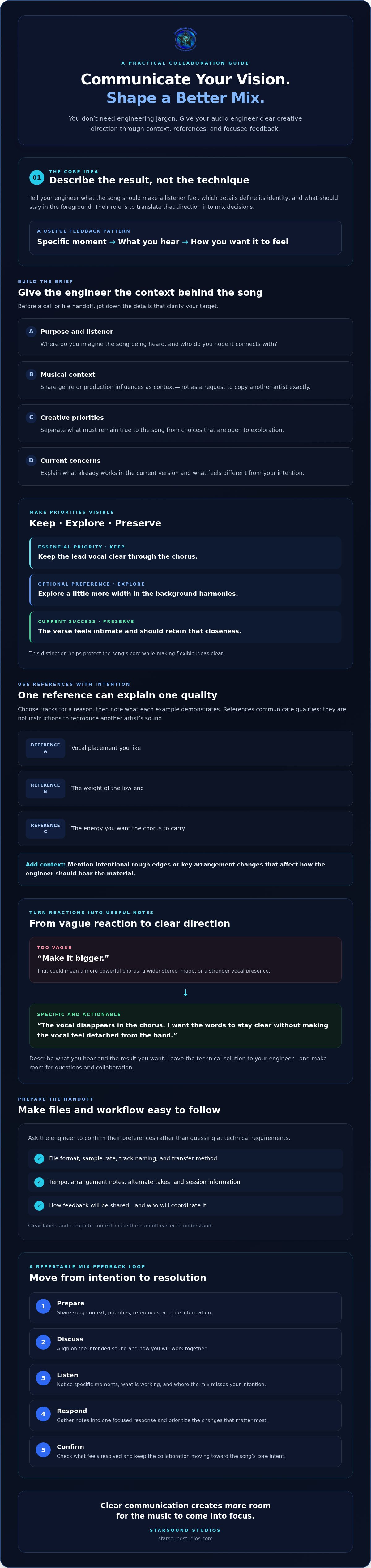
Start with the song’s emotional center, intended audience, and the role of its key elements. Is the vocal meant to feel intimate and exposed, or bold against a dense instrumental? Identify what’s essential and what’s optional. Then explain where the current version already works and where it misses the mark.
- Essential priority: Keep the lead vocal clear through the chorus.
- Optional preference: Explore a little more width in the background harmonies.
- Current success: The verse feels intimate and should retain that closeness.
This distinction helps your engineer protect the song’s core while understanding which ideas are open to interpretation.
Creative direction is more useful than vague praise or criticism
“Make it better” communicates dissatisfaction, but not what to listen for. “The vocal disappears in the chorus” points to a specific moment and a noticeable issue. Make the note more actionable by adding the desired result: “I want the words to stay clear without making the vocal feel detached from the band.”
Notice what’s missing: technical instructions. Once your engineer understands the result you’re after, they can suggest a solution. Feedback is a shared observation, not a verdict on anyone’s skill. Be direct about the sound, and leave room for the engineer to translate your direction into mix decisions.
A repeatable process makes collaboration easier: prepare the song context and priorities, discuss the intended sound, listen carefully to the mix, then give focused feedback and confirm what feels resolved. The following sections break down each step, from the initial brief to approval.
How to prepare a clear brief before contacting your audio engineer
A short, thoughtful brief gives your engineer a starting point before a call or file handoff. It doesn’t need to sound formal. The goal is to make the song’s purpose and creative priorities easy to understand, then agree on how you’ll work together. This is one of the most practical steps in learning how to communicate with your audio engineer.
Before reaching out, jot down:
- Purpose and listener: Where do you imagine the song being heard, and who do you hope it connects with?
- Musical context: What genre or production traditions inform it? Mention influences without assuming the track should sound exactly like them.
- Creative priorities: What must remain true to the song, and which choices are open to exploration?
- Current concerns: What’s working in the present version, and what feels different from your intention?
For a broader view of the process, read this guide to professional mixing and mastering.
Build a useful song brief and reference playlist
Choose references for a reason. One track might show the vocal placement you like, another the weight of the low end, and a third the energy you want the chorus to carry. Add a note explaining what each example demonstrates. References communicate qualities; they aren’t instructions to reproduce another artist’s sound.
Include a quick “keep, explore, context” note. Identify must-keep elements, flexible choices, and anything that affects how the engineer should hear the material, such as an intentional rough edge or a key arrangement change.
Agree on files, workflow, and expectations
Don’t guess at technical requirements. Ask the engineer to confirm the preferred file format, sample rate, track naming, and transfer method. Check how they’d like to receive tempo, arrangement notes, alternate takes, and session information. Clear labels and complete context make it easier to identify the right material and follow the song’s structure.
Set expectations before work begins, too. Confirm the intended deliverables, your main communication channel, who will gather feedback if several people are involved, and how review and approval will happen. Agree on when you’ll listen to a version and how you’ll send notes. The specifics vary by project, so discussing them together keeps the process clear.
To compare what a mixing service can include, review Starsound Studios’ mixing services and note which details you’ll want to discuss with your engineer.
How to describe the sound you want without engineering jargon
You don’t need to know the name of a compressor, reverb setting, or EQ move to explain what you hear. Your role is to describe the musical result you want; your engineer can translate that direction into mix decisions. A simple pattern keeps your note focused: identify the moment, describe what you hear, explain the feeling you want instead.
For example: “At 1:12, when the chorus starts, the track doesn’t lift as much as I imagined. I want that entrance to feel more energetic and open.” A timestamp points your engineer to the moment, while your description gives them room to explore a solution rather than follow a technical instruction that may not fit.
Turn feelings into specific listening notes
Words such as “bigger,” “warmer,” or “harsh” can mean different things to different people. Use them as a starting point, then add what you notice and what you hope to feel. “Make the chorus bigger” might lead to a useful question: does it need more impact, a stronger contrast with the verse, a wider feel, or more energy from the arrangement? You don’t need to decide the answer alone. Clarify the experience you want.
Instead of saying only “the vocal feels harsh,” try: “In the second verse, the vocal feels sharp and tiring to listen to, especially on the sustained notes. I’d like it to feel smoother while staying present.” This identifies the section, describes your listening impression, and names the desired quality. It’s a useful observation, not a prescription for a particular processing technique.
Keep notes focused. If a comment could point to several different issues, your engineer may ask what you mean or offer a question to narrow it down. Treat that exchange as part of collaboration. A quick clarification can prevent a well-intentioned change from solving the wrong problem.
Use references without asking for a copy
A reference track can help communicate a sound that’s difficult to describe, but explain exactly what you admire. Is it the intimate vocal, the solid low end, or how the chorus expands? Connect that quality to your own song’s mood, arrangement, and intended listener. For example: “I like how close the vocal feels in this reference. Could we keep that intimacy in our verses while preserving the energy of our busier arrangement?”
One reference can suggest a mood; another can illustrate a particular element. Neither needs to define your whole production. Keep your own artist identity at the center, and use each comparison to show a direction rather than request a replica. This is a practical part of how to communicate with your audio engineer: describe the sound in your own words, then use examples to add clarity.
How to give mix feedback that is specific, respectful, and useful
A thoughtful review gives your engineer a clear picture of what’s working and what still needs attention. Set aside time to listen without multitasking, then write your notes before responding. If you send a message after every playback, reactions can arrive without context or contradict earlier requests. A consolidated response helps the engineer understand your priorities and make changes with the whole song in mind.
As you review, separate objective issues from subjective preferences. A missing harmony or an edit that cuts off a sound is a concrete issue to flag. A preference such as wanting the bass to feel rounder is more interpretive, and your engineer may have a different way to achieve that impression. Both kinds of notes are useful when you identify them clearly.
Organize notes so your engineer can act on them
Group comments by song section, timestamp, and musical element. State the listening outcome you want before suggesting a fix. Mark essential requests separately from ideas you’re open to exploring. This structure makes it easier to understand what needs attention first and where the engineer has creative latitude.
- Timestamp and section: “At 0:48, entering the second verse…”
- Observation and goal: “…the transition feels abrupt; I’d like it to flow more naturally.”
- Priority: “This is a key change,” or “This is a preference, so use your judgment.”
You don’t have to specify how to fix the issue. Describe the desired experience and let your engineer assess possible approaches. This keeps feedback anchored in the music rather than prescribing a technical move that may create a new problem.
Handle disagreement and revision requests constructively
If a requested change affects another part of the mix, ask about the trade-off. For example: “Could we bring the synth forward without taking focus from the lead? What would you recommend?” Your engineer can explain the options, and you can decide together which outcome matters most.
If a revision still doesn’t feel right, clarify what remains unresolved instead of repeating a broad instruction. You might say that the chorus has more impact now, but the transition into it still feels too sudden. Keep the conversation direct and specific, and focus on the sound rather than the person. That’s how to communicate with your audio engineer while supporting honest feedback and a strong working relationship.
For an example of a studio offering mixing and other audio services, visit Starsound Studios.
How to work smoothly with a remote or local audio engineer
The communication plan can shift depending on where the work happens. In a shared studio, you can listen together, point to a moment as it plays, and talk through the song’s feel in real time. A remote mixing project relies more on written notes, shared files, and agreed review points. In either setting, clarity matters more than proximity. Starsound Studios is located in North Royalton, Ohio, and offers remote mixing and mastering to clients worldwide, making it an option for artists in the Cleveland area and beyond.
For a band or team, choose one person to collect everyone’s comments and send the consolidated response. That doesn’t mean other collaborators can’t contribute. It gives the engineer a single, coherent set of direction instead of conflicting messages arriving through different channels. Agree in advance on who has final approval, too.
Keep a remote project organized and easy to review
Use one agreed channel for project notes and file delivery, and label each mix version clearly so everyone knows which one they’re discussing. Keep feedback tied to the correct version instead of mixing comments on an older file with reactions to the latest pass. If team members disagree, have the designated contact gather their views and resolve conflicting priorities before sending notes.
Before the project is finalized, ask the engineer to confirm any technical or delivery requirements you’re unsure about. Naming the intended use of the files can help you ask the right questions without assuming which formats or versions are needed. A clean handoff makes the final stage easier to follow.
Make an in-studio conversation productive
Arrive with a few references and clear priorities, but leave room for your engineer’s judgment. You’re there to shape the artistic direction together, not to manage every technical decision. Listen to key sections as a team, describe what you hear, and explain the intended feeling. The engineer can then explore ways to bring that quality forward.
Before wrapping up, recap what you’ve agreed on: the next steps, any open questions, and who will follow up. That simple close prevents assumptions from turning into crossed wires later. For more context on the work and role, read this sound engineer craft and career guide.
Whether you’re meeting in person or collaborating remotely, knowing how to communicate with your audio engineer helps keep creative decisions connected to your vision. Starsound Studios offers stereo mixing, mastering, recording, and Dolby Atmos mixing in its North Royalton studio, as well as remote mixing and mastering.
Bring your vision into focus with a clear conversation
A stronger mix begins with shared understanding. Prepare a brief that explains the song’s purpose and priorities, use references to clarify the qualities you’re drawn to, and describe feedback through specific listening observations. You don’t need engineering jargon. You need a clear sense of what matters to the music and a willingness to work through decisions together.
That’s the heart of how to communicate with your audio engineer: offer creative direction, stay open to their expertise, and keep notes focused on the result you want. Whether you’re reviewing a mix remotely or sharing a studio session, a thoughtful process gives your ideas room to translate into sound.
Starsound Studios offers stereo mixing and mastering, with remote services available to clients worldwide and a studio in North Royalton, Ohio, serving the Cleveland area. Contact Starsound Studios to discuss mixing or mastering for your project.
Frequently Asked Questions
How do I explain the sound I want to an audio engineer?
Describe the moment, what you hear, and how you want it to feel. For example, note that the chorus feels less energetic than you intended and explain what kind of lift you’re hoping for. Add a timestamp or a reference track to make the note easier to understand. Learning how to communicate with your audio engineer is about expressing artistic intent clearly, not prescribing every technical choice.
Do I need to know audio-engineering terms to work with an engineer?
No. You can explain what you hear in everyday language, such as “the vocal feels distant” or “the bass gets hard to follow when the full band comes in.” If a comment could mean several things, your engineer can ask a follow-up question. Share the listening experience you want, and let the engineer translate that direction into technical decisions.
What should I send my audio engineer before mixing?
Share the audio files and any project information your engineer requests, along with a brief describing the song’s purpose, intended listener, key priorities, and important arrangement details. Include reference tracks with a note about what each one illustrates. Before exporting or transferring files, confirm the preferred format, sample rate, track labels, and delivery method with the engineer. Clear instructions help prevent avoidable confusion at handoff.
How do I give feedback on a mix?
Listen in a focused setting, take notes, and send one organized response rather than scattered reactions after each playback. Include timestamps, name the musical element, and describe the result you want. Separate objective issues, such as a missing part, from preferences about tone or feel. Mark which notes are essential and which leave room for the engineer’s judgment. Keep comments direct and focused on the music.
How many revisions should I ask my audio engineer for?
There isn’t one revision count that fits every project. Before work begins, ask how the review process is structured, what counts as a revision, and how feedback should be submitted. Gather your notes and send consolidated comments for each review, rather than adding isolated requests across multiple messages. Clear expectations help both you and your engineer understand the process and keep decisions focused on the mix.
Can I work with an audio engineer remotely?
Yes. Remote projects can be coordinated through agreed file-sharing and communication methods, with mix versions and feedback kept clearly organized. Confirm file requirements, review steps, and who will approve changes before work begins. Starsound Studios offers remote mixing and mastering to clients worldwide, alongside its North Royalton studio serving artists in the Cleveland, Ohio area. Distance doesn’t prevent a productive creative partnership when the workflow is clear.


