

Could one small code create confusion across an entire release? If you’re searching for an audio mastering studio Cleveland artists can work with, you’re already thinking about how your music will sound. ISRCs matter to another part of the process: identifying each recording correctly. The details can feel murky, especially when an ISRC, copyright registration, and UPC are mistaken for interchangeable codes.
Getting the metadata straight before distribution helps keep your release records organized. An ISRC identifies a specific sound recording, not the underlying composition, copyright ownership, or full release. This 2026 guide explains how independent artists in Ohio can obtain and assign ISRCs, when a new version may need a new code, and how to avoid duplicates or losing track of existing identifiers when changing distributors.
You’ll also learn how to keep recording titles, ISRCs, UPCs, and release details consistent. Mastering shapes the sound of a finished recording; accurate metadata helps identify it as it moves through release channels. Both deserve attention before your music goes live.
Key Takeaways
- Before assigning a code, identify the exact recording and determine whether your distribution workflow assigns ISRCs or expects you to supply them.
- Keep a reliable record of each ISRC so you can preserve consistent metadata if you move your catalog between distributors.
- Compare versions carefully: edits, remixes, and remasters may need different treatment from an unchanged recording reused on a later release.
- Before submitting a release, check the recording title, artist credit, version, code, release details, and final audio file.
- An audio mastering studio Cleveland artists work with can help prepare the sound; accurate recording metadata is a separate part of release readiness.
What Does an ISRC Code Identify for an Ohio Independent Artist?
An International Standard Recording Code (ISRC) identifies a particular sound recording or music video. It gives that recording a distinct identifier for release information and recording-related data. It doesn’t identify the underlying composition, prove who owns the work, or serve as an artist ID. For an overview of its purpose and format, see the International Standard Recording Code (ISRC).
An ISRC identifies a specific recording, not the song’s underlying composition or its owner. This distinction helps keep release metadata clear. Ohio artists use the applicable United States process; there isn’t a separate Ohio registration or rule for the code.
ISRC, copyright, and song ownership are not the same thing
Consider one composition recorded three ways: as a studio version, a live performance, and a remix. The composition is the underlying music and lyrics; each recording is a distinct recorded rendition. An ISRC identifies a recording, not the composition or who owns either one.
Having a code doesn’t replace copyright registration, settle a rights dispute, or confirm that you have permission to use every element in a recording. For questions about copyright registration or ownership, consult authoritative resources such as the U.S. Copyright Office. Keep those rights records separate from your ISRC and release metadata.
Why accurate recording identification matters after release
A consistent ISRC can help distinguish a recording in release metadata and support the organization of recording-related usage data. It is one piece of information attached to a release, not a promise of royalties, playlist placement, or complete tracking. Accurate titles, artist credits, and version details still matter.
In the United States, the RIAA runs the U.S. ISRC Agency, while SoundExchange has been designated as an authoritative source for U.S. ISRC data. These roles relate to code administration and data, not copyright ownership. IFPI’s role is international. Use current official guidance for the process that applies to your release, and don’t treat any organization as a substitute for rights advice.
Sound and identification serve different purposes. An audio mastering studio Cleveland artists work with can help shape a finished recording for release, while the ISRC identifies that recording in its metadata. Keep the code tied to the exact version it represents, and carry that information consistently into your release records.
How Can Independent Artists in Ohio Obtain and Assign an ISRC?
There are two broad routes: a distributor may assign codes during its release workflow, or an artist or registrant may obtain the ability to assign codes directly. The right route depends on how you plan to distribute the recording and manage its metadata. Determine who assigns the code before submitting release information.
Choose the assignment route before submitting a release
Use this sequence to keep the process organized:
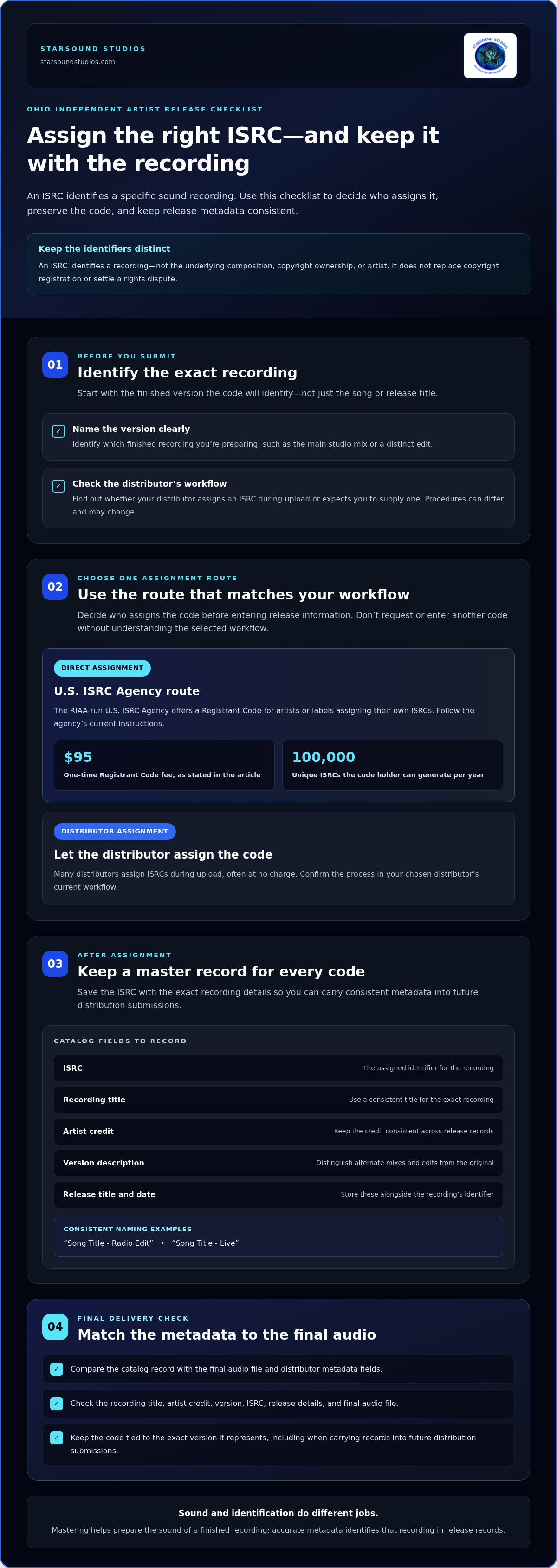
- Identify the recording. Decide exactly which finished version you’re preparing, such as the main studio mix or a distinct edit.
- Determine who assigns its code. Review your chosen distributor’s current workflow to see whether it supplies an ISRC or asks you to enter one. Distributor procedures can differ and may change.
- Use the appropriate route. In the United States, the RIAA-run U.S. ISRC Agency offers a Registrant Code for artists or labels assigning their own ISRCs. The current fee is a one-time $95, and the code allows its holder to generate up to 100,000 unique ISRCs per year. If you use this route, follow the agency’s current instructions. Many distributors also assign codes during upload, often at no charge. Don’t request or enter another code without understanding your selected workflow.
- Record and preserve the assigned code. Save it with the details for the exact recording, then carry it accurately into your release records and future distribution submissions.
For broader context on U.S. digital music rights, the Copyright Office’s Music Modernization Act resource explains a separate part of the music landscape. It doesn’t replace the ISRC Agency’s current assignment guidance or your distributor’s metadata instructions.
Create a reliable record for every assigned code
Keep a master catalog in a spreadsheet or another system you can maintain. For each recording, include the ISRC, recording title, artist credit, version description, release title, and release date. Use a consistent naming convention, such as “Song Title - Radio Edit” or “Song Title - Live,” to distinguish alternate mixes and edits from the original.
Before delivery, compare that record with the final audio file and the distributor’s metadata fields. A polished master and accurate identification support release preparation in different ways. An audio mastering studio Cleveland artists can work with can help prepare the sound while you maintain your recording metadata.
How Do ISRC Codes Differ Across Versions, Distributors, and Releases?
An ISRC follows the recording, not the release package or the distributor delivering it. The key question is whether you’re reusing the same recording or preparing a meaningfully different version. Note what changed, then consult current guidance from the U.S. ISRC Agency if the right approach isn’t clear.
Don’t reuse or change a code based only on a title or filename change. A label or filename can change while the audio remains the same, and one recording may appear on more than one release. Base the decision on the recording itself and applicable assignment guidance.
| Release situation | How to think about the ISRC |
|---|---|
| Original recording | Assign or receive a code for the specific finished recording through your chosen assignment route. |
| Materially different version | A remix, live recording, or substantially changed master may be treated as a distinct recording. Verify current assignment guidance for the specific change. |
| Unchanged re-release | If the same recording is included on a later single, EP, or album, retain its existing ISRC rather than creating a duplicate solely because the release or distributor changed. |
When might a new recording version need its own code?
A new remix or live performance is a different recorded version from the original studio master. A new edit or remaster needs closer review: don’t assume every change automatically calls for a new code or that the old one always remains appropriate. Document the version name and audio changes, then consult the agency’s current rules. That record helps you apply the decision consistently across your catalog and distribution workflow.
ISRC versus UPC: recording identifier versus release identifier
An ISRC identifies an individual recording. A UPC or EAN identifies a release package, such as a single, EP, or album. A one-track single can therefore have a release identifier for the package and an ISRC for its track. A multi-track album has a package identifier, while each recording on it has its own recording-level identifier. These are related metadata, but they aren’t interchangeable.
Keep the final audio version, its title, and the associated code aligned in your release notes. That’s useful whether you’re preparing files independently or working with an audio mastering studio Cleveland artists can turn to for release-ready sound. Mastering addresses the audio; the code identifies the recording. Give both details a clear place in your delivery preparation.
What Should Ohio Artists Check Before Sending ISRC Metadata to Distribution?
A final review can catch mismatches before your release enters a distributor’s delivery workflow. Check the metadata against the exact recording you intend to submit, then review the audio file separately. These are two parts of release preparation, and each needs attention.
Review metadata against the final recording and version
Use this checklist for each track, especially when your release includes alternate versions:
- Recording title: Check spelling, punctuation, and capitalization against your release records.
- Artist credit: Confirm the credited artist and any featured-artist details are consistent wherever they appear.
- Version: Label the intended mix or edit clearly, such as “Radio Edit” or “Instrumental,” where applicable.
- ISRC: Match the code to the specific recording version, not just a similar title or another track on the same release.
- Release details: Review the release title and other information required by your distributor’s current submission fields.
- Final audio file: Confirm you’re submitting the intended master and that its filename or delivery notes don’t conflict with the metadata.
Compare the same recording’s identifying details across your spreadsheet, release notes, and submission materials. Save a dated copy of the metadata you submit alongside a record of the final delivered audio. If a question comes up later, you’ll have a reference showing what was sent and which version it described.
Distributor fields and delivery requirements can change. Review the current instructions for your release instead of relying on an old template. Consistency helps reduce avoidable confusion, but it can’t guarantee acceptance by a distributor.
Keep audio mastering and ISRC administration distinct
Mastering prepares audio for release; an ISRC identifies a particular recording. One doesn’t automatically assign the other, and a polished master doesn’t replace accurate metadata. Treat the finished audio and the code as separate deliverables that must correspond to the same version.
If you’re preparing a final master, read the professional audio mastering guide as a separate part of your release planning. For hands-on support with your release’s sound, work with an audio mastering studio Cleveland artists can access locally or remotely. Keep control of your ISRC and metadata records as you prepare the distribution submission.
How Can Cleveland Artists Prepare Their Recordings for a Confident Release?
A smooth release handoff starts with one clearly identified recording version and metadata that describes it accurately. You don’t need a studio session to obtain an ISRC. Treat code assignment, audio production, and distribution delivery as connected but separate steps.
- Finalize the recording version. Confirm which mix or edit is the release master, and give it a clear version name.
- Document the metadata. Keep the assigned ISRC with the recording title, artist credit, version description, release details, and final audio file information.
- Prepare the distribution delivery. Compare the saved information with your distributor’s current submission instructions, then confirm that the audio and metadata refer to the same recording.
Build a release handoff that keeps the recording and metadata aligned
Gather the final master, version description, assigned code, and metadata record in one organized handoff. For example, when delivering a radio edit, make sure the filename, version label, and ISRC record all point to that edit rather than the full-length mix. Clear documentation gives collaborators a shared reference and helps prevent an outdated or alternate file from being mistaken for the intended master.
Keep this handoff useful whether you’re working in person or remotely. Starsound Studios is located in North Royalton, Ohio, and works with Greater Cleveland artists as well as remote clients. Explore the studio’s mastering services as one audio-production step in your release plan.
Where professional mastering fits into the release process
Mastering is audio post-production focused on preparing the sound of a finished mix. It doesn’t register a code or manage your distribution submission. Keeping these tasks distinct helps you protect both sides of the release: the sonic character of the master and the accuracy of its identifying information.
Starsound Studios offers stereo mastering and remote mastering for artists preparing music across the Greater Cleveland area and beyond. Whether you’re polishing a final mix locally or sending your project remotely, the sequence is the same: settle the recording version, document its metadata, then prepare the delivery. The ISRC helps identify the recording; your master carries its sound into the world.
Get Your Recording Ready for Its Next Stage
A confident release begins with clarity. An ISRC identifies a specific recording, not the composition or its owner. Choose the assignment route that fits your distribution workflow, then keep the code connected to the correct version. Before delivery, compare your titles, artist credits, version details, metadata, and final audio so they all describe the same recording.
Metadata and mastering do different jobs, but both support a thoughtful release. Starsound Studios is a recording facility in North Royalton, Ohio, serving local and remote artists with stereo mixing and mastering. It’s also a Dolby-certified Atmos mixing studio in Ohio. Whether your project is ready for a final sonic polish or still taking shape, choose a next step that serves the music and your vision.
Explore Starsound Studios mastering services for support preparing your release’s sound. Keep your recording details organized, trust the creative process, and get in touch with Starsound Studios to discuss mastering for your next release.
Frequently Asked Questions
What is an ISRC code for an independent artist?
An ISRC is an identifier associated with a particular sound recording or music video. It distinguishes that recording from others, including different recordings of the same composition. It doesn’t register copyright, establish ownership, or replace a release-level identifier such as a UPC. Keep the code connected to accurate recording metadata, and check current official assignment guidance before distributing your music.
Do Ohio artists need a different ISRC code from artists in other states?
No. Ohio artists generally follow the applicable United States ISRC process, not a separate Ohio-only system. An ISRC identifies a recording, not the state where the artist lives or made it. Assignment procedures and distributor workflows may change, so check current official guidance and your chosen distribution workflow’s instructions when preparing a release.
How do independent artists get an ISRC code?
Start by determining whether your release workflow expects you or your distributor to provide the code. Follow the applicable current assignment process, associate each code with the correct recording, and save it with the final version and its metadata. Distributor assignment procedures can differ. For Cleveland artists preparing a release, verify United States procedures through current authoritative guidance before submitting.
Can I use the same ISRC for a remix or remastered version?
It depends on the recording change and applicable assignment guidance, so don’t assume a remix or remaster should use the original code. A different mix or live recording may be treated differently from an unchanged copy of the same master. Document the version name and what changed, then consult current official guidance before delivery. A filename or title change alone doesn’t determine the code.
What is the difference between an ISRC and a UPC?
An ISRC identifies an individual sound recording or music video, while a UPC or EAN generally identifies a release package. A single may have one release-level identifier and an ISRC for its track; a multi-track release has a package identifier and recording-level information for each track. Enter each identifier in the appropriate field, following your distributor’s current requirements.
Does an ISRC code prove that I own the copyright?
No. An ISRC identifies a recording; it isn’t proof of copyright ownership, a copyright registration, or an agreement between collaborators. Keep rights documentation and ownership agreements separate from your recording metadata. For questions about copyright registration or ownership, consult authoritative copyright resources, such as the U.S. Copyright Office, or seek qualified legal counsel for advice about your circumstances.
Should I assign an ISRC before or after mastering?
Plan the code as part of your release metadata and make sure it corresponds to the recording version you intend to distribute. Mastering prepares the audio; an ISRC identifies the recording. They’re separate tasks. If the final version changes after you’ve documented its code, review current assignment guidance before submitting. An audio mastering studio Cleveland artists can work with can help prepare the sound, but mastering itself doesn’t assign an ISRC.


