

In 2026, the loudest master on the playlist is often the one that sounds the weakest. It's a hard truth for creators who want their music to feel massive, vibrant, and alive. You've likely felt the sting of a track losing its punch the moment it's uploaded, leaving you confused by the complex requirements of mastering for streaming services. It's frustrating to watch your hard work get flattened by an algorithm that seems to favor safety over energy.
We believe your music deserves a sonic sanctuary where technical precision meets artistic fire, allowing your unique identity to shine with stellar clarity. This guide will show you how to optimize your tracks for Spotify, Apple Music, and YouTube to ensure your sound remains competitive and dynamic across every device. You'll learn how to stop fighting the normalization software and start using it to preserve your sonic integrity. We're breaking down the latest LUFS targets, the necessity of true peak headroom, and the strategic balance between raw power and emotional impact. It's time to gain total confidence in your final release strategy.
Key Takeaways
- Discover why the "loudness war" has ended and how to prioritize sonic consistency so your tracks don't get turned down by platform algorithms.
- Master the technical essentials of mastering for streaming services by understanding the LUFS and True Peak targets that prevent digital distortion.
- Learn the specific normalization standards for Spotify, Apple Music, and YouTube so your music translates perfectly across every listener's device.
- Simplify your workflow with a "Golden Master" strategy that delivers a professional, high-fidelity sound without the headache of managing multiple exports.
- Explore how Dolby Atmos mixing provides a competitive edge, bypassing traditional stereo limitations and unlocking higher royalty potential on platforms like Apple Music.
Mastering for Streaming in 2026: Why the Loudness War is Over
The era of the brick-walled, hyper-compressed master is finally dead. In 2026, mastering for streaming services has evolved into a sophisticated technical handshake between your creative vision and the complex algorithms of global distribution. It's no longer about being the loudest track in the room; it's about being the most consistent. When your music hits a curated playlist alongside global chart-toppers, the goal is seamless integration. You want your listeners to feel the energy of your song without reaching for the volume knob. This shift marks the rise of Algorithm-Friendly mastering, a modern gold standard that prioritizes dynamic integrity over sheer decibel levels.
The Evolution of Digital Distribution
Streaming has completely reshaped how we experience sound. With the global music streaming market projected to reach up to $62.5 billion in 2026, digital platforms are the primary stage for nearly 90% of listeners. Spotify alone reported 761 million monthly active users in early 2026, highlighting the massive scale of these digital ecosystems. To manage this volume, platforms like Spotify and Apple Music utilize loudness normalization. This technology acts as a leveling field, ensuring a quiet folk ballad and a heavy techno track play back at the same perceived volume. At Starsound Studios, we view this as a creative sanctuary. It allows us to focus on the spirit of your work rather than the math of the meters, knowing the algorithm will handle the rest.
Loudness vs. Perceived Quality
There is a dangerous myth that louder equals better. In reality, a master pushed too hard often loses its soul. Excessive compression strips away the transients, the breath, and the emotional nuances that make a song feel alive. Dynamics are the heartbeat of a professional recording; they provide the vital push and pull that keeps a listener engaged. When a track is mastered too loud, the normalization algorithm simply turns it down, leaving you with a song that sounds small and flat compared to more dynamic hits. We focus on the emotional impact of the final polish. We ensure your transients hit with precision and your low end breathes with authority. By embracing this modern standard, you protect the spirit of your mix while ensuring it competes on a world-class level.
Understanding the Technical Specs: LUFS, True Peak, and Normalization
Traditional peak meters are essentially lying to you. In the analog days, staying out of the red was the only rule that mattered. Digital streaming has changed the game. Today, your DAW's peak meter only measures the highest voltage level of a sample, but it ignores how our ears actually process sound. This is where normalization comes in. Think of it as a tireless "gain rider" for the entire platform. If your track is significantly louder than the platform's target, the algorithm simply pulls the fader down. If you've over-compressed your mix to win a loudness race that no longer exists, you'll end up with a song that sounds small, flat, and lifeless compared to the hits. Understanding the math behind the music is the first step toward sonic dominance.
LUFS: The New Yardstick for Music
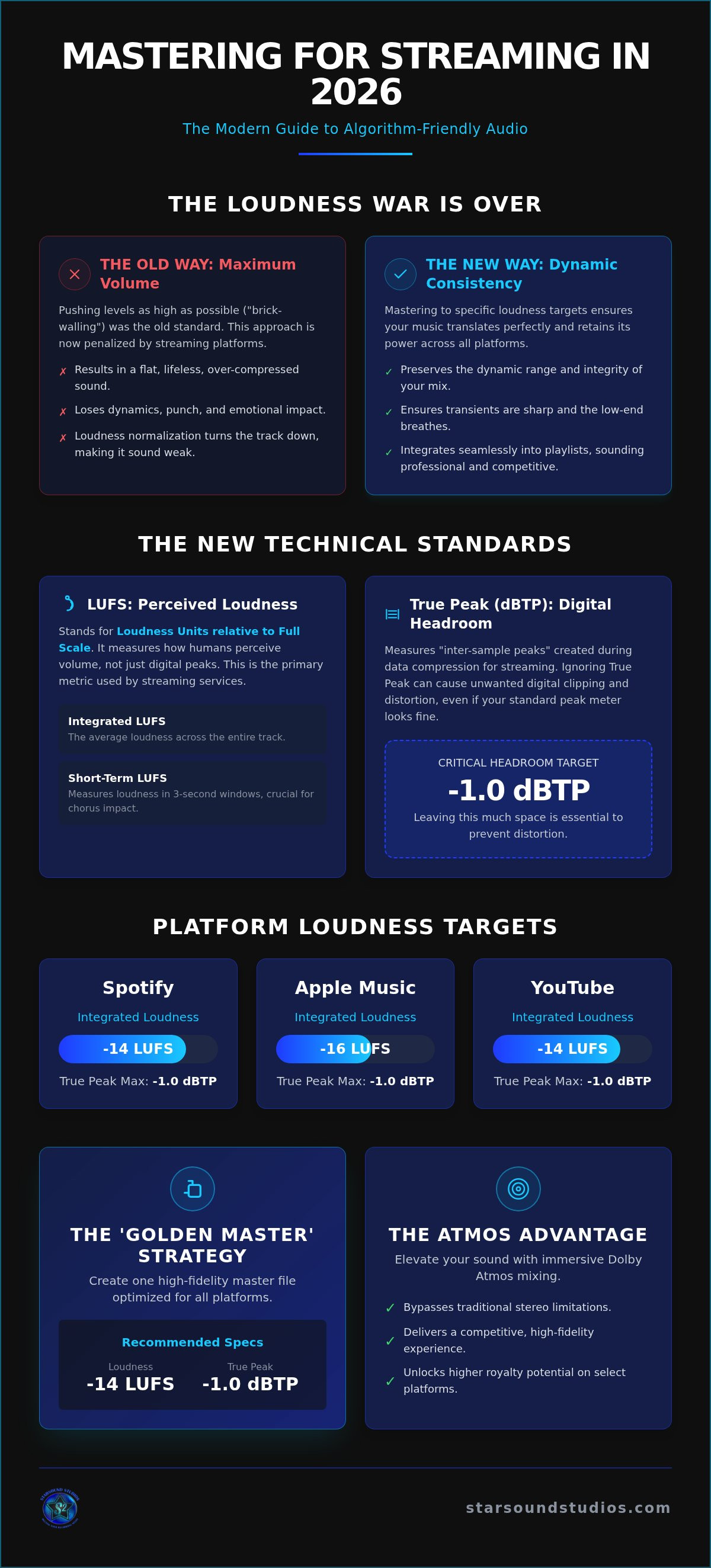
LUFS stands for Loudness Units relative to Full Scale. It's the measurement of how humans actually perceive volume. Unlike peak levels, LUFS accounts for the duration and frequency of sounds, giving a much more accurate picture of "loudness." When mastering for streaming services, we look at two main types of LUFS:
- Integrated LUFS: This is the average loudness across your entire song. Spotify targets -14 LUFS, while Apple Music settles at a slightly quieter -16 LUFS.
- Short-term LUFS: This measures loudness in three-second windows. It's vital for ensuring your choruses have the right "lift" without triggering aggressive limiting.
By targeting these specific numbers, you ensure the algorithm doesn't have to do heavy lifting, which keeps your transients sharp and your energy high.
DBTP: Why Headroom is Your Best Friend
True Peak (dBTP) is the hidden detail that separates professional releases from amateur exports. When your audio is converted into lossy formats like Ogg Vorbis or AAC for streaming, "inter-sample peaks" can occur. These are tiny spikes that exist between digital samples. If you don't leave enough headroom, these peaks will clip and distort during playback. Professional mastering services prioritize leaving at least -1.0 dBTP of headroom. For tracks that are mastered intentionally loud, we often push that to -2.0 dBTP to satisfy Amazon Music's HD standards and prevent artifacts on YouTube. This isn't just about playing it safe; it's about ensuring your creative spirit isn't muffled by digital grit. If you want to see how these technical specs can transform your sound, our remote mastering team is ready to bridge the gap between your home studio and world-class distribution.
Platform Breakdown: Spotify, Apple Music, and YouTube Standards
While the technical math provides a foundation, the real magic happens when you understand how each platform's unique ecosystem treats your audio. Mastering for streaming services isn't a one-size-fits-all process. It’s a strategic alignment with the specific behaviors of the world’s biggest digital stages. Each service employs its own flavor of normalization, meaning a master that sounds perfect on one might feel slightly "off" on another if you haven't planned for the transition. As we move deeper into 2026, the rise of lossless and high-resolution tiers makes these nuances even more critical. Listeners are using better gear, and they can hear the difference between a master that's breathing and one that's gasping for air.
Spotify: The -14 LUFS Standard
Spotify remains the heavy hitter with 761 million active users as of early 2026. Their default target is -14 LUFS, but there's a catch that many artists miss. Users can toggle between "Quiet," "Normal," and "Loud" settings in their app. If you master your track significantly hotter than -14, Spotify’s "Loud" setting will apply a peak limiter to your music to bring it down. This can introduce unwanted distortion and squash the transients you worked so hard to preserve. We recommend mastering for the "Normal" setting. This preserves the punch and clarity established during the stereo mixing stage, ensuring your music sounds intentional rather than accidental when it hits a playlist.
Apple Music and the Immersive Shift
Apple Music takes a more audiophile-centric approach. Their "Sound Check" feature targets -16 LUFS, favoring a slightly wider dynamic range than Spotify. This is where Apple Digital Masters (ADM) comes into play. It’s a set of rigorous standards that ensure high-resolution audio delivery from the source. By targeting -16 LUFS and maintaining -1.0 dBTP, you provide the algorithm with enough headroom to translate your work with absolute fidelity. This transparency is vital as Apple continues to push Spatial Audio. Tracks that excel in stereo are often the best candidates for immersive expansion in our 9.1.4 Dolby Atmos suite, where normalization issues are virtually bypassed by the format's metadata.
YouTube presents a different challenge. As the world’s largest music search engine, its requirements are unique because of its heavy video encoding. While it targets -14 LUFS, the conversion process can be unforgiving. If your True Peak is too close to zero, the conversion to various video qualities can cause audible artifacts and digital grit. We aim for a solid -14 LUFS with a conservative -1.0 or even -2.0 dBTP for YouTube. This ensures your music maintains its professional edge whether someone is watching a 4K music video on a home theater or streaming a low-bandwidth version on a mobile device.
The "Golden Master" Strategy: One Master to Rule Them All
Consistency is the cornerstone of a professional brand. Many artists fall into the trap of creating ten different exports for ten different platforms, but this is a recipe for sonic confusion. When you provide a different version for every service, you lose control over how your discography translates as a whole. The most effective approach in 2026 is the "Golden Master" strategy. This involves creating a single, high-fidelity file optimized for the strictest technical requirements. By satisfying the most demanding platform standards, your music will naturally excel everywhere else. Mastering for streaming services isn't about hitting a specific number with surgical precision; it's about finding the highest common denominator for quality.
Your Golden Master checklist should focus on these three pillars:
- True Peak: Set your ceiling to -1.0 dBTP. This satisfies the majority of platforms and prevents clipping during lossy conversion. If you're targeting Amazon Music HD specifically, consider -2.0 dBTP.
- Bit Depth: Always export at 24-bit or 32-bit float. This preserves the dynamic detail and low-level information that 16-bit files can sometimes truncate.
- Sample Rate: Stick to 48kHz or higher. While 44.1kHz is the legacy standard, modern distribution favors higher resolutions.
Focusing on the "Sweet Spot"
A common misconception is that you must hit exactly -14 LUFS to sound "correct" on Spotify. This is a ceiling, not a target. For modern genres like Hip-Hop, EDM, or Rock, the professional sweet spot often sits between -10 and -12 LUFS. When a master at -10 LUFS is turned down by a streaming algorithm, it retains its internal density and punch. It feels "heavy" even at a lower volume. Conversely, a track mastered too quietly (e.g., -18 LUFS) that gets turned up by the platform can often sound thin or highlight a noisy floor. We aim for a level that feels competitive and energetic before the algorithm even touches it.
Preparing Your Files for the Engineer
Before you send your tracks to a professional sound engineer, your export settings must be pristine. Ensure there are no limiters or heavy "safety" compression on your master bus. We need the headroom to sculpt the transients and find the perfect balance for your sound. Focus on the vibe of the mixdown rather than the final volume. If you're a Cleveland-based artist, we invite you to our North Royalton facility for a final listening session in a tuned environment to hear exactly how your transients will react. For creators worldwide, our remote mastering services provide that same high-end precision, ensuring your work is ready for global distribution.
Elevating Your Sound: The Atmos Advantage at Starsound Studios
Mastering for streaming services has traditionally been an exercise in compromise, balancing the energy of a mix against the rigid ceilings of stereo normalization. As we look toward the future of distribution, that landscape is shifting. Immersive audio has moved from a niche luxury to a mainstream requirement. By embracing Dolby Atmos, you aren't just adding a new format to your discography; you're future-proofing your art. Atmos masters utilize object-based metadata that adapts to the listener's environment, effectively bypassing the aggressive gain-reduction and limiting issues that often plague stereo masters on high-volume playlists. It represents the ultimate expression of sonic freedom.
Why Dolby Atmos is the New Streaming Standard
Major platforms like Apple Music, Tidal, and Amazon Music are no longer just supporting immersive audio; they're actively prioritizing it. In 2026, Apple Music continues to incentivize creators with a royalty bonus of up to 10% for tracks delivered in Spatial Audio. This isn't just about a potential pay increase; it's about visibility. The algorithms powering "New Music Daily" and other flagship playlists heavily favor Atmos-enabled content. This format provides a "spatial" feel, a sense of height, depth, and wrap-around energy that stereo masters simply cannot replicate. To dive deeper into the technical architecture of these mixes, explore our Dolby Atmos studio Cleveland pillar for a look at the future of Ohio’s sound.
The Starsound Experience: From North Royalton to the World
Starsound Studios serves as a bridge between your home-studio creativity and world-class distribution standards. As Ohio’s first and only Dolby-certified Atmos facility, we provide a creative sanctuary where the science of audio meets the spirit of creation. Our 9.1.4 immersive audio suite is meticulously tuned to ensure your transients hit with authority and your soundstage feels infinite. Whether you are a local Cleveland artist visiting us in North Royalton or a global creator utilizing our remote mastering services, you receive the direct expertise of Steve "The Mix."
We view every project as a collaborative mentorship. We are just as invested in your final product as you are, providing the grounded assurance that every technical detail is handled with absolute precision. Don't leave your release to the whims of a generic AI algorithm or a "set-and-forget" preset. Your music deserves a professional polish that translates across every device and platform. Partner with a team that understands the rhythm of the industry and the soul of your work. Let’s ensure your next release doesn't just meet the standard, but sets a new one.
Claim Your Place on the Global Stage
The shift toward dynamic, algorithm-friendly audio isn't just a technical hurdle; it's a creative liberation. By mastering for streaming services with a focus on integrity rather than sheer volume, you ensure your music hits with the same impact in a car as it does through high-end headphones. You've seen how the "Golden Master" strategy simplifies your workflow and how specific platform targets reward clarity over compression. Now, it's about taking that final step to ensure your vision isn't lost in translation.
Whether you're looking for the punch of a world-class stereo master or the revolutionary depth of an immersive mix, you need a partner who understands the science of the medium. As Ohio’s only Dolby-certified Atmos mixing studio, we provide the precision of our 9.1.4 Immersive Audio Suite alongside the expert guidance of Steve "The Mix." We don't just process files; we polish legacies. Elevate your sound with professional mastering at Starsound Studios. Your music is ready to be heard. Let's make sure it's impossible to ignore.
Frequently Asked Questions
What is the best LUFS level for Spotify in 2026?
While Spotify targets -14 LUFS integrated, the "best" level depends entirely on your genre and creative intent. For high-energy tracks like Hip-Hop or EDM, aiming for a sweet spot between -10 and -12 LUFS often yields better results. This ensures your transients remain punchy even when the algorithm turns the volume down. Mastering for streaming services is about finding that perfect balance where your music feels dense and energetic without triggering aggressive platform limiting.
Will my song sound quieter if I don’t master to -14 LUFS?
No, your song won't sound quieter because the platform's normalization algorithm adjusts the gain automatically. If you master to a quieter level like -18 LUFS, the service will turn it up to match their target. However, mastering too quiet can sometimes highlight a noisy floor or make your mix feel thin. We aim for a level where your dynamics feel powerful and intentional, ensuring your track stands tall next to global chart toppers.
Should I create different masters for Apple Music and YouTube?
We generally recommend a "Golden Master" strategy instead of managing dozens of inconsistent exports. A single, high-quality master at -1.0 dBTP with a loudness level around -12 to -14 LUFS translates beautifully across all major services. While YouTube has unique video encoding needs and Apple Music prefers a -16 LUFS target, optimizing for the strictest True Peak requirements ensures your sonic identity remains consistent across every digital stage without the headache of multiple files.
What is True Peak and why should I care?
True Peak (dBTP) measures the actual peak voltage of an audio signal, including the tiny inter-sample peaks that standard peak meters often miss. You should care because these hidden peaks cause digital clipping during the conversion to lossy formats like AAC or Ogg Vorbis. By leaving at least -1.0 dBTP of headroom, you protect your music from unwanted distortion. It's a vital technical safeguard that keeps your transients sharp and your audio fidelity pristine for the listener.
Can I master my own music for streaming using plugins?
You can use plugins to master your own music, but you lose the critical perspective of a seasoned set of ears. Professional mastering for streaming services is about more than just a limiter chain; it's about acoustic translation and objective judgment. A professional engineer uses a tuned environment to catch phase issues or frequency imbalances that home monitors might miss. We provide the technical precision and collaborative mentorship that automated plugins or AI simply can't replicate.
How does Dolby Atmos affect my streaming loudness?
Dolby Atmos utilizes object-based metadata that handles loudness differently than traditional stereo files. Atmos tracks on Apple Music target a quieter -18 LUFS, which allows for significantly more dynamic range and spatial movement. Because the format is immersive, it bypasses many of the aggressive limiting issues found in standard stereo mastering. It offers a cleaner, more expansive listening experience that rewards artists who prioritize depth and emotional impact over sheer decibel pressure and volume.
Why does my music sound distorted on some streaming services?
Distortion usually occurs due to inter-sample clipping or aggressive platform-side limiting. If your master is pushed too close to 0.0 dB or lacks sufficient True Peak headroom, the encoding process for lossy formats will create audible artifacts. Additionally, if your track is excessively loud, a service's internal limiter may kick in to protect the listener's ears. This results in a gritty, flattened sound that lacks the professional polish and clarity of a well-balanced, world-class master.
Is AI mastering good enough for professional streaming releases?
AI mastering is a convenient tool for quick demos, but it lacks the emotional intelligence and genre-specific nuance of a human engineer. An algorithm can't understand the spirit of your track or make creative decisions about the energy of a bridge. For professional releases where your reputation is on the line, the collaborative mentorship and technical accuracy of a certified facility ensure your unique identity remains the priority. Real expertise translates your vision into a polished, competitive result.


