

What if your song sounds like a Grammy-winning hit in your studio but falls completely flat the moment it hits a smartphone speaker? It is the ultimate artist's nightmare. You have poured your soul into every lyric and melody, yet the final result feels small, cluttered, or inconsistent. This disconnect often stems from a fundamental misunderstanding of mixing vs mastering. These two stages are the final gatekeepers of your sound. One focuses on the internal balance of your instruments. The other ensures your vision translates perfectly across every playback system in the world.
You want your music to compete with the biggest names on global streaming platforms. We understand that pressure. It is why we treat every project as a collaborative mission to reach its highest potential. In this guide, you will discover the critical differences between these two disciplines and learn how each stage transforms your raw recordings into a polished, radio-ready masterpiece. We provide a clear roadmap for finishing your song, from achieving current -14 LUFS loudness targets to leveraging the immersive power of Dolby Atmos v5.5. You will learn exactly when a project is ready for the next stage and how to achieve the sonic clarity your art deserves.
Key Takeaways
- Grasp the essential distinction between mixing vs mastering; learn how to pivot from balancing individual tracks to perfecting the final listener experience.
- Learn how professional multitrack sculpting and creative automation inject life, movement, and emotional energy into your raw recordings.
- Discover why "fresh ears" and high-resolution stereo processing are essential for ensuring your track sounds consistent across AirPods, car speakers, and club systems.
- Develop a realistic roadmap for your production timeline by identifying why a detailed mix requires days of focus while mastering delivers the final punch in a few high-intensity hours.
- See how the evolution of Dolby Atmos is merging traditional stages, offering a competitive advantage in an immersive-first market.
The Core Distinction: Why Your Music Needs Both Mixing and Mastering
Think of your song as a living, breathing ecosystem. In the world of mixing vs mastering, these two processes operate on entirely different scales. Mixing is your microscopic lens. It is the deep dive into the multitrack session where every snare hit and vocal ad-lib is scrutinized for its place in the sonic field. Mastering is the macroscopic view. It is the wide-angle lens that ensures your creation survives the transition from a controlled studio environment to the chaotic reality of the listener's world.
Consider the culinary arts as a parallel. Mixing is the chef meticulously selecting ingredients, balancing spices, and controlling the heat to create a complex flavor profile. Mastering is the final plating and the atmosphere of the dining room. Even the most delicious dish loses its impact if it is served on a cold, chipped plate with no aesthetic intent. Skipping either stage results in "demo-sounding" tracks. They lack the professional weight, punch, and emotional gravity required to compete in 2026. You need both to turn a creative spark into a world-class release.
The Purpose of the Mix
This stage is about sculpting raw energy into a refined narrative. We use the multitrack session to create a three-dimensional space where every element has room to breathe. It is not just about volume; it is about establishing an emotional hierarchy. We decide what grabs the listener’s attention first and what provides the subtle, supportive foundation. Technical health is paramount here. We address phase alignment and frequency masking to ensure the low end is tight and the highs are crystalline. Without a solid mix, your song remains a collection of parts rather than a cohesive experience.
The Purpose of the Master
Once the mix is finalized, mastering acts as the ultimate bridge to the consumer. This stage provides sonic cohesion. It ensures that if you are releasing an EP or album, every track feels like it belongs to the same artistic family. We optimize the technical specifications to meet modern streaming demands. In 2026, targeting around -14 LUFS integrated loudness remains the industry benchmark for platforms like Spotify and Apple Music to avoid unwanted limiting. Mastering also serves as the final safety net. A professional engineer brings fresh ears to the project, catching minute clicks or pops that can easily be missed after hours of intensive mixing. It provides the final sheen that makes a track feel expensive and ready for the world.
The Art of the Mix: Sculpting the Multitrack Session
Mixing is where your raw recordings find their purpose. When you engage a professional mixing and mastering service, the process begins with technical organization and creative vision. We take your multitrack session, often consisting of dozens or even hundreds of individual channels, and begin the delicate process of sculpting. This is not just about making things audible. It is about emotional impact. We balance the "Big Three": Level, Pan, and Frequency. Level establishes the foundation; Pan creates the width and stereo image; Frequency, or EQ, carves out space so the kick drum doesn't swallow the bass guitar. In the broader conversation of mixing vs mastering, the mix is where the creative identity is truly forged.
Static mixes feel lifeless. To create excitement, we use automation to breathe movement into the arrangement. A chorus might expand in width, or a vocal might gain a touch more reverb during a bridge to signal a shift in mood. This dynamic evolution keeps the listener engaged from start to finish. Headroom is the intentional buffer of space between the loudest peak of your audio and the point of digital clipping, providing the essential canvas for a mastering engineer to apply final processing without distortion.
Processing Individual Elements
The lead vocal is the heart of your story. Our approach focuses on making that vocal shine through precise tuning and timing corrections that feel natural rather than robotic. We also look at the rhythm section with a critical eye. Sometimes a recording needs drum enhancement to add punch, while other times we preserve the raw, original spirit of the kit. Saturation is our secret weapon for "vibe." It adds harmonic interest and warmth, giving the track a professional, "expensive" texture that digital recordings often lack.
When is a Mix Actually Finished?
You have likely tried the "car test" to see if your low end translates. While helpful, it is no substitute for a professionally treated environment. Professional rooms reveal phase issues and subtle frequency build-ups that consumer speakers simply hide. Before you decide a song is done, consult our guide on track preparation to ensure you are ready for the final polish. Use this checklist to confirm your mix is ready for the next stage of mixing vs mastering:
- Phase Alignment: Ensure multi-mic recordings, like drums or stacked guitars, are not canceling each other out.
- Vocal Consistency: Check that the lead is clearly audible in every section, from the quietest verse to the loudest chorus.
- Dynamic Range: Avoid over-compressing; leave enough life in the transients for the mastering stage to work its magic.
If you feel your project is close but needs that final professional touch, consider exploring our stereo mixing services to elevate your vision.
Mastering the Final Stereo File: The Bridge to the Listener
Mastering is the final handshake between your creative vision and the listener's reality. While mixing builds the internal architecture of a song, mastering ensures that architecture survives the outside world. It is the art of translation. Your track must hit with the same emotional impact on high-end club systems as it does on a pair of standard AirPods or through the speakers of a commuter car. This stage is not about drastic changes. It is about the "1% shifts"—subtle EQ curves and surgical compression—that collectively make a 100% difference in how the music feels.
Beyond the sonics, this is where your project becomes a professional product. We handle the technical housekeeping that artists often overlook. This includes embedding ISRC codes and finalizing metadata so your royalties are tracked correctly across digital distribution platforms. A professional sound engineer acts as the final quality control, ensuring your work is ready for the global stage.
Loudness Standards in 2026
The "loudness wars" have evolved into a quest for quality. In 2026, streaming platforms use sophisticated normalization algorithms to keep volume levels consistent for listeners. We typically target an integrated loudness of approximately -14 LUFS. This provides enough punch to compete without triggering the aggressive limiting that can squash your transients. We also maintain a -4dB True Peak ceiling. This specific headroom prevents the digital clipping and inter-sample distortion that often plague low-quality playback devices. Whether you are delivering in WAV, AIFF, or MP3, we ensure the file format is optimized for its final destination.
The Fresh Ears Advantage
In the debate of mixing vs mastering, perspective is your most valuable asset. The engineer who spent forty hours mixing your song may have developed "blind spots" to specific frequency build-ups. Their ears have adjusted to the unique acoustics of their room. Bringing in a dedicated mastering engineer provides an objective, high-level view. We don't focus on the individual snare hit or the reverb tail on a backing vocal. We focus on the song as a single, cohesive unit. This fresh perspective allows us to catch minute errors and tonal imbalances that the creator is often too close to hear.
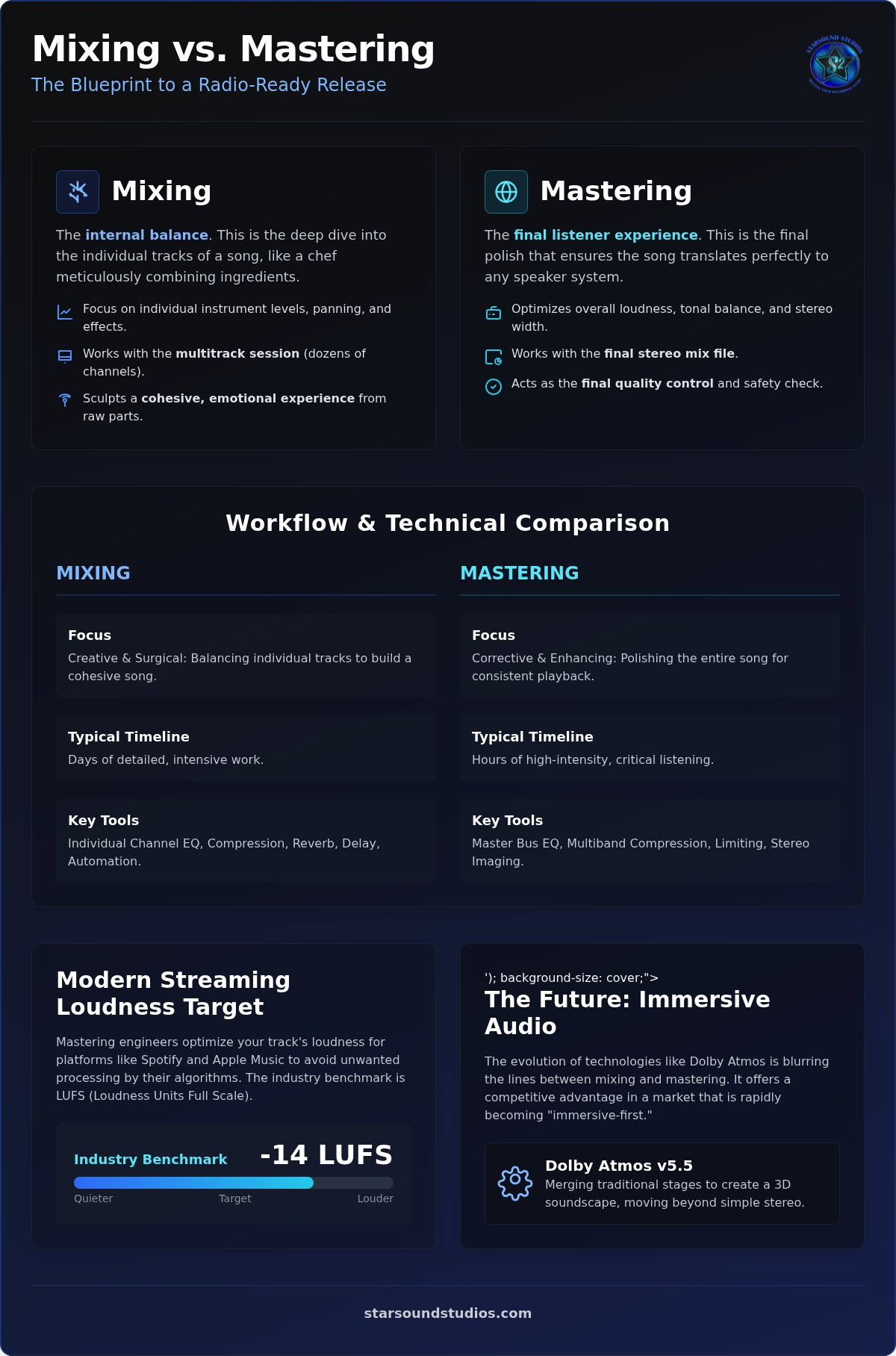
Mixing vs. Mastering Workflow: A Technical Comparison
The technical landscape of mixing vs mastering is defined by a shift in perspective. Mixing is a battle with complexity. You are managing a multitrack DAW session that might contain 100 individual channels of raw audio, each requiring surgical attention to level, phase, and tone. Mastering, however, is the art of high-resolution stereo processing. It focuses on a single, final stereo file or a select group of stems. High-resolution mastering requires a treated acoustic environment because you cannot fix what you cannot accurately hear.
Many creators fall into the "Master Bus" trap. They load their final mix bus with heavy limiters and compressors, attempting to achieve professional loudness while they mix. This is not mastering. It is simply mixing into a ceiling. This approach often destroys the dynamic range and transients that a dedicated mastering engineer needs to make your track breathe. By keeping these workflows separate, you ensure that the creative decisions made during the mix aren't compromised by the technical requirements of the final output. If you want to move beyond the master bus trap, explore our professional mastering services to experience the clarity of a dedicated signal path.
Time allocation also varies significantly between these stages. A complex mix can take days of iterative work, involving automation passes and detailed vocal editing. Mastering is a more concentrated process. It typically takes only a few hours of intensive, objective listening. It is the final "sanity check" that ensures your days of mixing translate into a world-class result.
The Software vs. Hardware Debate
We believe in a hybrid approach that bridges the gap between analog "mojo" and digital precision. While modern plugins offer incredible flexibility, high-end analog hardware provides a harmonic warmth and depth that is difficult to replicate. This is where AI mastering services often fail the "emotional test." An algorithm can analyze frequencies, but it cannot feel the intentional tension of a bridge or the raw grit of a rock vocal. It lacks the human intuition required to make creative decisions that enhance the spirit of your song.
Workflow Comparison Table
- Inputs: 24-100+ individual tracks (Mixing) vs. 1-8 stems or a single stereo file (Mastering).
- Goals: Establishing balance, character, and emotional hierarchy (Mixing) vs. Ensuring translation, consistency, and industry-standard loudness (Mastering).
- Delivery: Final mixdown or stems (Mixing) vs. Distribution-ready WAVs or DDP files (Mastering).
The Future of Post-Production: Dolby Atmos and Immersive Audio
Stereo has been the industry standard for decades, but the horizon has shifted. The traditional conversation surrounding mixing vs mastering takes on an entirely new dimension when we move into the immersive space. Dolby Atmos mixing in Cleveland is no longer just a premium add-on for major label artists. It is a fundamental reimagining of the sonic canvas. In this object-based environment, the rigid boundaries between the mix and the master begin to blur. You are no longer confined to a flat left-right plane. You are placing the listener inside the music.
In the Atmos workflow, "mastering" is often integrated directly into the immersive mix process. Because the Dolby Atmos Renderer v5.5 handles the final AC-4 L3 encoding and integrated loudness targets, the traditional hand-off to a separate mastering stage is evolving. The 9.1.4 experience, utilizing 14 discrete speakers including four overheads, ensures your vision translates perfectly to everything from high-end home theaters to binaural headphone renders. By adopting this technology now, you position your music for the next decade of streaming. Major platforms like Apple Music and Amazon Music increasingly prioritize immersive tracks for editorial playlisting, giving Atmos-ready artists a massive competitive advantage.
Starsound’s Immersive Edge
We are proud to host Ohio’s first and only Dolby-certified Atmos mixing facility. Our 9.1.4 immersive audio suite was built for creators who refuse to be limited by yesterday's standards. This is a collaborative journey. Steve "The Mix" provides a mentorship-style approach, guiding you through the transition from stereo stems to a fully realized immersive soundstage. We don't just push buttons; we help you find new creative opportunities within the 3D space. This high-attention environment ensures your unique identity remains the priority as we push your sound to its absolute limit.
Getting Started with Starsound
Distance is never a barrier to sonic excellence. While our physical sanctuary is located in North Royalton, we offer robust remote mixing and remote mastering services for artists across the globe. Booking a session is a seamless process designed to respect your creative momentum. Whether you are visiting us in person or collaborating from a different time zone, the Starsound promise remains the same. We provide the grounded assurance that every technical detail is handled with precision while maintaining the artistic spirit of your work. Your project is in passionate hands, and we are ready to help you finish your song with the world-class polish it deserves.
Your Vision, Perfectly Realized
Achieving sonic excellence is about more than just technical proficiency; it's about honoring the emotional core of your music. Understanding the nuances of mixing vs mastering is the first step toward a professional release. While mixing carves out the space for your artistic expression, mastering provides the final polish that ensures your sound translates across every platform. We have explored how high-resolution processing and immersive technology like Dolby Atmos are redefining the standard for 2026. Your art deserves a finish that matches its ambition.
At Starsound Studios, we provide the technical precision and creative sanctuary required to reach your highest potential. As Ohio’s only Dolby-certified Atmos studio, our 9.1.4 immersive audio suite offers a competitive edge that stereo alone can't match. Steve "The Mix" brings a mentorship-style approach to every project, ensuring your unique identity remains the focus from the first fader move to the final master. Elevate your sound with professional mixing and mastering at Starsound Studios. Let’s transform your raw recordings into a world-class masterpiece together. Your best work is yet to be heard.
Frequently Asked Questions
Can I master my own music if I have the right plugins?
You can certainly master your own tracks with modern plugins, but you often sacrifice objectivity and acoustic accuracy. A professional mastering engineer brings a fresh perspective and a calibrated listening environment that home studios simply cannot replicate. They catch subtle frequency build-ups and phase issues that your room might hide. It is about the human intuition and the specialized gear that turn a good mix into a world-class record.
How much headroom should I leave in my mix for the mastering engineer?
You should aim to leave between -3dB and -6dB of headroom on your master fader. This intentional buffer ensures your audio never hits 0dB, which causes permanent digital clipping. Providing this space is the greatest gift you can give a mastering engineer. It allows them to apply surgical EQ and compression without fighting against a pre-squashed signal. Always check that your loudest peaks have room to breathe before exporting.
Is stem mastering better than traditional stereo mastering?
Stem mastering provides a middle ground between a full mix and a stereo master. By providing 4 to 8 grouped tracks, such as drums, bass, and vocals, you give the engineer more control to fix specific balance issues. This is particularly helpful if you are unsure about your vocal levels. However, traditional stereo mastering is usually sufficient if your mix is already technically sound and well-balanced.
Do I need a separate engineer for mixing and mastering?
Employing separate engineers is the industry gold standard for a reason. When you navigate the stages of mixing vs mastering, having a second pair of expert ears acts as an essential quality control bridge. A dedicated mastering engineer identifies blind spots that the mixing engineer might have developed after days of intensive work. This collaborative approach ensures your project reaches its highest potential before it hits the streaming platforms.
What is the standard turnaround time for professional mixing and mastering?
Most professional studios deliver a final mix within 3 to 7 business days, while mastering typically requires 24 to 72 hours. These timelines allow for intensive listening sessions and the necessary ear breaks to maintain objectivity. Immersive projects, such as those in our 9.1.4 suite, might require slightly more time for complex rendering and quality checks. We prioritize technical precision to ensure your project is radio-ready upon delivery.
Why does my master sound quieter than other songs on Spotify?
Your track likely lacks the proper integrated loudness or has excessive true peaks. Spotify and Apple Music use normalization to keep volume levels consistent at roughly -14 LUFS. If your master is too dynamic or has stray peaks, the platform's algorithm will lower the volume to protect the listener's experience. Professional mastering balances these technical targets with the emotional energy of your music to ensure it hits hard every time.
What file format should I send for professional mastering?
Always export your final mix as a high-resolution, uncompressed WAV or AIFF file. You should maintain the same sample rate and bit depth used during your recording and mixing sessions, typically 24-bit or 32-bit float at 48kHz or higher. Avoid sending MP3s or other lossy formats, as these have already discarded vital sonic information. High-resolution files provide the clean canvas needed for premium results in the final stage of mixing vs mastering.
Is Dolby Atmos mixing necessary for every genre of music?
Dolby Atmos is no longer exclusive to blockbuster films or major label pop stars. Whether you produce folk, electronic, or experimental jazz, the immersive 9.1.4 format offers a competitive advantage for editorial playlisting. Major streaming services are prioritizing object-based audio because it provides a superior listener experience. Investing in an Atmos mix future-proofs your music and allows it to stand out in an increasingly crowded digital landscape.


