

You've spent hours tracking the perfect take, yet the playback feels small, cluttered, and frustratingly muddy. It's a common hurdle where the kick drum fights the bass and your vocals never quite find their place in the spotlight. To truly grasp what is audio mixing, you must see it as the bridge between a raw performance and a radio-ready record. It is the technical and artistic process of carving out a sonic sanctuary where every instrument has the space to breathe and tell its story.
We understand that your music is more than just data; it's your identity. This guide will reveal how raw multitrack recordings are transformed into a polished, professional song through the delicate balance of art and science. You'll discover the fundamental pillars of a world-class mix, finally learn the crucial difference between mixing and mastering, and see why a professional engineer's ears are your greatest asset. From the precision of stereo balance to the immersive power of a 9.1.4 Dolby Atmos suite, we're pulling back the curtain on the production experience.
Key Takeaways
- Understand what is audio mixing as the essential bridge between a raw, disjointed recording and a radio-ready masterpiece.
- Identify the four pillars of a professional mix to ensure your tracks achieve maximum clarity, depth, and emotional impact.
- Distinguish the specific roles of mixing and mastering so you can better communicate your creative vision to your engineering team.
- Explore the immersive future of audio by learning how 9.1.4 Dolby Atmos technology creates a sonic sanctuary for your listeners.
- Recognize how the synergy of high-end analog gear and professional ears elevates a project from a home demo to a world-class production.
Defining Audio Mixing: The Bridge Between Recording and Mastering
Think of your favorite song. It didn't start as a cohesive wall of sound. It began as a collection of isolated tracks, often recorded at different times and in various environments. To define audio mixing (recorded music) accurately, one must look past the faders and knobs. It is the technical and artistic process of blending these distinct elements into a single, unified experience. When artists ask what is audio mixing, they're often searching for the secret sauce that transforms a cluttered demo into a professional record. It is the bridge between the raw energy of a recording session and the final, competitive polish of mastering.
Without a dedicated mixing stage, raw recordings often sound "unfinished" or small. This is because instruments naturally fight for the same sonic real estate. A kick drum might mask the bass guitar, or a dense synth pad might swallow the lead vocal. Mixing is the "director's cut" of your musical vision. It's where we decide which elements take the lead and which provide the atmospheric foundation. Beyond the technicality, a great mix has a profound psychological impact. It guides the listener's heart by highlighting the emotional peak of a chorus or the intimacy of a whispered verse. We create a hierarchy of sound that keeps the audience engaged from the first beat to the final fade.
This same level of attention to the listener's emotional journey is crucial in live environments as well. For those organizing significant events, Stevie Dee Wedding DJ provides professional entertainment and MC services across Ireland, ensuring the sound and energy of a wedding are as expertly managed as a studio production.
The Goal of the Mix: Balance and Perspective
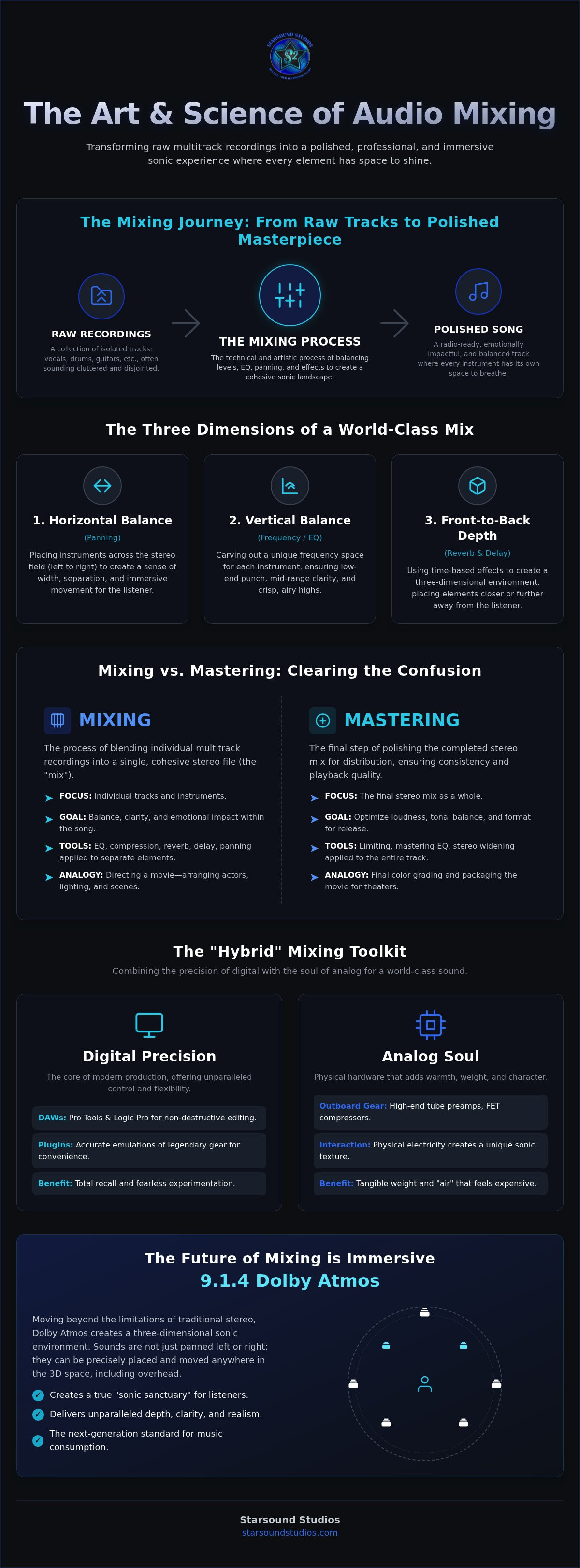
We approach every project through three distinct dimensions to ensure your work reaches its highest potential. Horizontal balance involves panning, where we place instruments across the stereo field to create a sense of width and movement. Vertical balance is about frequency management. We use EQ to carve out a unique space for every instrument, ensuring the low-end is punchy while the high-end remains crisp and airy. Finally, we establish front-to-back depth. By utilizing time-based effects like reverb and delay, we place the listener in a specific environment. This creates a sonic sanctuary where the music feels three-dimensional rather than flat and static.
The Role of the Mixing Engineer
A professional engineer at Starsound Studios acts as a collaborative mentor rather than a mere service provider. When you've spent weeks tracking a song, it's easy to lose perspective. You might obsess over a minor guitar flourish while missing the fact that the vocal is buried. Steve "The Mix" provides those essential objective ears. We translate your emotional cues into precise technical adjustments. If you want a track to feel "aggressive" or "dreamy," we know exactly which compressor or saturation tool will achieve that result. This partnership ensures the technical details are handled with absolute precision, leaving you free to focus on the spirit of your creation.
The Modern Mixing Toolkit: From DAWs to Analog Soul
The landscape of record production has shifted dramatically. Decades ago, what is audio mixing was defined by massive analog consoles and miles of copper cable. Today, the process is more streamlined but no less complex. We utilize a "Hybrid" approach that captures the best of both eras. It pairs the surgical precision of digital editing with the harmonic richness of analog soul. This synergy allows us to maintain absolute control over every transient while injecting the warmth that makes a record feel alive.
Digital Audio Workstations (DAWs)
Pro Tools and Logic Pro serve as the command centers of our facility. These platforms act as the central hub for modern production, offering non-destructive editing and total recall. This means every creative decision is reversible, allowing for fearless experimentation during the mix. When considering what is audio mixing, the software is merely the medium for your message. Whether you are getting started with mixing or are a seasoned artist, the DAW is your essential canvas. While software is powerful, the skill of the engineer remains the primary variable. A world-class tool is only as good as the professional wielding it.
Plugins vs. Outboard Gear
Modern software plugins are incredible for their convenience. They emulate legendary compressors and EQs with startling accuracy, providing instant access to virtual gear that once required a massive physical footprint. However, physical outboard gear still provides a unique energy that code cannot fully replicate. Running a lead vocal through a high-end tube preamp or a drum bus through a physical FET compressor adds a tangible weight and "air" to the signal. This physical interaction with electricity creates a sonic texture that feels expensive and polished.
At Starsound Studios, we don't believe in choosing sides. We embrace the "Hybrid" workflow by using digital tools for surgical cleaning and analog hardware for character and spirit. This commitment to using the best of both worlds ensures your project achieves a world-class result that translates perfectly across all listening systems. If you're ready to hear your tracks through our high-end signal chain, our stereo mixing services are designed to bring that professional edge to your music.
The Four Pillars of a Professional Mix
A great record is built on a solid architectural foundation. While the technical definition of what is audio mixing involves combining tracks, the reality is far more nuanced. It is an intentional construction of sound where every element serves the song's emotional core. We begin this process with level balancing. This is the most critical pillar. If the relative volumes between the kick drum, the vocal, and the guitars aren't dialed in, no amount of expensive processing can save the track. It's about finding the "pocket" where the rhythm section supports the melody without overshadowing the artist's message.
Equalization (EQ) and the Sonic Spectrum
EQ is our primary tool for carving out a unique space for every instrument within the frequency spectrum. We focus on cleaning up "mud" in the low-mids, typically the 200Hz to 500Hz range, where guitars and keyboards often clash. We also address harshness in the high frequencies to ensure the listen is smooth and inviting. We prioritize subtractive EQ, cutting away unnecessary frequencies before we ever consider a boost. This prevents "frequency masking," a common phenomenon where one sound hides another because they share the same sonic real estate. By giving each element its own window, the entire mix gains immediate clarity.
Dynamics: Compression and Limiting
Dynamic control is about both consistency and impact. We use compression to tame erratic vocal performances, ensuring every syllable is heard clearly without the listener needing to touch the volume knob. It acts as the "glue" that binds disparate tracks together into a cohesive unit. For drums, we use it to add "snap" and "weight" to the transients. One of our signature techniques is parallel compression. By blending a dry, natural signal with a heavily compressed version, we achieve a modern, high-energy sound that retains its natural spirit while feeling massive and powerful.
Space and Time: Reverb, Delay, and Modulation
Spatial processing adds a three-dimensional depth that draws the audience into your sonic sanctuary. We use reverb to create a sense of place, whether it's an intimate room or a vast cathedral. Delays are essential for adding rhythmic complexity and vocal "slap" that adds character. We focus on the relationship between width and depth. By carefully placing effects, we make a mix feel wider than the speakers themselves. This holistic approach defines what is audio mixing at Starsound Studios, where we use our professional ears to ensure your music has the impact it deserves.
Mixing vs. Mastering: Clearing the Confusion
One of the most frequent questions we encounter in our creative sanctuary is the distinction between these two final stages of production. While they're often grouped together, they represent entirely different objectives and technical mindsets. To understand what is audio mixing in its proper context, you must view it as the microscopic work. It's the painstaking process of ensuring the vocal sits perfectly against the snare and the synths don't crowd the guitars. Mastering, conversely, is the macroscopic perspective. It's the final lens through which your entire project is viewed, ensuring it sounds world-class whether it's played in a club or on a smartphone. For a deep dive into that final stage, explore our Professional Audio Mastering in Cleveland: The Ultimate Guide (2026).
A successful record relies on a healthy hand-off between these two phases. You simply cannot achieve a competitive master if the underlying mix is cluttered or distorted. This is why what is audio mixing is often considered the most transformative stage of the entire production. It's where the individual tracks are molded into a cohesive story. If the mix is right, mastering becomes an exercise in enhancement rather than repair. We offer integrated mixing and mastering services to ensure this transition is flawless, maintaining the spirit of your vision from the first fader move to the final export.
The Hand-off: Preparing for the Final Polish
A seasoned mixing engineer provides the mastering engineer with "headroom," which is essentially sonic breathing room. This involves keeping the peak levels of the final bounce well below the digital ceiling, typically around -6dB. This technical discipline allows the mastering stage to enhance the track's energy without introducing artifacts. The final bounce must be delivered in high-resolution formats, such as 24-bit or 32-bit WAV files, to preserve every ounce of fidelity. This precision ensures that the final polish adds the necessary weight and air without compromising the mix's integrity.
Key Differences at a Glance
The mindsets required for these stages are distinct. Mixing is about creation and character; mastering is about correction and consistency. While some engineers do both, they require different monitoring environments and a fresh set of objective ears for the best results.
- Mixing: Focuses on balance, clarity, emotion, and individual instrument detail.
- Mastering: Focuses on consistency, loudness, formatting, and final tonal balance.
Ready to experience the difference a professional touch makes? Book our Stereo Mixing services today to build the foundation your music deserves.
The Future of Mixing: From Stereo to Dolby Atmos
The sonic landscape is shifting beneath our feet. For decades, the industry standard was limited to the left and right speakers. However, stereo is no longer the final frontier for serious artists. We're entering a new era where the listener isn't just watching the music; they're standing inside it. This immersive revolution represents the most significant leap in what is audio mixing since the transition from mono. At Starsound Studios, we've embraced this future as Ohio's first Dolby-certified 9.1.4 Atmos studio. It's a technical feat that allows us to place sounds above, behind, and around the audience, creating a visceral experience that a standard stereo file simply cannot match.
What is Immersive Audio Mixing?
Immersive mixing moves beyond the traditional 180-degree plane to a full 360-degree sound field. In a 9.1.4 system, we utilize nine ear-level speakers, one subwoofer, and four overhead speakers to build a truly three-dimensional environment. This isn't just a gimmick for film soundtracks. Major streaming platforms like Apple Music and Tidal have prioritized Atmos, making it an essential format for artists who want to stay competitive. To learn more about this process, read The Definitive Guide to Dolby Atmos Mixing in Cleveland. It's about giving your fans a sanctuary of sound where they can lose themselves in your art.
Why Professional Mixing Matters in 2026
The barrier to entry for music production has never been lower, but the gap between a "home mix" and a professional studio result has never been wider. While home setups are great for sketching ideas, they often lack the tuned acoustic environment required for accurate decision-making. You can't fix what you can't hear. Professional what is audio mixing relies on a room that's been surgically treated to eliminate standing waves and frequency buildup. This accuracy ensures your mix translates perfectly from high-end headphones to car speakers, which can be further optimized by mobile electronics experts like Music In Motion.
Starsound Studios provides the sonic sanctuary your music deserves. We offer a high-energy, creative environment where the science of the medium meets the spirit of your creation. By trusting your project to a facility with a certified 9.1.4 suite and seasoned ears like Steve "The Mix," you're ensuring your work reaches its highest potential. It's the difference between a song that sounds "good for a demo" and a record that commands attention on a global stage, whether broadcast through ReliaStream or featured on major streaming platforms.
Transform Your Sound into a Sonic Masterpiece
Your music deserves a space where technical precision meets creative soul. We've explored how what is audio mixing serves as the vital bridge between a raw, unpolished recording and a world-class release. From carving out frequency space with surgical EQ to building a deep, three-dimensional soundstage through 9.1.4 immersive audio, the process is about more than just volume. It's about ensuring your unique identity shines through every speaker with clarity and emotional impact. Don't settle for "good enough" when your vision has the potential to be legendary.
At Starsound Studios, we provide the expert ears and high-end environment your art requires. As Ohio's first and only Dolby-certified Atmos studio, we combine Steve "The Mix's" expertise with cutting-edge 9.1.4 capabilities to transform your tracks. Whether you're seeking classic stereo clarity or the future of immersive sound, your work is in passionate, professional hands. We treat every project as a collaborative journey toward excellence.
Ready to elevate your sound? Book a mixing session at Starsound Studios today. Your masterpiece is waiting to be heard. Let's create something truly unforgettable together.
Frequently Asked Questions
Is audio mixing the same as mastering?
No, mixing and mastering are two distinct stages of the production cycle. Mixing involves balancing individual tracks like vocals, drums, and guitars to create a cohesive song. Mastering is the final step that treats the completed stereo file to ensure it sounds consistent and professional across all playback systems. While mixing focuses on the internal relationships of a song, mastering provides the final competitive polish and loudness.
How long does it typically take to mix a single song?
A professional mix usually takes between four and eight hours to complete. This timeline depends heavily on the track count and the complexity of the arrangement. A simple acoustic ballad might be finished quickly, while a dense pop or rock production with over one hundred tracks requires more time for surgical EQ and automation. We prioritize precision to ensure every element sits perfectly in the sonic sanctuary we build for your music.
Can I mix my own music at home, or do I need a pro?
You can certainly mix at home, but a professional engineer provides objective ears and a high-end acoustic environment. Home setups often suffer from frequency build-ups that lead to inaccurate decisions. A pro brings years of experience and specialized outboard gear that adds a level of clarity and impact that's difficult to achieve alone. Partnering with a mentor ensures your tracks reach their highest potential without the guesswork of a DIY approach.
What files do I need to send to a mixing engineer?
You should provide individual WAV or AIFF multitrack files, often called stems, at the original sample rate and bit depth. It's crucial to ensure all tracks are consolidated so they start at the exact same point in time. Remove any non-essential processing like basic EQs or compressors, but keep any effects that are vital to the sound's character. This clean hand-off allows the engineer to focus on what is audio mixing: building a professional balance from the ground up.
What is a 'rough mix' and why is it important?
A rough mix is a basic balance of the song that you've created during the recording process. It serves as a vital creative reference for the engineer by showing your intended hierarchy and emotional goals. While the final mix will sound much more polished, the rough mix communicates which elements you feel are most important. It's the starting point for our collaborative journey, ensuring the final result remains true to your original vision.
How much does professional audio mixing cost in 2026?
Professional mixing rates vary based on the engineer's experience and the studio's technical capabilities. Some engineers charge a flat fee per song, while others work on an hourly basis. Because every project has unique needs, from track count to the desired immersive format, it's best to contact a studio directly. This allows you to receive a tailored quote that reflects the specific technical requirements and creative spirit of your music.
Does mixing involve fixing out-of-tune vocals?
Vocal tuning is generally considered a separate editing task that happens before the mixing stage begins. While many engineers are experts in pitch correction software, it's often billed as an add-on service. It's always a good idea to discuss vocal editing during your initial consultation. This ensures the engineer can focus their energy on the creative balance and sonic impact of the track once the performances are perfectly tuned and timed.
Can you mix a song that was recorded in a home bedroom?
We can definitely mix tracks recorded in a home environment. A significant part of what is audio mixing involves using professional tools to clean up the limitations of a home recording, such as room resonances or technical noise. While a professional recording environment is ideal, our high-end signal chain and tuned room can add the weight and air your home tracks might be missing. We transform your raw captures into a radio-ready record.


