

What if the most expensive microphone in your locker isn't the reason your vocals sound thin and distant? It's a common frustration for artists to pour their raw soul into a performance only to hear a boxy, sibilant result that lacks that elusive radio-ready sheen. You know the talent is there, but the translation from the booth to the monitors feels like it's losing its magic. Mastering professional vocal recording tips is about more than just gear; it's about the delicate synergy between psychological comfort and technical excellence.
This guide will help you bridge the gap between a simple demo and a world-class masterpiece. You'll learn to command the technical precision of high-end signal chains while cultivating the artistic mindset required for studio excellence. Precision matters. Energy is everything. We're going to break down everything from taming excessive room noise to maintaining consistent performance energy throughout a long session. By the end, you'll have the confidence to produce clear, upfront tracks that stand out in any mix. Let's explore the holistic process of turning your vision into a polished, professional result that reflects your unique identity.
Key Takeaways
- Understand how the psychological atmosphere of your recording space directly influences the pitch, timing, and emotional depth of your performance.
- Discover essential professional vocal recording tips for matching your voice to specific microphone diaphragms and high-end preamps for a radio-ready sound.
- Master the physical art of mic technique, using distance and the proximity effect to shape your frequency balance before the signal ever reaches your DAW.
- Explore the technical requirements for tracking vocals in immersive 9.1.4 environments, where the balance between dry takes and room character is critical.
- Learn why moving beyond a home setup to a professional, mentor-led facility provides the technical precision and vocal clarity your project deserves.
The Psychology of a Professional Vocal Session
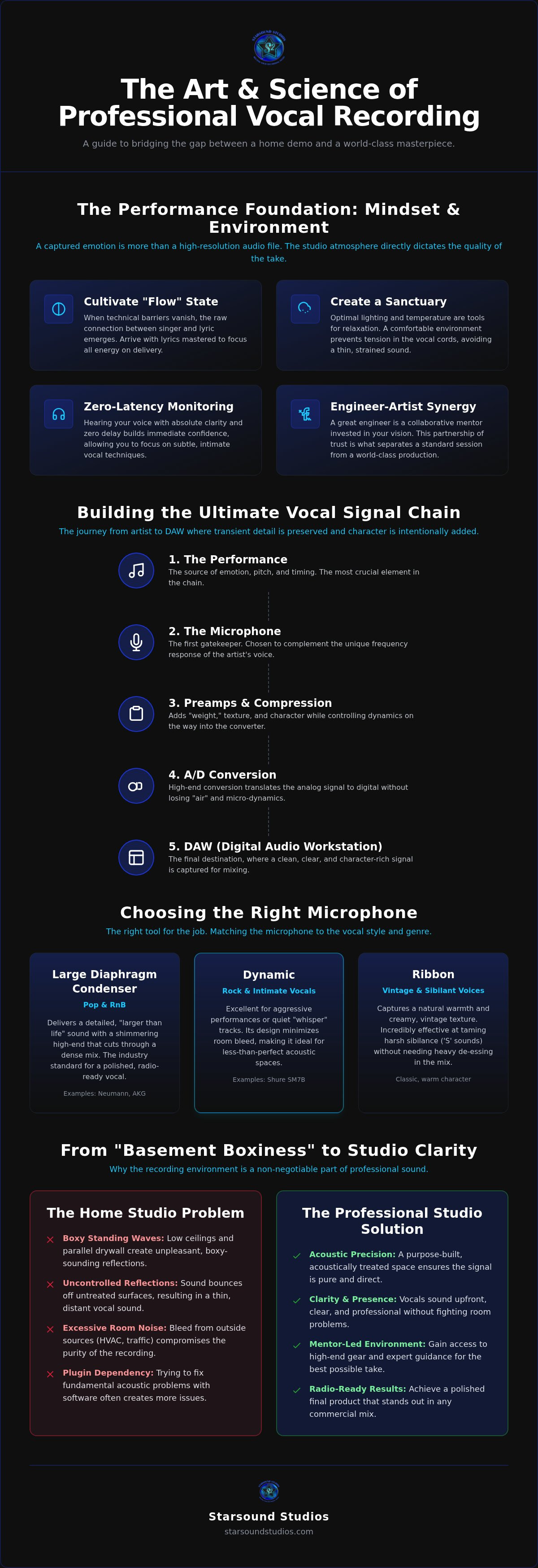
A professional vocal recording is more than a high-resolution audio file. It is a captured emotion; a singular moment in time where technique and feeling collide. When you step into the booth, you aren't just providing data for a DAW. You are translating a vision. Understanding this shift in perspective is one of the most vital professional vocal recording tips for any serious artist. If the performance lacks soul, no amount of elite processing can manufacture it later. The goal is to reach a state of "flow" where the technical barriers vanish, leaving only the raw connection between the singer and the lyric.
The atmosphere of a studio directly dictates the quality of the take. Stress and self-consciousness are the ultimate enemies of perfect pitch and fluid timing. Tension in the body leads to tension in the vocal cords, resulting in a thin, strained sound. Preparation rituals should extend far beyond drinking tea or honey. True mastery involves arriving with a deep, internal command of the lyrics and a clear mental focus. When you don't have to worry about what line comes next, you can dedicate your entire energy to how that line is delivered.
Creating a Creative Sanctuary
At Starsound Studios in North Royalton, we believe the environment is a physical extension of the instrument. Lighting and room temperature are not mere afterthoughts; they are tools for relaxation. A room that is too cold can cause muscles to constrict, while harsh lighting can make an artist feel exposed rather than inspired. We prioritize an artist-centric atmosphere that feels like a sanctuary, allowing you to take risks without fear. A critical component of this comfort is a zero-latency headphone mix. Hearing yourself with absolute clarity and zero delay builds immediate confidence, allowing you to focus on subtle vocal mic techniques that bring intimacy to the track.
The Engineer-Artist Synergy
The relationship between an artist and an engineer should be one of collaborative mentorship. You aren't just hiring someone to press "record." You're partnering with an expert who is just as invested in the final product as you are. A professional engineer provides real-time feedback that serves as the fastest route to a better take. This synergy is built on trust. You need to know that when they ask for "one more," it isn't because the last one was bad, but because they see the potential for something legendary. Effectively communicating your sonic vision using descriptive, sensory words helps your engineer dial in the right textures, ensuring the technical signal chain supports your artistic intent perfectly. This level of partnership is what separates a standard session from a world-class production.
Building the Ultimate Vocal Signal Chain
Capturing world-class vocals requires a signal chain that respects the artist's unique frequency response. It isn't just about spending money on gear. It's about intentional matching. One of the most overlooked professional vocal recording tips is understanding that the microphone is merely the first gatekeeper. The journey from the artist's lips to the digital audio workstation involves multiple stages where transient detail can either be preserved or lost. Achieving professional sounding vocals requires a transparent path that adds character without sacrificing clarity. This is especially true when trying to overcome the "Cleveland Basement" effect, where low ceilings and parallel drywall create boxy standing waves that no plugin can truly fix.
Professional A/D conversion also plays a massive role in this chain. High-end interfaces ensure that the subtle nuances of a performance, the breath, the "air," and the micro-dynamics, aren't blurred during the translation to digital. In a controlled facility like Starsound Studios, we replace those basement echoes with acoustic precision, ensuring the signal is pure before it ever hits a preamp.
Choosing the Right Microphone
Large Diaphragm Condensers are the industry standard for Pop and RnB because they offer a detailed, "larger than life" sound. Brands like Neumann or AKG excel here, providing a shimmering high-end that sits perfectly in a dense mix. However, a condenser isn't always the answer. Dynamic mics, such as the SM7B, are incredible for aggressive rock vocals or intimate, "whisper" style tracks where you want to minimize room bleed. For those seeking a creamy, vintage texture, Ribbon mics capture a natural warmth that tames harsh sibilance without the need for heavy de-essing later.
Preamps and Compression on the Way In
The preamp is where you add "weight" and "expensive" texture to the recording. You generally choose between two flavors: the "British Sound" or the "American Sound." British-style preamps, often modeled after Neve designs, provide thick, harmonic saturation that makes a vocal feel grounded and lush. American-style preamps, like those from API, offer a punchy, fast, and mid-forward response that helps a singer cut through a rock or country arrangement.
Smoothing out peaks with outboard compression during tracking is another secret to a polished sound. Using a classic optical compressor like an LA-2A provides a gentle, musical leveling that makes the artist's voice feel consistent. This gain staging is critical. You want a healthy signal that peaks around -6dB to -10dB to ensure you have plenty of headroom for the mix. If you're tired of fighting with home-studio limitations, booking time for professional recording and mixing in a mentor-led environment can instantly elevate your sonic identity.
Vocal Mic Technique: Capturing the Perfect Take
Stepping in front of a high-end microphone is a physical act. It requires more than just standing still and singing. One of the most effective professional vocal recording tips involves treating the distance between your mouth and the capsule as a dynamic control. In a professional environment, you aren't just a performer; you're an operator of a precision instrument. Mastering this interaction ensures that the engineer captures a take that is already 90% mixed before it even hits the computer. Precision in the booth saves hours in the edit.
A shift of just two inches can radically alter the frequency balance of your track. Close-up placement captures every nuance of the breath and mouth clicks, which can be desirable for intimate genres. However, it also risks an unnatural buildup of low frequencies. Conversely, backing away allows the voice to bloom and sound more natural, though it introduces more of the room's character. Managing sibilance, those harsh "S" and "T" sounds, is another crucial skill. A secret weapon is off-axis recording. By rotating the microphone slightly (about 10 to 15 degrees) so you aren't singing directly into the center of the diaphragm, you can soften sharp transients without losing high-end clarity.
Mastering the Proximity Effect
Directional microphones naturally boost bass frequencies as the sound source moves closer. This is known as the proximity effect. It's a powerful tool for modern pop and RnB. Leaning in during a verse creates an intimate, "in-your-ear" feel that resonates with listeners. It adds a sense of weight and authority to the performance. However, you must be careful. Failing to pull back during a high-energy chorus can lead to a "boxy" sound that clutters the low-mids. Learning when to lean in and when to give the mic space is the hallmark of a seasoned pro.
Advanced Mic Placement Tactics
Try the "Height Hack" to refine your tone. Angling the microphone slightly downward toward the mouth can reduce excessive chest resonance, which is helpful for singers with naturally deep or "boomy" voices. For those seeking complex textures, a "Two-Mic" approach uses a large-diaphragm condenser for detail and a dynamic mic for grit. This level of technical nuance is why elite recording studios are essential for artists who have outgrown their home setups. Proper pop filter placement is also vital. Keep the filter three to four inches from the mic to manage plosives like "P" and "B" sounds without muffling the high frequencies. These small adjustments make the difference between a demo and a masterpiece.
Tracking Vocals for Dolby Atmos and Immersive Audio
Immersive audio has fundamentally shifted the architecture of vocal production. It's no longer just about left and right. It's about height, depth, and the space behind the listener. To succeed in this 3D environment, your professional vocal recording tips must evolve. In a 9.1.4 system, the lead vocal often remains anchored in the center, but the "space" around it becomes a canvas for creative exploration. Capturing a crystal-clear "dry" vocal is the priority, but recording a secondary "room" mic can provide the organic textures needed for Atmos object placement. This approach allows the engineer to manipulate the vocal's position without it feeling detached from the song's emotional core.
Phase coherence is critical when using multiple microphones to capture this immersive character. Even a slight misalignment between a close mic and a room mic can cause frequency cancellations that weaken the vocal's impact. This is where the technical precision of a high-end facility pays off. Starsound’s Dolby-certified suite in North Royalton provides the exact monitoring environment required to hear these micro-details. Precision matters. Energy is everything. You need to know that your source audio is robust enough to survive the translation into a three-dimensional field.
Vocal Layering in the 3D Space
Recording for Atmos allows you to place harmonies in the "height" channels, creating a towering wall of sound that stereo simply cannot replicate. This requires a different approach to doubling. Every layer must be tracked with absolute cleanliness. Excessive room noise or sibilance becomes much more obvious when a vocal is isolated as an "object" in the 3D field. Utilizing a high-resolution audio format aiff ensures that these layers retain their transient detail and frequency range during the complex immersive mixing process. Cleaner takes lead to more expansive mixes.
Immersive Reverb and Ambience
In the immersive world, "baked-in" effects are often a hindrance. If you record with heavy reverb, you lose the ability to move that vocal object freely within the room. It's better to capture the natural, controlled ambience of a dedicated facility. This allows the engineer to place the vocal in a virtual space that feels grounded and real. Preparing for a session at a dolby atmos studio cleveland means focusing on the purity of the take. Let the 9.1.4 environment handle the "where," while you focus on the "what."
Ready to hear your voice in 3D? Book your immersive tracking session at Starsound Studios and step into the future of sound.
The Starsound Advantage: Elevating Cleveland’s Sound
Moving from a home setup to a professional facility is the definitive turning point for any serious artist. While home recording has become more accessible, it often hits a ceiling regarding acoustic accuracy and signal purity. Starsound Studios provides the technical firepower and creative sanctuary required to break through that barrier. In our North Royalton facility, you aren't just getting professional vocal recording tips; you're gaining access to a world-class signal chain featuring Neumann microphones and Avalon preamps. This is where the science of audio meets the spirit of your performance. Every session acts as a collaborative masterclass, led by engineers who are as invested in your sonic identity as you are.
The leap to a pro studio isn't just about the gear. It's about the mentorship. When you step into our space, you're entering a dedicated environment designed to minimize distractions and maximize inspiration. We handle the technical precision, the gain staging, and the phase coherence, so you can focus entirely on the emotion of the take. This synergy between artist and engineer is what transforms a simple vocal file into a compelling musical statement.
From Tracking to the Final Master
Our holistic approach ensures that your vision remains intact from the first breath to the final playback. We take your raw vocal and refine it through elite mixing and mastering services to ensure every syllable sits perfectly in the pocket. While tracking is the foundation, professional mastering is the essential final step that provides the competitive loudness and tonal balance required for modern streaming platforms. As Ohio’s only Dolby-certified 9.1.4 Atmos environment, we offer a sonic experience that goes beyond stereo, placing your voice in a three-dimensional field that truly surrounds the listener. Precision matters. Energy is everything.
Ready to Capture Your Best Performance?
Preparation is the key to studio efficiency. When you book your session, come prepared with your lyrics, any necessary stems, and a clear idea of your sonic references. This allows us to spend more time experimenting with textures and less time on basic setup. We're here to help you reach your highest potential, providing the grounded assurance that every technical detail is handled with absolute precision. Your unique identity is our priority, and we're excited to help you share it with the world. Book your professional vocal recording session at Starsound Studios today!
Step Into the Future of Your Sound
Capturing a world-class performance requires more than just a quiet room. It demands a deliberate blend of psychological comfort, technical mastery, and elite hardware. By implementing these professional vocal recording tips, you've already taken the first step toward transforming your raw takes into radio-ready masterpieces. Whether you're mastering the proximity effect or tracking for a three-dimensional immersive mix, the goal remains the same: capturing the soul of the artist with absolute clarity. Precision matters. Energy is everything.
At Starsound Studios, we provide the ultimate creative sanctuary in North Royalton. As Ohio's only Dolby-certified Atmos studio, our 9.1.4 Immersive Audio Suite offers a sonic experience that home setups simply can't match. You'll benefit from mentor-led sessions with Steve 'The Mix', ensuring every technical detail is handled with precision while you focus on the art. Don't settle for "good enough" when excellence is within reach. Elevate your sound, Book a session at Starsound Studios. We're ready to help you reach your highest potential and share your unique identity with the world.
Frequently Asked Questions
What is the best microphone for recording professional vocals at home?
The best microphone for your home setup depends largely on your room's acoustic treatment. A large diaphragm condenser, such as an AKG C214, offers excellent clarity for pop and RnB in treated spaces. If your room is untreated, a dynamic mic like the Shure SM7B is often better at rejecting unwanted background noise. These are essential professional vocal recording tips for those building a starter setup. Always match the mic's frequency response to your specific vocal character.
How do I stop my vocals from sounding 'boxy' or 'roomy'?
Boxy vocals are usually caused by small rooms with parallel drywall that creates muddy frequency buildups. To stop this, use acoustic panels or heavy blankets to dampen reflections around the singer. If you can't treat the room, move the microphone away from the center of the space and closer to the vocalist. Recording in a professional facility like Starsound Studios eliminates this issue entirely. Our North Royalton suite provides a transparent, upfront sound without those distracting basement echoes.
Do I need to use a pop filter for every vocal recording?
You should use a pop filter for almost every session involving a sensitive condenser microphone. It stops the "P" and "B" plosives from hitting the capsule and causing low-end distortion. While some dynamic mics have internal protection, an external filter adds an extra layer of safety. This small tool saves hours of tedious editing during the mixing process. It also helps the singer maintain a consistent and safe distance from the microphone capsule.
What is the ideal distance from the microphone for a singer?
The ideal distance is typically 6 to 8 inches from the capsule for a balanced, natural tone. For intimate, modern pop tracks, you might lean in to about 2 or 3 inches to utilize the proximity effect for extra warmth. Conversely, pull back during high-energy choruses to avoid overloading the preamp or creating boxy frequency buildups. Mastering this physical movement is one of the most practical professional vocal recording tips for achieving a polished, radio-ready take.
Can you fix a bad vocal recording in the mix?
You cannot truly fix a bad recording during the mixing stage. Modern tools like pitch correction and spectral editing can help, but they can't manufacture the emotional depth of a great performance. A recording with excessive room noise or poor gain staging will always sound amateur regardless of the processing used. The goal is to capture a world-class performance at the source. This ensures the mixing stage is about creative enhancement rather than damage control.
This philosophy of capturing quality at the source is universal, whether you are recording music or spoken word. For creators who want to see how these professional standards are applied to digital broadcasting, check out Podcast Zurich for examples of high-end audio and video podcasting services.
How much does a professional vocal recording session cost in Cleveland?
Costs for a professional session in the Greater Cleveland area vary based on the studio's equipment and the engineer's level of expertise. High-end facilities with Dolby certification or elite signal chains typically reflect that value in their hourly or project rates. It's best to check individual studio websites or contact them directly for current pricing information. Investing in a mentor-led session ensures you get the highest quality results and the most value out of your studio time.
What should I drink before a vocal recording session to stay clear?
Stick to room temperature water or warm herbal tea with honey to keep your vocal cords hydrated and relaxed. These options help soothe the throat without causing the excessive mucus buildup associated with dairy products. Avoid caffeine, which can dry out your throat, and stay away from ice-cold drinks. Cold liquids can cause your vocal muscles to constrict. This makes it significantly harder to perform with the fluid timing and pitch accuracy required for a professional session.
Is it better to record vocals with or without effects like reverb?
It's almost always better to record your vocals "dry" to ensure maximum flexibility during the mixing process. Recording with permanent reverb or delay limits your ability to move the vocal in a 3D space later. However, you should definitely use these effects in your headphone monitor mix during the session. Hearing a bit of reverb can boost your confidence and help you stay in pitch. Just make sure those effects are for monitoring only and aren't committed to the final audio file.


