

What if your listeners weren't just hearing your song, but were actually standing inside the heartbeat of your arrangement? It's a question that defines the modern production landscape. For decades, we've lived in the flat, two-dimensional world of left and right. Now, the industry is shifting toward a 360-degree reality that feels less like a recording and more like a physical environment. You might worry that your music will sound thin or lose its impact when translated to an immersive space. It's a valid concern, especially when the technical jargon of ADM files and object-based panning starts to cloud the creative vision.
We understand that every note you record is a piece of your identity. Deciding between stereo vs dolby atmos mixing isn't just a technical choice; it's a strategic move for your legacy. This guide will show you how to navigate this transition with confidence. We'll explore the tangible ROI of Atmos, how to manage the costs of high-end engineering, and the specific ways immersive audio can elevate your genre. By the end, you'll know exactly how to future-proof your masters and ensure your work resonates with the depth and clarity it deserves in 2026 and beyond.
Key Takeaways
- Grasp the fundamental shift from balancing two channels to placing audio objects in a 3D environment when weighing stereo vs dolby atmos mixing.
- Learn how object-based audio future-proofs your catalog by translating your creative vision perfectly to any speaker configuration or spatial headphones.
- Determine if your specific genre thrives in an immersive soundstage or if the purist stereo approach better serves your artistic intent.
- Gain a clear checklist for session preparation, focusing on consolidated stems and raw signals to maximize the depth of your final immersive master.
- Understand the value of partnering with a Dolby-certified studio to ensure your project meets rigorous industry standards for fidelity and impact.
Defining the Soundstage: Stereo vs. Dolby Atmos Basics
Audio evolution isn't just about higher bitrates or cleaner preamps; it's about how we perceive space. For decades, the conversation around stereo vs dolby atmos mixing was confined to high-end cinema or experimental galleries. Today, that boundary has dissolved. As we move through 2026, spatial audio has transitioned from a luxury add-on to a streaming requirement. Listeners no longer want to just hear a performance. They want to be enveloped by it. While stereo provides a beautiful, curated window into a song, Atmos invites the listener to step through that window and into the room with the artist.
The fundamental difference lies in the architecture of the soundstage. Traditional mixing relies on a fixed perspective where every element must fight for real estate between two speakers. If a vocal is too loud, it masks the snare. If the guitars are too wide, the center feels empty. Immersive mixing breaks these chains, allowing sounds to exist as independent objects in a three-dimensional sphere. This shift solves the "sweet spot" problem that has plagued hi-fi enthusiasts for years. In a stereo setup, moving a few inches to the left ruins the image. With the intelligence of an immersive render, the mix scales across devices to maintain its emotional impact whether you're in a car or using spatial headphones.
The History of the Stereo Image
The two-channel format has reigned as the industry standard for over 70 years, providing a reliable framework for everything from rock anthems to jazz standards. It's a system built on the X-Y axis, using volume and timing differences to trick our brains into perceiving width. While this has served us well, it's a limited canvas for the complex, multi-layered productions of the modern era. Stereo is a fixed-perspective representation of sound. This rigidity means that once a mix is finished, its spatial layout is locked. As listening habits shift toward mobile devices and smart speakers, the limitations of this flat plane become more apparent, often leaving the music feeling "small" compared to the interactive media surrounding it.
What Makes Dolby Atmos Different?
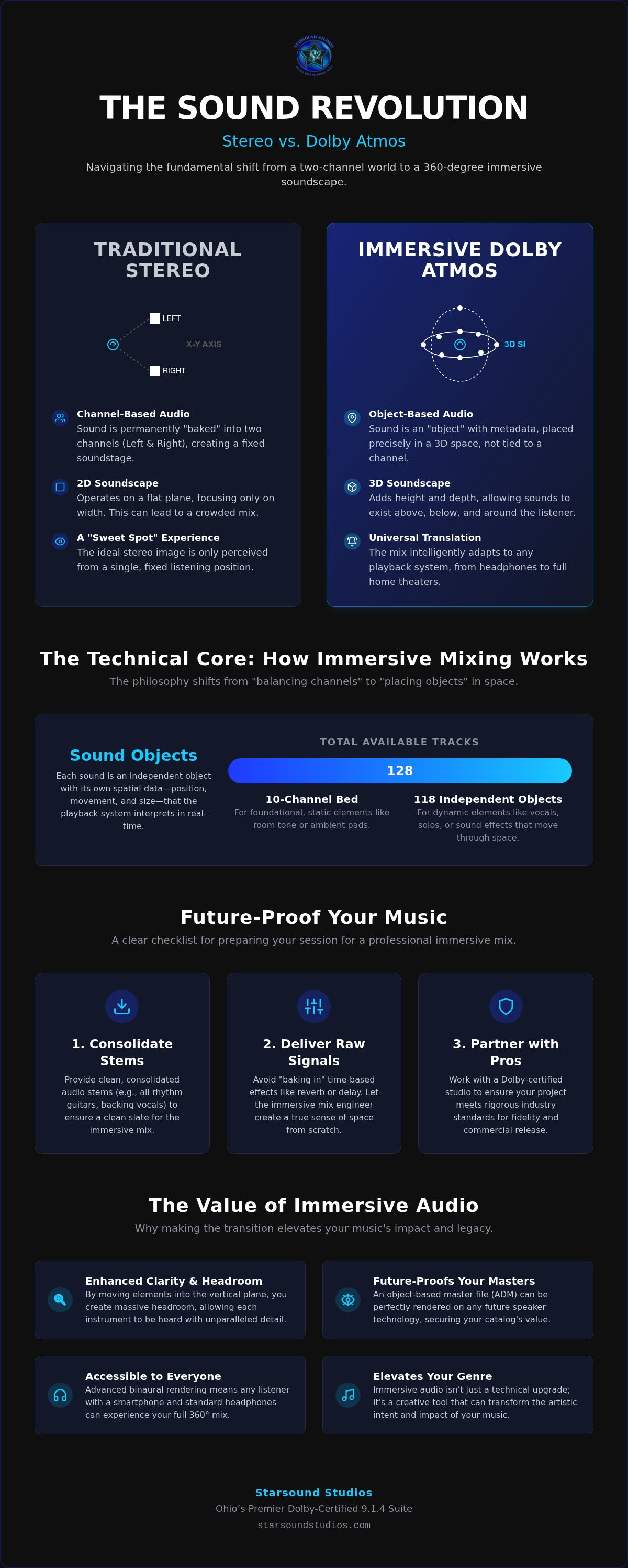
Transitioning to Dolby Atmos changes the engineering philosophy from "balancing channels" to "placing objects." Instead of routing a guitar to the left speaker, you're assigning it a coordinate in 3D space. This includes the critical addition of height channels, which provide a sense of scale that stereo simply cannot replicate. Imagine a synth pad that doesn't just sit behind the vocal but floats above the listener's head, or a percussion loop that circles the room. This isn't just a gimmick; it's a tool for clarity. By moving elements into the vertical plane, you create massive amounts of headroom for the core elements of your track. Thanks to advanced binaural rendering, this 360-degree experience translates perfectly to standard headphones, making high-end immersion accessible to everyone with a smartphone.
Channels vs. Objects: The Technical Core of Immersive Mixing
Understanding the technical shift between these formats requires a move away from the "baked-in" mindset of traditional engineering. In a standard setup, audio is tied to specific channels. If you mix a guitar to the left channel, it stays there. This is the rigid reality of channel-based audio. Whether it is a simple stereo pair or a complex 7.1 surround array, the sound is hard-wired to the speakers. If the listener lacks a specific speaker, that part of the mix is simply folded or lost. It is a system that demands the listener adapt to the technology.
Object-based audio flips this script entirely. When looking at stereo vs dolby atmos mixing, the defining factor is metadata. Instead of a fixed channel, an "object" is a piece of audio paired with spatial data. This data tells the playback system exactly where that sound should exist in a 3D room. The metadata acts as an intelligent translator, allowing the mix to scale. It doesn't matter if the listener is using a massive home theater or a pair of earbuds. The system calculates the best way to represent that object’s position in real-time, ensuring your creative intent remains intact across every device.
The Power of Sound Objects
At its core, an object is any audio track that has been uncoupled from the traditional "bed" of the mix. In a professional session, you have access to a 128-track limit. This includes a 10-channel bed for foundational elements and up to 118 independent objects. Each object possesses metadata for position, movement, and even "size." This allows a vocal to feel intimate and focused, while a cinematic synth pad can be stretched to occupy the entire ceiling. For creators looking to dive deep into the technicalities, academic research on Atmos mixing highlights the importance of the Renderer in managing these complex data streams. This level of control means you no longer have to compromise on clarity to achieve width.
The 9.1.4 Configuration Explained
Deciphering the numbers of a professional suite is essential for understanding the fidelity of your final master. A 9.1.4 system consists of nine ear-level speakers, one subwoofer for the Low-Frequency Effects (LFE), and four overhead height speakers. This specific layout is the gold standard for professional mixing suites in Cleveland. While consumer gear often uses "virtualized" Atmos to simulate height through software, nothing replaces the precision of physical drivers. At Starsound Studios, Steve 'The Mix' utilizes this 9.1.4 array to make critical engineering decisions that simply cannot be made on headphones alone. This physical environment allows for a level of depth and impact that defines a truly world-class record. When you're ready to hear your tracks translated through a world-class system, the team at Starsound Studios is ready to guide your project.
Choosing Your Format: Aesthetic and Commercial Considerations
Deciding between stereo vs dolby atmos mixing isn't a zero-sum game. Many artists fear that committing to immersive audio means abandoning the punch and familiarity of a stereo master. In reality, the most successful modern releases utilize a hybrid workflow where both versions are crafted to complement one another. While stereo remains the baseline for vinyl and traditional radio, Atmos provides the premium experience that high-end streaming platforms now prioritize. If you are looking to Get Started With Making Music in Dolby Atmos, understanding this aesthetic balance is your first step toward a world-class release.
Future-proofing your music is also a matter of financial wisdom. Recording and mixing with an immersive mindset today prevents the high cost of retroactively opening old sessions to create stems years down the line. By the time we reach the end of 2026, immersive audio will likely be the expected standard for all major label releases. Capturing that spatial data now ensures your music remains relevant and playable on the hardware of the future without requiring expensive re-mixing of your back catalog.
Does Your Genre Need Immersive Audio?
The emotional impact of spatial audio varies across genres, but its utility is universal. In acoustic and jazz recordings, Atmos recreates the physical intimacy of a live room, placing the listener at the center of the ensemble. For hip-hop and pop, spatial movement becomes a creative production tool, allowing ad-libs and textures to dance around the lead vocal. Even in rock and metal, where critics often argue for the "wall of sound" purity of stereo, Atmos offers a solution to high-density mud. By moving double-tracked guitars and orchestral layers into the height channels, you maintain the aggression of the track while uncovering hidden details that a flat stereo plane would normally crush.
The Streaming Advantage
From a commercial standpoint, the shift is undeniable. Platforms like Apple Music and Tidal have integrated spatial audio into their core identity, often giving Atmos-enabled tracks preferential placement in curated playlists. The "Spatial Audio" badge acts as a visual seal of quality, significantly increasing click-through rates among curious listeners. Beyond visibility, there are tangible financial benefits. Major streaming services have adjusted their royalty structures to favor immersive content, meaning your investment in professional mixing and mastering services can lead to higher per-stream payouts. This royalty bump is designed to encourage high-fidelity output, rewarding artists who prioritize the listener’s environment as much as the song itself.
How to Prepare Your Session for a Professional Immersive Mix
Preparing your session for an immersive environment is a fundamental departure from traditional stereo prep. It isn't just about cleaning up your edits. It's about curating a 3D environment. When you weigh the differences between stereo vs dolby atmos mixing, the success of the spatial version depends heavily on how you organize your tracks before they reach the desk. A session with 200 raw tracks can be overwhelming and counterproductive. We prefer consolidated stems that group similar instruments while leaving enough individual flexibility for spatial positioning. This meticulous organization ensures a seamless integration into our Dolby Atmos studio Cleveland workflow.
One of the most critical decisions involves your effects. Your Atmos engineer needs access to both dry signals and your creative "wet" effects. If a specific reverb or delay is part of your song's DNA, provide it as a separate stem. This allows the engineer to place the dry vocal in the phantom center while the delay trails dance in the height channels or circle the listener. This level of control is what makes a spatial mix feel intentional rather than accidental. It transforms a simple recording into a living, breathing space.
Stem Preparation Checklist
- Export full-length WAV files: Every track must start at Bar 1, Beat 1. This prevents alignment issues and keeps the emotional timing of your performance perfectly intact across the timeline.
- Isolate vocal layers: Keep your lead vocals, harmonies, and ad-libs on separate stems. Spatial audio thrives when these layers can be placed at different depths and heights within the room.
- Include reference mixes: Always provide your latest stereo bounce. It serves as a vital roadmap for the engineer to understand your intended energy, balance, and aesthetic goals.
Creative Arrangement for 3D
Arrangement decisions now have a third dimension. During the tracking phase, think about "Height" elements. Shakers, high-frequency synth pads, and ambient textures are perfect candidates for the overhead speakers. If your arrangement is too dense in the low-mids, the immersive field can feel crowded. Leaving "air" in your production allows the spatial objects to move freely without masking each other. It is often helpful to consult with a sound engineer during the tracking process to ensure your sounds are optimized for a 360-degree stage. Ready to see how your arrangement translates to a world-class 9.1.4 suite? Book your session at Starsound Studios to start the transformation.
Starsound Studios: Ohio’s Premier Dolby-Certified 9.1.4 Suite
Choosing between stereo vs dolby atmos mixing is a pivotal moment in an artist's career. It marks the transition from traditional production to a world of limitless spatial potential. While many studios offer "immersive" services using software alone, true Atmos requires a physical environment built to exacting standards. Starsound Studios in North Royalton stands as Ohio’s first and only Dolby-certified facility. This isn't just a title. It's a guarantee that the room you're mixing in meets the rigorous acoustic requirements set by Dolby's own engineers. For local Cleveland creators, this means having a world-class asset right in their backyard.
At the heart of the studio is Steve 'The Mix.' With decades of high-fidelity engineering expertise, Steve acts as a collaborative mentor for every project that enters the suite. He doesn't just push faders; he helps you realize the spatial vision of your music. Whether you're a local band or a remote artist halfway across the globe, the process is built on reliability and artistic enthusiasm. Our remote mixing services ensure that your project receives the same elite 9.1.4 treatment, regardless of your physical location. We've designed Starsound to be a creative sanctuary where the science of audio meets the spirit of creation.
The Certified Difference
Dolby certification is the bridge between your creative session and the listener's ears. When we deliver your final ADM BWF file, it carries the metadata required for flawless translation across Apple Music, Amazon Music, and Tidal. Without a certified room, you're essentially mixing in the dark, hoping the spatial cues you hear on headphones will work on a home theater system. The 9.1.4 configuration at Starsound provides a pinpoint-accurate acoustic environment where every sound object is placed with mathematical certainty and artistic flair. This precision ensures that the height, depth, and width of your mix remain consistent, protecting the emotional integrity of your work.
Book Your Immersive Experience
The shift toward immersive audio can feel daunting, but you don't have to navigate it alone. We invite local artists to tour our North Royalton facility to hear the difference for themselves. Standing in the center of a 9.1.4 array is a transformative experience that changes how you think about arrangement and production. If you're ready to move beyond the limitations of stereo vs dolby atmos mixing and embrace the future of sound, we're here to guide the way. Your music deserves the highest level of attention and technical excellence. Contact Starsound Studios for a consultation and let's discuss how to elevate your next release into a new dimension.
Step Into the Future of Sound
The journey from a flat stereo plane to a 360-degree environment is more than a technical upgrade; it is a creative revolution. We have explored how the shift from channel-based limits to object-based metadata allows your music to breathe, move, and resonate in a true 3D space. Whether you are seeking the commercial advantage of playlist visibility or the pure artistic depth of an immersive arrangement, the decision between stereo vs dolby atmos mixing will define how your work is remembered in 2026. Your music deserves a home where technical precision meets artistic spirit.
At Starsound Studios, we offer the grounded assurance that every detail of your spatial image is handled with world-class expertise. As Ohio's only Dolby-certified 9.1.4 suite led by Steve 'The Mix,' we remain a trusted sanctuary for Cleveland's top artists and creators worldwide. Don't let your vision be confined to two speakers when it can envelop the world. Elevate Your Sound with Dolby Atmos at Starsound Studios and give your listeners the experience they have been waiting for. Your highest potential is within reach.
Frequently Asked Questions
Is Dolby Atmos mixing better than traditional stereo mixing?
It isn't a matter of one being better, but rather a difference in dimension and listener intent. Stereo offers a focused, two-channel perspective that remains the standard for vinyl and traditional radio. Dolby Atmos provides an immersive 360-degree environment that adds height and depth. Choosing between stereo vs dolby atmos mixing depends on your artistic goals. Atmos allows for greater clarity in dense arrangements, while stereo maintains a classic, punchy familiarity.
Do I need special equipment to listen to a Dolby Atmos mix?
You don't need a full theater setup to enjoy immersive audio. While a 9.1.4 speaker array provides the most accurate experience, advanced binaural rendering allows listeners to hear Atmos on standard headphones. Modern smartphones and smart speakers also include built-in support for spatial audio playback. This accessibility ensures your creative vision reaches the widest possible audience without requiring them to purchase expensive high-fidelity hardware or specialized home systems.
How much more does a Dolby Atmos mix cost compared to stereo?
The investment for an immersive mix typically reflects the increased technical complexity and specialized equipment required. Because Atmos involves managing up to 128 objects in a 3D space rather than balancing two channels, the engineering process is more intensive. While costs vary based on the project's scale, many artists find the long-term ROI is significant. It future-proofs your catalog and unlocks higher royalty tiers on platforms that prioritize spatial content.
Can I mix my song in Dolby Atmos using only headphones?
You can start an immersive mix on headphones, but a professional result requires a calibrated physical room. Headphones use binaural virtualization to simulate space, which can lead to inaccurate placement decisions. A Dolby-certified 9.1.4 suite allows an engineer to hear how sounds move through actual air. This physical accuracy is essential for ensuring your mix translates correctly across all playback systems, from consumer earbuds to massive home theater configurations.
What is an ADM BWF file and why do I need it for distribution?
An ADM BWF is the master file used for Dolby Atmos distribution. Unlike a standard stereo WAV, this file contains the actual audio along with the spatial metadata for every object in your mix. Aggregators and streaming services require this specific format to ensure the playback system knows exactly where to place sounds in the listener's environment. It acts as the intelligent blueprint for your 3D soundstage during the streaming process.
Will my Atmos mix sound different on Spotify vs Apple Music?
The playback experience can vary slightly due to how each platform handles binaural rendering and loudness normalization. Apple Music uses its own proprietary spatial audio engine, while other services might use different rendering protocols. A professional engineer ensures your master is optimized for these specific variations. By adhering to strict delivery standards, we ensure your artistic intent remains consistent whether your fans are streaming on Tidal, Amazon, or Apple.
Do I have to re-record my song to get an Atmos mix?
You don't need to re-record your tracks to move into the immersive space. We can create a world-class Atmos mix using the existing stems from your stereo session. However, thinking about spatial placement during the recording phase can lead to more creative results. If you have your raw files and creative effects ready, we can uncouple those elements from the stereo plane and place them anywhere in the 360-degree field.
Why is Starsound Studios the only Dolby-certified studio in Ohio?
Achieving Dolby certification requires meeting rigorous acoustic and technical standards that most residential or project studios cannot support. From specific room dimensions to precise speaker placement and sound pressure levels, every detail is inspected by Dolby's engineering team. Starsound invested in this certification to provide Ohio artists with a world-class facility that rivals national standards. It ensures your 9.1.4 mix is accurate, professional, and ready for high-level global distribution.


