
What if your listeners didn't just hear your music, but lived inside it? For decades, the stereo field has been a flat canvas limited to a left and right speaker. But the industry is shifting; you've likely felt the pressure to keep up with these evolving standards. It's natural to feel a bit of tech fatigue when people ask, "what is dolby atmos mixing?" You might worry about complex terms like metadata or fear that your fans need a high-end home theater to appreciate the work. We understand that hesitation. Your art deserves to be heard exactly as you envisioned it, without technical barriers getting in the way.
This guide is designed to bridge the gap between your creative vision and global streaming standards. We'll show you how Dolby Atmos transforms a standard track into a three-dimensional experience that puts the listener at the center of the sound. You'll learn the vital difference between traditional channel-based audio and modern object-based audio. By the end, you'll know how to leverage this format for platforms like Apple Music and whether your next release requires a certified 9.1.4 studio environment like our suite in North Royalton. Pure immersion. No compromises. It's time to stop thinking in two dimensions and start building worlds.
Key Takeaways
- Understand exactly what is dolby atmos mixing and how it transitions your music from a flat stereo image into a fully immersive, 3D environment.
- Learn the difference between bed tracks and audio objects to gain total creative control over where every sound lives in the sonic sphere.
- Explore how immersive mixing provides superior headroom and vocal clarity, ensuring your tracks sound polished and professional on every platform.
- Master the essential preparation steps needed to organize your project stems for a seamless professional Atmos workflow.
- Determine why a certified 9.1.4 studio in the Cleveland area is the only way to guarantee your mix meets the technical rigors of global industry standards.
Beyond Two Speakers: Defining Dolby Atmos Mixing
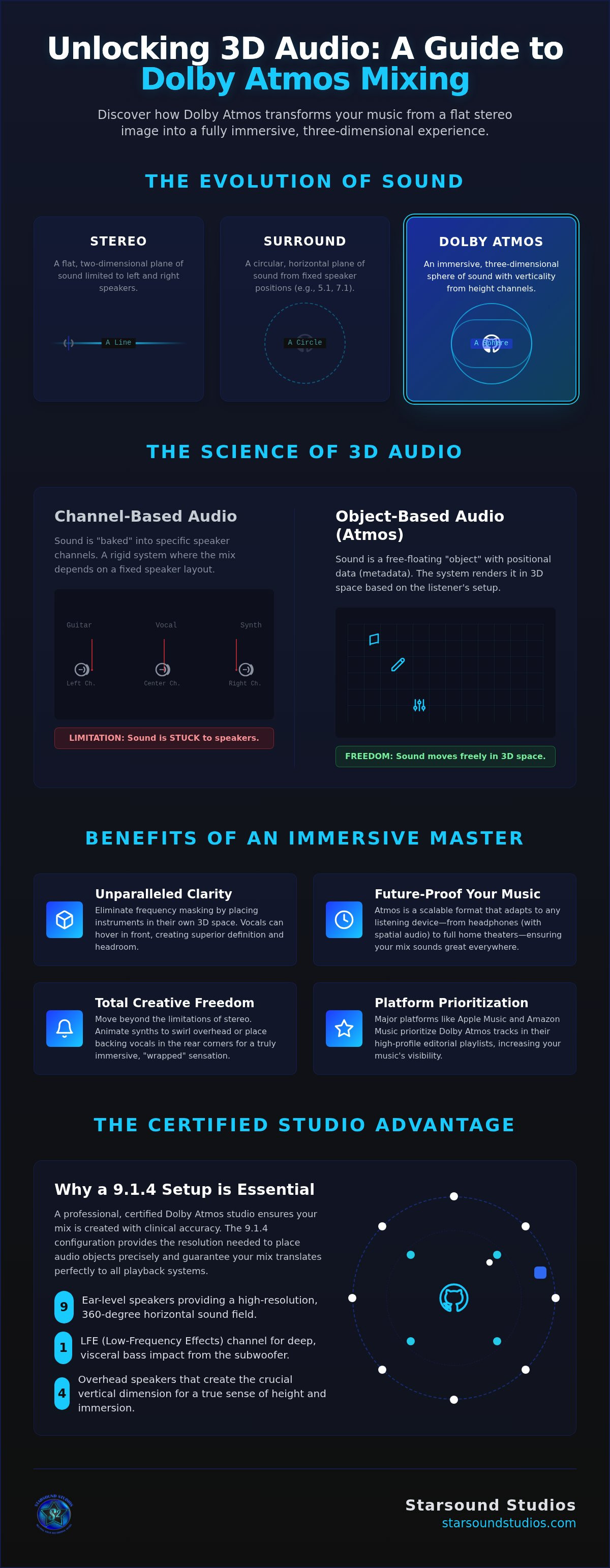
The traditional stereo image is a flat wall of sound. It's a two-dimensional plane where instruments compete for space between a left and right speaker. When you ask what is dolby atmos mixing, you're looking for the exit from that flatland. It isn't just about adding more speakers or creating a louder master. It's a fundamental shift from channel-based restrictions to an object-based freedom. You're no longer just listening to a song; you're stepping inside a sonic sphere where every instrument has its own coordinate in 3D space. This is where technical precision meets the soul of your creation.
What is Immersive Audio?
Stereo is a line. Surround sound is a circle. Immersive audio is a sphere. By introducing height channels, we unlock the "final frontier" of the soundstage. This verticality creates a sense of air and realism that stereo simply cannot replicate. Imagine a synth pad that doesn't just sit behind the vocal, but floats above the listener's head. As of August 2026, this isn't just a luxury for audiophiles. Major platforms like Apple Music and Amazon Music now prioritize Atmos tracks in their editorial playlists. To compete on a global scale, your music needs the depth and clarity that only a three-dimensional master provides. Understanding what is dolby atmos mixing means recognizing that your music is no longer tethered to a physical box.
The Evolution from Surround Sound to Atmos
Old surround formats like 5.1 or 7.1 were rigid. They relied on fixed speaker positions, meaning if your room didn't match the studio's layout, the mix fell apart. The Dolby Atmos surround sound technology solved this by introducing metadata. Instead of a sound being "stuck" in the left-rear speaker, it's treated as an independent object with instructions on where to go. This metadata tells the system exactly where to place that sound based on how many speakers are available. In a professional environment like our 9.1.4 suite in North Royalton, we have the precision to place these objects with clinical accuracy. It's a future-proof solution for a fragmented hardware market. Atmos is a scalable audio technology that adapts to the listener's hardware. Whether your fans are in a car or using spatial audio on their earbuds, the integrity of your vision remains intact.
The Science of 3D Audio: Objects vs. Channels
To truly grasp what is dolby atmos mixing, you have to look past the speakers and into the data. Unlike traditional stereo, which is "baked" into two tracks, an Atmos mix consists of two distinct layers: Bed Tracks and Audio Objects. Think of the Bed as your sonic foundation. It handles the grounded elements like the kick drum, bass, and environmental textures. These are routed to specific speaker groups. The Audio Objects, however, are the superstars of the mix. These are individual sound files that aren't tied to any speaker at all. They're free agents in a three-dimensional field.
This magic happens because of metadata. Every object carries a digital instruction manual that tells the system exactly where it should be in the room at any given millisecond. The Dolby Atmos Renderer acts as the brain of the operation. It's a sophisticated software engine that translates these instructions in real-time. It ensures that whether your listener has a full theater or just a pair of headphones, the spatial intent remains perfect. If you're ready to hear your tracks in this new dimension, our team at Starsound Studios is here to guide the way.
How Objects Transform the Mix
The creative freedom here is staggering. In a traditional stereo mix, you're constantly fighting frequency masking. If the guitars and vocals occupy the same sonic space, they clash. In an immersive environment, you can physically move the guitars to the side and hover the lead vocal three feet in front of the listener's face. This separation creates a level of clarity that was previously impossible. You can automate a synth lead to swirl above the listener's head or place backing vocals in the rear corners to create an intimate, "wrapped" sensation. It's about liberating the sound from the hardware and letting it breathe.
Understanding the Speaker Layout (9.1.4)
Precision requires the right environment. While many home setups use a 5.1 or 7.1 layout, a professional studio like ours utilizes a 9.1.4 configuration. The "9" represents the ear-level speakers, providing a high-resolution ring of sound. The "1" is the LFE (subwoofer) for that deep, visceral impact. Finally, the "4" identifies the overhead speakers that provide the essential height dimension. This specific layout offers significantly better panning resolution than a 7.1.4 setup, allowing for smoother transitions as sounds move through the room. Achieving this level of accuracy isn't a DIY task. It requires a space that is accredited for Dolby Atmos projects, ensuring the room's acoustics and speaker timing meet the industry's most rigorous standards. It's the difference between a "3D effect" and a true professional master.
Stereo vs. Atmos: Why Your Music Needs an Immersive Master
Stereo is a crowded apartment. Atmos is a sprawling estate. When you're stuck in two channels, you often have to rely on aggressive compression to make every element heard. This "loudness war" legacy frequently kills the soul and dynamics of a track. Because Atmos distributes sonic energy across a 3D field, you gain massive headroom. You don't have to squash your transients to achieve clarity. Understanding what is dolby atmos mixing starts with realizing it's about the freedom to let your music breathe. Then there is the center channel. In stereo, the vocal is a "phantom" created by the left and right speakers. In an immersive environment, the lead vocal is often isolated, giving it a physical presence and incredible intimacy. It feels like the artist is standing right in front of you.
Labels aren't just suggesting this format anymore; they're demanding it. As we move through 2026, having an Atmos version of your release is becoming a standard delivery requirement. It future-proofs your catalog for whatever hardware comes next. Creating a professional Atmos mix ensures your art remains relevant as listeners migrate toward spatial-ready devices. You're investing in the longevity of your music by meeting the quality expectations of modern streaming platforms.
Binaural Audio: The Secret to Atmos on Headphones
A common myth is that you need a room full of speakers to hear the difference. That's simply not true. Most listeners experience Atmos through binaural rendering on standard earbuds. This technology uses a Head-Related Transfer Function (HRTF) to trick the brain into perceiving three-dimensional space. It mimics how sound waves interact with your ears and shoulders in the real world. On devices like AirPods, an Atmos track feels significantly wider and deeper than a standard stereo file. During the mixing process, we carefully adjust binaural render settings to ensure that the "distance" of each object translates perfectly to headphones. This ensures your fans get the immersive experience whether they're in a car or on a subway.
The Emotional Impact of Immersion
There is an undeniable "goosebump factor" when music surrounds you. It isn't just for big EDM drops or cinematic scores. A delicate folk track can use Atmos to place the listener in the center of a quiet room, feeling every finger pluck on the strings. Conversely, a pop track can use aggressive movement to create a high-energy, psychedelic experience that keeps the listener engaged. As mixing and mastering services evolve, the focus is shifting toward this deep emotional connection. It's about more than just technology. It's about removing the barrier between the artist's heart and the listener's ear. At Starsound Studios, we treat every immersive project as a chance to redefine that connection for your audience.
The Workflow: How a Professional Atmos Mix is Built
Building an immersive master is a meticulous, multi-stage journey. It requires a blend of technical mastery and artistic intuition. When artists ask what is dolby atmos mixing in a practical sense, they're asking about the transformation of raw stems into a dynamic, three-dimensional environment. This isn't a "one-click" process. It begins with rigorous organization and ends with a high-resolution export that meets global streaming specifications. Every decision made in our North Royalton suite is designed to enhance the emotional weight of your music.
- Step 1: Preparation. We start by organizing your project into high-quality stems. Clean, well-recorded files are the lifeblood of a great Atmos mix.
- Step 2: Bed and Object Assignment. We decide which elements provide the grounded foundation (the Bed) and which elements will move freely through space as Audio Objects.
- Step 3: Spatial Panning. Using our state-of-the-art 9.1.4 suite, we place every sound with clinical precision to build your sonic world.
- Step 4: The ADM BWF Export. This is the final master file. It contains all your audio data plus the metadata that tells streaming platforms exactly how to play it back.
Preparing Your Tracks for the 3D Stage
Success starts before the first fader moves. We recommend providing dry stems alongside your stereo reference mix. Effects like reverb and delay often need to be "re-imagined" in 3D space to prevent sonic clutter. Phase coherence is also vital. In multi-mic setups, such as drum kits or piano recordings, any phase issues become glaringly obvious once sounds are panned overhead or behind the listener. If you're still in the tracking phase, check out our guide to recording studios for tips on capturing Atmos-ready audio. Ready to start your project? Book your Atmos session at our facility today and let's build something incredible.
The Role of the Dolby Atmos Renderer
The Renderer is the heart of the professional workflow. It allows the engineer to monitor the mix in 9.1.4, 5.1, and Binaural modes simultaneously. This ensures the creative intent translates across all devices. We also prioritize "fold-down" compatibility. Your mix must sound incredible on a full home theater, but it also needs to remain coherent on a mono smart speaker. Finally, we adhere to strict loudness standards. Unlike stereo mixes that often push for maximum volume, Atmos requires an integrated loudness of -18 LUFS. This provides the massive dynamic range and headroom that makes immersive audio so breathtaking. It's about quality, not just quantity. We handle the technical precision so you can stay focused on the art.
Choosing a Certified Dolby Atmos Studio in Cleveland
The rise of spatial audio has led to a flood of "DIY Atmos" attempts. However, true immersive audio requires more than just a software plugin. To achieve professional results, you need a room designed from the ground up for acoustic precision. When you truly grasp what is dolby atmos mixing, you realize it's a marriage of high-level math and creative intuition. A Dolby-certified studio undergoes rigorous vetting. This process ensures that the speaker placement, timing, and room frequency response meet the exact standards set by Dolby’s own engineers. At Starsound Studios, we provide that grounded assurance. We ensure your mix doesn't just sound good in our room, but translates perfectly to every listener's system.
As the first and only Dolby-certified Atmos mixing studio in Ohio, we've built a facility that bridges the gap between local talent and global streaming standards. Our suite isn't a sterile, corporate environment. It's a creative sanctuary. We handle the technical heavy lifting so you can stay in your flow. Whether you're a Cleveland local or an artist from across the globe, our facility is designed to elevate your sound to the highest possible level.
Inside Ohio's Premier 9.1.4 Suite
Our state-of-the-art suite in North Royalton features a 9.1.4 immersive audio configuration. This setup is the gold standard for accuracy. It provides thirteen speakers and a subwoofer to create a seamless, high-resolution sonic sphere. Working with a dedicated sound engineer like Steve "The Mix" means your project is in the hands of a seasoned expert. He understands the art of the 3D stage as deeply as the technical specifications. We invite you to experience the "Starsound difference" in person. Feel the energy of a room where every reflection is controlled and every sound has a home. It's an aspirational space built for artists who refuse to be left behind by industry standards.
Remote Atmos Mixing for Global Clients
You don't have to be in the Greater Cleveland area to benefit from our expertise. We utilize high-resolution streaming technology like Audiomovers to facilitate remote mixing sessions. This allows you to hear the mix in real-time from your own studio with incredible fidelity. The process is simple. You send us your dry stems, and we collaborate closely to build your immersive world. Once the mix is perfected, you receive a professional ADM BWF master ready for distribution. Remote mixing makes the answer to what is dolby atmos mixing accessible to creators regardless of their geography. Don't let your location limit your potential. Book your Dolby Atmos session at Starsound Studios today and transform your stereo project into a spatial masterpiece.
Step Into the Future of Three-Dimensional Sound
The music industry has moved beyond the two-channel horizon. By understanding what is dolby atmos mixing, you've taken the first step toward future-proofing your catalog and connecting with fans on a deeper, more visceral level. You now know the power of object-based audio, the intimacy of the center channel, and the necessity of a certified 9.1.4 environment to ensure your vision translates globally. Pure immersion. Total clarity. Your music is no longer a flat image; it's a living environment.
Your art deserves a space where technical precision meets a creative sanctuary. At our state-of-the-art North Royalton facility, we provide the expertise to bridge the gap between local talent and global streaming standards. Led by Steve 'The Mix', we're here to ensure your transition into immersive audio is seamless and inspiring. It's time to stop competing for space in a flat stereo field and start building three-dimensional worlds. Your listeners are waiting to step inside.
Elevate your sound with Ohio's only Certified Dolby Atmos Studio and give your audience the experience they've been waiting for. The sphere is yours to create.
Frequently Asked Questions
Do I need special headphones to hear a Dolby Atmos mix?
No, you don't need special hardware. Binaural rendering allows any standard headphones to deliver the immersive effect. By using metadata to mimic how human ears perceive space, the format ensures your fans hear the depth of your work on their existing earbuds. This universal accessibility is a core part of what is dolby atmos mixing. It's why the format is becoming the new industry standard for mobile listeners everywhere.
Can I mix Dolby Atmos at home with plugins like Logic Pro?
Softwares like Logic Pro and the Dolby Atmos Renderer, available for $299, offer native tools for spatial panning. You can certainly begin the process at home. However, a home setup can't replace a certified 9.1.4 environment. Without a physical speaker array, you're guessing how the objects interact in a real room. Most professionals use home studios for prep but finish in a calibrated suite to guarantee accuracy.
What is the difference between Dolby Atmos and Apple Spatial Audio?
Dolby Atmos is the production format, while Apple Spatial Audio is the playback system. Think of Atmos as the high-resolution 3D file we create in the studio. Spatial Audio is the technology Apple uses to render that file for listeners on AirPods or HomePods. Apple's system often includes extra features like dynamic head tracking. This shifts the soundstage as you move your head to create a more realistic environment.
Why is my Atmos mix quieter than my stereo mix on Spotify?
Atmos tracks are mastered to a target of -18 LUFS. This is lower than a typical stereo master. It isn't a mistake. It's a requirement. This extra headroom allows for the incredible dynamic range and spatial separation that defines the experience. Streaming platforms use loudness normalization to balance these levels. Your track won't actually sound quiet to a listener alongside other songs in a playlist. It just has more room to breathe.
How do I upload a Dolby Atmos track to DistroKid or TuneCore?
You'll need to provide an ADM BWF file to your distributor. Services like DistroKid and TuneCore have specific upload paths for spatial audio. Usually, you upload your standard stereo WAV first, then attach the Atmos file as a secondary master. Always double-check your distribution tier. Some platforms require a specific plan to unlock Atmos delivery. We provide the exact file format you need to make this distribution process simple and successful.
Is Dolby Atmos mixing only for big-budget movie soundtracks?
Not anymore. While Atmos originated in theaters, it's now the dominant format for immersive music streaming. Artists in every genre, from jazz to hip-hop, use it to stand out on editorial playlists. It's an accessible way to offer your audience a premium experience that goes beyond the limitations of stereo. It's a vital tool for anyone asking what is dolby atmos mixing and how it can elevate their specific sound.
What file format do I receive after an Atmos mix is finished?
Your main deliverable is an ADM BWF file. This is a specialized master that contains all the audio tracks plus the metadata instructions for the spatial positioning. You'll also receive a binaural stereo version for easy referencing on standard systems. The ADM file is the "gold standard" required by Apple Music and Tidal. It ensures your 3D vision is preserved exactly as it was intended during the professional mixing process.
Can I turn an old stereo recording into a Dolby Atmos mix?
You can definitely reimagine your older projects if you have the original stems. By taking your existing multitracks and placing them into a 3D field, we can give your catalog a second life. This process allows you to re-engage your fans with a fresh, immersive perspective on familiar songs. As long as we have the individual tracks for vocals and instruments, we can build a full spatial world for your listeners.


